The Face of Resilience

Guest post by Anna Welch

Anna Welch is a farmer in Rush County, Indiana. With her husband and business partner, she owns Fields of Agape, growing organic grain, beans, and seed. Now she’s working to establish a cooperative mill in Carthage that would allow many more organic and transitional farmers to bring their products to niche markets. After we had a conversation about some of the barriers she’s faced, she sent me this reflection.

I think of the many times I wanted to quit, that it felt impossible to go forward with the limited resources and lack of support around me. I’ve been through periods of deep depression, anger, hopelessness, and resentment. I’ve been humbled many times over since committing my life to stewardship of the land and its fruit.
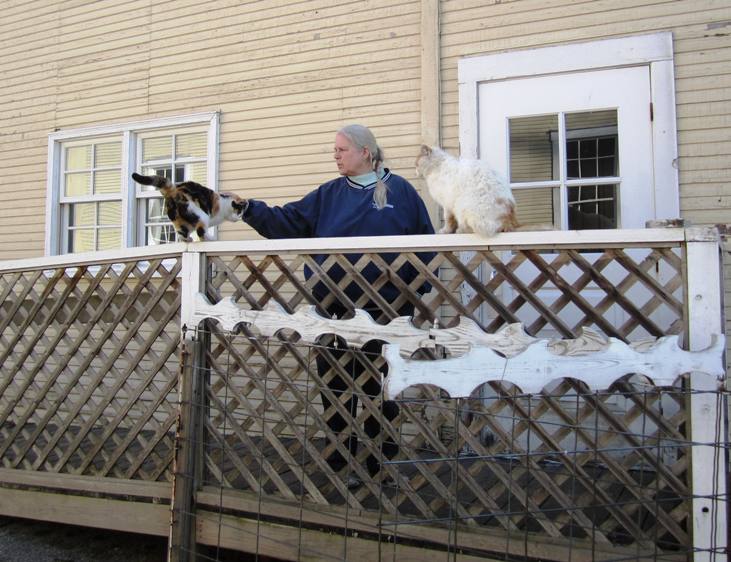
Anna Welch with friends at the entrance of the Carthage Mill. The historic Tweedy Lumber Mill is now the site of a sustainable ag business incubator.

Anna Welch with friends at the entrance of the Carthage Mill. The historic Tweedy Lumber Mill is now the site of a sustainable ag business incubator.

I had two choices: quit and return to the workforce, or retreat to a place of rest, and pray, reflect, journal, and wait to see who or what changed around me. Someone spoke words of encouragement, or a visitor stopped by the Carthage Mill and said how this place is necessary and will come to pass.

One of my greatest encouragers here at Carthage was my friend Allen, who came daily with his dog Rusty. The first day he stopped by, I was cleaning golden flax seed. He heard the machine and the gate was open, so he stopped. I’m so glad he did.

Allen had Lou Gehrig’s disease, but every day he drove his wheelchair on a route around Carthage, observing bean and corn fields, enjoying wildlife, and stopping by the mill, his favorite place. He worked the Alaskan pipeline in his younger years and lived in a teepee in Montana. He loved the mill, and he encouraged me to keep doing what I was doing.

I realized that if Allen could be in the state he was in and encourage me, then I needed to think outside of myself and look at what I could do to make a difference. Allen died this past October, and I officially formed The Carthage Mill, LLC with help from Hoosier Organic Marketing Education. I know he is pleased.

Regardless of the negative circumstances that we may be facing, there is always hope, always a divine purpose awaiting each of us—if we can turn our focus away from self and focus on those around us, on what needs exist, then determine what gifts and resources we have to overcome the challenge, or to serve someone. Nothing can stop us from fulfilling our purpose if we are on the right path.
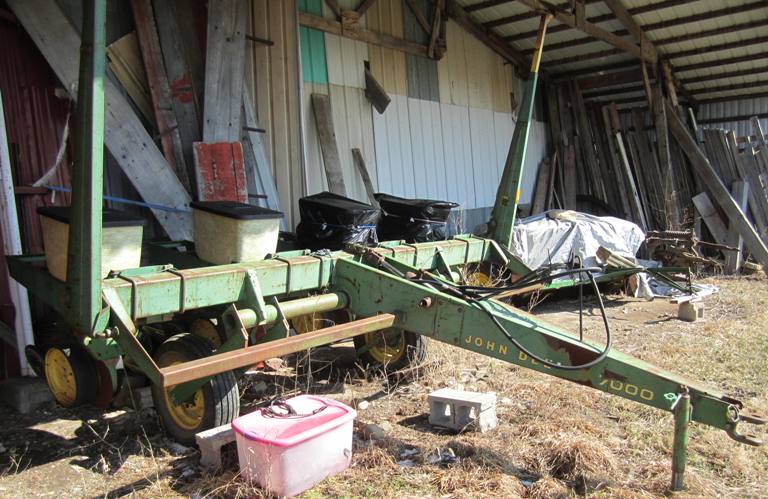
Equipment used to plant Fields of Agape grain and beans.

Equipment used to plant Fields of Agape grain and beans.

I have found that the success in life is how we learn to handle adversity and challenges. If we can grasp how to press on through adversity with humility and unconditional love for others (regardless of how they treat us), we will find our way.

When we find like-minded people whose passion is a good fit with our own, whose hearts are for others, then within that group each person can reach their potential quicker.

Encouragement, sharing of resources, being driven by the passion to serve rather than by personal gain—all of this brings about magnificent changes in communities large and small.

I’m never going to stop believing that it can happen.

A Beautiful Thing

As the Intergovernmental Panel on Climate Change gathers in Japan to finalize their report on the status of global warming, I’m thinking about hope. Hope as choice and saving grace. Here’s a piece I wrote some time back.

My spouse and I recently watched a library DVD of the HBO series Enlightened, in which Laura Dern plays a woman seeking to expose the wrongdoing of her corporate employer.

Photo by manyhighways.com, via Flickr Commons

Photo by manyhighways.com, via Flickr Commons

The show is a mix of humor and pathos and drama, with the main character, Amy Jellicoe, revealed as both tender-hearted and colossally insensitive. She’s self-centered, obnoxious, impulsive—and, at times, luminous in her dreaming of a different world.

By the last episode, Dern’s character has discovered the cost of being a whistleblower, having lost her job and her love interest. The last blow comes when Amy’s mother says she is no longer welcome to live in her house.

The final scene finds her knocking at the door of her ex-husband Levi, who knows her best. Sitting next to Levi on his front stoop, Amy asks him, “Am I crazy?”

What a question. I’ve asked it of myself so many times. Am I crazy to think that this world can transform, that we can evolve as a species? Am I crazy to believe that we can pull each other to a higher vibration—one that would usher in a new era of equity and resilience?

Am I insane to believe that we can still thrive, even in the face of this terrible and seemingly irreversible mess we’ve made?

In the final words of the series, Levi, played by Luke Wilson, turns to her and says, “No.”

He says, “You’re just full of hope. You got more hope than most people do.”

He tells her, “It’s a beautiful thing to have a little hope for the world, you know?”

Photo by ZeHawk, via Flickr Commons

Photo by ZeHawk, via Flickr Commons

I’ve come to believe that to be hopeful is rarely foolish, or naïve, or crazy. Or if it is all of those, perhaps it doesn’t matter.

Hope is a choice I make for the sake of my own soul and soul of the world, for the health of those around me. I regularly renew my decision to be a holder of hope.

I choose to believe that it’s possible to live in such a way that doesn’t steal from the impoverished on the other side of the world, that doesn’t rape the earth. I choose to envision the possibility of healing this beleaguered planet.

Maybe I am crazy.

But I still believe. This better world is on its way.

To Belong

Winter aconites blooming in March 2013

Winter aconites blooming in March 2013

“As the globalized, placeless world spreads,
and as progress is increasingly defined as the ability to look out of a hotel window in any city and see the same corporate logos lit up in familiar neon,
it could be that the most radical thing to do
is to belong.”

Paul Kingsnorth, Real England

Relocalizing the Food System

I love writing stories about food and farming. The people I meet are so passionate about their work. Almost everyone I interview is invested in reforming the broken food system. Bonus: They give me tasty things to eat.

Here’s a rundown of the treats I’ve sampled just in the past few weeks.

  • Cissy, a woman who’s long been the vanguard of Indiana’s organic movement, gave me some intensely flavorful pickles she made from cucumbers raised in her kitchen garden. I washed it down a glass of homemade kombucha that couldn’t be beat.
  • Jim, a farmer in Owen County, sent me home with a bunch of carrots he pulled from the wet earth like a late winter miracle.
  • Anna, a farmer in Rush County, gave me a huge jar of rolled wheat that her cooperative had grown and milled. (I used some in banana bread I baked for my weekly writing date—my writer buddies pronounced it wonderful.)
Checking out a display of LocalFolks Foods at Moore Corner Store while on assignment

Checking out a display of LocalFolks Foods at Moore Corner Store while on assignment

And a couple weeks ago, at Moore Corner Store, proprietor Jasen Moore offered me a taste of ketchup made by Indiana’s own LocalFolks Foods.

I’m no ketchup connoisseur, and in fact we never purchase it. But if I were a fan of this most American of condiments, I would never buy a national brand again. LocalFolks’ is sweetened with sugar, not the genetically modified scariness that comprises high-fructose corn syrup.

I happened to be in the natural food store when Hoosier Microgreens’ Alex Sulanke came along to introduce his product. So I got to munch uber-fresh sprouts of radish, cabbage, kale, arugula, and mustard from “the smallest farm in Indiana” (120 square feet).

Moore Corner Store is in the business of connecting small farmers and food entrepreneurs to the consumer. Though its hours are limited at present, this shop and others like it fill a critical role in relocalizing our food system.

For Jasen and his wife Sara, Moore Corner Store is more than just a business. It’s a mission. Jasen told me the enterprise arose out of concern for the state of our economy. Big box stores have fragmented communities and hurt the little guy.

Moore2“But a store like this…supports the local economy, minimizes carbon footprint, puts actual nutritious food on your plate, and it’s close to home.” The Moores live just up the street from the shop, though both must spend time elsewhere to make ends meet.

I just saw a documentary called Down to Earth in which the iconoclastic farmer Joel Salatin (made famous in Michael Pollan’s Omnivore’s Dilemma) made an important point: Your purchase of a farmer’s product might be the thing that keeps that farm afloat another week.

Is it worth changing our habits to spend a little more of our money at a farmers’ market or a shop like the Moores’? I would say yes. What about you? Have you connected with a small farmer, producer, or locally owned shop lately?

Check out my piece on Moore Corner Store here.

Small Respite

Final in a series

Author Rebecca Solnit writes about how we have changed in the last 20 years, mainly due to online connectivity. We have shorter attention spans. Our time is chopped into bits. We indulge our need for constant updates and check-ins.

She wrote that all this makes deep thinking and reading very difficult to sustain.

And often the habit of seeking external input subverts our inner knowing.

With that in mind, I conducted an experiment in the last weeks of 2013. I took a break from Facebook. I found it instructive—not always comfortable, but interesting.

I find that a quality of inner silence arises when I’m not hooked into an external source of connection. I’m not distracting myself through the random bits of pathos, trivia, deep thoughts, outrage, and silliness that constitute my Facebook feed—so I can face more easily the stuff that needs to be addressed, whether a stuck emotion or a dreaded task.

Back to my conversation with my friend Kate Boyd: She told me she had seen the film Inside Llewyn Davis and was struck by the pace of life pre-Internet. The breathing space of that age.

I had the same experience, and a sadness at what is lost, when I read The Guernsey Literary and Potato Peel Pie Society, which takes place post-World War II. The story unfolds in letters. I mourn the loss of letters.

Photo by Cas, via Flickr Commons

Photo by Cas, via Flickr Commons

Much of the story happens on an island, and the main character has long spacious hours in nature. I mourn the loss of time unfettered, disconnected from constant inputs.

There’s no going back, of course. But it helps me to put rules around my Facebooking, even bendable ones: No checking after 9pm. No checking before I get some work done. One day a week cold turkey.

Each Sunday I strive for an Internet-free day, but one day really isn’t enough to touch that sense of quiet. During my self-imposed “FaceBreak” and also during last October’s writing residency at Mesa Refuge, I came closer.

The hours at Mesa Refuge were largely Internet-free. There was no expectation to track anything other than my own thoughts and the work of my cohorts. The main questions were: “Did you break through that block you had last night, did you write your scene, did you get to the place you need to be?”

My writing shed at Mesa Refuge

My writing shed at Mesa Refuge

My time there was about ideas and creativity—and connection to something slower and sweeter than the latest argument or article posted online. Something, dare I say, eternal.

I’m looking forward to two writing retreats this summer that I hope will offer the same sense of spaciousness. And in the meantime, I manage as best I can—carving out Screen-free Sunday as a small respite, bringing some awareness into the mix when I remember to.

I hope this keeps me from having to file “social bankruptcy,” as in this very funny Portlandia clip (that a friend shared on Facebook).

What about you: Do you have techniques that help you deal with information overload? Have you ever taken a break from social media, by choice or necessity? Tell us about it in the comments!

Of Facebook and Firehoses

Part 2 in a series

My friend Kate Boyd and I were recently discussing smartphones and other addictions. Her weakness is checking email on her smartphone. And the little blinking light on my phone does hook me, but my real weakness is distracting myself with Facebook during my workday.

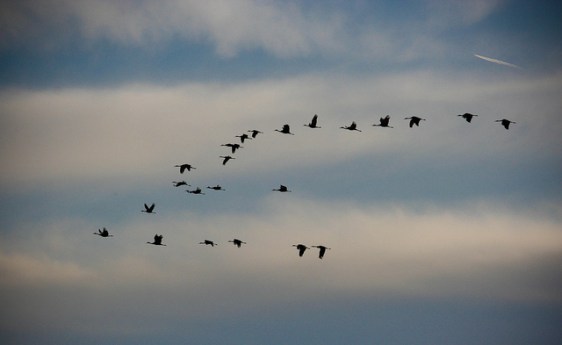
Say I log on to share something cool, like how I just saw some sandhill cranes flying low over my neighborhood.

Photo of sandhill cranes in flight by Jessica Lamirand, via Flickr Commons

Photo of sandhill cranes in flight by Jessica Lamirand, via Flickr Commons

If I’m not vigilant, I’ll spend a half hour reading other people’s posts before I even remember what I came there to say. Once I do post, I have to keep checking back every 10 minutes.

Did anyone comment? Did anyone even “like”? Shall I post an interesting article or quote I’ve come across, or repost someone else’s content, or “like” someone else’s, perhaps post a comment? Then: did anyone else comment on my comments?

Was I witty, was I urbane, did someone love what I said, does anyone out there love me? Am I loveable?

Yes, it pretty much comes down to that, as embarrassing as that is.

Kate reminded me that it’s brain chemistry, not a personal failing, that’s behind the constant reaching for external input. That hit of dopamine. It’s a recipe for addiction.

By John Karakatsanis, via Wikimedia Commons

By John Karakatsanis, via Wikimedia Commons

So, are we just wired to get hooked on Facebook, or whatever our personal weakness might be? Are we strong enough to override the habit, even once in a while?

Kate and I met years ago in a mindfulness class, so we share a common foundation. That training is useful in bringing awareness to habitual (mindless) behavior.

Lately I strive to notice when the itch arises. What am I thinking; what am I feeling? What precipitates the need to find a friendly word online? Often there’s some sense of lack, some uncomfortable feeling, or a wish to delay a task.

My hope is to bring more mindfulness into my relationship with online connectivity. To choose it, deliberately. I read a suggestion somewhere: Take three breaths before engaging in social media. (And I actually thought, Three breaths? I don’t have time for that!)

Wisdom 2.0 author Soren Gordhamer says the key to mindful engagement online is to first take a moment to remember that we are already connected. To really feel this truest connection, one that is not dependent on a touchscreen or a mouse click. Then log on.

Photo by Matthew Montgomery, via Flickr Commons

Photo by Matthew Montgomery, via Flickr Commons

Fair enough. If I remembered to breathe and/or connect to All That Is, it might shift the vibe significantly. (Perhaps the lovability question would be solved once and for all?)

I would still be confronted with major Information Overload once I’m there, however. Not to mention the complaints, tirades, and reports of all that’s wrong with the world.

Then again, the feed could show nothing but sweetness and light, and it would still pose a problem: The sheer volume of input is draining in itself. I find myself skimming everything, flitting from one shiny thing to the next.

We all drink from the firehose now. Facebook or no Facebook, modern life is a firehose. But for me, social media is the breaking point.

I’ve found that there’s no respite unless I carve one out.

Next up: Finding a respite

The Other Face of Facebook

Part 1 in a series

A few months ago I blogged about how fantastic social media can be during an extreme weather event. The Facebook group for my neighborhood was a much-needed source of information, entertainment, and connection during a snowbound week.

It’s true that Facebook enriches my life. My Facebook feed has brought me wisdom, creative expression, long lost friends, writing jobs, amusement, and fascinating news stories, local and global.

But then there’s the other face of Facebook. Take the aforementioned neighbors’ page, which can be quite helpful, not just in a crisis. We’ve returned lost dogs to their owners, rallied to raise money to protect our public art, and urged each other to support small businesses during a grueling winter.

All good. And why is it that seemingly every other day, there’s arguing and accusation and drama all over that page? Why do so many discussions devolve into a pissing contest?

The nutty thing is how compelling it can be, like some kind of reality TV show that’s simultaneously grotesque and addictive. Even though I rarely engage, it’s hard to look away. With Herculean strength I resist the urge to read every argumentative comment thread.

The joke’s on us. I can’t remember where I saw it (probably on Facebook), but someone wondered what a person from the past would think if the smartphone had been foreseen: “Someday, we’ll have a device in our pocket that gives us access to the sum total of human knowledge. We’ll be able to connect instantaneously with anyone, anywhere. And we’ll use it to watch kitty videos and pick fights with strangers.”

Kitty

Obligatory Cute Kitty

(I have friends on the neighbors’ page, but many of the participants are relative strangers, except through their repeated appearance in that forum. Come to think of it, what’s crazier than arguing with strangers? Lurking among the arguing strangers.)

I blame the physiological response that accompanies a “hit” online. There’s a corresponding hit of dopamine. That spells addiction.

Photo by Michael Schlinge, via Flickr Commons

Photo by Michael Schlinge, via Flickr Commons

Still, my energy healer friend Merry Henn has found the Internet to be a partner in healing. “Through Facebook I have found that what I am feeling on a particular day is often being experienced by many others. The Internet is our energetic connection made manifest. It has a collective consciousness, and often the exact resources we need will appear before we even ask for them. Just be aware that prolonged computer exposure scrambles your energies.”

Perhaps it’s all about the intention we set, or the mindfulness with which we seek. Clicking around mindlessly, I sometimes seem more likely to encounter collective fear/unconsciousness than than collective wisdom. Before I know it my energy is in a downward spiral.

But then I’ll see something redemptive, some kindness or insight. Example: musician friend Sean Flora recently pointed out that whenever someone “spouts some godawful crap…there is some kind of hurt behind it.” He noted that in online interaction, it’s harder to remember that a hurt little child is driving the diatribes. He spoke of finding a path to connection and compassion—while recognizing how our own hurts might affect others.

A good thing to remember in both online and face-to-face conversations.

What about you: How do you experience social media forums like Facebook?

Next up: More on social media addiction, and strategies.

Localizing the Winery

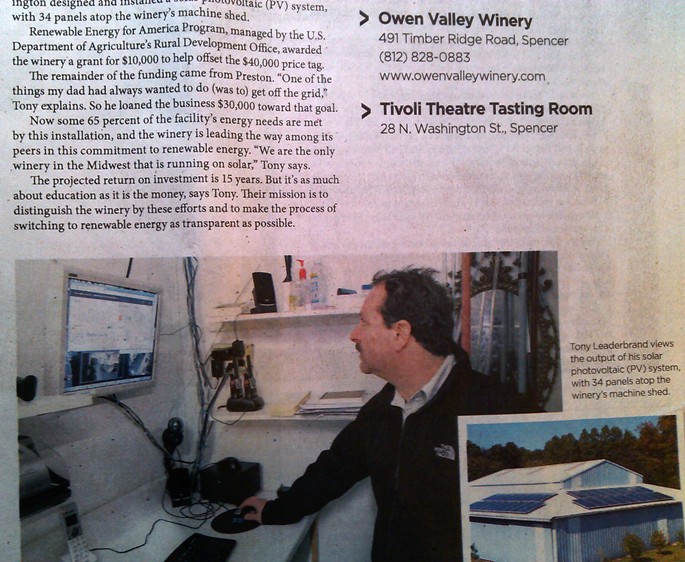
When is a winery more than a winery? When it contributes to revitalizing a rural community, putting the local economy at the forefront of its mission. Owen Valley Winery, which I discovered on assignment for Farm Indiana, is just such a place.

IMG_20140301_135319

Here’s a look at the piece I wrote for this month’s issue of Farm Indiana.

I thoroughly enjoyed my conversation with Tony Leaderbrand (pictured above), who told me the whole story of the family-owned business’s evolution. Aside from their commitment to showcasing Owen County’s locally grown and made products, the winery is unique in another respect. It is the first Midwestern winery to run on solar power.

IMG_20140301_135602

A grant from the Renewable Energy for America Program helped pay for the solar panels that now produce a large portion of the winery’s energy needs.

Locally grown persimmons are among the fruits used in Owen Valley Winery’s products. I was moved by stories of people bringing their excess fruit in shoeboxes and buckets every fall to sell to the winery. Tony made me see that winemaking is truly a local ag-based endeavor. (Due to demand for dry wine, they also use some California-grown grapes as well.)

photodune-1133279-wine-s

Photo by groceris, via PhotoDune

Tony told me all about the repurposed items that went into construction of the tasting room and production facility. In fact, the second tasting room is kind of an upcycling project in itself: It’s located in the renovated Tivoli Theatre, a historic building in Spencer, IN.

On a personal note, Tony talked about how eating produce from local farms is a winner both in terms of health benefits and reduced packaging. Not to mention the benefits of keeping dollars circulating in the local community.

“I think there’s such a need for us all to come full circle on purchasing,” he said. “We have to break these old habits of going to these superstores. You’ve got to know where everything you buy comes from.”

You can read the full article here (do a search on Owen Valley Winery to jump to the piece.)

A Lifesized Lego Set for Farmers and Makers

I was invited to visit the Indiana Small Farm Conference this past weekend, and was I ever glad I went. I got to reconnect with some farmer friends and make new connections. I learned about the challenges facing the people who grow our food on a small scale. And of course lunch was delicious, as well it should be with food supplied from local farms and prepared by the stellar whole-foods caterer known as The Juniper Spoon.

But the highlight was a session with a representative from Open Source Ecology. This is a group I’ve had my eye on for a while because of the radical way they are working to take back the building blocks of modern life. The goal is nothing less than a modular, low-cost, DIY “Global Village Construction Set” of 50 machines that would meet the major needs of civilization.

The best part? The plans are all open source, allowing anyone, anywhere, to try them out and make improvements.

The 50 machines, from tractor to 3D printer to wind turbine.

The 50 machines, from tractor to 3D printer to wind turbine.

OSE Construction Manager Chris Reinhart, it turns out, lives just an hour away from me. He calls himself a tinkerer and maker, and holds an architecture degree from Ball State. He is developing plans for a micro-house that could be built by a small group of people in a handful of days, using equipment from the GVCS.

He posts his plans on Facebook and logs his work online for all to see. As a writer I shudder at the prospect of having so many eyes on a work-in-progress, but transparency is the name of the game here. Reinhart says the idea is to “tap the hive mind” and constantly iterate improvements.

Another goal is to standardize workflows. Reinhart explained that a group of 16-20 people could break into smaller teams, each take a module (there’s one for plumbing, one for windows, etc.), and work separately until time to put the construction together. He likened the system to a life-sized Lego set that can be snapped together.

The above TED talk by OSE’s founder, Marcin Jakubowski, talks about how lowering the barriers to farming, building, and manufacturing can unleash human potential. An entrepreneur who wants to start a construction company can jump right in. A household can add a DIY wind turbine and sell energy back to the grid. Farmers can be less dependent on manufacturers.

Think of it: That irritating built-in limitation of purchased gadgets, planned obsolescence, would become a thing of the past as people discover how to build and fix their own machines.

“This is a different model, economically and socially,” Reinhart says. In contrast to a top-down command and control ethos, this bottom-up model empowers many people on the ground, all making and innovating and selling to each other. I love the collaborative “do-it-with-others” spirit of these guys. Go DIWO!

OSE is planning an intensive workshop series to teach people to build six of the 16 machines that have been prototyped so far. For more information, check out this Crash Course on OSE.

Correction: The original blog post indicated that six machines have been prototyped; in actual fact 16 are in prototype phase, and the workshops are being offered on the six most mature designs.

Inhaling the Universe

Andromeda Galaxy, by Cestomano, via flickr Commons

Andromeda Galaxy, by Cestomano, via flickr Commons

“What thrilled me the most was the fact that millions of meteors burn up every day as they enter our atmosphere.

As a result, Earth receives 10 tons of dust from outer space.

Not only do we take in the world with each breath, we are inhaling the universe.”

—Terry Tempest Williams, in When Women Were Birds