A Week in the Life, Irvington-style

Last week, I realized how much I rely on my neighborhood for commerce, entertainment, exercise, and other essentials. To wit:

Tuesday morning I took part in the Writing Habit, a weekly mini-retreat for writers put on by Urban Plot in the library of a local church. With two other writers tapping away on their keyboards, I cranked out some verbiage.

Kitley finds writing more taxing than stalking sparrows. Sometimes I agree.

Kitley finds writing more taxing than stalking sparrows. Sometimes I agree.

In the evening I walked two blocks to Dairy Queen (OK, it’s not locally owned, but a business in our own little plaza). My neighbor had called a meeting, sweetening the deal with ice cream. We were there to explore teaming the Irvington Green Initiative and a budding arts initiative with local organizations like Trade School Indy to share admin/event/classroom space sometime in the future. An intriguing possibility.

Wednesday, before sunup, I went to earlybird piyo (Pilates/yoga fusion) at Irvington Wellness Center, my favorite place for yoga and other such pursuits. In the afternoon, I biked over to meet a writer friend at Starbucks (because our old haunt, Lazy Daze Coffeehouse, tragically closed this summer).

I walked from there to Help My Mac Plus, where I found a refurbished MacBook Air with my name on it. A stunning development, given how terminally conflicted I am about gadgets and the resources they require. I had just begun to put out feelers for a lightweight laptop for my upcoming research trip/ writers’ residency. I’m thrilled with my find, awarding myself double bonus points for supporting a local business and avoiding buying new.

Thursday evening it was back to Irvington Wellness for yoga class, taught by another Irvingtonian (I inquired after her hens, as one does here).

Friday evening was the highlight. First we went out to eat with a friend at local eatery Legend, where the owners know us by name and the food is delicious. Then to see Delta Duo and friends perform at Bookmamas in the Underground 9.

JJ plays a resonator slide guitar in the style used by Delta bluesmen of the 1930s. Irina's violin accompaniment is haunting.

JJ plays a resonator slide guitar in the style used by Delta bluesmen of the 1930s. Irina’s violin accompaniment is haunting. Photo courtesy of the Delta Duo.

Two local singer/songwriters kicked it off, after which the headliners laid it down. Delta Duo pairs JJ the Chicago-born bluesman with Irina the classically trained Russian violinist for a sound like none other. Suffice to say this monthly show will be a priority from now on. (Bonus: no cover charge.)

But the weekend wasn’t over yet. Saturday after supper, Judy and I rode our bikes to our new neighborhood ice cream shop Wyliepalooza, then popped in on old friends to catch up.

And Sunday was the farmers market. Judy and I biked over, bought bread and produce, and ran into several friends, including the aforementioned JJ and Irina.

This is the third mention of ice cream in this post. Confession: I actually can't eat ice cream! Wish I could!

This is the third mention of ice cream in this post. Confession: I actually can’t eat ice cream. Wish I could!

In short, it was a great week to be an Irvingtonian. What’s new in your neighborhood?

From Dismemberment to Oneness

Rebecca Solnit, on how leprosy numbs the extremities so that sufferers don’t realize when they are damaging their own tissues:

“The disease strangles nerves, kills off feeling, and what you cannot feel you cannot take care of.”

She speaks of a kind of dismemberment, of patients who feel no pain, so they injure themselves, even blind themselves.

She quotes a missionary doctor: “One of the boys said to me, “My hands and feet don’t feel part of me. They are like tools I can use. But they aren’t really me. I can see them, but in my mind they are dead.'”

Reading, it struck me that this statement could also sum up the dominant cultural attitude toward our own earth home. Though we belong to her and she to us, for so long we’ve disowned her, exploiting her riches as just so many dead “resources.”

We’ve been operating under the delusion that we are separate from the biosphere and the myriad life forms that share it—and separate from each other too. The results are catastrophic. If we lack feeling for each other, the soil under our feet, the waters that flow, and the skies above, we won’t consider these worthwhile of care.

"Holding Hands," by Paige Shoemaker, via Flickr Creative Commons

“Holding Hands,” by Paige Shoemaker, via Flickr Creative Commons

But perhaps that’s changing now, bit by bit.

More and more of us are waking up to our empathetic selves. We’re feeling a kinship not just with other humans but with the earth herself. We’re re-membering our entire human family and our deep connection to the planet that holds us.

I think of the empathy displayed by Antoinette Tuff as she disarmed a young mentally ill man bent on violence in her school. In the midst of her fear, this bookkeeper found a way to connect with the young would-be shooter, seeing him as a hurting soul. Her ability to reach him on a human level may have averted a major tragedy.

Meanwhile, this summer a group has been tracing the route of the Keystone XL Pipeline in the Great Plains. The pipeline, as I posted in May, would allow the release of enormous levels of carbon—enough to create irreversible climate change.

Trans Canada Keystone Oil Pipeline, by shannonpatrick17, via Flickr Creative Commons

Trans Canada Keystone Oil Pipeline, by shannonpatrick17, via Flickr Creative Commons

Taking both a physical and a spiritual journey through the heart of North America, Compassionate Earth Walk aims to nourish the earth, while inviting all humans to return to oneness in the community of life.

From the story on Resilience.org:

“We walk in response to climate change and in gratitude for the earth which has given freely to us for so long. We walk as an act of healing both symbolic and literal, including healing of the walkers, the land, the communities impacted by the pipeline, and the whole human consciousness of separation.”

No more numbness. No more dismemberment. The pain of our suffering planet and fellow earthlings might be difficult to face, but feeling it means we’re awake. It means we can care.

To Be Hopeful in Bad Times

Howard Zinn, by Jim from Stevens Point, WI, USA, via Wikimedia Commons

Howard Zinn, by Jim from Stevens Point, WI, USA, via Wikimedia Commons

On this Labor Day, here’s a quote from a celebrated historian, the voice of the common people.

“To be hopeful in bad times is not just foolishly romantic. It is based on the fact that human history is a history not only of cruelty but also of compassion, sacrifice, courage, kindness.

What we choose to emphasize in this complex history will determine our lives. If we see only the worst, it destroys our capacity to do something. If we remember those times and places—and there are so many—where people have behaved magnificently, this gives us the energy to act, and at least the possibility of sending this spinning top of a world in a different direction.

And if we do act, in however small a way, we don’t have to wait for some grand utopian future. The future is an infinite succession of presents, and to live now as we think human beings should live, in defiance of all that is bad around us, is itself a marvelous victory.”

—Howard Zinn, from You Can’t Be Neutral On A Moving Train, 1994

A Beautiful Indebtedness

I’ve been reading Rebecca Solnit’s latest resonant book The Faraway Nearby, and every day there’s a new discovery—about writing, about alienation, about the uses of stories. This morning’s passage evoked the web of interrelatedness and care that can happen among neighbors and friends.

In the author’s case, a cancer diagnosis showed her how much goodwill she had banked. People came from everywhere to help her.

She reflects:

“Before money…people didn’t barter, but gave and received as needs and goods ebbed and flowed. They thereby incurred the indebtedness that bound them together, and reciprocated slowly, incompletely, in the ongoing transaction that is a community.”

In some parts of the world, surely this beautiful indebtedness is still the norm. In my neighborhood, it’s making a steady return, in many small ways.

Some intertwined examples from this past week: I put a call out for dill on the Facebook Neighbors Garden page, offering other herbs in exchange. I’d planted dill, but the black swallowtail caterpillars ate every single sprig of it.

Black swallowtail caterpillars happily chewing up my dill earlier this summer

Black swallowtail caterpillars enthusiastically chewing through my dill supply earlier this summer

I wasn’t too sad about the loss, knowing the beauty that would come of it—until I saw the enticing baby cucumbers at the farmers market and ended up buying three pounds’ worth. I wanted to make a crock of pickles.

Happily, Amy of Fraudulent Farmgirl fame offered her unused dill. Over the weekend I biked over to harvest some, using most of it for pickling and borscht.

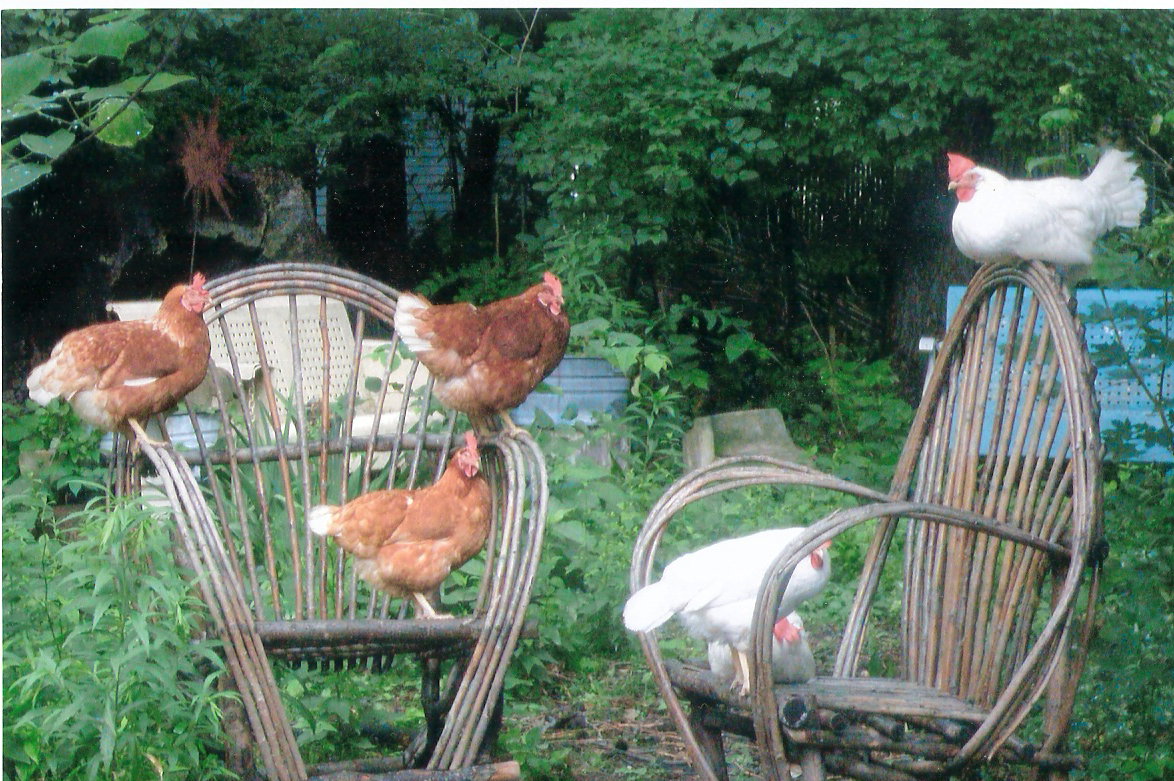
On that same bike trip, I stopped at Laura’s to unload some goodies on her hens. That morning I had cut back my severely cabbage worm-infested collards. I brought over the collard leaves, creepy crawlies and all, for the chickens‘ enjoyment. Laura sent me home with heirloom tomatoes and a photograph of the hens posing for a family portrait.

Laura's contented flock

Laura’s contented flock

Today Dawn Facebooked her own plea for dill, and since I had some left, I took it down to her house on my morning dog walk. Dawn put three things into a blue cloth bag of mine that was at her house from some earlier exchange. I came home with:

  • a salsa wrap made from her dehydrated tomatoes
  • grape juice from another neighbor’s unused Concord grapes (Dawn and I had picked the grapes Monday while catching up on life)
  • some maca powder, having mentioned in passing that I’d run out

I promptly put the maca in a green drink, the one I’m sipping right now. It also contains: frozen blueberries (brought back from Michigan by Anna), whey (received from Corinna down the street who makes her own Greek-style yogurt), lettuce (from farmers market), and kale (from my garden).

To add further depth to this web of connection: Laura was the source of my kale seedlings, a late-summer addition to my garden and currently the focal point of my daily worm-picking meditation. I no longer squish or stomp the worms while grimacing and/or squealing. I save them for Laura’s hens. The very hens that supply my eggs.

Writing this, I’m realizing my good fortune: my indebtedness extends even beyond my human neighbors.

What precious debts have you incurred in your community?

To a Young Cicada

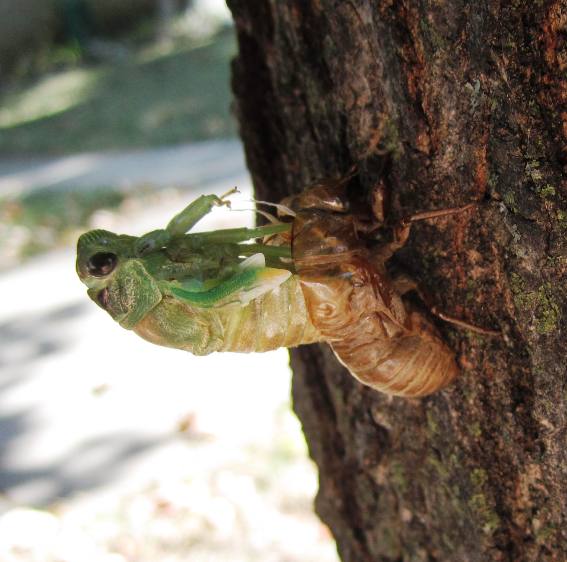
I looked for you today. There on the trunk of the maple tree, surrounded by the carapaces of your siblings, you’d been left behind. You were still unzipping your old skin and squeezing out. I saw your convulsive twitch, your jointed limbs, your staring eyes. Your struggle to be born. Your excruciating vulnerability in the moment of leaving your armor.

top viewI know you from your song, the vibrating sine wave soundtrack of every August of my life. Your evening crescendo drowns out human words spoken under the trees.

cicada shell

I know you from your shell, the source of childhood torment. Yesterday I picked one off a raspberry with shivering fingers, reliving the horror of such husks left by a prankster brother: on my pillow, my bookshelf, my lightswitch.

I know you from your rare jittering bounce on the ground, a curiosity for the dog, an opportunity for the cat. And once you turned up at my back door after I wrote a poem in which you starred. You looked at me as if to say, You rang?

cicadaBut I’ve never seen you like this, in the act of slow-motion vaulting into your new shape.

for blogDoes it hurt, this freeze-frame backflip into airborne freedom? It looks like it would hurt.

Maybe it hurts like a numbed limb awakening, the flow of blood returning. A rightness in the pain. A sensing that what comes next is flight.

Do you look back at that exoskeleton that used to house you, once you’ve finally juddered free? That hull too small to contain you? No. The buzzing symphony pulls you up to the treetops. You ready your instrument.

Calling All Lifelong Learners

Continuing an intermittent series on education
“Crazies only need apply,” jokes Blaire Huntley, speaking of Trade School of Indianapolis’s call for teachers. Previous “crazies” taught such varied topics as law, nail art, beekeeping, creative writing, bookbinding, public speaking, yoga, and even cuddling.

Making this curriculum even more unique: not one cent changes hands. Instead, teachers request items and services in trade for their tutelage.

I took this class last fall: Primitive Natural Cordage with Creek Stewart of Willow Haven Outdoor.

I took this class last fall: Primitive Natural Cordage with Creek Stewart of Willow Haven Outdoor. All it cost me was the stalk of a yucca plant.

TSI is part of a barter-for-knowledge network anchored by Trade School New York, which Blaire encountered when she lived in New York City.

Though she worked eight jobs in NYC and was way too busy to take classes, when she moved to Indy, she brought along her love of learning—and the seed of an idea. Why not start a Trade School in her adopted city? Now, she says, she feels like “the smartest person in the world,” because she gets to learn from so many passionate, creative teachers.

The community embraced the model wholeheartedly. “As people are learning about us, once they know about it, they want to be involved,” says co-founder Brittany West. In the year since its launch, TSI has offered 80 classes. For the fall 2013 semester (October-November), already a record 40 classes have been proposed, and the window to apply is still open.

Compared to other Trade Schools worldwide (there are now 50), “we are always the one with the most classes going on,” says Blaire.

TSI is also one of the few such schools so far sustained without funding. Both women work for free, devoting their off-work hours to coordinating, publicizing, and attending sessions. Classroom space is donated in several venues, including Indy’s Kitchen, where cooking classes are extremely popular.

Art of Indian Cuisine at Indy's Kitchen

Art of Indian Cuisine at Indy’s Kitchen. New this semester: teachers can request items on behalf of an organization. For example, the fall Indian cooking class will be offered in exchange for donations for Gleaners Food Bank.

Brittany says the philosophy behind TSI, that “education should be accessible to everyone,” is a powerful notion. “I love that I can bring an apple or a bag of oranges in exchange for learning these great things.”

People engage with each other differently when payment is made in nonmonetary gifts instead of cash, the women say. It creates a shared experience and a deepened sense of connection.

Blaire and Brittany are looking to crowdfund classroom space for a permanent TSI home, potentially shared with other likeminded community organizations. They envision tripling the number of classes, and offering daytime sessions as well as their current evening classes.

Instructors of Backpacking 101

Instructors of Backpacking 101

Are you a lifelong learner, or someone with a skill to share? Have you experienced the fun of bypassing the money economy and found that you’ve made a deeper connection as a result? Then check out the following:

1.) Go to TSI’s Kickstarter grant appeal (great incentives!) and give what you can before Aug. 31.

2.) (For locals) Plan to attend TSI’s one-year anniversary party September 5, featuring a swap-and-trade area, teacher meet-and-greets, live music, and complimentary Sun King beer.

3.) Propose a class! “We believe everyone has something to offer, so no fancy degrees or certificates required.”

Photos courtesy of Trade School of Indianapolis

My Garden Tower, One Month Later

It’s been about a month since Judy and I planted our Garden Tower. I last posted about it the day we picked it up from the Good Earth. Time for a post showing the progression.

After some discussion we sited the barrel just outside our back door. We had to sacrifice a few cabbage and collard plants to clear out the space, but it’s the best spot for it. The light color of the siding will reflect light for the plants growing on the back side (though one friend insists we need to innovate some sort of lazy susan apparatus to be able to spin the whole barrel around!)

Filling the Barrel

Filling the Barrel

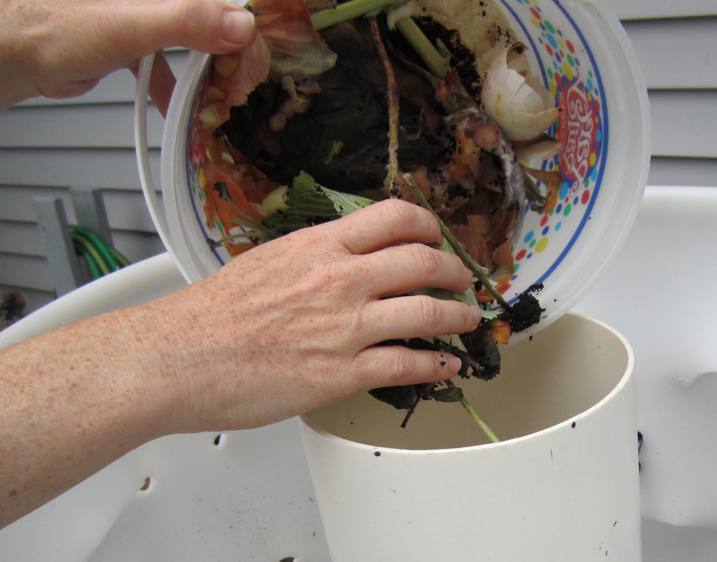
One of the things I love most about the Garden Tower is its built-in worm composting. I could hardly wait to put saved-up kitchen scraps in there. We also added some semi-decomposed stuff from the compost pile to jump start it.

Adding vegetable matter to the center tube

Adding vegetable matter to the center tube

I bought red wigglers at a feed-and-seed shop, and there were also worms in the soil mix since we used some of our own sifted compost.

Just a handful of worms is enough: they reproduce rapidly.

Just a handful of worms is enough: they reproduce rapidly.

I had soaked seeds in water overnight to give them a head start. It was great fun poking them into the soil.

Planting Little Marvel peas on the more shaded side.

Planting Little Marvel peas on the more shaded side.

Plants scavenged from friends and a local nursery helped round it out.

I bought a couple of bell pepper plants that looked like they might survive, and this gorgeous Genovese basil. I also planted parsley starts around the back and a tomato sucker that a gardener friend rooted.

I bought a couple of bell pepper plants that looked like they might survive, and this gorgeous Genovese basil. I also planted parsley starts around the back and a tomato sucker that a gardener friend rooted.

Soon the seeds started to sprout.

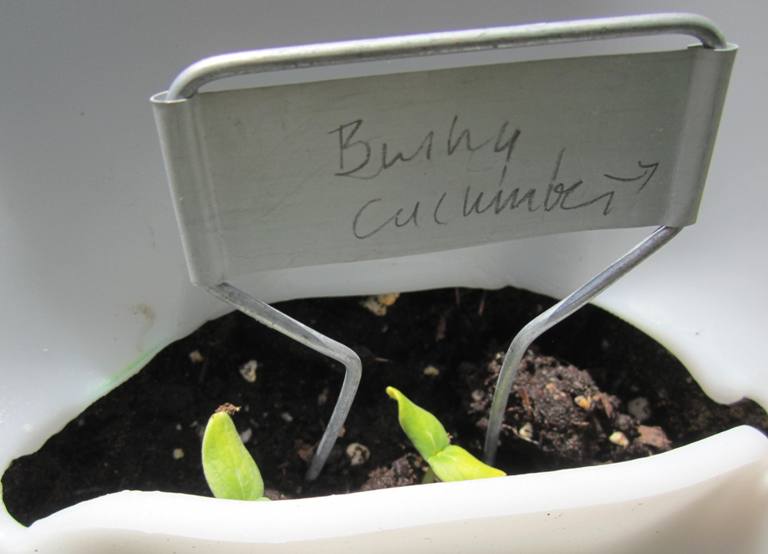
Cucumbers were first to sprout. I don't know if I'll get any cukes having planted them late in the season, but it's fun trying.

Cucumbers were first to sprout. I don’t know if I’ll get any cukes having planted them late in the season, but it’s fun trying.

It was like springtime in July.

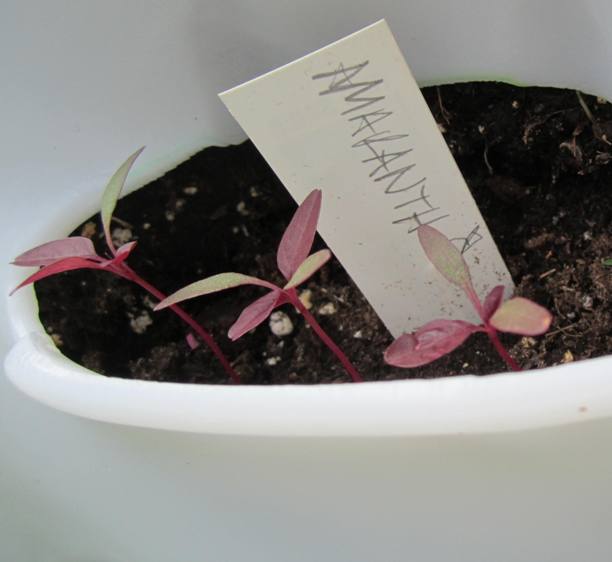
Really excited about the amaranth!

Really excited about the amaranth!

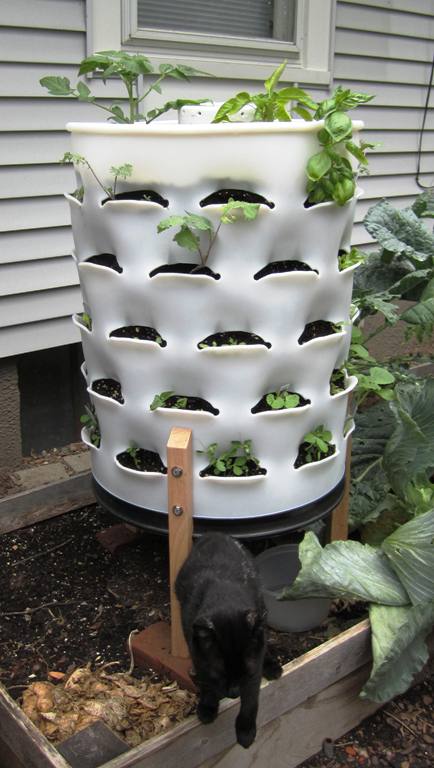
After a couple weeks it looked like this. (The cat loves hanging out in the cool shade underneath the tower.)

About 2 weeks after planting.

About 2 weeks after planting.

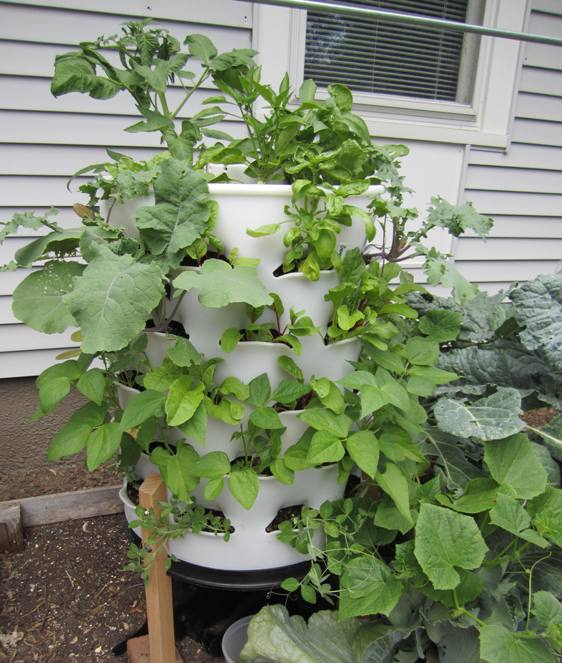
Today it looks like this!

Check out the cucumber vines, lower right. (And yes that is a cat under there.)

Check out the cucumber vines, lower right. (And yes that is a cat under there.)

The tomato “sucker” has suckers of its own now, and soon I’ll have to stake it. I’ve harvested basil, parsley, and a few thinnings of the greens. The worms have been chewing through their food, so in a few months I’ll have a different kind of harvest—worm castings.

We’re thinking of rigging up some sort of covering to extend the season. I hope we can keep snipping kale and chard into the winter.

I love my Garden Tower. Of course, it is not necessary to purchase this product to have a similar vertical garden. “You just need a blow torch and a two-by-four,” says one plucky friend. That seems a little more than I want to do, but this Garden Sack design looks to be a good DIY alternative.

Book Offers a Vision of the Possible

I’ve had this book out from the library the past few weeks, but after test-driving it, I just emailed Kathleen at Bookmamas to ask her to order it for me. It’s a keeper. Here’s my review:

Wendy Tremayne’s The Good Life Lab: Radical Experiments in Hands-on Living gives a powerful example of a reimagined world in the shape of one couple’s desert homesteading adventures.

Prickly pear, an example of the desert bounty gathered by Tremayne. Photo by Jon Sullivan [Public domain], via Wikimedia Commons

Prickly pear, an example of the desert bounty gathered by Tremayne. Photo by Jon Sullivan [Public domain], via Wikimedia Commons

Many of us work toward self-sufficiency (or better, community-wide resilience, broadening the circle from homestead to neighborhood). But we’re hampered by the need to make money to prop up our lifestyles, cutting into the time we have to learn and practice new skills. Wendy and partner Mikey demonstrate what is possible by leaping into a completely new way of life. They cash out their retirement accounts (a prescient move, before the crash) and transplant themselves into Truth or Consequences, NM to build a new life.

And build they do: using waste materials and nature’s bounty, they craft a beautiful, abundant, interconnected home base that allows them to live their deepest values.

In contrast to some “green lifestyle” books that focus on giving up luxuries for the earth’s sake, this book offers an exuberant romp through the reclamation of life’s biggest gifts: time, beauty, creativity, connection, purpose. More than just a memoir, it is an invitation to adopt the “maker” mindset. Tremayne’s lyrical descriptions of the spiritual aspects of this journey, coupled with the gorgeous, whimsical artwork and photographs, make this an inspirational book.

The author (who founded Swap-O-Rama-Rama, a community-based textile repurposing/skill sharing extravaganza) observes, “When all of life is for sale, it is a revolutionary act to become a maker of things.” She describes “life in the waste stream” as the ultimate freedom.

“By relying on waste, on what nature provides, and on ourselves, we gave the world a chance to demonstrate abundance. By becoming makers of things, we let our creativity become a transformative link between the free materials available to us and the finished goods that made our lives better.”

She notes that mistakes are part of this process, and describes combatting the inevitable “I can’t do that” by simply taking the next step. For those of us who consider ourselves less than handy (ahem), the book offers both challenge and a roadmap. The last section, in fact, provides concrete steps toward reclaiming the building blocks of life, covering food, power generation, fuel, and shelter.

The physical book itself embodies the new world by its very design, in which art and joy and utility are married into a brilliant manifesto.

In short: Stop what you are doing and order one now from your local independent bookstore, people!

(Can’t wait till your book arrives? Hungry for more after reading it? Check out Wendy and Mikey’s blog at Holy Scrap.)

Elders Building a Healthier Future

They meet in Chase Legacy Center’s art room every Thursday for herbal tea and the deeper refreshment of conversation. Known as WeAct (When Elders Act, Communities Thrive), the group began as a natural living discussion circle, and evolved into a discussion/action group.

The weekly gathering of elders is convened by the decidedly youthful Greg Monzel. Today he’s harvested Echinacea and mint from the herb garden tended by the group just outside. With curved shears, he snips the big healthy blooms and fragrant leaves into a blue teakettle as people stroll in.

An herbalist, Greg offers his prodigious knowledge of wildcrafting and permaculture, but participants have a wealth of information too. The discussion moves in spirals, touching on plant medicine, gardening, and other homespun topics.

We explore the identification and uses of lamb’s quarters, with one member noting that this “weed” is high in iron. From another participant, we get the inside scoop on Distelrath Farms’ new cooperative model, which allows the farmer more time to pursue his mission: educating children.

From another, we learn of Taj Mahal’s original plan to be a farmer, and why he changed his mind: “He couldn’t figure out how you could keep from being poisoned by putting poison on the ground.” We lament the way conventional agriculture wages war on the land.

Comfrey root bearing a smile

Greg produces a section of comfrey root dug from his garden. A terrifically tough—and useful—plant, comfrey’s roots extend some 40 feet underground. He cuts the root into tiny pieces to send home with everyone. Each garden can benefit from nutrients pulled up from the depths.

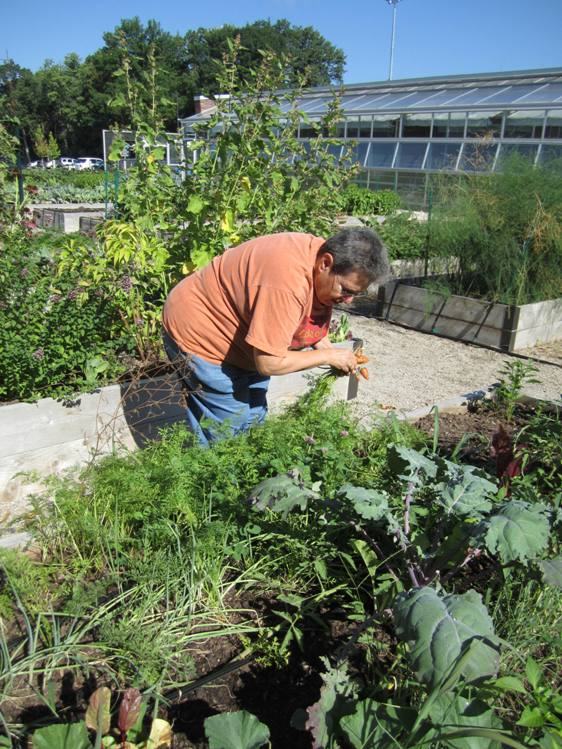
After a while we take cups of bright-tasting tea outdoors to the raised beds designated for WeAct use. There’s the excitement of lifting carrots from the earth. We discuss uses of borage and alfalfa, remedies for mildew, and where to buy a hori hori. Greg urges us to take dill seeds and coriander seeds to plant or eat.

The sky is deep cloudless blue for the first time in days. We stand in the sunshine enjoying the cool morning breeze. It’s the kind of moment that you wish could last all day, and in fact Greg says it is the high point of his week. Too soon, the group disperses.

Harvesting carrots from WeAct's group vegetable bed

Harvesting carrots from WeAct’s shared vegetable bed

Though we don’t visit it on this day, WeAct also maintains a vegetable plot on the adjoining vocational high school campus near the Colonel’s Cupboard, a student-run restaurant. The group supports the school’s horticulture and culinary programs in gardening and preparing homegrown produce.

From the mission statement: “WeAct is an activist organization of elders (and elders in training) who meet weekly for continuing education and community engagement…We consider anyone age 50 and over an elder, though the group is also open to elders in training who may be under 50.”

Among the goals:

  • to reaffirm the wisdom of community elders
  • to advocate for the right to home-grown nutrition
  • to create awareness of community resilience and natural balance

How are the elders (and elders-in-training) in your community manifesting a healthy vision for the future?

Finding Refuge

Some days you wake up thinking, What is the point of any of this? Why do I self-inflict all this work, all these expectations? Your writing feels stale, your tasks stretch before you like so much drudgery, your paperwork piles to the ceiling.

And you think: I will never, ever catch up. I will never move through the world without this exhaustion. I will never be able to fully focus on my writing the way I need to.

Then a note appears in your inbox from a woman you contacted months ago. You mailed her your application in slim hope of gaining entry to a selective writers’ retreat miles away. The first words in this email are “I am delighted to inform you…” You read the note again. And again.

And the whole sky can’t contain your gratitude.

By Frank Schulenburg, via Wikimedia Commons

Tomales Bay, which is overlooked by Mesa Refuge from its bluff. Photo by Frank Schulenburg, via Wikimedia Commons.

For two weeks in October, I will reside with two other writers at Mesa Refuge, a retreat for people exploring the intersections of nature, economics, and social equity.

It’s a precious gift—a chance to dive deep.

“The landscape of sky, marsh, and bay flowing to the sea helped concentrate my mind. I loved the quiet. I loved the wild garden overlooking the wetlands below and the hundreds of birds circling above. It is rare and wonderful to feel so quietly cared for—so completely supported and encouraged.”

—former resident Chris Desser

Some of the authors I admire most have found the solitude and focus here to create their transformative books: Michael Pollan. Terry Tempest Williams. Frances Moore Lappé. Natalie Goldberg.

These are writers whose work has changed my life. There are no words adequate to express how honored I am to gain a place in this residency program.

And what a thrill to get this tweet from an alumna today:

Already I feel renewed by a beneficent universe.