The Mighty Will Fall

In just a few hours the March Against Monsanto begins here in Indianapolis. On the march’s worldwide Facebook page, New Zealand, Australia and Japan are already representing. At last count nearly 300,000 people in 58 countries worldwide were committed to taking a stand today.

Why march? Pick your reason.

  • We march for freedom and self-determination in the face of Monsanto’s monopoly over the world’s food supply.
  • We march to protect both human health and the earth we love from dangerous genetically modified organisms.
  • We march to refute the insane notion that it is possible to patent life.
  • We march to protest the insidious cronyism in the U.S. government, where ex-Monsanto executives are in charge of ensuring the safety of what we ingest–and are designing laws that make Monsanto basically immune to any legal counterattack.

One of my sheroes, Vandana Shiva, says it all in this video.

I’ve said “we”–but disappointingly, my body is not yet back in marching shape. My marching will have to be done through these pixels, and through the seeds I plant and save, and through the petitions and letters I sign, the calls I make.

Funny thing: I thought I was brought down by something tiny, the fangs of a wee arachnid. Turns out it was something even smaller, the lowly bacterium.

More accurately, bacteria. That is, a community of bacterium. Right? My medical consult is sleeping at the moment, but I think that is right. A community of teeny tiny organisms has brought me pretty much to a standstill.

By Mkaercher, via Wikimedia Commons

By Mkaercher, via Wikimedia Commons

Do the words “small but mighty” come to mind?

What I take from this is the strength of the collective. Monsanto may be monied, powerful, backed by government insiders, seemingly invincible–but WE have each other. We have our passion and our deep concern for the future. We have our love, as Shiva says, for “freedom and democracy, love for the Earth, the soil, the seed.”

All of which gives us the capacity to fan out and fell this giant.

Let’s do this thing.
“To Spend my Days Serving”

I’ve been felled by a Brown Recluse spider bite or possibly a boil-gone-bad (staph infection), and no I won’t share a photo of the wound. I wouldn’t inflict that on anyone–except my crazy herbalist, who delights in such things.

Being a little less mobile than usual has given me a chance to catch up on my reading, at least in theory. I have a whole trayful of publications and other reading material I never seem to get to, and on top of the pile was the March-April issue of Branches Magazine. Ironically, it was themed Best Medicine (as is the current issue). The very first piece stopped me cold. I wish I could link to it but the periodical does not maintain online versions of articles.

“The Best Medicine: Joyful Living” is a first-person essay by David Forsell, president of Keep Indianapolis Beautiful, an action-oriented powerhouse here in my hometown. Think tree plantings and neighborhood cleanups, communities given resources and support to beautify their surroundings. My little juneberry tree who lifted my spirits the day after the Boston bombings? It came from that organization.

Forsell has a rare form of cancer that is “slow but relentless,” and he recently recovered from his 13th surgery to remove yet another tumor. He writes of the example of his mother, who had the same illness, and the search for meaning in the midst of physical suffering. Awareness of his mortality, he writes, has spurred him to make the most of his limited and precious time.

And isn’t this something we all might keep in mind–the certainty of our death–to live a more meaningful life?

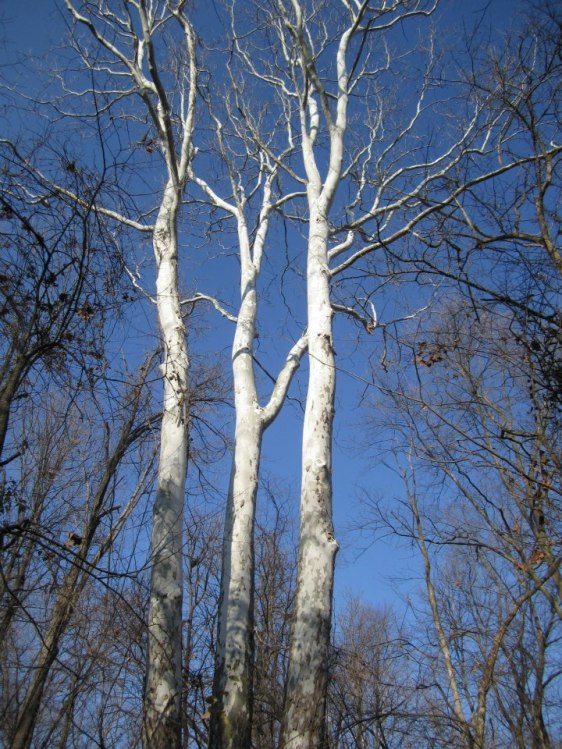
Sycamores in November

Sycamores in November

Forsell came to the Irvington Green Hour last summer to talk about trees with a bunch of us treehugger types, all of us concerned about the impact of the drought. I remember being struck by his authenticity and gentleness.

Here is a quote from this powerful essay:

“In more than two decades marked by surgeries and reminders of my mortality, I have realized I want to spend my days serving: having joy, and hoping I can help others have it too. I want to…heal that which is beautiful but broken or scarred or neglected or compromised in this world….”

He goes on to say that while he may not be able to stop the cancer, it is within his power to help heal the world.

There’s no greater gift than that.

To Shed our Fear

In light of my last post, this quote leapt out at me from the pages of The Blue Sweater, Jacqueline Novogratz’s visionary book. I’ve been a fan of Wangari Maathai since the early 1990s, when I read about her leadership of the Green Belt Movement. This grassroots initiative organizes women in rural Kenya to plant trees, combatting both deforestation and disempowerment.

By Demosh via Wikimedia Commons

The late Wangari Maathai holding a trophy awarded to her by the Kenya National Commission on Human Rights. By Demosh via Wikimedia Commons

“In the course of history, there comes a time
when humanity is called
to shift to a new level of consciousness,
to reach a higher moral ground.

A time when we have to shed our fear and give hope to each other.

That time is now.”

–Kenyan environmental and political activist Wangari Maathai, the first African woman to receive the Nobel Peace Prize

Can We Change Course in Time?

Last week, one day after I heard the author of The Pipeline and the Paradigm speak about the insanity of our fossil fuel-based “business-as-usual” storyline, we reached a chilling milestone.

The CO2 counter on the side of Mauna Loa, which measures parts per million (ppm) of carbon in the atmosphere, tipped past 400. As Bill McKibben wrote, “It’s a grim landmark—it’s been several million years since CO2 reached these levels in the atmosphere.”

Scientists have identified 350ppm as the safest upper limit for a life-sustaining biosphere.

Sam Avery had just told us that we are on the cusp of a new paradigm—moving from the old story, which values living systems only in terms of dollars, to the new, which affirms that living systems are inherently valuable.

Olympia, Washington. Keystone XL Pipeline protest. By Brylie Oxley via Wikimedia Commons

Olympia, Washington. Keystone XL Pipeline protest. By Brylie Oxley via Wikimedia Commons

The Keystone XL Pipeline, which would carry noxious tar sands from Alberta to Texas, is a “pivot point between these two worlds,” he told us. Opening the pipeline would allow the release of enormous levels of carbon—enough to create irreversible climate change.

Depressingly, that 400ppm number is not even indicative of current carbon emissions. There is a 10- to 40-year time lag before we feel the effects of today’s emissions. And greenhouse gases stay for hundreds of thousands of years in the atmosphere.

It’s not only the carbon that is concerning. The 36-inch-diameter pipeline, only one-half inch thick, will be continually abraded by the rough tar sands. When there is a spill—and it’s not if, but when—this stuff behaves differently than crude. It is heavy; it sinks to the bottom of lakes and rivers.

I don’t know about you, but the prospect makes me nauseous. Deepwater Horizon was bad enough. How much more can we foul our nest? (The good folks of Mayflower, AR are dealing with a tar sands spill right now.)

A map showing aquifer thickness of the Ogallala Aquifer with the proposed Keystone XL Pipeline route laid over. Via Wikimedia Commons

A map showing aquifer thickness of the Ogallala Aquifer with the proposed Keystone XL Pipeline route laid over. Via Wikimedia Commons

Avery advocates dramatic action to nudge the new paradigm into being. He’s spreading the message that we can collectively make a different choice.

“We have to believe it to make it happen,” he said, though he admitted that right now, he “might bet against human survival” given the current trajectory.

“We can’t rely on market forces to do it for us,” Avery said. “We’re going to have to decide exactly when and where and how we are going to get off fossil fuels.”

This requires nothing short of evolution—an epic shift in consciousness. It would mean making the decision, globally, to leave carbon underground despite ever-increasing energy demands. To do otherwise is to jeopardize our home and our survival, not to mention the survival of innumerable precious species and ecosystems. Can we change course in time?

Some 50,000 people have pledged to participate in civil disobedience if Keystone is approved. Avery himself, who traveled the pipeline route during his book research, is prepared to “stand between the earth and destruction.”

Who will stand with him?

Learning to Learn

Third in a series on education
Recently I spent a day with a Bloomington, IN homeschooling cooperative. Two families work together on homesteading projects on each others’ land. This allows their four children, ages 8 to 12, to learn by doing—while increasing their confidence and skills.

Projects range from seed saving to bike maintenance to creation of a family almanac. They’ve gone mushroom hunting, practiced knot skills, and (on rainy days) learned knitting and mending. They’re working on a fire pit and hoping to build a treehouse.

Reading and quizzing each other from a book called Moving Heavy Things

Reading and quizzing each other from a book called Moving Heavy Things

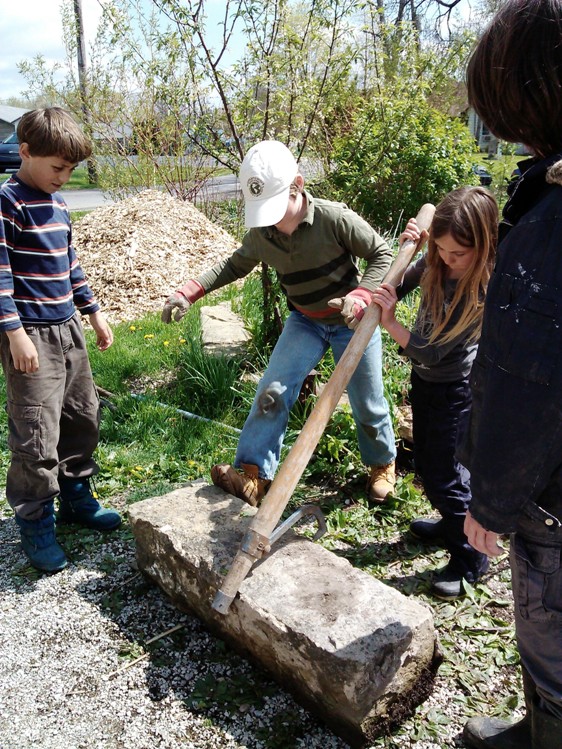
The day I was there, the students were studying how to move a heavy sandstone block down a sloping driveway from the front yard to the back. They were to place it into a rectangular hole in the dirt, forming part of an herb garden’s perimeter. The emphasis was on problem solving, collaborative effort, and applying their study of friction and levers.

Sawing PVC pipe to roll the plywood with the block on top (note that is just a practice stone, not the super-heavy one they were charged with moving)

Sawing PVC pipe to roll the plywood with the block on top (note that is just a practice stone, not the super-heavy one they were charged with moving)

This was no small task and involved an array of tools, including something I’d never heard of called a cant hook. The mom/teachers, Stacey and Dani, encouraged them to try out every idea and see what worked best. The kids worked by experimentation, reasoning, puzzling, trying, and talking—displaying remarkable tenacity through the whole process.

Using a cant hook to move the sandstone block

Using a cant hook to move the sandstone block

There was not one temper tantrum. I could see that the communication skills these kids develop through group projects will go a long way toward smoothing their way in the world—while also contributing to the healing of that same world.

Stacey says she’s motivated by a belief that children can be the instigators of deep change. “I try to not spend a lot of time in a fear/worry place (even though it is hard sometimes), and in doing this mentor joy, hope, the power we have, and that change is possible.  When children/adults have trust in themselves, self-empowerment and understanding of the world, beautiful things happen!”

“I think they are continually seeing how they make a difference and create change.”

Picking violets for our lunch salad

Picking violets for our lunch salad

By the end of my visit, the children had moved one monstrously heavy block into place in the back yard, where it will begin the delineation of an herb spiral. There was great cheering when the block was finally nestled into place.

As results-oriented as we are these days, this may not seem like much for several hours’ work. But in the process, they learned to learn, to cooperate, and to not fear failure.

Watching them, I wondered how my life would be different if I had had these sorts of experiences in my own childhood. I might consider myself in a different light now. I might be handy, of all things. At the very least I would be braver, less fearful of being wrong.

This concludes the education series, at least for now. (I could share much more about both the KI school and these homeschoolers, but that’s where the book comes in.)

Solar Cooking Season at Last

Taking a break from the education series for a little joyous yippee-skip, because today? I busted out the solar cooker!

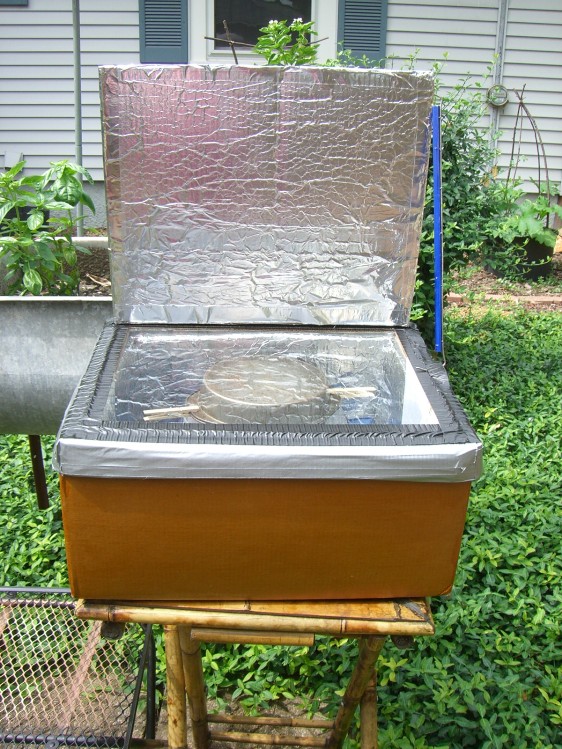
Yep, on this cool, breezy day I solar cooked for the first time this year. It makes me so happy to usher in the season this way. Despite the chill, the sun is high and bright, the sky bluest blue, and in the solar cooker the oven thermometer registered 275 degrees.

I was having so much fun, I neglected to take any photos of my handmade cooker doing its thing.

Solar Cooker

This is not a photo from today, but from my very first summer of solar cooking, 5 years ago. Nowadays I know enough to put a dark cloth over my cookware. And I don’t use clothespins anymore, at least not inside the cooker. But you get the idea.

OK this isn’t a food blog… but here is what went into the soup that is just now steaming in my mug after simmering out there all day:

  • leeks from my CSA (community-supported agriculture, a weekly allotment of locally grown vegies, yum)
  • baby carrots, also from the CSA
  • sage and dill, ditto
  • parsley I dried at some point, can’t remember the origin, possibly the back yard
  • corn my partner and I bought at the farmers market and froze during the summer
  • a dried Aleppo pepper from the community garden, given to me by my friend Heidi
  • potatoes purchased at the food co-op
  • celery that really really needed to be used up
  • frozen chicken stock I made during the winter from an Amish-raised chicken
  • salt, pepper, and love, baby!

Tell you what, it hits the spot.

Also from that first year. But I did toast pumpkin seeds today on top of the soup.

Also from that first year. But I did toast pumpkin seeds today in a tray on top of the soup. I’ll put them in my salads this week.

I love cobbling together a dish like that, using produce from the garden or market or CSA, or whatever needs to be used up to make room for fresher stuff. (Time to get that corn all eaten up before it shows up in the markets again.)

I’m so looking forward to another long summer of solar cooking. I can almost taste the plum cobbler now.

There’s more about my solar cooker and how you can make one here.

KI EcoCenter: Transforming Education

Second in a series on education
KI EcoCenter, or Kheprw Institute, has been making change for nearly a decade in my hometown. In recent years, educator Khalil MwaAfrika came on board the community empowerment center to start an independent school. He was tired of discussing school reform while watching the educational system destroy African-American children, particularly boys.

Khepri, by Jeff Dahl via Wikimedia Commons

Khepri, by Jeff Dahl (GFDL or Creative Commons) via Wikimedia Commons

Instead of reform, he is invested in nothing less than education’s complete transformation. As  mentioned in a previous post, “Kheprw” was an Egyptian god with a scarab beetle head. This beetle was a symbol of rebirth in Egypt—so the center is fittingly named.

KI’s school offers a rigorous program for African-American students. Classes are very small, allowing a high degree of mentorship. Community members interact with the students every day in this intergenerational model.

MwaAfrika emphasizes that igniting a passion for learning is key. Instead of promoting a particular ideology, faculty create space for discourse and dialogue. In that environment the children learn critical thinking skills. They are encouraged to puzzle things out themselves.

In contrast with the traditional school system, here there is no need for the youngsters to feel they must give up their own rich culture in order to succeed.

This issue came up repeatedly at the center’s recent Real Talk Summit on urban education. Because our dominant culture is white/upper middle class, racism is the water we all swim in—leading to schools that don’t believe in children from other races and classes.

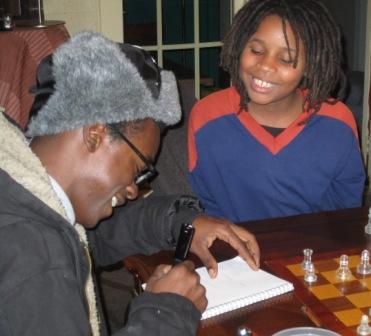
A faculty member and student at KI EcoCenter Community School

A faculty member and student at KI EcoCenter Community School

But KI is different. “We’ve set up an environment where (black students) can be themselves, where they can learn exponentially, where they never have to compromise who they are,” MwaAfrika says.

KI founder Imhotep Adisa notes, “The primary purpose of education is indoctrination. It’s not liberation.”

Part of that indoctrination is the consumerism that is jeopardizing the earth. “We’re at a very ugly place in the history of the planet,” he says. “Regardless of gender, race, and class, the old paradigm has accelerated this…We have to develop new tools for a new paradigm. We have to have the courage to say, ‘That’s not the world we want for ourselves and our children.’”

KI’s adults model that courage every day. Teaching youth to interface with the culture of power while retaining their identity is a critical aspect of their work.

Social enterprises are part of this, as the students work with KI’s bootstrappers (young adults) to develop the skills needed to thrive in a resource-strapped world.

Barrel at left is via KI's Express Yourself Rainbarrels enterprise, with my chosen artwork

Barrel at left is via KI’s Express Yourself Rainbarrels enterprise, with my chosen artwork

Above (at left) is the rainbarrel made by bootstrappers and students for my urban homestead, via the Express Yourself Rainbarrels enterprise. My partner added it to our rain catchment setup, just in time for big rains.

(Indy-area readers, check it out: Save on your water bill, display your artwork, and support a great organization all at the same time.)

Read more about KI’s work in my Indiana Living Green story.

Next: Bloomington’s homeschooling cooperative, exploring the homestead as learning environment.

For the Sake of the Future

First in a series on education.
It’s been a long time since I was in school, but recent encounters started me thinking about those days again. A few weeks ago I spent an afternoon with a homeschooling cooperative, and last week I joined KI EcoCenter’s discussion on urban education. Both groups inspire me by demonstrating alternative ways of educating youth. I plan to devote an upcoming blog post to each.

Though I know many fine teachers, it does seem to me that something is fundamentally broken in the traditional school model.

By Aburk018 at en.wikibooks [Public domain], from Wikimedia Commons

By Aburk018 at en.wikibooks [Public domain], from Wikimedia Commons

Back in the day, I was a mess socially, but quite good at getting the grade. I clearly remember telling my church youth leader at the glib age of 17, “I usually just study for the test and then forget everything right away. It’s easy to get an A.”

His face turned mournful, and he said, “So the system’s got you beat.”

I zoned out on whatever he said next. I was excelling in school, easily maintaining my position at the top of my class—ever since I figured out that daydreaming was best done outside the classroom. No one had ever criticized my methods before.

Straight A’s aside, I didn’t integrate much of what I learned, despite some stellar teachers. School was about checking boxes. Only in an occasional literature class would I feel truly engaged and energized. Most of the time (so it seems now) I was half asleep.

Recently I read a man quoted as saying that school taught him to work very hard at things that don’t matter. He said it was great preparation for life in the workforce—but not really for life.

This was my path: doing what the adults said, getting things done on time, but rarely connecting to the material in any real way.

KONICA MINOLTA DIGITAL CAMERA

And I had years of box-checking ahead of me—because much of my working life turned out to be School 2.0. I was free in my off hours to pursue my dreams, but my workaday world belonged to someone else.

I’ve been done with that world for years now, ever since health issues mercifully sidelined me from my corporate job. (Incidentally: doing much better these days.)

I gave away so much of myself in those decades I spent plodding through life in service of someone else’s objectives. Now I look at corporations from the outside and grieve the creative energy locked up in their gears. I look at the classrooms of today, so focused on test scores, and mourn each lost spark.

How much creative thinking is crushed under the boot of the educational system? How much innovation is chewed up in corporations?

Nowadays we need the brilliance of every single mind we’ve got. What’s facing us is nothing less than global collapse. We can’t afford to have anyone zone out.

So why can’t we do this differently? Could we give our youth real-world problems to address, and expect them to show us their best work, not for a test score, but for the sake of our shared future?

The times demand it.

Next: KI EcoCenter, developing tools for the new paradigm.

Time to shout “STOP”…..March Against Monsanto.

“My own reason for supporting this movement is because I believe in freedom. Freedom to grow my own food, food that I feel happy to eat. Freedom to save seeds from the plants that I grow. Freedom to distribute them as I please among other growers. Monsanto wants to curtail these freedoms, because these freedoms don’t put money in their pockets.”

Well said, Bridget.

I’ll be attending the March Against Monsanto in my own town–will you?

bridget's avatarfromacountrycottage

017

On May 25th of this year a great event is happening. Where is it happening?  Everywhere! If you check out  http://www.march-against-monsanto.com   you will find marches organised to protest against the giant corporation that is Monsanto. All over the World marches are scheduled. We must make our feelings felt. Not only to Monsanto but also to our governments, for they are the ones allowing Monsanto to infiltrate our farms, gardens and allottments.

019

Tami Monroe Canal, creator or the now viral Facebook page March Against Monsanto, says she was inspired to start the movement to protect her 2 daughters. “I feel Monsanto threatens their generations health, fertility and longevity. I could’nt sit by idly, waiting for someone else to do something.”

My own reason for supporting this movement is because I believe in freedom. Freedom to grow my own food, food that I feel happy to eat. Freedom to save seeds from the…

View original post 242 more words

Living Below the Line

My friend Cathy has been posting on Facebook this week about her experience participating in a challenge called Live Below the Line. For five days, she and her fundraising team are limiting what they spend on food to $1.50 a day.

The idea is to create awareness of the plight of 1.4 billion people all over the world who live in extreme poverty—people who must cover not just food but basic necessities with the equivalent of $1.50 per day.

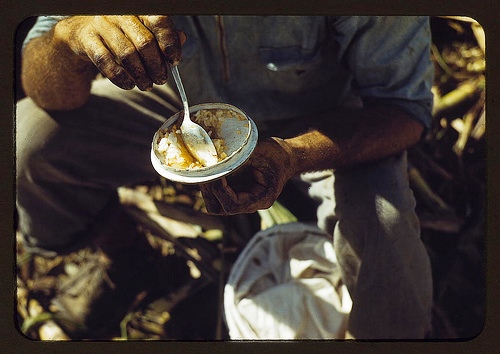
Rice in a lunch of plantation worker

Rice in a lunch of plantation worker

The Global Poverty Project is the organizer, and they’ve partnered with U.S. charities fighting hunger and poverty around the globe. My friend and her group have chosen to raise money for CARE.

According to the site, Live Below the Line is running in the US, UK, and Australia simultaneously, with more than 20,000 people participating.

Cathy reports that this is the second year she’s participated in the challenge. “I found it such a powerful experience that I did it again. The lack of choice and the mental aspect are far worse than the reality of the food itself or serious hunger.” Her Facebook posts show how the eye-opening experience can increase a sense of gratitude and compassion:

  • Today I cannot help on reflecting how easy my life is overall. I cooked the rice in the rice cooker after rinsing it with my filtered water that I had to walk nowhere to retrieve. I soaked my beans overnight in filtered water and then cooked them on my gas stove with the mere twist of my wrist required to turn it on…
  • I felt a bit hungry after lunch. I have to be conscious of how much I eat so that I do not run out. Yes, I am a tad ashamed to admit, I have threatened my family members not to dare touch any of my rice or beans. Imagine if so little actually had to feed my family.
  • Today I had minor obsessions with the bananas and yogurt, both appeared so enticing. It did make me think about those whose livelihoods depend on the fruit and vegetables they grow—but must sell in order to make the meager income they provide.

Having empathy with people in vastly different circumstances is surely one of the things that is going to save all of us. In Cathy’s words:

“I am humbled by how easy my life is, simply by virtue of where I was born. Unfair. This week is about experiencing, raising awareness, and helping fund hand-ups—not hand-outs. If you are so inclined, please donate to CARE.”