Seven Steeples Farm

Last month I got to meet Justin Berg and Mike Higbee, who are doing something I admire: turning unused urban land into an agricultural oasis. As with many such endeavors, they glean local materials to build soil—leaves from curbside refuse, manure from the police department’s Mounted Patrol stables.

What’s unique about this urban farm, though, is that it’s being built atop the pulverized remains of an old mental institution.

Seven Steeples Farm

Seven Steeples Farm

To anyone growing up in Indy, as I did, “Central State” was synonymous with the loonybin. We all knew that it was an insane asylum, back in the day, and as late as 1994 it was still operating as a psychiatric facility.

The enormous campus fell into disuse after Central State Hospital closed, but recently the site has been redeveloped into Central Greens urban village. Part of the project includes Seven Steeples Farm, so-called because the 5-acre parcel being farmed is on the footprint of a building called Seven Steeples, where women were institutionalized.

The building was demolished midcentury, and apparently is now buried under the vast lawn area where Justin and Mike have begun growing produce for the past year. Sheltering old trees that must have borne witness to all kinds of pain still stand, shading the chicken run and outdoor classroom area.

I have to say, this thing has lit my imagination in surprising ways. I’ve read The Yellow Wallpaper and other stories of “madwomen in the attic.” How easy it was to cart women away for any infraction back when this asylum was established (1850s.) I can think of several reasons why I myself, in an earlier era, could have gotten myself tossed in there.

And what sort of “treatment” did the women undergo, inside the walls of Seven Steeples?

It feels to me like a major healing of an old wound to have an urban farm there. Community volunteers (and patrons) enjoy a peaceful setting smack in the middle of a somewhat sketchy part of town. The food is accessibly priced so that people living in the middle of a food desert can have a decent choice of nourishment.

Justin Berg, farm manager, and Mike Higbee, project coordinator, with lady friend

Justin Berg, farm manager, and Mike Higbee, project coordinator, with lady friend

Visitors love to sit on the stumps next to the chicken run and just get on “chicken time.”

The farm has announced 2015 CSA (community supported agriculture) plans, and will also have a weekly farm stand to sell eggs and produce. (More info: info@sevensteeplesfarm.com or 317-713-9263.)

Justin says, “Call to set up a tour, and everyone’s more than welcome to come by the farm stand if they’re in the area. They can grab up some produce and come check out what a rural setting could look like in the city.”

See my Farm Indiana piece for more on this project.

A Rural Rebirth, One Ag Business at a Time

Earlier this summer I visited Becca Selkirk at her Wayne County, IN farm, Unique 2 Eat, where she raises quail, chickens, and rabbits. She sells the eggs from her quail and chickens, along with rabbit meat. And she has two goats just for fun.

I was researching a story for Farm Indiana, having met her through Carthage Mill. (You might remember founder Anna Welch’s powerful guest post, “The Face of Resilience,” from a few months back.)

The mill is a sustainable agriculture business incubator, and its existence allowed Becca to expand into animal feed.

Becca Selkirk with a handful of her locally grown and milled feed.

Becca Selkirk with a handful of her locally grown and milled feed.

Using all organic and local ingredients, such as Fields of Agape‘s black bean halves and flax seeds, she’s developed a high-quality chicken feed. At 19 percent protein, her layer feed out-competes the industry standard. It’s all ground right onsite.

She markets her products at the mill and through Hoosier Harvest Market, the online marketplace that delivers small farmers’ and producers’ wares to several drop points.

I interviewed one Carthage resident who made the switch for his chickens and was thrilled with the result. “The quality of it’s great,” Devon Hamilton told me. “And my birds look healthier.” He says the price point is only slightly higher than what he was buying. And it’s worth it to him to know the ingredients were locally and sustainably raised.

Next on Becca's list is a formula for quail feed.

Next on Becca’s list is a formula for quail feed.

Plus, he wants to support the new venture. “I was there one day when Becca was mixing (the feed),” he says, “and she was working very hard. It’s very labor-intensive.” He feels that Becca has priced her feed appropriately, given everything that goes into it.

Becca is also one of the principals of local fertilizer maker Sterling Formulations, another company leasing space at Carthage Mill. And I just found out that she’s been able to expand into another new line. She’s cooking up ready-to-eat soups and developing a gluten-free pizza crust for “take-and-bake.”

She’s only been able to do this because of Carthage Mill: It has a commercial kitchen that’s certified for use in organic food production.

This is rural revitalization, one small ag business at a time.

Check out the full Farm Indiana story on Unique 2 Eat Farm. (Warning: adorable fuzzy animal photos involved—Josh Marshall‘s photography is terrific as always.) For more on Carthage Mill, see “Cooperative Offers Rural Rebirth,” my Acres USA story.


Peace Pilgrim’s Breakfast

Can you stand one more post about berries? Since we don't have blueberries growing wild in Indiana, I chose this photo of mulberries to accompany the quote.

Can you stand one more post about berries? Since we don’t have blueberries growing wild in Indiana, I chose this photo of mulberries to accompany the quote.

“One morning for breakfast I had blueberries covered with dew, picking them from the bushes as I journeyed through the New England mountains.

I thought of my fellow human beings eating various kinds of processed and flavored foods, and I realized that if I could choose my breakfast from all the foods in the world, I could not make a better choice than blueberries covered with dew.”

Peace Pilgrim

Will Allen Visits Peaceful Grounds

It was an honor to meet Growing Power founder Will Allen last weekend. The urban farming advocate was in town to support the work of his student Linda Proffitt at Peaceful Grounds. (Here’s my earlier post about this inspiring demonstration farm, which is a regional training center for Growing Power.)

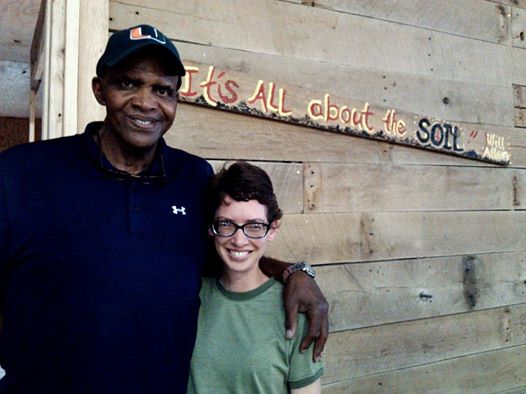
This aphorism hangs on the wall at Peaceful Grounds.

This aphorism hangs on the wall at Peaceful Grounds.

The former pro basketball player told me that he learned how to broadcast seed as a child. He can pick up a handful of seed and not drop one of them. He has the muscle memory for broadcasting those seeds, whether arugula or chard or carrots—and all require different release rates. His sharecropper father taught him as a child, and all these years later, he retains the skill.

Now he sows great swaths of salad greens in his Milwaukee farm operations. Calling himself a “crusty old farmer,” he is the embodiment of Growing Power’s stated vision: “to inspire communities to build sustainable food systems that are equitable and ecologically sound, creating a just world, one food-secure community at a time.”

In 25 urban farm sites, on places like brownfields, school property, and land leased from corporations, the organization models how to get this done. The food is distributed through multiple channels, from Community Supported Agriculture accounts to a major distributor, Sysco. “Just another customer” is how he describes the corporation that ships GPI wares all over southeast Wisconsin.

Though the local food movement continues to make strides, there’s still a long way to go. Despite all the options—the CSAs, the farm stands, the farmers markets, the small mom and pop stores stocking local fare—Allen says up to 99 percent of the food eaten in major cities comes from 1500 miles away. “The vast majority of people will shop square,” he says, referring to big box stores.

Only $13 million of the U.S. food sector is generated by eco-agriculture—about the equivalent of three McDonalds. Growing Power represents 20 percent of that share. To fully transform the food system would require 50 million people to start growing food in their own yards, he says.

Turning the ship around has been the iconic Allen’s life work for the past 21 years.

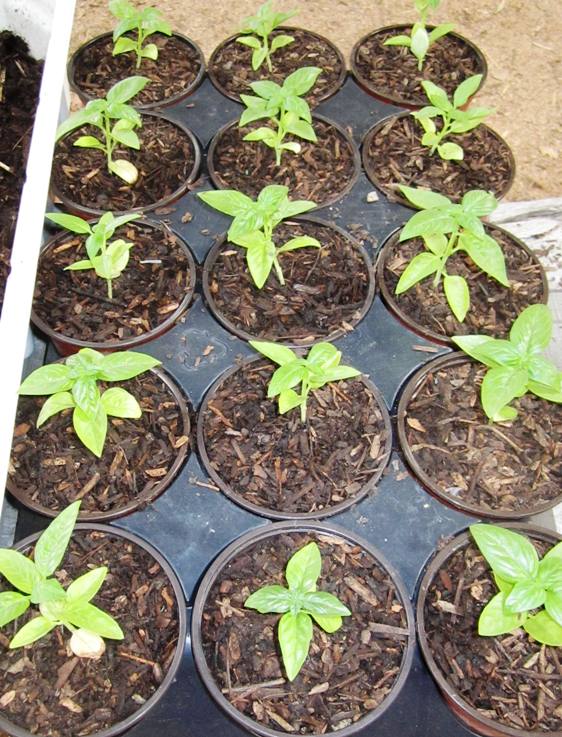
Basil sprouts at Peaceful Grounds, a regional training center for Will Allen's organization, Growing Power.

Basil sprouts at Peaceful Grounds, a regional training center for Will Allen’s organization, Growing Power.

He envisions for-profit businesses taking up the charge of urban food security, with nonprofits assuming a training and organizing role.

In his own organization, the people responsible for growing the food are extremely efficient, and training happens as a separate program. That’s a critical point, because farming isn’t easy. Efficiency is the name of the game.

“My crew comes from the community, and they live in the community, but they are professionals. Everybody thinks you can take interns and integrate them with professionals, but you can’t. You’ll lose money hand over fist.”

He's very tall.

That’s me on the right.

More of my conversation with Will Allen can be found in today’s Nuvo article.

Also check out Robb Smith’s terrific podcast interview over at DIY Food Supply.

Homegrown “Superfruit”

I saw this item for sale at my food co-op, Pogue’s Run Grocer, and it cracked me up.

Turkish Superfruit! Check it!

White mulberries, a “Turkish Superfruit,” only $5.99 for 4 ounces. What. A. Steal!

Just a week ago I spent a pleasant morning bicycling around the neighborhood with a friend. We stopped to pick from the mulberry trees that grow wild along the creek, meanwhile catching up on each others’ lives.

Mulberries are great in smoothies and crisps, and they are abundant, free, and nutritious (apparently a Superfruit, no less!). My friend and I were delighted with our harvest. Along with the usual purple, we found a white mulberry tree. It might be my imagination, but I always think the white berries are particularly sweet (though a bit less appetizing in appearance).

Superfruit from the hood. Free of charge. Bring your own bucket.

Superfruit from the hood. Free of charge. Bring your own bucket.

I once blogged about how homesteading (even on my modest scale) can make me feel like a chump because of all the extra work it takes to live “simply.” And how other times, I feel the tiniest bit smug, because—look! So much wealth on so little money.

Yeah, this is one of those smug times.

Farming Females

Last month I enjoyed interviewing several women for a special section in Farm Indiana on women in agriculture. While some didn’t consider themselves farmers, all had valuable perspectives about what it means to bring a female sensibility to agriculture.

Many spoke of women’s connection to the earth as something deep and primal. Several compared the nurturing of plants and animals to caring for children.

And Kay Niedenthal, an urban farmer in Indianapolis, might have been talking about our procreative power when she said, “It’s like magic to make something from nothing. To start with dirt and a seed and then have a meal.”

Anna Welch of Fields of Agape in a field being prepared for hull-less oats.

Anna Welch of Fields of Agape in a field being prepared for hull-less oats. (The periodical has a much better photo of Anna by the terrific photographer Josh Marshall.)

I was intrigued by the fact that Anita Spencer of Homestead Growers didn’t start out growing organically. She and her husband were Miracle-Gro fans at the start. When a friend asked if they’d ever considered going organic, she said, “We laughed at her!”

But that question planted a seed all its own. They took a look at the contents of the famed formulation and realized they didn’t want all those chemicals in their bodies and those of their children. Nor did they want to sell produce grown that way.

Now Anita is proud to offer high-quality, chemical-free food to her customers through both Homestead Growers and its spinoff line of tomato sauces, Local Folks Foods.

(As a side note, this anecdote showed me how questions can spur behavior change, even the questions don’t seem well-received. I resolve to ask more questions!)

For the full story, including seven mini-profiles of women in agriculture and Josh Marshall’s beautiful photos, see the current issue of Farm Indiana (page A8).

Pay It Local

In Ball State University’s Down to Earth documentary about sustainable food systems, renegade farmer Joel Salatin makes a key point about the importance of spending food dollars locally. A small amount of cash spent at the farmers market or local food store might make a huge difference to the vendors there. You never know what kind of difficulties they face, and where they stand on the thin line between a manageable load and giving up.

It’s kind of like paying it forward, only you’re “paying it local.”

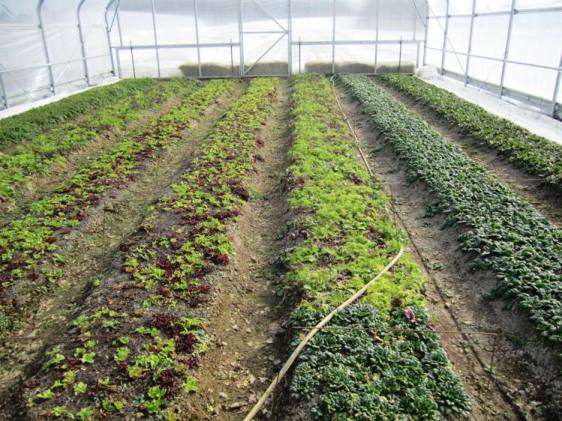
Freedom Valley Farm's high tunnel beds.

Freedom Valley Farm’s high tunnel beds.

It reminded me of something I blogged some months back:

The row we plant might be just the encouragement our elderly neighbor needs to start seeds on a windowsill. Which might nudge her granddaughter to visit a farmers market and buy a farmer’s tomatoes, and one of those funny-looking squashes while she’s at it. Maybe she’ll come back in ensuing weeks and bring her children and a friend, buying more locally grown food. Which shows the farmer that his produce is desired, and keeps him from throwing in the towel after a tough summer.

Since I wrote that I’ve talked to many small farmers as part of my freelancing job, and I’ve learned that farming is more difficult than any nonfarmer could ever imagine. What they do requires a lot of faith. And people to buy what they’re selling.

When I interviewed Hoosier Organic Marketing Education (HOME) founder Cissy Bowman for a Farm Indiana story, she emphasized the critical role of the nonfarmer ally. “Never feel disempowered,” she told me. “As a consumer your opinion is the most important, because you’re the one who buys it.”

Our consumer choice is not even just about food. It’s also about keeping land out of developers’ hands. If farmers can earn a living wage, fewer properties will be snatched up and turned into subdivisions and shopping malls. That means more acreage for wildlife, native plants, and pollinators.

From the front page of Farm Indiana

From the front page of Farm Indiana

The current issue of Farm Indiana contains two stories I wrote. One is about Cissy and HOME, a terrific nonprofit organization that helps farmers like Anna Welch with rural development projects and educates everyone about the importance of organics. The other is about Freedom Valley Farm, an Owen County operation that I thoroughly enjoyed visiting.

Jim Baughman showed me around his farm on a February day.

Jim Baughman showed me around his farm on a February day.

I can testify that Jim’s winter produce is among the best I’ve tasted. We’re talking melt-in-your-mouth spinach and juicy-crisp carrots. This guy is good at what he does, and he does it all without chemicals.

To read the stories, click here.

Relocalizing the Food System

I love writing stories about food and farming. The people I meet are so passionate about their work. Almost everyone I interview is invested in reforming the broken food system. Bonus: They give me tasty things to eat.

Here’s a rundown of the treats I’ve sampled just in the past few weeks.

  • Cissy, a woman who’s long been the vanguard of Indiana’s organic movement, gave me some intensely flavorful pickles she made from cucumbers raised in her kitchen garden. I washed it down a glass of homemade kombucha that couldn’t be beat.
  • Jim, a farmer in Owen County, sent me home with a bunch of carrots he pulled from the wet earth like a late winter miracle.
  • Anna, a farmer in Rush County, gave me a huge jar of rolled wheat that her cooperative had grown and milled. (I used some in banana bread I baked for my weekly writing date—my writer buddies pronounced it wonderful.)
Checking out a display of LocalFolks Foods at Moore Corner Store while on assignment

Checking out a display of LocalFolks Foods at Moore Corner Store while on assignment

And a couple weeks ago, at Moore Corner Store, proprietor Jasen Moore offered me a taste of ketchup made by Indiana’s own LocalFolks Foods.

I’m no ketchup connoisseur, and in fact we never purchase it. But if I were a fan of this most American of condiments, I would never buy a national brand again. LocalFolks’ is sweetened with sugar, not the genetically modified scariness that comprises high-fructose corn syrup.

I happened to be in the natural food store when Hoosier Microgreens’ Alex Sulanke came along to introduce his product. So I got to munch uber-fresh sprouts of radish, cabbage, kale, arugula, and mustard from “the smallest farm in Indiana” (120 square feet).

Moore Corner Store is in the business of connecting small farmers and food entrepreneurs to the consumer. Though its hours are limited at present, this shop and others like it fill a critical role in relocalizing our food system.

For Jasen and his wife Sara, Moore Corner Store is more than just a business. It’s a mission. Jasen told me the enterprise arose out of concern for the state of our economy. Big box stores have fragmented communities and hurt the little guy.

Moore2“But a store like this…supports the local economy, minimizes carbon footprint, puts actual nutritious food on your plate, and it’s close to home.” The Moores live just up the street from the shop, though both must spend time elsewhere to make ends meet.

I just saw a documentary called Down to Earth in which the iconoclastic farmer Joel Salatin (made famous in Michael Pollan’s Omnivore’s Dilemma) made an important point: Your purchase of a farmer’s product might be the thing that keeps that farm afloat another week.

Is it worth changing our habits to spend a little more of our money at a farmers’ market or a shop like the Moores’? I would say yes. What about you? Have you connected with a small farmer, producer, or locally owned shop lately?

Check out my piece on Moore Corner Store here.

Localizing the Winery

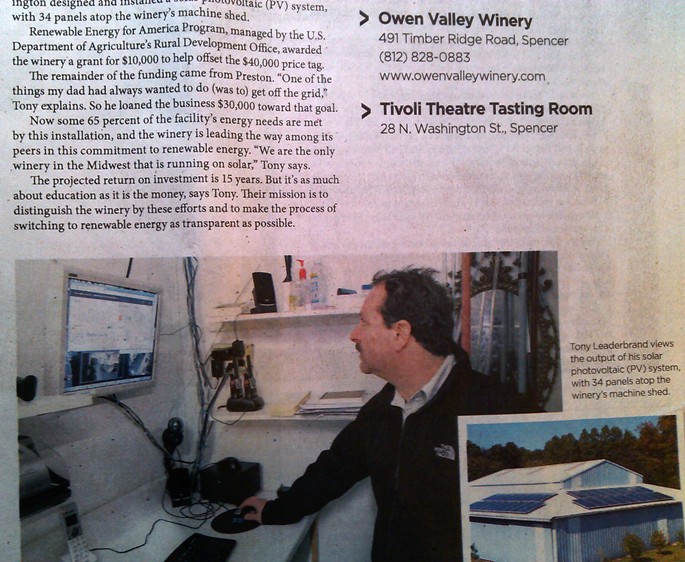
When is a winery more than a winery? When it contributes to revitalizing a rural community, putting the local economy at the forefront of its mission. Owen Valley Winery, which I discovered on assignment for Farm Indiana, is just such a place.

IMG_20140301_135319

Here’s a look at the piece I wrote for this month’s issue of Farm Indiana.

I thoroughly enjoyed my conversation with Tony Leaderbrand (pictured above), who told me the whole story of the family-owned business’s evolution. Aside from their commitment to showcasing Owen County’s locally grown and made products, the winery is unique in another respect. It is the first Midwestern winery to run on solar power.

IMG_20140301_135602

A grant from the Renewable Energy for America Program helped pay for the solar panels that now produce a large portion of the winery’s energy needs.

Locally grown persimmons are among the fruits used in Owen Valley Winery’s products. I was moved by stories of people bringing their excess fruit in shoeboxes and buckets every fall to sell to the winery. Tony made me see that winemaking is truly a local ag-based endeavor. (Due to demand for dry wine, they also use some California-grown grapes as well.)

photodune-1133279-wine-s

Photo by groceris, via PhotoDune

Tony told me all about the repurposed items that went into construction of the tasting room and production facility. In fact, the second tasting room is kind of an upcycling project in itself: It’s located in the renovated Tivoli Theatre, a historic building in Spencer, IN.

On a personal note, Tony talked about how eating produce from local farms is a winner both in terms of health benefits and reduced packaging. Not to mention the benefits of keeping dollars circulating in the local community.

“I think there’s such a need for us all to come full circle on purchasing,” he said. “We have to break these old habits of going to these superstores. You’ve got to know where everything you buy comes from.”

You can read the full article here (do a search on Owen Valley Winery to jump to the piece.)

Restoring the Land

IMG_20140110_101420

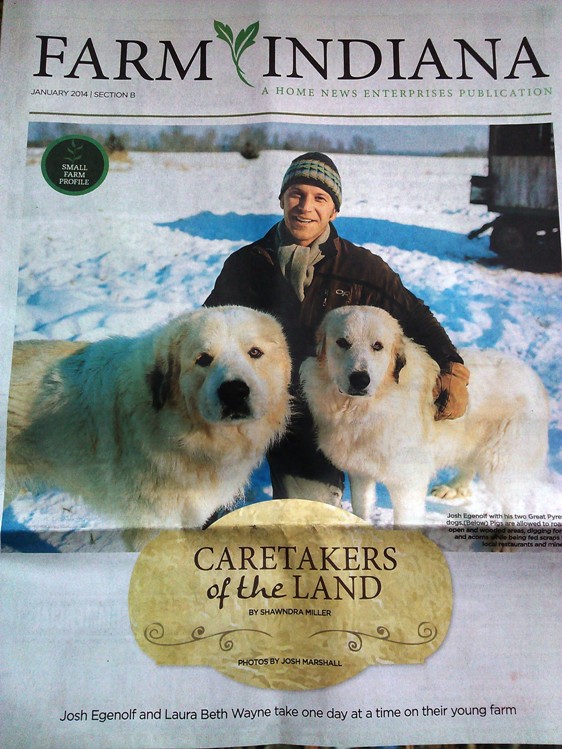
Cover page of my Farm Indiana profile of WE Farm

Dr. Lisa Harris remembers well the first conversation with the young man who would come to farm her land—they talked for hours, almost an entire day. “I was so impressed with how deliberate and thoughtful he was,” she told me.

Dr. Harris is Eskenazi Health’s medical director, a vegetarian with a lifelong interest in eating healthy food. As I learned when I wrote about WE Farm for Farm Indiana, she leases her Owen County property to Josh Egenolf and Laura Beth Wayne’s pastured beef cattle, poultry, and pork operation.

“Most people in the United States do eat meat,” she said. “So if I can be part of something that gives people access to meat from animals that have lived well, it seems like a perfect opportunity.”

Like many of us, Dr. Harris tries to live as lightly as possible, and Josh’s plans to make her land productive really spoke to that goal. “What Josh is doing,” she said, “is in every sense helping to improve the land.” WE Farm’s integrated, rotational grazing plan means the animals work in concert with nature to restore pastureland—all the while sequestering carbon and nitrogen in the soil.

The day I visited the farm last November in preparation for my Farm Indiana story, four happy dogs ran in front of the pickup truck as we drove up the lane to tend the livestock. Owen County is picturesque, with wooded hills and deep valleys. Josh showed me the steep woodlot where the hogs are periodically turned loose to forage for acorns and pawpaws. They also help him clear out understory invasives, just by doing what pigs do.

Breeder pigs enjoying their mineral rations on a frosty November morning.

Breeder pigs enjoying their mineral rations on a frosty November morning.

Josh was raised on a farm just a few miles up the road, and he treasures the richness of his a rural childhood. Giving that experience to his own child (and another on the way) is a big reason why he moved back to the area after pursuing his doctorate in ecology at the University of Georgia.

Also, he wanted to be put what he’d learned there into practice. Agriculture, he told me, has enormous potential for creating meaningful environmental change.

He said, “In 2007 I read The Omnivore’s Dilemma. Before that it never occurred to me that there might be anything troublesome about the way meat was produced, other than animal welfare stuff. That’s very clear to me…you shouldn’t treat your animals poorly. They need to be respected. But it didn’t occur to me that there was a single thing wrong with them eating grain and (even) industrial byproducts.”

He knows that many people still don’t realize the environmental and health issues that accompany feeding grain to meat animals, but a growing customer base tells him how many people value pastured meat. “It’s like an awakening that needs to happen.”

Josh and Laura Beth strive to keep the business as local as possible, keeping close to home in all their dealings. For more on their endeavors, check out my Farm Indiana story and the WE Farm website.