Can We Change Course in Time?

Last week, one day after I heard the author of The Pipeline and the Paradigm speak about the insanity of our fossil fuel-based “business-as-usual” storyline, we reached a chilling milestone.

The CO2 counter on the side of Mauna Loa, which measures parts per million (ppm) of carbon in the atmosphere, tipped past 400. As Bill McKibben wrote, “It’s a grim landmark—it’s been several million years since CO2 reached these levels in the atmosphere.”

Scientists have identified 350ppm as the safest upper limit for a life-sustaining biosphere.

Sam Avery had just told us that we are on the cusp of a new paradigm—moving from the old story, which values living systems only in terms of dollars, to the new, which affirms that living systems are inherently valuable.

Olympia, Washington. Keystone XL Pipeline protest. By Brylie Oxley via Wikimedia Commons

Olympia, Washington. Keystone XL Pipeline protest. By Brylie Oxley via Wikimedia Commons

The Keystone XL Pipeline, which would carry noxious tar sands from Alberta to Texas, is a “pivot point between these two worlds,” he told us. Opening the pipeline would allow the release of enormous levels of carbon—enough to create irreversible climate change.

Depressingly, that 400ppm number is not even indicative of current carbon emissions. There is a 10- to 40-year time lag before we feel the effects of today’s emissions. And greenhouse gases stay for hundreds of thousands of years in the atmosphere.

It’s not only the carbon that is concerning. The 36-inch-diameter pipeline, only one-half inch thick, will be continually abraded by the rough tar sands. When there is a spill—and it’s not if, but when—this stuff behaves differently than crude. It is heavy; it sinks to the bottom of lakes and rivers.

I don’t know about you, but the prospect makes me nauseous. Deepwater Horizon was bad enough. How much more can we foul our nest? (The good folks of Mayflower, AR are dealing with a tar sands spill right now.)

A map showing aquifer thickness of the Ogallala Aquifer with the proposed Keystone XL Pipeline route laid over. Via Wikimedia Commons

A map showing aquifer thickness of the Ogallala Aquifer with the proposed Keystone XL Pipeline route laid over. Via Wikimedia Commons

Avery advocates dramatic action to nudge the new paradigm into being. He’s spreading the message that we can collectively make a different choice.

“We have to believe it to make it happen,” he said, though he admitted that right now, he “might bet against human survival” given the current trajectory.

“We can’t rely on market forces to do it for us,” Avery said. “We’re going to have to decide exactly when and where and how we are going to get off fossil fuels.”

This requires nothing short of evolution—an epic shift in consciousness. It would mean making the decision, globally, to leave carbon underground despite ever-increasing energy demands. To do otherwise is to jeopardize our home and our survival, not to mention the survival of innumerable precious species and ecosystems. Can we change course in time?

Some 50,000 people have pledged to participate in civil disobedience if Keystone is approved. Avery himself, who traveled the pipeline route during his book research, is prepared to “stand between the earth and destruction.”

Who will stand with him?

For the Sake of the Future

First in a series on education.
It’s been a long time since I was in school, but recent encounters started me thinking about those days again. A few weeks ago I spent an afternoon with a homeschooling cooperative, and last week I joined KI EcoCenter’s discussion on urban education. Both groups inspire me by demonstrating alternative ways of educating youth. I plan to devote an upcoming blog post to each.

Though I know many fine teachers, it does seem to me that something is fundamentally broken in the traditional school model.

By Aburk018 at en.wikibooks [Public domain], from Wikimedia Commons

By Aburk018 at en.wikibooks [Public domain], from Wikimedia Commons

Back in the day, I was a mess socially, but quite good at getting the grade. I clearly remember telling my church youth leader at the glib age of 17, “I usually just study for the test and then forget everything right away. It’s easy to get an A.”

His face turned mournful, and he said, “So the system’s got you beat.”

I zoned out on whatever he said next. I was excelling in school, easily maintaining my position at the top of my class—ever since I figured out that daydreaming was best done outside the classroom. No one had ever criticized my methods before.

Straight A’s aside, I didn’t integrate much of what I learned, despite some stellar teachers. School was about checking boxes. Only in an occasional literature class would I feel truly engaged and energized. Most of the time (so it seems now) I was half asleep.

Recently I read a man quoted as saying that school taught him to work very hard at things that don’t matter. He said it was great preparation for life in the workforce—but not really for life.

This was my path: doing what the adults said, getting things done on time, but rarely connecting to the material in any real way.

KONICA MINOLTA DIGITAL CAMERA

And I had years of box-checking ahead of me—because much of my working life turned out to be School 2.0. I was free in my off hours to pursue my dreams, but my workaday world belonged to someone else.

I’ve been done with that world for years now, ever since health issues mercifully sidelined me from my corporate job. (Incidentally: doing much better these days.)

I gave away so much of myself in those decades I spent plodding through life in service of someone else’s objectives. Now I look at corporations from the outside and grieve the creative energy locked up in their gears. I look at the classrooms of today, so focused on test scores, and mourn each lost spark.

How much creative thinking is crushed under the boot of the educational system? How much innovation is chewed up in corporations?

Nowadays we need the brilliance of every single mind we’ve got. What’s facing us is nothing less than global collapse. We can’t afford to have anyone zone out.

So why can’t we do this differently? Could we give our youth real-world problems to address, and expect them to show us their best work, not for a test score, but for the sake of our shared future?

The times demand it.

Next: KI EcoCenter, developing tools for the new paradigm.

Birthing a New Story

Does it ever seem to you like an age of innocence is past? I’ve been thinking about this since reading Charles Eisenstein’s brilliant article, 2013: The Space Between Stories.

He describes a nostalgia for the cultural myth of his youth, “a world in which there was nothing wrong with soda pop, in which the Superbowl was important, in which the world’s greatest democracy was bringing democracy to the world, in which science was going to make life better and better. Life made sense.”

By Simon Q from United Kingdom (Rusting Sherman Hull Uploaded by High Contrast) via Wikimedia Commons

By Simon Q from United Kingdom (Rusting Sherman Hull Uploaded by High Contrast) via Wikimedia Commons

He talks about how we used to believe that the good folks in charge had things all under control, but of course it’s clear now that isn’t true. Our eyes are opening. We can’t ignore the perpetuation of global poverty and extreme inequity. We’re waking up, painfully, to the destruction wrought in the name of commerce and greed. We see that things are falling apart, and the institutions and experts we used to trust are not going to fix it.

And we can never get back to that old cultural story. We’re birthing the new story now, but we’re in a between-time. Our lack of shared cultural myth makes this a turbulent and often frightening time, with the extreme death throes of the old story showing us the worst of the worst.

Or that’s what Eisenstein thinks anyway, and it rings true for me.

Joanna Macy says it this way:

This is a dark time filled with suffering, as old systems and previous certainties come apart.

Like living cells in a larger body, we feel the trauma of our world. It is natural and even healthy that we do, for it shows we are still vitally linked in the web of life. So don’t be afraid of the grief you may feel, or of the anger or fear: these responses arise, not from some private pathology, but from the depths of our mutual belonging.

Bow to your pain for the world when it makes itself felt, and honor it as testimony to our interconnectedness.

So instead of running from our pain in this chaotic between-time, we can turn toward it, with compassion. We can grieve what’s passing away, mourn what’s lost to us forever. We can acknowledge the emotions that arise as we awaken, even the ones we’ve been taught are best kept locked down.

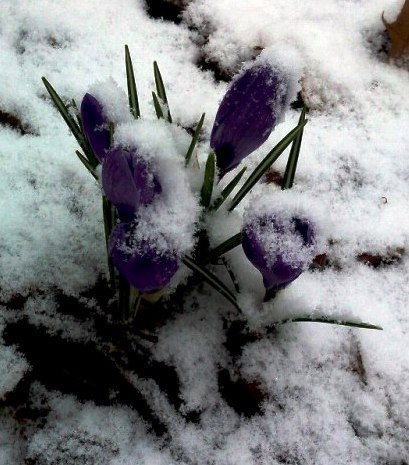
Crocus blooms under snow

Crocus blooms under snow

Instead of cutting off the feeling parts of ourselves, we can invite our whole selves to help dream the new story.

What story shall we create?

On Earth Day and Every Day

“The eyes of the future are looking back at us and they are praying for us to see beyond our own time. They are kneeling with clasped hands that we might act with restraint, leaving room for the life that is destined to come.

We have it within our power to create merciful acts.”

— naturalist and author Terry Tempest Williams

Cheselden_t36_prayer(Thanks to Orion Kriegman of Jamaica Plain New Economy Transition for bringing this quote by one of my favorite authors to my attention.)

In Troubled Times

This morning when I looked out my front window, I saw that the juneberry we planted two years ago was budding. Through the rain I could see the sketch of pale green buds dotting each limb, all the way out to the tips–with the promise of sweet berries contained in each one.

Buds that will open into a white blossom, eventually fruiting into delicious berries

Buds that will open into a white blossom, eventually fruiting into delicious berries

The young tree has made it through two of the hottest summers on record, and those tender buds gave my heavy heart a lift.

We planted it because we wanted to grow fruit on our lot, and we nurtured it with weekly waterings through crippling drought and heat. When the rain barrel went dry, I carried buckets from indoors, saving shower water, cooking water, and the dehumidifier’s daily emptying–occasionally breaking down and stretching the hose across the lawn to let it run for a slow hour.

There’s a passage I like from Buddhist teacher Thich Nhat Hanh, called Interbeing. It begins:

“If you are a poet, you will see clearly that there is a cloud floating in this sheet of paper…”

My tree contains multitudes. It has the memory of picking juneberries with my dad a few years ago, before he got sick, before he died, in the forgotten pocket park wedged between two busy streets. There were three small trees just loaded with juicy wine-colored berries. Dad picked from the high branches and left me the low ones. When the low limbs were picked clean, he pulled the ends of the high branches down so I could reach.

Also part of my tree is Jason, the neighbor who helped dig the hole and position the root ball on planting day. And Jerome, the young man who brought it to us through his work with Keep Indianapolis Beautiful. This year Jerome has parlayed his passion for trees into his own business as a certified arborist, Tree-Centric Solutions–pledging to not only plant, treat, and prune trees, but find uses for wood from trees that can’t be saved.

My juneberry even holds the “woman tree,” an old redbud whose upreaching shape I cherished. I called her that because she always looked so feminine to me. The woman tree was just beyond where the juneberry is now, and she had to come down because half the branches were dead. Taking her out meant we freed up room for a fruiting tree.

Irony: I learned that redbud flowers are edible just after we had ours cut down. I could have decorated so many salads with the woman tree’s bounty. Not only that, but Jerome’s service came too late for her: What I wouldn’t give to have something made from the wood of that beloved redbud!

So all that’s in this juneberry too: my regrets, my ignorance, my wishing things were otherwise. But mostly, these are outshone by pride and hope.

I share all this because in troubled times, sometimes things like this can help: a small tree in the rain, holding memories and care, covered in promise.

The Shadow Side

Here’s a thought for a gorgeous spring day when the shovel is about as high-tech as I’d like to get.

© Phil Date | Dreamstime Stock Photos

© Phil Date | Dreamstime Stock Photos

For all the successes of Western civilization,
the world has paid a dear price in terms of the most crucial component of existence–
our human spirit.

The shadow side of high technology–

modern warfare
& thoughtless homicide and suicide,
urban blight,
ecological mayhem,
cataclysmic climate change,
polarization of economic resources–

is bad enough.

Much worse, our focus on exponential progress
in science and technology has left many of us

bereft

in the realm of meaning and joy, and of knowing
how our lives fit into the

grand scheme

of existence for all eternity.

From Proof of Heaven, by Eben Alexander

An Appeal Denied

Update: Community Access Television has posted a video of the April 3 Board of Zoning Appeals meeting. Minutes have not been posted on the BZA site yet.

Last night I met up with friends to drive to Bloomington, IN for a Board of Zoning Appeals meeting. We were among 80 others there championing permaculture designers/teachers Peter Bane and Keith Johnson, who were pursuing variances for their small suburban lot. Since last summer, they’ve been mired in a conflict with Monroe County, primarily about placement and square footage of structures at Renaissance Farm.

The main issue was that they didn’t follow proper procedures, but they were under the impression that agricultural buildings are exempt from the process. I won’t go into detail about the legalities as that’s not the purpose of my blog—but you can refer to the meeting materials.

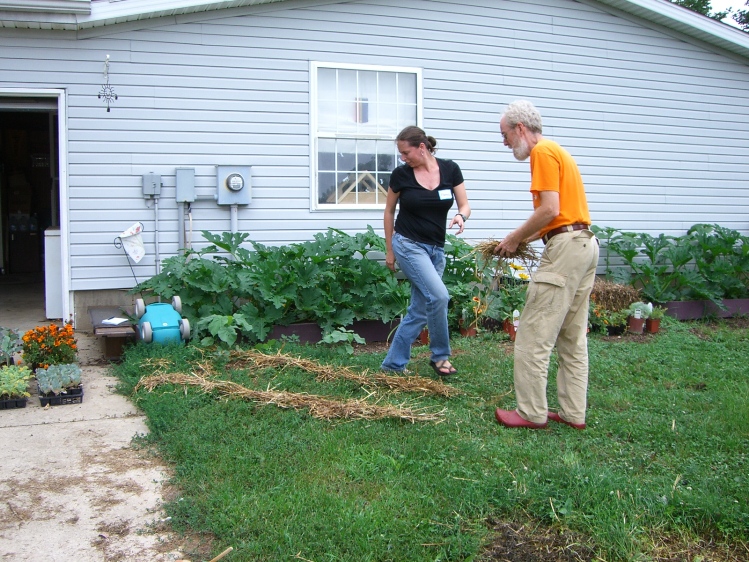
Peter Bane with co-teacher Rhonda Baird laying out a garden path during 2007 permaculture class

Peter Bane with co-teacher Rhonda Baird laying out a garden path, 2007 permaculture class

It was moving to hear the 30-plus testimonies of Peter and Keith’s impact. (I first met Peter in 2007 at a one-day permaculture overview class, and his passion infected me with the need to come right home and plant my entire lot in food.)

The intergenerational crowd was made up of neighbors, IU profs and grads, pastors, farmers, small business owners, a newspaper editor, a City Councilman, and young Bloomington natives who moved away and then returned, largely because they wanted to learn from these luminaries.

Neighbor after neighbor told of the duo’s generosity in sharing both knowledge and produce. Many have started gardening themselves. One said she travels all over the country; when she tells people she lives on the same street as these renowned Permaculture designers, “they are in awe.”

A sampling of comments:

“Everything they are doing is a practical and immediate way of changing the world for the better.”

“They are showing that young people can have a viable future in spite of the climatic, economic, environmental, and other issues facing us.”

“It’s beyond sustainable, it’s regenerative.”

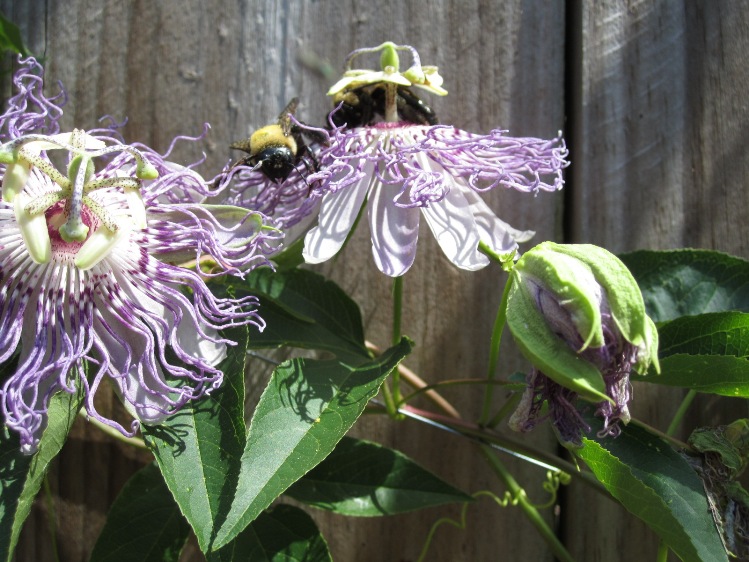
A maypop planted along our fence, one of many plantings inspired by permaculture

A maypop planted along our fence, one of many plantings inspired by Keith and Peter’s work

There seemed to be an understanding in the room, even among officials, that we are at a crossroads. One supporter told them, “I am sympathetic to you who must uphold laws that support suburban sprawl and ignore what the future requires of us.” Another said, “We are living in a world where the rules are changing.” Another warned that big timber, big ag, and mining will dominate rural areas if we don’t change our ways.

But apparently these are not the concerns of a body pledged to oversee existing laws, faulty as they are.

After four hours the board approved all but one variance—a critical one. The barn must be moved about 10 feet from its current position to be in compliance.

It was a shock. Especially after board member Jerry Pittsford, who expressed dismay that Peter and Keith had circumvented the process, had said, “I like rules, but I’m finding very little that tells me the rules need to be followed here.”

There were a number of reasons to approve the variance and only one to deny it—the fact that they did not consult with the county and submit the proper paperwork. Even as the board expressed admiration for Peter and Keith’s work, they could not get past that lapse.

It’s unclear what the next step is for Renaissance Farm, but whatever comes, I hope these two visionaries were bolstered by the outpouring of love and appreciation from neighbors, former students, and admirers.

Inspiration from Across the Pond

© Scott Patterson | Dreamstime Stock Photos

© Scott Patterson | Dreamstime Stock Photos

I just found out about a forthcoming book called Stories of the Great Turning, which features first-person accounts of Brits who are transforming their lives in inspiring ways. According to Vala Publishers:

“These are the stories of just a few people who decided to act, in their own lives, in response to the challenges of climate change and environmental degradation, and found their own way to make a difference. They are not stories about celebrities, environmental geeks or gurus but honest accounts from people who…’just got on with it.’

It is a book that takes the question, ‘What can I do?’ and sets out to find some answers using one of our species’ most vital skills: the ability to tell stories in which to spread knowledge, ideas, inspiration and hope.”

Kindred spirits if there ever were. And there’s a foreword by beloved eco-activist Joanna Macy, and I think you know how much I adore her. (“Now is the time to clothe ourselves in our true authority.” –from the Foreword.)

I’m invited to the book launch next month. Exciting! It’s in Bristol, England, so I won’t be there, but still!

A Whole New Earth

Nuvo Newsweekly has published my piece responding to Barbara Kingsolver’s novel Flight Behavior.

“It’s an elegy to the beauty of the familiar world, the world that is soon to be a thing of the past. Kingsolver invites us to begin the process of grieving, embodying that lost beauty in the form of the monarch butterfly…”

© Cinc212 | Dreamstime Stock Photos

© Cinc212 | Dreamstime Stock Photos

Indy-area folks can pick up Nuvo for free, or you can read the rest of the article here.

Have you read the book? What was your response?

What is Community Resilience?

So what do we mean by community resilience, anyway? There are several ways of looking at it.

© Egidijus Mika | Dreamstime Stock Photos

© Egidijus Mika | Dreamstime Stock Photos

1. Community resilience means taking a do-it-with-others (DIWO) response to these threats:

  • global warming
  • food insecurity
  • the end of cheap oil, or “peak oil”
  • economic distress

2. Community resilience is the ability to:

3. Community resilience requires:

4. Resilience differs from sustainability because it presupposes:

5. Resilience and resourcefulness are Siamese twins. The question to ask is, “How do you turn yourself into the resource you need at all times?” –Diop Adisa from KI EcoCenter

6. (Joke) Resilience is code for “we’re screwed.” —Apocadoc Jim Poyser, editor of Indiana Living Green*

*This is actually the PG-rated version of Jim’s definition.

What is your preferred definition of community resilience? And how does your community stack up?