Living Proof

Yesterday at Rivoli Park Labyrinth, I met up with a riotous party of plants, insects, and birds.

The park, which formed on a vacant lot thanks to community organizer Lisa Boyles, has gotten overgrown this rainy summer—but it is also a haven for life.
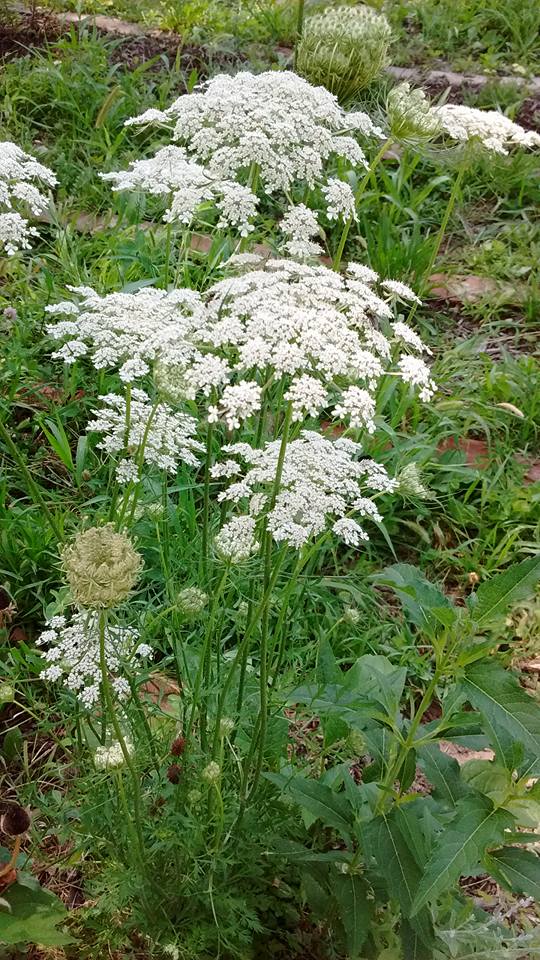
"Queen Anne’s Lace provides beneficial nectar to insects during this dry part of the summer when they don’t have many options. Caterpillars of the Eastern Black Swallowtail butterfly eat the leaves, bees and other insects drink the nectar, and predatory insects, such as the Green Lacewing, come to Queen Anne’s Lace to attack prey, such as aphids" according to Chiot's Run. (Click photo for more.)

“Queen Anne’s Lace provides beneficial nectar to insects… Caterpillars of the Eastern Black Swallowtail butterfly eat the leaves… and predatory insects come to Queen Anne’s Lace to attack prey,” according to Chiot’s Run. (Click photo for more.)

Some plants we call weeds and others we call ornamentals. Some we consider natives, wildflowers, edibles, or another elevated status. Some we designate as invasive, others as desirable.

What I realized yesterday: These divisions are more important to humans than the rest of nature, which seeks its own balance.

The plants called “weeds” are the ones we pull out. Still, the grasshoppers, bees, and spiders find food and shelter on plants of all stripes. They are the epitome of nonjudgment, our guides in an insectile anti-labeling initiative.
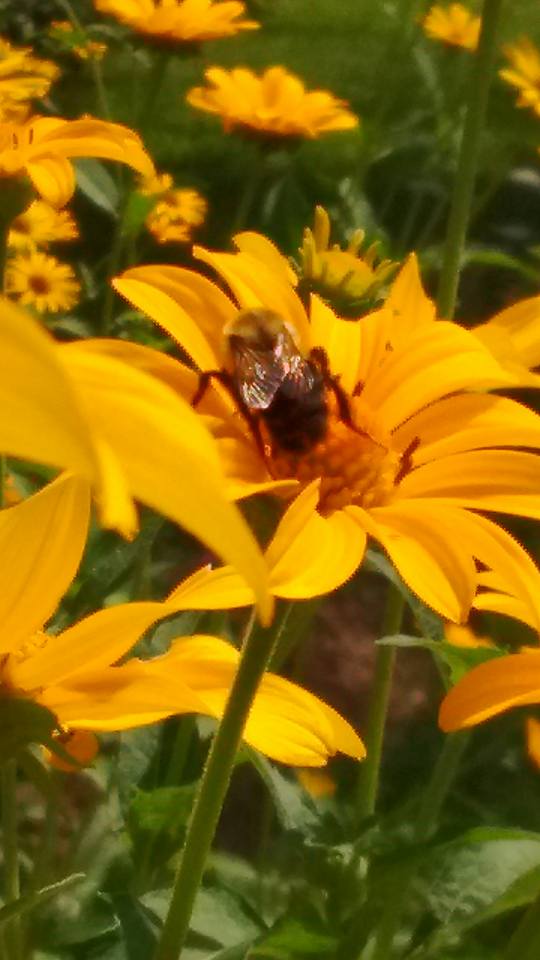
Friendly pollinator

Friendly pollinator

So often I am quick to judge something good or bad.

Just now I went to strike that sentence, gauging it too trite! As testament to my new commitment to allowing things to be messy and imperfect, I am leaving it there.

Lisa and I talked about this very thing: In my writing, I declared my intent to finish my book while letting go of the need for it to be “perfect, balanced, and comprehensive.” Lisa swept her arm toward the “weedy” labyrinth and said, “Here’s living proof that a project doesn’t have to be perfect—just look at it!”

What I saw: voluptuous plants abuzz with happy pollinators. Abundant living entities in ongoing conversation, all encircling the glorious hibiscus at the center. The idea of perfection doesn’t really apply when we’re partnering with life, does it? So it can be with writing.

I told Lisa that the labyrinth didn’t have to reach some ideal in order to be a marvelous contribution to the community. Uh, hello. Maybe I should write that down and stick it on my computer monitor.

Repeat after me: We don’t have to reach some ideal in order to be a marvelous contribution!

Transition and Transformation

Every writer should have a worm colony to eat her spent words. Especially if she’s grieving the loss of her beloved dog.

His name was Marley. We named him after the great Bob Marley. This was before "Marley and Me."

His name was Marley. We named him after the great Bob Marley. (This was before “Marley and Me.”)

I feed my drafts to the shredder when they’ve served their purpose. The shredder cross-cuts everything into bits the width of a highlighter’s stroke, the length of the tiniest paperclip. When the receptacle is full, I shower this ticker tape parade over one of four worm farms I’ve got going right now.

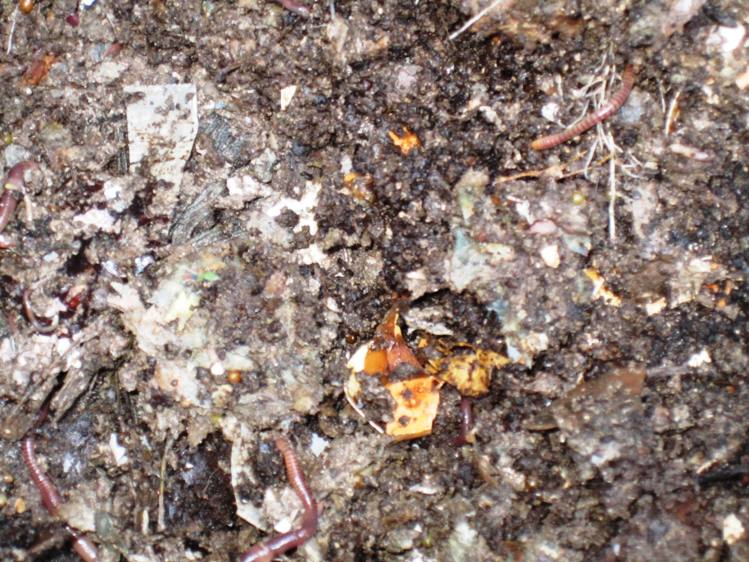
Worm pit after ticker tape parade

Worm pit after ticker tape parade, with rainwater.

Are they actually eating my words or are they just nesting there, my happy, scrappy red wigglers, snug in moist paper and a bit of soil and leaves? With rotting vegetable parings for their buffet.

I wrote once long ago, or stole the idea, of everything in a writer’s life becoming compost. “It’s all material,” an early writing teacher told me. Now even my stilted phrases and test drafts and failed pieces have become compost.

I’m feeding the worms that in turn offer their pooped-out product to nourish my soil—soil in which we grow the food that feeds the writer who makes the words that shelter the worms. A closed loop.

Also in the worm bins? Junk mail, that clutters my desk until I go on a shredding rampage. Cardboard toilet paper rolls chopped into bits. Tea leaves from my tea ball. Shed leaves from houseplants. Newspapers. Anything else I can think of: Q tips, napkins, toothpicks, and other rarely used ephemera.

Also: Mats cut from the cat’s britches, tangled there over weeks of neglect while I worried over her brother, the dog. Tissues loaded with my snot and tears, from meltdowns over that same dog’s decline.

Moistened with rainwater, it all melts together into the special kind of slop that worms (I’m told) adore—sweetened with handfuls of veggie scraps and stale crackers and the like.

Worms at work

Worms at work

The dog died; the worms and time work together to turn something lost into something gained.

Sweet dreams, friend.

Sweet dreams, friend.

An Unexpected Gift

Yesterday, Father’s Day, brought me an unexpected gift. A neighbor messaged me late in the evening offering just-picked raspberries. Would we like some? Of course! “Check on your porch by the mailbox,” she messaged a few minutes later.

My dessert: raspberries, kefir, vanilla, toasted sunflower seeds.

How was she to know that red raspberries would bring me a direct connection with my Dad, who grew them up until the year he died? His overabundance was always my gain. Even the container they came in, a repurposed plastic food tub, evoked his (and Mom’s) habit of reusing everything.

They're half gone already, because I had some for breakfast too!

They’re half gone already, because I had some for breakfast too.

A friend tells me this morning, Surely that was a gift straight from your father.

I miss him. On Friday I received a quilt specially made from a few of the T shirts he used to wear. Yesterday morning I put my cheek against that “Seize the Carp” square and imagined his heart beating under the fabric.

Many thanks to Helen Ryan-King for making this for me.

Many thanks to Helen Ryan-King for making this for me.

No one else will ever love me the way he loved me, a friend wrote, on losing her own dad.

A statement true and sad.

So many of us walk around with broken hearts. I think of the Buddhist story of the woman mad with grief after the death of her only child. The Buddha offers to bring the child back, but only if she can find a mustard seed from a house untouched by death.

She searches house to house. Here someone has lost a parent, there a child, there a beloved brother, there a cherished friend. She comes back and tells the Buddha, I couldn’t find anyone untouched by loss.

She lets the child go.

Knowing we all share this human experience, I want to open to the love that is available all around me, in so many forms.

A couple I know slightly from down the street, seeing me standing on my bike in the bike lane, slow their car to check on me: “You OK?” (Just waiting for a break in traffic to make a dicey turn—but it touches me to hear their concern.)

A cat named Morty, leery of everyone but his deceased owner, finds me on my front step. Rubs against my knee, beaks my nose with his. Hello, new friend.

A concert of singing bowls, vibrating with tabla, flute, and didgeridoo, offers me a place to rest in All That Is.

What I want to say is this: May my broken heart be of service. May I remember that this brokenness is something we all share. May our connection help to heal a broken world.

And Now for Something Completely Different

I don’t very often blog about my personal writing project(s), but the terrific nature writer Katherine Hauswirth nominated me for a “blog hop” (writers sharing about their work). So, bear with me as I answer a few questions…

What is the working title of your book (or story)?
Thrivalists: Reimagining the World in an Age of Crisis is the working title of the nonfiction book I’m currently “shopping.” It’s in research/pitching phase, and in the meantime I’ve started work on another project, as yet untitled. Also, some of my articles and essays are linked here.

Where did the idea come from for these books?
Thrivalists came about when I realized how little media attention goes to the people who are pulling together to make a major shift on our planet. I’m so inspired by the community resilience movement and all its permutations. My goal with the book is to shine a light on folks working toward greater ecological/economic/social balance. (Secondary goal and total bonus: to get to rub elbows with fun people and learn all kinds of mad skillz.)

A sister volunteer/learner at an Olympia Mycelial Network project in Washington State

A sister volunteer/learner at an Olympia Mycelial Network project in Washington State

The second project is a work of creative nonfiction exploring my 15-year recovery from fibromyalgia, culminating in emergence of my own healing abilities. Part of my inspiration came from Seven Steeples Farm, where I’m helping to grow produce right where an 1880s-era women’s mental institution once stood.

What genre do your books fall under?
Creative nonfiction, tending toward memoir on the new project. Thrivalists is closer to immersion journalism, still with an element of memoir, and the book would be shelved under Green Living/Activism.

Which actors would you choose to play your characters in a movie rendition?
I’m thinking Julianne Moore could play this Mudgirl, but that’s as far as I’ve gotten on that question!

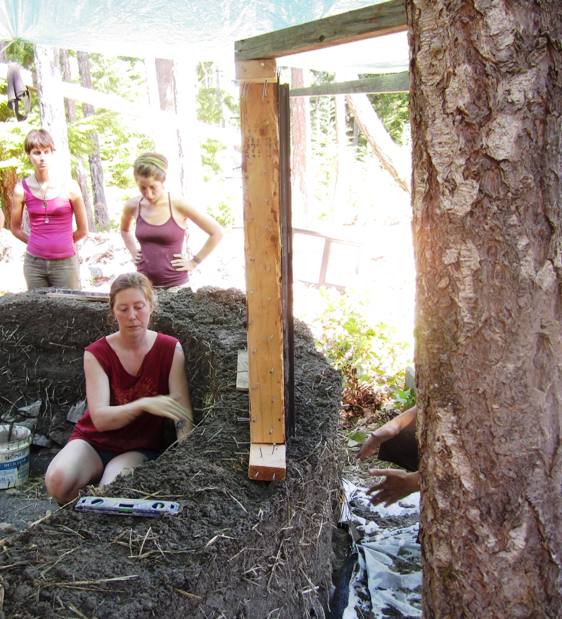
Rose (inside wall) facilitates a Mudgirls workshop.

Rose (inside wall) facilitates a Mudgirls workshop.

What is the one-sentence synopsis of your book?
Oof. Can I buy a sentence?

During a season of tending crops at Seven Steeples Farm, where the tomatoes and peas grow from ground that once held a 19th century mental institution for women, Shawndra Miller explores the turn in her own life from a 15-year bout with a debilitating mind/body ailment. While working the land she reflects on a wider societal transformation embodied by Seven Steeples, where something new is growing on the shell of the old.

Will your book(s) be self-published or represented by an agency?
I’m open at this point. My book proposal for Thrivalists has been making the rounds of agents and small presses. Meanwhile, I’m enjoying the process of discovery on the new project, while continuing to explore and highlight the community resilience movement.

How long did it take you to write the first draft of your manuscript?
The original Thrivalists book proposal, with a couple sample chapters, took about six months, but I keep adding to it as I travel and research, so it’s a moving target. The new one is still very young.

What other books would you compare this story to within your genre?
Thrivalists is a bit like Omnivore’s Dilemma in the way that the author’s process of research and discovery pulls the reader along. In subject matter, it’s close to Walk Out Walk On: A Learning Journey into Communities Daring to Live the Future Now by Margaret Wheatley and Deborah Frieze.

It’s hard to say on the new project since it needs more time to bake, but it might be compared to When Women Were Birds by Terry Tempest Williams.

Who or what inspired you to write this book?
I’m inspired by Charles Eisenstein’s work, in particular The More Beautiful World Our Hearts Know Is Possible. Without a massive consciousness shift, no amount of environmental activism or social change work will alter the bottom line of a culture built on dominance, control, and fear. That’s part of what I want to explore in the new project.

Thanks to Katherine Hauswirth for tagging me with this assignment! I nominate Julie Stewart, writer-and-farmer-in-residence at Urban Plot, to do the next blog hop.

The Urban Forest

Holly Jones grew up considering trees as relatives. A Native American (“though I might not look like it!”) she sees the world populated with winged people, creeping people, branching people. “A lot of different people are considered sacred in my circle.”

As director of the Indiana Urban Forest Council, she brings that sense of interconnection to her advocacy.

Holly spoke to a group of treehuggers in my neighborhood this week at the Irvington Green Hour.

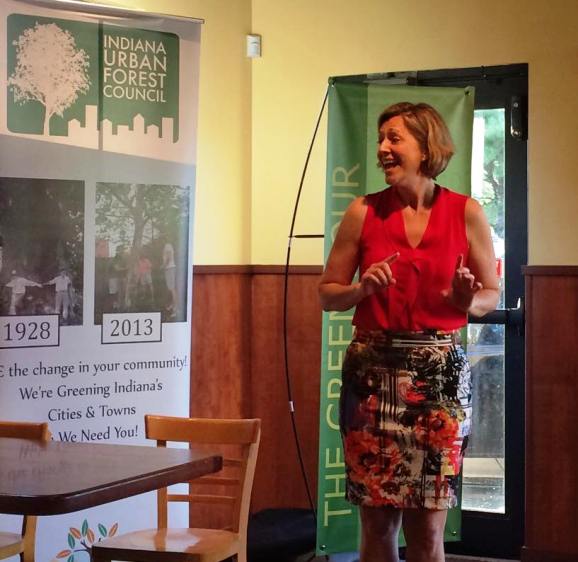
Holly Jones at the Indiana Urban Tree Council

Holly Jones at the Indiana Urban Tree Council. Photo by Jeff Echols.

She asked us to consider the sounds we might take for granted, the chickadee’s call and other songs of the urban forest. “These sounds are a part of you whether you realize it or not,” she said. “And these sounds are quietly going away.”

With landscapes devoted to specimen plants that hail from a completely different part of the world, it’s no wonder that native species are struggling. Jones said a turnaround will require a different mentality than purchasing random flowering plants from the big box store. Choosing native plants is the only way to feed and shelter the insects and birds that evolved alongside them.

Basically, the foundation of life is in our hands, even we urbanites sitting here on our postage-stamp lots.

“If you want to see life happen, and magic happen, that takes time,” she said, telling the story of planting her first rain garden. As the plants matured, her sense of wonder expanded beyond expectation. “I had to go out and get new guide books! There were so many new species I’d never seen before.”

Holly told us that trees offer their biggest bloom when they’re dying. Some might point to the prolific blooms and deny that a tree’s under stress (from climate change, insect infestation, or pollution) but that’s not the case. “That tree’s giving it all she’s got. She’s saying, ‘It’s my last chance to get my seed out there.’”

In a state where 98 percent of our forests are gone, caring for the remaining trees is essential. Street trees give back 600 times what we invest, with the biggest return coming after the first 10 years.

Average lifespan of a street tree? Seven years.

There are ways to cost-calculate a tree’s service to humans. My streetside sycamore, according to the National Tree Benefit Calculator, will do all this in 2015:

  • intercept 2,015 gallons of stormwater runoff
  • raise the property value by $47
  • conserve 55 Kilowatt / hours of electricity for cooling
  • absorb pollutants through its leaves, while releasing oxygen
  • reduce atmospheric carbon by 299 pounds

According to the model, this adds up to $68 in annual benefits provided by my 11-inch diameter sycamore.

By Jakec, via Wikimedia Commons

Photo by Jakec, via Wikimedia Commons

Considering that the tree is 40-plus years old, according to this site, that’s a significant dollar amount over its lifespan.

This is all great information for people who need numbers to support a pro-tree position. And it’s not even counting some of the benefits Holly spoke of at the Green Hour. Higher percentage tree canopies correlate to greater health, better school grades, improved sense of community, and more.

To my mind, though, the unquantifiable might be the most powerful thing of all. Trees are wise, restful, gracious spirits. They root deep and stretch high, giving them access to information we humans are not privy to. This sycamore’s presence in my life is a gift.

And that’s just one tree among the urban forest that I love so much.

Want to take action? For locals, here are some ideas:

The Miracle of Seeds

I’ve been thinking about how tenacious life is, encapsulated in a tiny seed. Some seeds I plant, but others sprout all on their own.

I’m probably the only person on my block who gives a cheer when she sees these coming up.

Lamb's quarters

Lamb’s quarters

These are lamb’s quarters, considered a weed, but deliberately planted two years ago in my garden. This is the second year they will have reseeded, and I can’t wait to taste them again when they get a little bigger. (They’re terrific fried crispy in my cast-iron skillet, with a couple eggs cracked over them. And incredibly energizing, as all edible weeds are.)

Here is part of another patch of self-sowing plants that are on their third (or fourth?) year of growing freely in my garden: arugula.

Arugula volunteers in leaf mulch

Arugula “volunteers” in leaf mulch

I wasn’t sure they would come up this year because I mulched so heavily last fall with shredded leaves. But lo: I pull away the top layer and find them rooted right in the leaf mold.

Miracles like these show up all the time, if we know to look.

“There is no way to re-enchant our lives in a disenchanted culture except by becoming renegades from that culture and planting the seeds for a new one.”

Thomas Moore, author and psychotherapist

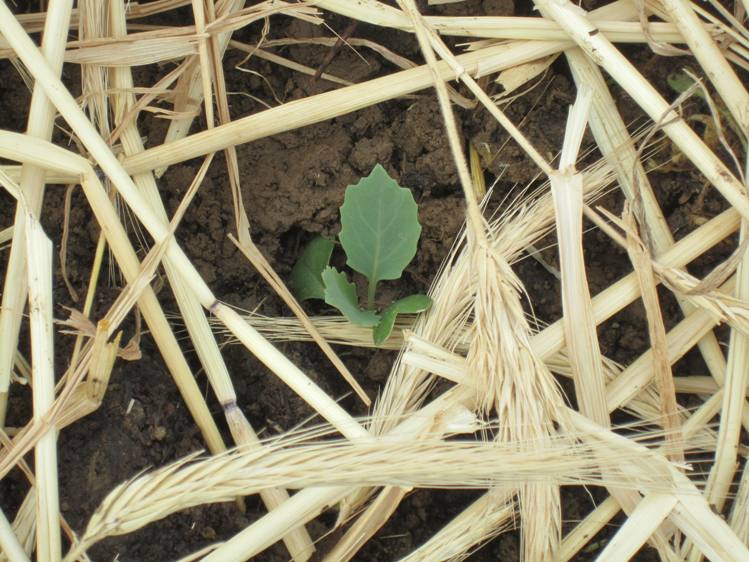
Perhaps growing food for people in need would fall under this “renegade” notion? Here is a seedling started by a southern Indiana farmer and planted by a volunteer for the Hoosier Hills Food Bank.

Cabbage seedling planted by a volunteer at a food bank garden

Cabbage seedling planted by a volunteer at a food bank garden

And one more: Late last fall I blogged about starting Austrian winter peas and my happiness at their growth in cold weather. They are generally not grown for a pea harvest, but intended as a cover crop with benefits—pea shoots are sweet and tender.

They didn’t do much during the winter, but this spring they are the healthiest of plants in my garden. I have snipped them nearly every day as salad and smoothie additions, and they are growing as fast as I can cut!

Austrian winter peas in spring

Austrian winter peas in spring

With seeds on my mind, no wonder this statement in a new mother’s Facebook post snagged my attention:

“I did not know until I got pregnant that the first organ to develop is the heart. It’s as if a heart seed gets planted and from the heart grows the human.”

Laura Henderson, founder of Growing Places Indy

Miraculous.

“What the World Needs”

I can always tell when I’m overloaded with the news; that’s when I start to despair. So much mess to clean up. It seems ridiculously tangled-up and tiresome, painful to look at.

In my own state we are attempting to disentangle from newly passed legislation designed to show my GLBT brothers and sisters that we are not welcome. Elsewhere, of course, there’s worse news. In Kenya suicide bombers caused untold anguish. In California the drought is now so severe that the governor mandated water restrictions. Then there’s the German pilot who decided to fly a planeful of people into the side of a mountain. For what?

Time to turn off NPR. When I get overwhelmed, this timeless advice from theologian Howard Thurman is a comfort:

“Don’t ask yourself what the world needs. Ask yourself what makes you come alive and then go do that. Because what the world needs is people who have come alive.”

By psyberartist (amaryllis  Uploaded by russavia) via Wikimedia Commons

By psyberartist (amaryllis Uploaded by russavia) via Wikimedia Commons

Definitely the needs of the world are bottomless, and the conflicts seem never-ending. So this question is a good barometer, an antidote to paralysis: What renews my heart? For me it is things like making meaning, being of service in small ways, reflecting, putting some hard-won learnings to use for others.

Sometimes, though, all that seems ever so small, and the question becomes: How do we renew ourselves, in this season of renewal, to continue with our chosen work?

Then a member of my extended family gives me a tremendous gift. She tells me that she regularly shares my reflections with her four teenagers. Some years back when I coauthored a book called Sudden Spirit: A Book of Holy Moments, she started the tradition of reading aloud from this work and discussing it with her children. Now that the kids are older, she’ll print thought-provoking blog posts and passages (mine among them) and ask them to initial when they’ve read them.

You can bet I was touched when I heard that! (And maybe she had told me before but I forgot; sometimes it’s hard for me to receive stuff like this.)

Knowing this totally refuels me. Because so much of what I do is basically invisible, it’s hard to know what kind of impact I’m having. But apparently, my little musings are helping the next generation of leaders.

Note to self: Remember to tell people I appreciate their work! (I think I’ll start with Roy Ballard and Michael Morrow, the men behind Hoosier Harvest Market. This online virtual farmers market brings me lovely salad greens, eggs, quail eggs, apples and so on—all locally grown and delivered to order to a business near my home.)

Because maybe it’s less a matter of renewing ourselves than renewing each other. Maybe then we can remember what exactly it is that makes us come alive, and have the courage to pursue it. Who in your life could use some of that fuel?

The Reimagining

Scott Russell Sanders, one of Indiana’s sagest voices for social and ecological justice, led a workshop Sunday called Writing While the World Burns.* His books, from Writing from the Center to A Conservationist Manifesto, have inspired me and countless other readers.

Before I even read the workshop description, I knew I needed to be there.

Untitled

I wasn’t disappointed. Scott has a generosity, thoughtfulness, and grace about him that may be a product of his years, or perhaps he’s just built that way. He brought together a disparate group of deeply passionate people and got us talking about where our work and lives fit into the bigger picture.

I know I’ve been on a bit of a Wendell Berry kick of late, but Scott’s the one who gave a Berry quote as context for that exercise:

“The significance—and ultimately the quality—of the work we do is determined by our understanding of the story in which we are taking part.”

Where do we fit? What is our important piece of the puzzle?

In my case, my larger story has to do with lighting the Lights—spreading the word about the tremendous work being done on so many fronts. And not only that, but being a Light, in my own small way.

Earth Hour moment at home - Córdoba Argentina

In fact, “story” is an apt word, because I see all of these efforts as a grand transition to the Story of Reunion (in Charles Eisenstein’s words)—leaving the defunct Story of Separation behind.

As writers, Scott told us, (and as teachers, artists, visionaries, and the like) we enlarge people’s vision of what’s possible. We write a new language that can supplant that tired old ethic of economic gain at any cost. We expand people’s understanding of humanity by sharing our knowledge of those they might consider “other.”

In short, we reimagine the world, and invite others to join us.

*Many thanks to the Indiana Writers Center for offering this tremendous workshop.

Love Where You Live

I asked for a magnifying glass in my Christmas stocking this year. I’d just read Lyanda Lynn Haupt’s excellent book Crow Planet, in which she advocates becoming a “citizen naturalist.” I aspire to that: to take the time to look closely at nature, right here in the urban habitat. (She takes up a similar theme in The Urban Bestiary, which I enjoyed just as much.)

I wish I’d had the magnifying glass with me the other day when I was walking my dog and spotted the first yellow crocuses popping up. I could have fallen on my knees in front of them. I love the beauty of winter, but after days on end of white/gray/black/brown, that splooch of color just about knocks me out.

Photo by Vincent de Groot, via Wikimedia Commons

Photo by Vincent de Groot, via Wikimedia Commons

Wendell Berry has written of the importance of “backing out of the future into the present, where we are alive, where we belong.” As we make this shift, he says, we also move our focus from an abstraction called “the environment” into the places where we actually live.

This makes sense. When I co-founded the Irvington Green Initiative some years back, we settled on the tagline “Love Where You Live.”

The notion was echoed by my friend Maggie Goeglein Hanna, executive director of Fall Creek Gardens Urban Growers Resource Center. In a recent conversation, she said:

“I feel like you can’t really expect people to care about the natural world if they have no investment in their own place … In my mind, environmental solutions aren’t going to come if we’re only concerned about the pandas in China or the rainforest in the Amazon. Those are important things, but so is our own place, and it won’t ever get better if we all don’t take care of our own place.”

She went on to say that organic gardening in a community setting, as at Fall Creek Gardens, is a way of “opening up the conversation.” Finding earthworms in ground that used to be compacted dirt, watching a family of mockingbirds, planting seeds—all of these root us in the soil that nurtures us.

So with spring officially just hours away (wahoo!) (at least in the northern hemisphere), I’m doing more than planning this year’s garden. I’m renewing my commitment to enjoying the place where I live, and to observing the creatures and plants that share it with me.

What about you: What does it mean to love where you live?

Wild Geese Wisdom

From Wendell Berry’s poem “The Wild Geese” comes this steadying stanza:

…And we pray, not
for new earth or heaven, but to be
quiet in heart, and in eye
clear. What we need is here.

I found his poem in a new essay collection called Sustainable Happiness, edited by the staff of Yes! Magazine. It reminded me of my introduction to the poet Mary Oliver, whose poem “Wild Geese” begins:

You do not have to be good.
You do not have to walk on your knees
for a hundred miles through the desert repenting.
You only have to let the soft animal of your body
love what it loves…

This was my first Mary Oliver experience years ago: having this poem recited just for me by my Rolfer while he worked the fascia of my feet to smithereens. (Rolfing is a super-intense type of bodywork that pairs well with poetry.)

I give you the lovely Mary Oliver, reading her poem.