A Sacred Act

“Healing the wounds of the earth and its people does not require saintliness or a political party, only gumption and persistence. it is not a liberal or a conservative activity; it is a sacred act. It is a massive enterprise undertaken by ordinary citizens everywhere…”

—Paul Hawken, in Blessed Unrest

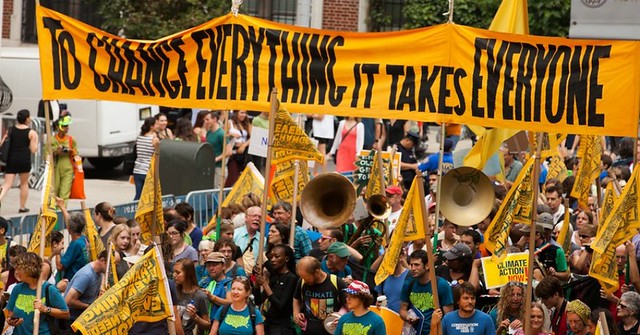
People's Climate March 2014 NYC
Some 400,000 people demonstrated for climate action in New York City last weekend. (A friend and I went to the youth-led Bloomington rally to help “raise the alarm” about climate change; the best part after the hooting and hollering was singing “We’ve got the whole world in our hands.”)

Stay tuned for a guest post from someone who joined the NYC demonstration.

Lighting a Candle

So much sadness, trauma, pain, anger, fear is showing up in the personal news of my friends and in the wider news of recent weeks. But  here is a prayer for all of us, a message from an intuitive who grew up in war-torn Lebanon:

“I am lighting a candle in my heart for everyone… everyone… everyone. My heart is ablaze. My tears of joy, tears of sadness, tears of humility, and tears of hope bring this burn to a sizzle…only to find out that these candles are magical…they never go out.

By Luca Casartelli (Own work) via Wikimedia Commons

By Luca Casartelli (Own work) via Wikimedia Commons

Remember those special birthday cake candles that could not be stopped? The ones you blow out and they light up again? Ah, I am relieved that the light of my heart is infinite and eternal… has no borders… and ripples, boundless.

Now that love is set to permanent, I can really do my magic.”

—Iva of Sophia Speaks

Building with the Mudgirls

I spent part of last week at a workshop offered by the Mudgirls, a natural building collective in British Columbia.

The Mudgirls strive to live lightly on the earth while sharing skills among themselves and the wider community. And when it comes to resilience, building shelter from earthen materials is about as serious as you can get. This is a group that embodies the reimagined world, and a powerful DIWO (do-it-with-others) spirit.

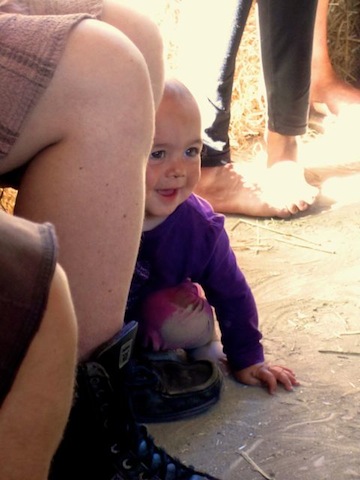
The Mudgirls do their work in child- and mother-friendly style.

The Mudgirls do their work in child- and mother-friendly style.

Collective member Rose hosted our workshop on cooperatively owned land on Denman Island. We camped in the forest by night and bartered our labor for instruction by day. About 15 others took part, bringing enthusiasm and good humor to the work.

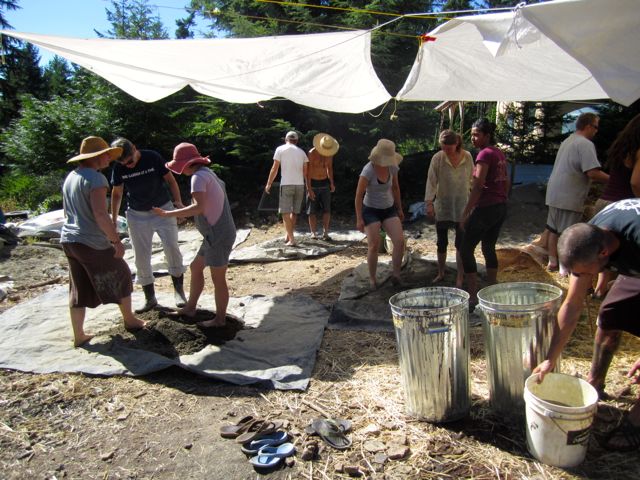
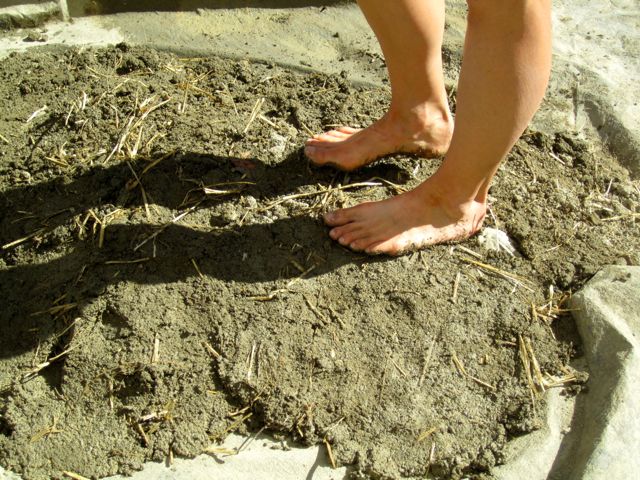
Some of our group making cob, a mix of clay, sand, straw, and water.

Some of our group making cob, a mix of clay, sand, straw, and water.

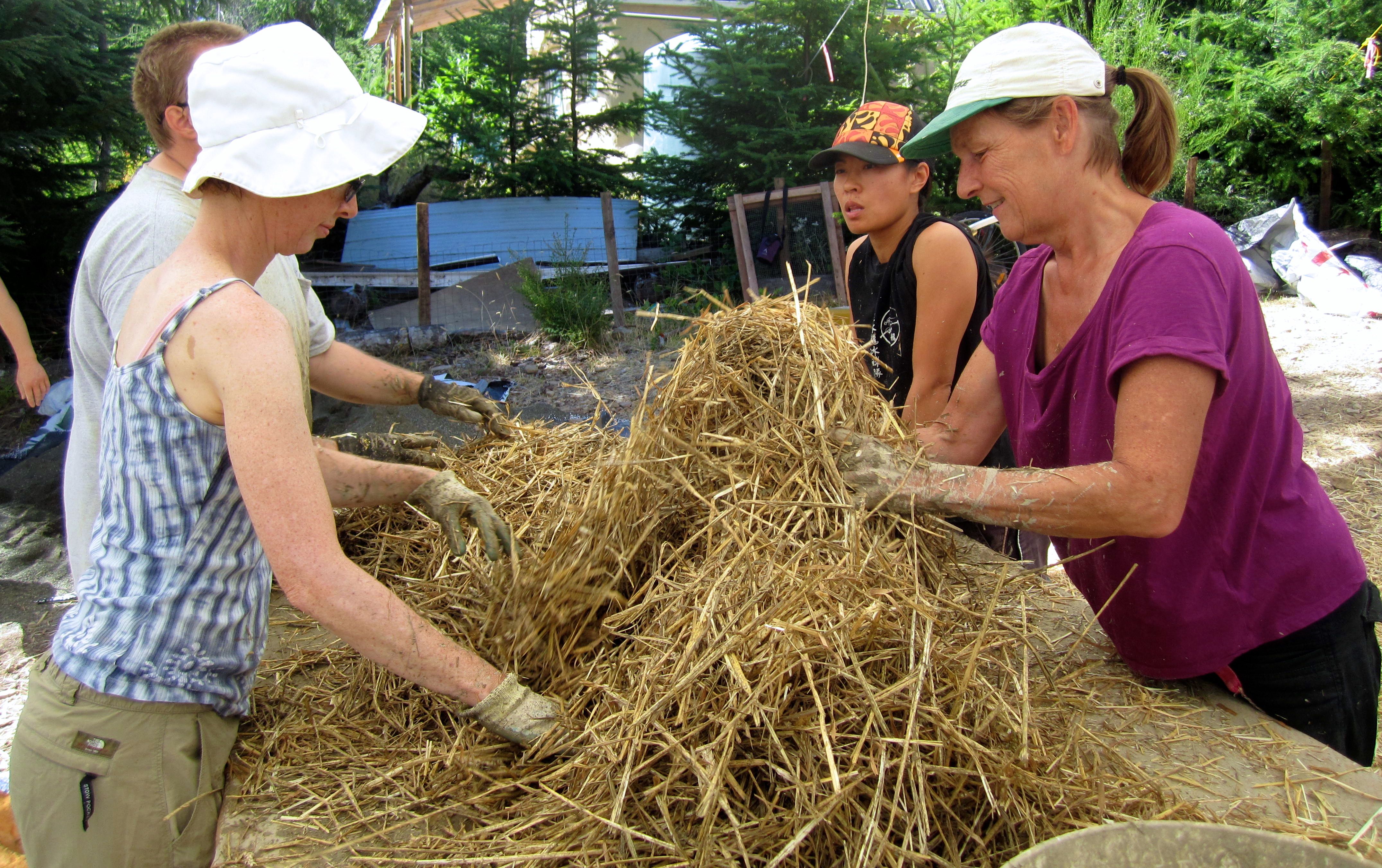
Rose is converting an existing structure on the land into a home for herself and her family. Using temporary plywood forms, we packed the walls with insulating material called slip straw. We made this insulation from straw and a clay-and-water slurry.

Making "slip straw" to insulate the walls. (Spot the pasty writer?)

Making “slip straw” to insulate the walls. (Spot the pasty writer?)

In a few weeks the walls will be dry enough to plaster.

house

House with slip straw insulation in the walls. The plywood is temporary, just to create a form to pack the slip straw in.

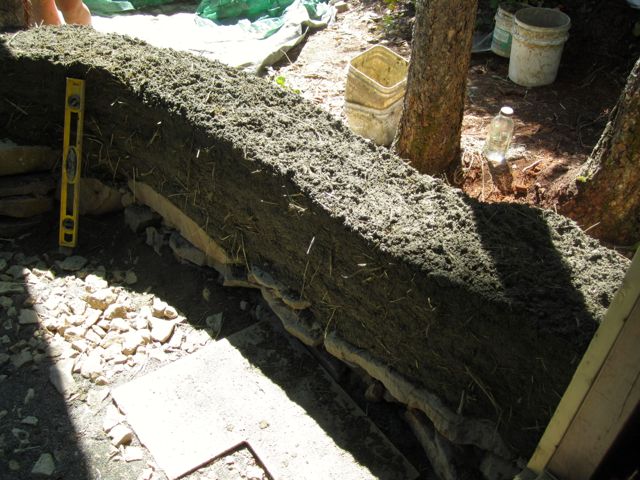
A hand-laid stone foundation forms the base for a cob-walled addition. (The team that worked on setting the stone found it a lesson in patience.)

Wall taking shape on top of the stone foundation

Wall taking shape on top of the stone foundation

We all helped mix the cob, which is a blend of clay, sand, and water, with a sprinkling of straw. While clay has compressive strength, it lacks tensile strength–the role of the straw. We learned that the straw has a similar job as rebar in concrete, adding internal structure to the dense material.

Mixing a batch of cob.

Mixing a batch of cob.

Building the wall was perhaps the most exciting task.

Building the wall

Building the wall

Some people made it look easy. But I’m still not sure the section I worked on could be called plumb!

Room addition taking form, with window.

Room addition taking form, with window.

I asked Molly, one of the Mudgirls who helped with instruction, how the Mudgirls mission fits into the broader picture of ecological and societal upheaval. Beyond  her passion for natural building, she told me, what excites her is the community that’s being nurtured.

Molly mixing clay slip with a giant eggbeater-type tool.

Molly mixing clay slip with a giant eggbeater-type tool.

The women of the collective have known each other for years and have a solid commitment to each other. They make decisions by consensus, taking the time to talk things out (though in recent years the talks are shorter as the big issues have been resolved). Members all know that they have each others’ best interest at heart, and each agrees to take responsibility for her own needs and desires.

Molly said that people who come to workshops often reconnect at later events, forming lasting friendships. So community extends beyond the core collective. She sees participants as pollinators, taking our inspiration beyond the islands of British Columbia.

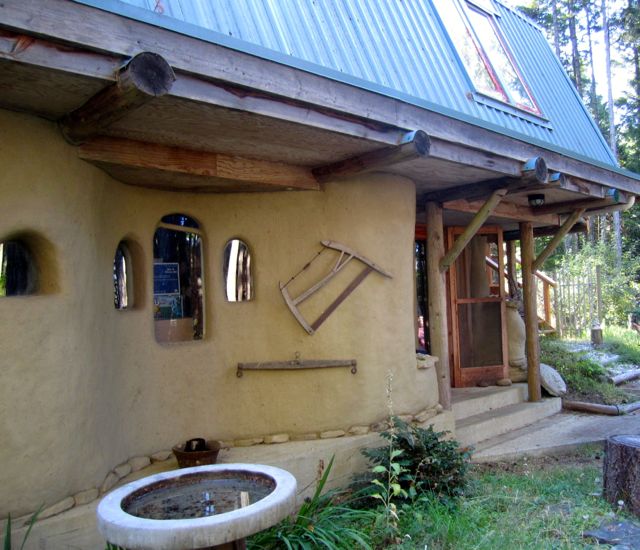
Example of a finished cob house (actually this one's a hybrid).

Example of a finished cob exterior.

For me the experience was all about the freedom to try something new. I had to grant myself compassion for the learning curve, and work on forgiving my body its frailties. The Mudgirls’ supportive environment made that possible.

And it was thrilling to help build an actual home. These hands that spend so much time on a keyboard are part of Rose’s homestead now.

Possible

Two quotes from Indian author and activist Arundhati Roy are on my mind tonight. First the disturbing.

“Either way, change will come. It could be bloody, or it could be beautiful. It depends on us.”

I don’t even have to look to the horrifying news out of the Middle East to find us awash in blood. Here in my town, last week two men pulled out guns to shoot each other for the unpardonable crime of bumping each other on the sidewalk.

It seems that people are less and less respectful of life, while the means to do harm are more and more lethal, efficient, and accessible. Where will it end?

And yet.

“Another world is not only possible, she is on her way. On a quiet day, I can hear her breathing.”

Yes, I hear her too. This is why I make a point, every day, to dwell in quiet.

Walking the Labyrinth on World Labyrinth Day in May.

Walking the Labyrinth on World Labyrinth Day in May.

Today I walked the Rivoli Park Labyrinth. I said an invocation before stepping in, and as I wound my way to the center, I imagined transformation happening. The breeze rearranging molecules, my porous body, which is really made of space and light and whirling particles.

I reached the stone at the center, and just as I sat down the sun broke through the clouds. I felt it warm my back.

I listened.

I said, thank you. And: may it be so.

Resilient Communities and People: How Yoga Can Help

Guest post by Gaynell Collier-Magar

Hi everyone! I am so honored to be a guest blogger on Shawndra’s amazing website. Shawndra is one of my Irvington Wellness Center yoga students. She has a beautiful, thoughtful practice, both on and off of the mat. She personifies how yoga can help with resiliency in life.

Yoga is a 5000-year-old tradition of practices (the Eight Limbs) to reduce suffering and still the mind. It is not a religion. However, the practices have been incorporated by many religions: Buddhism, Hinduism, and contemplative Christianity to name a few.

The physical practice or “asana” (“seat”) is meant to create resiliency in the body and mind to enable sitting in meditation for long periods of time. Unfortunately, in the West, the physical practice is often perceived as the path to buns of steel, pretzel poses, and very thin 20-something bodies.

The first lines of the Yoga Sutras state: “Now, the teachings of yoga. Yoga is to still the patternings of consciousness”. The Sutras explain how our habitual ways of thinking create suffering and how we can remedy this.

When we are reimagining a future for our communities, yoga could be a useful tool.

Photo by Jenny Spadafora

Photo by Jenny Spadafora, via Flickr Commons

So how does this happen? In the physical practice, it begins with being in the present moment—in the body and the breath. To get a feel for what I mean, try this:

Notice how you are sitting now. Are you slumping? Good…notice how you feel heavy in your body. Now, sit up straight, feel your bottom sitting in your chair, feel your feet on the floor, and lift your chest. Do you feel any lighter in your body? Slump again and notice. Sit up again and notice. Now close your eyes, put your hands on the tops of your thighs and take three deep, slow breaths. Focus on the exhale.

What was your mind doing? Chances are it wasn’t making a to-do list, obsessing about the person at work who drives you crazy, or yearning after a piece of chocolate. You begin to get a glimpse of the mind becoming more still—an experience that increases in depth and length with further practice.

The practice is to notice what is happening in the present moment, practice non-reaction, and return to the present moment. Neuroscience is showing that these practices literally re-wire the brain.

Two of the liabilities of community work are burnout and lack of fresh ideas. Our ego-driven “monkey mind” robs us of tremendous energy and creativity. As we engage in practices that still the mind, we create a mindspace in which to think outside the box—and the energy to act accordingly.

Photo by TZA, via Flickr Commons

Photo by TZA, via Flickr Commons

We also create a mind that is equanimous and unattached, yet deeply caring. We create a mind that is focused and in the present moment. We create a mind that is resilient.

It is not a leap of consciousness nor faith to realize how resilient minds can create resilient communities. The Buddha said, “All that we are is a result of what we have thought. The mind is everything. What we think we become.”

Gaynell has been a yoga practitioner for over 14 years. She was certified as a Vinyasa yoga instructor in 2009 by Rolf Gates and is a registered yoga teacher with Yoga Alliance. She is certified to teach adaptive yoga to people with physical disabilities, having studied with Matthew Sanford of Mind Body Solutions. She has taught Vinyasa, adaptive, and 12-step recovery yoga classes in Indianapolis and Cozumel, Mexico in Spanish and English. She holds a Bachelor’s Degree in Social Work and owns her own landscaping business, Growing Connection.

Join Gaynell and other terrific instructors at Shine Out Yoga Celebration, July 11-12 in Indianapolis, benefiting Mighty Lotus.
Evidence of the Shift

Final in a series

I’ve often written here about feeling overwhelmed, feeling helpless, feeling despairing. At times it seemed the news was all bad.

The Maldives, one of the island nations imperiled by rising seas. Photo by Nevit Dilman, via Wikimedia Commons.

The Maldives, one of the island nations imperiled by rising seas. Photo by Nevit Dilman, via Wikimedia Commons.

At times I feel besieged by evidence that we as a species are beyond hope. Sometimes all I hear is the lowest common denominator outshouting all reason. Sometimes all I see is fear feeding on fear, a downward spiral with no bottom.

Then along comes a hopeful story of human connection, small but significant.

Bethann was at the zoo with her daughter when she heard a man say, “You heard the one about the two Mexicans?” As it happens, Bethann has adopted two children who are not Caucasian. The man had his own young son with him. Bethann stepped up, with nervous heart, determined to make a difference.

Here’s the story in her own words:

“While at the zoo with Bo this morning, a guy with a toddler (loudly) told a joke that started with ‘How many Mexicans does it take…’ I found a moment when he was separated from his group and pointed to Bo and said ‘See that kid? She’s mine and she’s incredible. I can see you love your kid a lot. But, every time you tell one of those jokes, you teach your kid that it’s OK to treat my kid like crap. And, I am sure you don’t mean to teach your child to hurt others, but that is exactly what you just did there.’ He actually quietly said ‘I understand.’ God willing, there will be one more person on this earth who thinks before he teaches his kid to hate.”

Photo by Debbie L., via Flickr Commons

Photo by Debbie L., via Flickr Commons

How stunning that this man, instead of lashing out or being defensive, very quietly said, “I understand.”

To me this is evidence of the shift that Julia Bystrova of Transition US described, the widespread awakening that is already happening. I see it in the way Bethann stood in her center and spoke quietly but strongly to hold this man accountable. I see it in the way she allowed him room to hear her. I see it in his respectful and surprising response.

What evidence have you encountered of this kind of transformation? I’d love to hear your stories.

Confronting the Shadow

Second in a series

Consciousness shift is one thing, but what do we do about systemic ills?

I asked Julia Bystrova of Transition US about the governmental corruption holding us back from systemic policy-level changes—the big changes we are going to need, if we have a prayer of surviving the linked crises facing us. She had an interesting answer.

She pointed out that a healthy consciousness shift is already manifesting on the local level—witness sensible policy changes in cities all over the country. In LA, for example, a group called Tree People convinced their city that urban forestry is key to watershed management.

Photo by Lida, via Flickr Commons.

Photo by Lida, via Flickr Commons.

More than 1000 mayors have endorsed the US Conference of Mayors Climate Protection Agreement, vowing to reduce carbon emissions in their cities below 1990 levels, in line with the Kyoto Protocol.

And my own city, right smack in the middle of the stolid Midwest, shows some movement. This year we are gaining both a bike share and an electric car share program.

But beyond the local level where we can see real change happening, the picture looks bleak. As Julia put it, much of our larger governmental machine was “hijacked by corporate pirates.” These titans are not interested in seeing communities flourish on a local scale—not when there are profits to be had.

Greed and control are their modus operandi. Their greed is so extreme that they are willingly sacrificing people’s lives. And they’re deliberately sacrificing the life of the planet.

“That’s what we’re up against,” Julia told me. “We’re up against this darkness. It’s very classic, very mythological…It’s like this classic tale (that) I believe we are living out.”

But spiritually awake people can shine a light on the collective shadow. That’s what these madmen, as Julia calls them, represent: our collective shadow. It’s up to us to gain the maturity to stand our ground, in love and compassion, in the presence of this darkness.

In psychological work, the shadow is the unacknowledged, hated part of ourselves that rules our behavior—unless we turn toward it with love.

It’s time to look at such perpetrators in the face, with full awareness, unafraid.

Rebirth, by Jason Samfield, via Flickr Commons.

Rebirth, by Jason Samfield, via Flickr Commons.

Julia believes that more and more of us are reaching this level of awakening. If we confront them from a high level of integrity, institutions entrenched in corrupt power will crumble.

Again, a powerful vision to hold.

Next: Evidence of the shift.

Inner Transition As Key to Collective Work

First in a series of three

In my last post I suggested that an internal shift is as critical as the external changes we so desperately need. I’d like to explore that idea further in this series.

While in California last fall I had a conversation with Julia Bystrova, who was developing a series of “inner transition” tools with Transition US.

The Transition movement is a worldwide push to bring communities into a relocalized post-oil economy. The idea is to reduce consumption and embrace local energy, while building food security and resilience.

Transition Linithgow. Photo by John Lord, via Flickr Commons.

Transition Linithgow. Photo by John Lord, via Flickr Commons.

Julia told me that this movement suffers from a particular conflict: Some people want to jump right in and work on projects, while others prioritize the internal transformation process. The first camp gets impatient with the second, which has often been marginalized. Working groups often struggle to collaborate effectively, caught up in conflicts and divisions.

The solution is to give “inner tools” their due, Julia says. Both external output and internal process are valid. And as Julia says, the external is a mirror of the internal. “There needs to be group process that accepts both in a way that is complementary, because we need both.”

Mapping the Transition. Photo by Chris Hill

Mapping the Transition. Photo by Chris Hill, via Flickr Commons.

I tend to agree, having been involved in some groups that struggle to find cohesiveness. Group dynamics are tricky. To my mind, conflict is likely to persist until we each are willing to be present to our own emotional states.

If we walk through life largely unconscious of what triggers our pain, we’ll always be in a reactive mode. People push our buttons, we react, and conflicts escalate, all because we can’t take look honestly at the storms raging within us.

And it’s crucial that we find a way to work together.

Julia Bystrova and author Mary Pipher both say that we are all doing important work now. Even if we think we’re removed from the front lines, we’re not. Because the central task of our time is just that: working toward a healthier ecosystem and a just economy.

Julia believes that societal transformation can happen fast. She envisions a cascade effect that will be breathtaking in its global reach.

She told me that a certain threshold of consciousness is already on its way. With each of us lighting the spark of countless others, Julia believes we will see the world transformed.

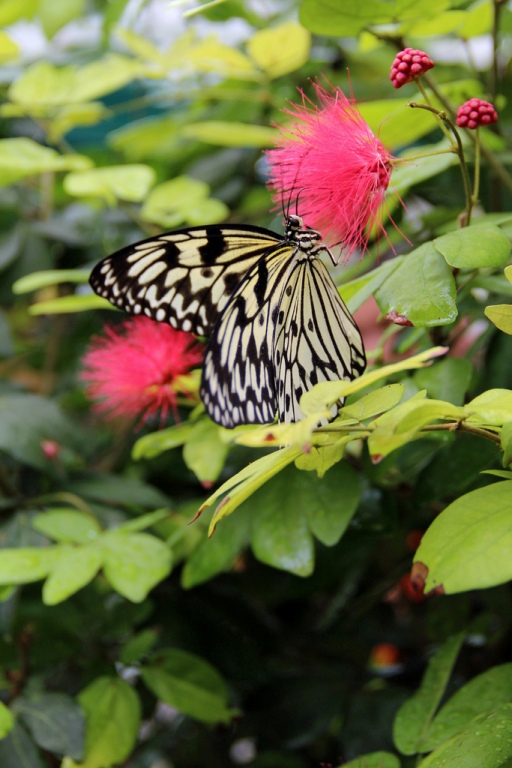
Swallowtail. Photo by Heidi Unger.

Swallowtail. Photo by Heidi Unger.

Mary Pipher also expects widespread transformation. As people open to their deepest feelings about the state of the world, she says a shift in consciousness is inevitable. All those awakening hearts will simply mandate deep change.

So much of the news we hear is bad. In some parts of the world, it’s possible for a woman to be stoned to death, or for schoolgirls to be abducted en masse, while here at home mass shootings no longer arouse outrage. Meanwhile an island nation is projected to be entirely underwater by 2020 as Antarctic shrinks. Monarch butterflies are reaching Mexico in drastically reduced numbers—part of “the sixth extinction.

Stories like these can swamp me in despair. But these women’s vision of transformation holds the antidote to hopelessness.

Next: Confronting the shadow.

Yoga: Leading with the Heart

I’ve practiced yoga for many years, starting in my 20s. My practice fell off in my 30s, around the time my health went wonky. For a long stretch, whenever I attended a class or practiced at home, the result was exhaustion and pain.

But in the last several years I’ve come back to yoga as I’ve rebuilt my health. Now I see my weekly Irvington Wellness Center class with Gaynell Collier-Magar as one of the pillars of my spiritual and physical self-care regimen.

Photo by Lyn Talley, via flickr Commons

Not a picture from our class. Photo by Lyn Talley, via flickr Commons

In Gaynell’s classes, you won’t find that punctilious solemnity that infects some yoga classes. She teaches with a lightness and authenticity that nourishes all comers. And she brings her whole self to teaching. I love that she doesn’t take herself too seriously. Nor does she shy away from the spiritual underpinnings of yogic practice.

Week after week, she nudges us to experience the support of unseen energies around us, to feel into our physical bodies and the air around them.

As we move into a standing posture, Gaynell might say something like, “Lead with your heart; allow your heart to move toward the wall…and now [a smile in her voice], loosening the grip with which you normally hold your life, raise your arms overhead.” Which makes us laugh in self-recognition while carefully forming our bodies into the shape she models.

Photo by Ariane, via flickr Commons

Not a picture of our class or anyone I know. Photo by Ariane, via flickr Commons.

Sometimes it takes stillness to open us to the love that’s all around us. It happened in last week’s class when I found myself holding a posture called the Half Pigeon. This pose has us fold the torso over a bent knee while stretched out face-down on the mat.

Gaynell queues up her play lists with care, and for this extended hold of Half Pigeon, she played a song celebrating the Divine Mother. The vocalist sang her tribute with piercing simplicity. With my forehead pressed to the mat, I felt tears well up from deep inside.

In previous years I might have cried in yoga classes out of grief, out of frustration, out of anger at my body (or at the instructor). Sometimes I cried from plain old weariness and physical pain.

But my heart is full now, and my body and spirit feel replete. My tears are not expressions of hurt. I weep because I feel steeped in love and gratitude.

Photo by Nicolas L., via flickr Commons

Photo by Nicolas L., via flickr Commons

Have you felt that—that opening in your heart center like a flower’s petals unfurling? I hope you have. I wish it for everyone.

I used to believe (or part of me shouted loudly enough to make me think I should believe) that an open heart was less essential than, say, large dramatic projects. It was the outer stuff that would change the world, not the inner.

Now I tend to think that this infusion of love is foundational to any external work, and that any worldchanging shift must manifest on both an internal and an external level.

Gaynell’s own writing will take a turn on this blog in coming weeks. Stay tuned to learn her perspective on how yoga supports resilient communities.