Fungi Offer a Model and a Hope

Last weekend’s Radical Mycology Convergence was an eye-opener to the mystery and power of the fungus kingdom.
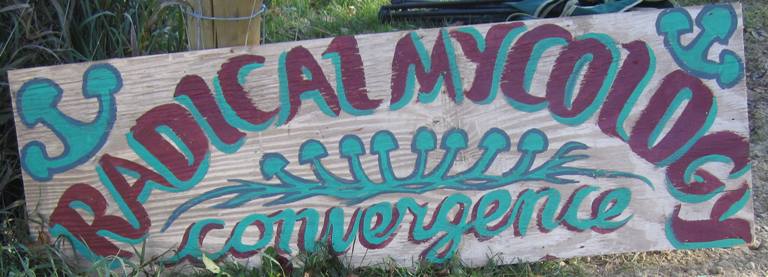
signDid you know that fungi called endophytes live within plants, lending structure and resilience to the plant? “If we took away the fungal cells, we would see these scrawny, floppy little trees,” said Maia, one of the organizers.

Or that mycorrhizal fungi help plant roots take in nutrients in exchange for sugars? Trees in a forest benefit from this “silent stewardship role,” said Peter, an organizer and earlier contributor to this blog. He explained that the mycelium channels sugars to baby trees deep under the forest canopy to ensure their survival. Perhaps thinking of the “next seven spore generations.”

Or that only 10 percent of our cells is actually human—the rest bacterial and fungal? “We need to stop thinking of ourselves as singular organisms,” said Willoughby, another organizer. “We are walking ecosystems. We need to appreciate and nurture all these cells within us.”

From microscopic fungi, whose ecological role is often overlooked, to the 2500-acre honey mushroom in Oregon (largest living organism in the world), the message is clear: Fungi offer the human race a model and a hope.

Mycelium colonizing a log that's been inoculated with shiitake mushroom spore.

Mycelium colonizing a log that’s been inoculated with shiitake mushroom spore.

What struck me about the Radical Mycology Convergence was the deep respect for nature in general and fungi in particular. Here is a movement that is not about exploitive, extractive approaches to a “natural resource,” but rather: working with fungi as allies for the betterment of all life. That includes cultivating mushrooms for food sovereignty, medicine, and remediation.

The promise of mycoremediation is great, and Radical Mycology is all about spreading the tools for home cultivation. But as Peter emphasized, we need to be humble in our explorations. We don’t want to just burst onto a contaminated scene and “throw oyster mushrooms at it” without first observing the healing already taking place, organically, through the wisdom of the fungi naturally present.

“Who are we to say we know more than nature does?” he said. The time for presumptive action is over. We must first watch, learn, observe.

I learned so much more, but here’s one last thing: When a mushroom gets ready to reproduce, it sends out spores. A spore germinates into a hypha, a filament. It’s one strand of what eventually, with luck, becomes a mycelial network.

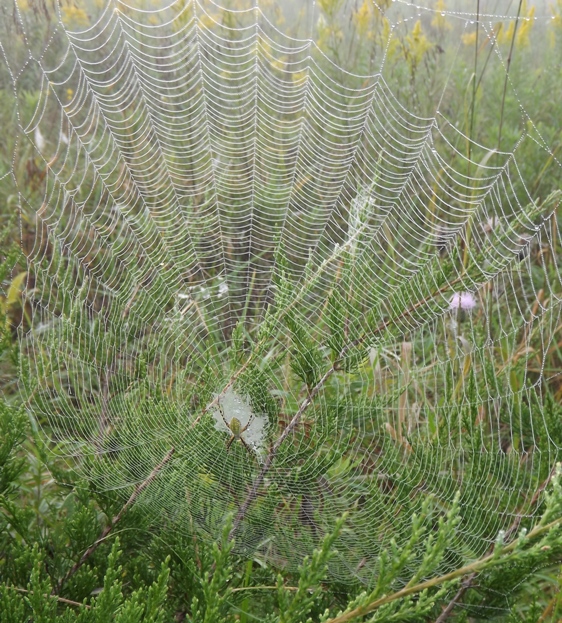
But that hypha is only one cell thick, and needs a partner, a genetic match. It works invisibly, underground. You can’t see it. If it comes together with another hypha, that’s when mycelium begins to branch in all directions through its environment. And finally, when conditions are right, it makes a beautiful fruiting body, a mushroom.
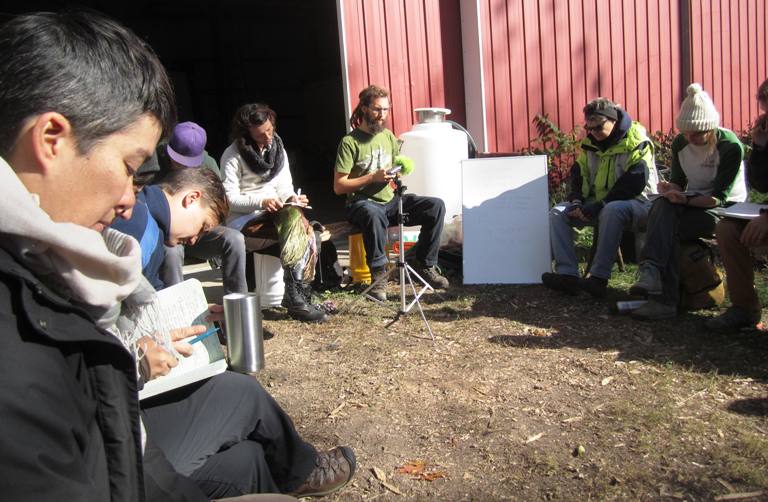
Cultivation workshop at the Radical Mycology Convergence (an event that one organizer likened to "the fruiting body of a mycelial network.")

Cultivation workshop at the Radical Mycology Convergence (an event that one organizer likened to “the fruiting body of a mycelial network.”)

A fitting metaphor for social change work, which is not always visible to the mainstream.

We may feel like we’re laboring in the dark, but when we connect with others—even starting with just one!—the network that results can produce something nourishing and healthy, a powerful gift that seems to show up “overnight.”

Putting the “Radical” in Mycology

Soon I’ll be on my way to this weekend’s Radical Mycology Convergence, an annual gathering of citizen scientists, mushroom enthusiasts, and other earth-loving types. It’s all about learning how to heal the earth by partnering with fungi.

Radical Mycology Collective founder Peter McCoy’s guest post explained how mushrooms become our allies, teachers, and partners.

“The Radical Mycology project revolves around just this philosophy: that by studying, working with, and learning from the fungal kingdom, humans can best find solutions to problems of personal, societal, and ecological health.”

—Peter McCoy

I mentioned before that I had a chance to help Peter and other radical mycologists with an installation of bioluminescent mushroom mycelium this summer in Olympia, WA. Here’s a bit more about that experience to whet your appetite for the convergence.

We used both “plug spawn” and “chip spawn” of a mushroom called panellus stipticus.
Peter holds a jar of "plug spawn"--bits of furniture dowel that he inoculated with mycelium.

Peter holds a jar of “plug spawn”–bits of furniture dowel that he inoculated with mycelium.

Panellus is not known for remediative properties, but for its ability to—seriously—glow in the dark.

I saw this bioluminescence for myself when I took a section of inoculated burlap home. Tiny mushrooms had emerged on the outside of the “chip spawn” bag, and they did indeed glow in the dark. One of the coolest things I’ve seen in a long time.

Checking out the "fruiting bodies" (tiny mushrooms) on the outside of the burlap bag full of inoculated wood chips.

Checking out the “fruiting bodies” (tiny mushrooms) on the outside of the burlap bag full of inoculated wood chips.

We used inoculated wood chips to make a path around an herb garden.

Lining the path with burlap

Lining the path with burlap

The hope is that on dark nights, visitors to the Commons at Fertile Ground will see a faintly glowing path. (And check the size of that rosemary plant in the photo above. That’s the Pacific Northwest for you.)

Spreading inoculated wood chips

Spreading inoculated wood chips

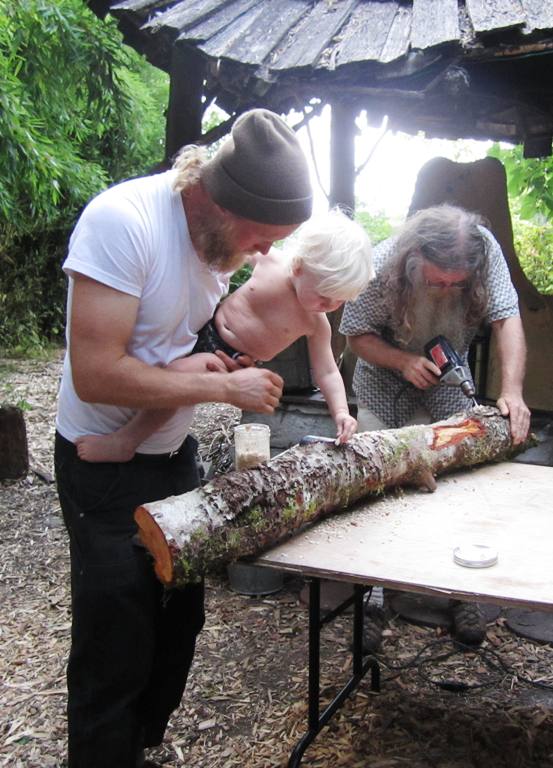
The dowel bits went into a freshly cut red alder log. Eventually the log itself should glow, or it may even pop out with little glowing mushrooms.

Drilling holes (at right) to be filled with plug spawn (left)

Drilling holes (at right) to be filled with plug spawn (left)

Peter emphasized that the same techniques could be used in a mycoremediation project, or to grow mushrooms as food or medicine.

Radical mycologists!

Radical mycologists (with finished alder log)

I’m so looking forward to learning more this weekend—it promises to be a deep immersion in all things mycological. A sampling of workshops:

  • Liquid Culture will Change the World
  • Direct Action for Myco-Activists
  • Permaculture for Radicals

The leaders will be guiding us through several onsite remediation projects. Other attractions: a Passion Show, culture/spore swap, and “forays.” Wahoo!

So to get in the spirit, for the first time ever I tried a mushroom called chicken of the woods. Its beautiful orange folds just called to me from the food co-op bin.

By Kbh3rd (Own work), via Wikimedia Commons

By Kbh3rd (Own work), via Wikimedia Commons

I’ve been sauteeing bits of it up with my eggs every day for lunch. I’m finding it a pretty complement to bright orange egg yolks, and it does taste like chicken. So here’s to trying new things.

Note: Registration is still open for the Radical Mycology Convergence, happening Oct. 9-13 in Orangeville, IL.

Lessons from the Ecovillage

Guest blogger Jami Gaither reports on her recent stay at Dancing Rabbit Ecovillage, located in Rutledge, MO.

Guest post by Jami Gaither

I expected my three-week Visitor Session at Dancing Rabbit Ecovillage to expose me to natural building, cisterns and alternative power. What I didn’t expect were the surprises I encountered.

Photo by Jami Gaither

Photo by Jami Gaither

The first surprise was the amazingly good vegan/vegetarian food. Who knew it could be so tasty, filling and energizing? We had meat for only three meals in three weeks. While I rarely eat fish, at my first dinner back in “concrete world” I ordered Mahi Mahi. This was the most attractive item on the menu and a healthy alternative to my usual chicken or pork. My time at Dancing Rabbit influenced how I see and consume food.

The limited and well-planned use of vehicles was another revelation. Each week, residents review the needed vehicle plans. Seventy people manage to share four vehicles: a Jetta, a Passat, a Leaf, and a large work truck with optional trailer. They do this by planning trips and combining them when possible. The cost for each trip is paid by the member taking it. The $0.65/mile covers the cost of the car, gas, insurance, and maintenance.

For example, a 125-mile round-trip from Dancing Rabbit to the Possibility Alliance, an educational homestead in La Plata, MO, cost me just over $20 ($81.25 divided by 4 riders). This initially seemed pricey to me. But I realized that minimizing the need for travel and sharing rides makes the cost of having a vehicle very reasonable.

The full schedules of members was a third recognition. “Rabbits,” as residents are known, are busy building homes (largely by hand) while raising food (via small-scale organic gardening) and children (some are home-schooled). They do all this in keeping with a commitment to the Dancing Rabbit mission:

To create a society, the size of a small town or village, made up of individuals and communities of various sizes and social structures, which allows and encourages its members to live sustainably. To encourage this sustainable society to grow to have the size and recognition necessary to have an influence on the global community by example, education, and research.

Members and residents spend a few to several hours per week on tasks that keep the community and co-ops functioning. Tasks range from clearing paths and dumping humey (humanure) buckets to cooking a meal for a food co-op. Many also pledge hours to committee work. Since discussions are consensus-based with open/clear/respectful communication by all, this important work can be some of the hardest to do.

Photo by Jami Gaither

Photo by Jami Gaither

This brings me to the biggest surprise of all: the commitment to interact using non-violent communication (NVC) and mediation. My NVC training was eye-opening; it takes much energy, commitment, honesty, and trust.

Some say that living in an intentional community is the most expensive, longest lasting personal development program you’ll ever experience. The community becomes a house of mirrors. Even in my short visit, I learned how my perspective and experience govern my words and deeds. Several interactions indicated I’d hit a nerve or spoken callously…unaware or inconsiderate of the perspective of the other. Working on self-improvement can be a long process.

Some argue that we do not have environmental problems, only communication problems that prevent us from using resources wisely and for the greatest good of the whole. The more we communicate, the closer we feel to others. That sense of connectedness encourages us to take care of others and be less self-focused.

Photo by Jami Gaither

Photo by Jami Gaither

I believe that with some effort, we can each make strides to be more self-aware and considerate. In time, we can interact more effectively and humanely with our fellow beings on Mother Earth.

Ohio native Jami Gaither is a recently retired metallurgical engineer now pursuing a lifestyle based on sustainability, simplicity and fun. While not yet certain of her life path to come, the process of exploring is keeping her enthralled. She lives in Minnesota with her husband Danny.

Reconnecting

Today I enjoyed time with two friends in two separate food-related endeavors. One of them crazy enough to get up early and go questing for a supposedly killer purslane haul. The other tenacious enough to spend several hours shredding produce in my kitchen to make two varieties of sauerkraut.

Two crocks of veggies are fermenting on my table right now.

A batch we made together another time.

A batch we made together another time.

The purslane was a little “gone by,” but we are salvaging it as chicken feed.

And in both cases, we had a great time together, reconnecting.

It made me think of something I just read in an e-newsletter from an eco-village called Dancing Rabbit.

Relearning harmony with the earth at this time in existence is a great undertaking, in a world where bug spray, Big Macs, smartphones, and petroleum are readily available.

Young Thoughtful

It is a great undertaking, I agree. Everything in our culture pulls in the opposite direction. But friends can ease the way. They make swimming upstream companionable.

What about you? In what ways do your friends join you in living a bit more lightly on the planet?

Building with the Mudgirls

I spent part of last week at a workshop offered by the Mudgirls, a natural building collective in British Columbia.

The Mudgirls strive to live lightly on the earth while sharing skills among themselves and the wider community. And when it comes to resilience, building shelter from earthen materials is about as serious as you can get. This is a group that embodies the reimagined world, and a powerful DIWO (do-it-with-others) spirit.

The Mudgirls do their work in child- and mother-friendly style.

The Mudgirls do their work in child- and mother-friendly style.

Collective member Rose hosted our workshop on cooperatively owned land on Denman Island. We camped in the forest by night and bartered our labor for instruction by day. About 15 others took part, bringing enthusiasm and good humor to the work.

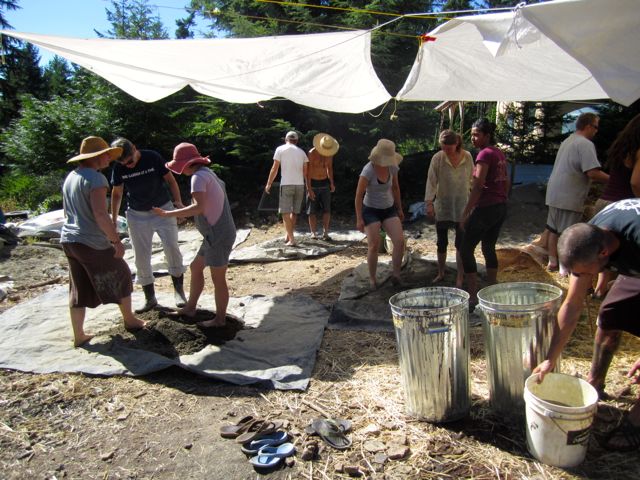
Some of our group making cob, a mix of clay, sand, straw, and water.

Some of our group making cob, a mix of clay, sand, straw, and water.

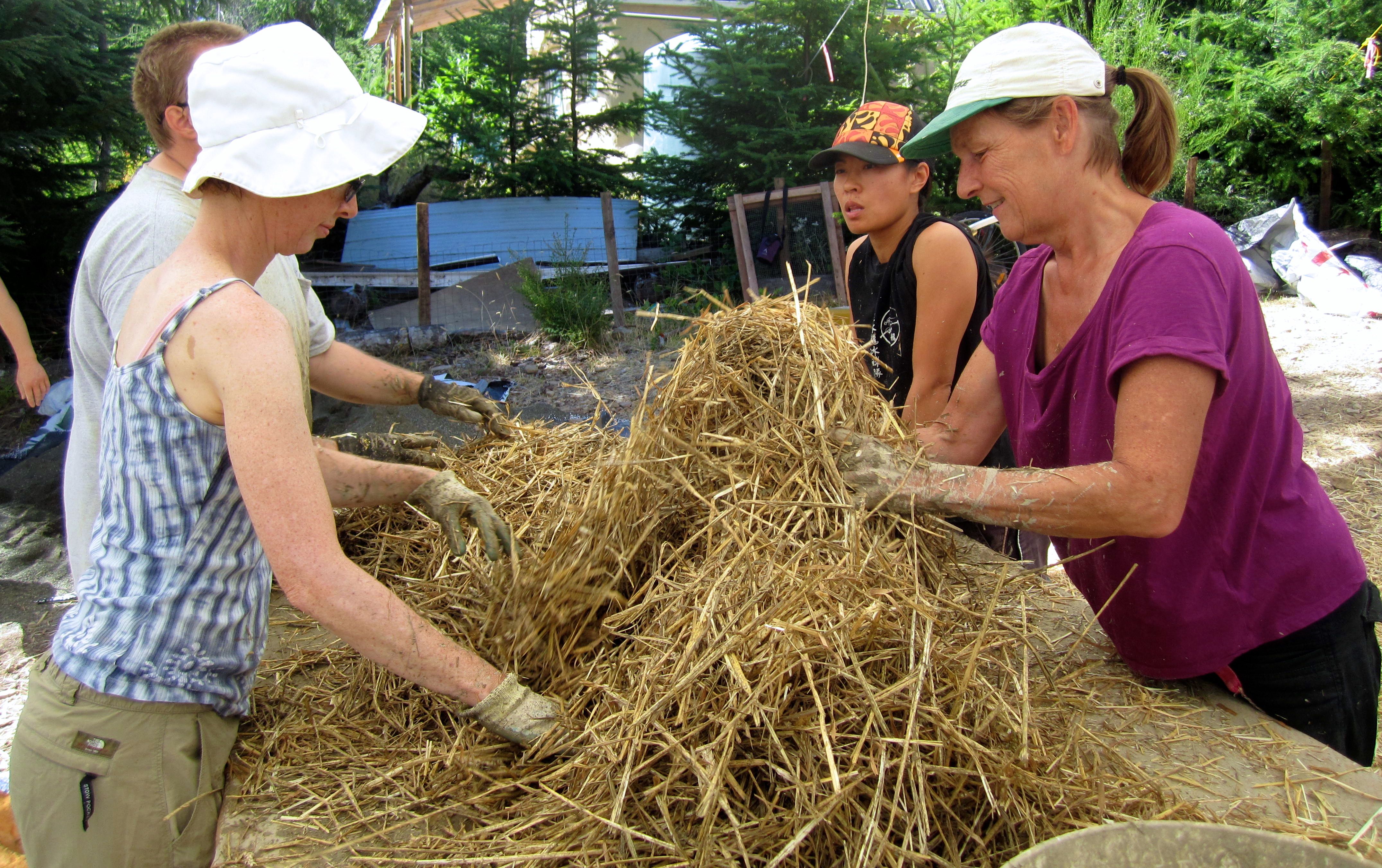
Rose is converting an existing structure on the land into a home for herself and her family. Using temporary plywood forms, we packed the walls with insulating material called slip straw. We made this insulation from straw and a clay-and-water slurry.

Making "slip straw" to insulate the walls. (Spot the pasty writer?)

Making “slip straw” to insulate the walls. (Spot the pasty writer?)

In a few weeks the walls will be dry enough to plaster.

house

House with slip straw insulation in the walls. The plywood is temporary, just to create a form to pack the slip straw in.

A hand-laid stone foundation forms the base for a cob-walled addition. (The team that worked on setting the stone found it a lesson in patience.)

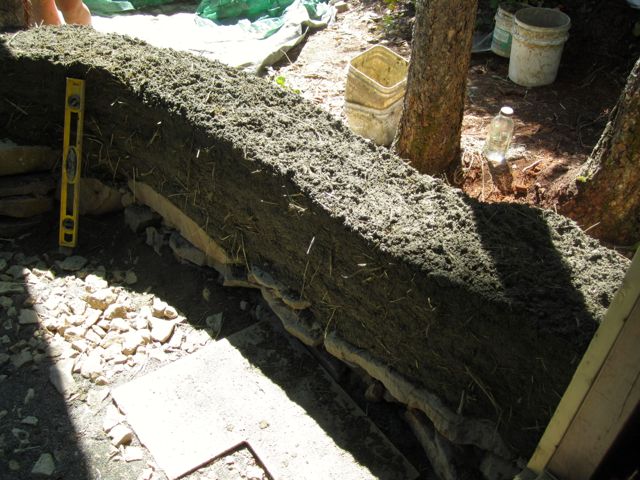
Wall taking shape on top of the stone foundation

Wall taking shape on top of the stone foundation

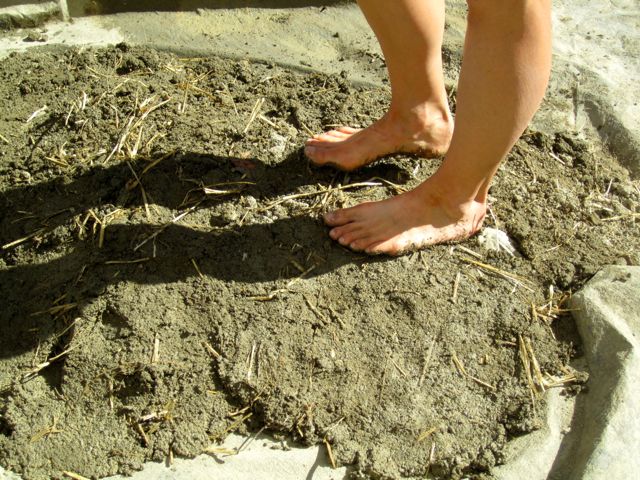
We all helped mix the cob, which is a blend of clay, sand, and water, with a sprinkling of straw. While clay has compressive strength, it lacks tensile strength–the role of the straw. We learned that the straw has a similar job as rebar in concrete, adding internal structure to the dense material.

Mixing a batch of cob.

Mixing a batch of cob.

Building the wall was perhaps the most exciting task.

Building the wall

Building the wall

Some people made it look easy. But I’m still not sure the section I worked on could be called plumb!

Room addition taking form, with window.

Room addition taking form, with window.

I asked Molly, one of the Mudgirls who helped with instruction, how the Mudgirls mission fits into the broader picture of ecological and societal upheaval. Beyond  her passion for natural building, she told me, what excites her is the community that’s being nurtured.

Molly mixing clay slip with a giant eggbeater-type tool.

Molly mixing clay slip with a giant eggbeater-type tool.

The women of the collective have known each other for years and have a solid commitment to each other. They make decisions by consensus, taking the time to talk things out (though in recent years the talks are shorter as the big issues have been resolved). Members all know that they have each others’ best interest at heart, and each agrees to take responsibility for her own needs and desires.

Molly said that people who come to workshops often reconnect at later events, forming lasting friendships. So community extends beyond the core collective. She sees participants as pollinators, taking our inspiration beyond the islands of British Columbia.

Example of a finished cob house (actually this one's a hybrid).

Example of a finished cob exterior.

For me the experience was all about the freedom to try something new. I had to grant myself compassion for the learning curve, and work on forgiving my body its frailties. The Mudgirls’ supportive environment made that possible.

And it was thrilling to help build an actual home. These hands that spend so much time on a keyboard are part of Rose’s homestead now.

Celebrating the Promise

The highlight of my Fourth of July? It was not the fireworks nor the pretty paper lanterns floating up and glowing orange against the deepening dusk. No, the high point came during the drive home.

photo by Ian Kluft, via Wikimedia Commons

photo by Ian Kluft, via Wikimedia Commons

Our downtown viewing spot was a friend’s porch. Through the trees we could see the beautiful fireworks like flowers in the sky. But we left before the show was over, not being a fan of traffic. So we had fireworks in the rearview window while driving down the main east-west artery towards home. Here’s what struck me: the folks who came out all along the street to catch a glimpse of the fireworks.

It moved me to see the good people of eastside Indy taking over parking lots and green lawns, perching on guard rails and idling on off ramps, clustered in doorways and on sidewalks. All along the street, all the way to my neighborhood, they looked the same way. People of all ages and races and walks of life sat on their lawn chairs, blankets, and tailgates with their faces to the downtown skyline on a mild summer evening.

Maternal on the Fourth

I found it so tender to envision this scene replicated in small towns and municipalities and big cities all over the nation. My countrymen and -women seeing beauty in the sky, children gasping in delight (and dogs ducking in terror), all on the same night. That peaceful slump of bodies—lovers holding each other, parents pushing strollers, children racing around—just as they had on so many Fourth of July nights during my childhood.

I felt a rush of love for everyone celebrating the promise of our young country, and that may be as patriotic as I get.

Homegrown “Superfruit”

I saw this item for sale at my food co-op, Pogue’s Run Grocer, and it cracked me up.

Turkish Superfruit! Check it!

White mulberries, a “Turkish Superfruit,” only $5.99 for 4 ounces. What. A. Steal!

Just a week ago I spent a pleasant morning bicycling around the neighborhood with a friend. We stopped to pick from the mulberry trees that grow wild along the creek, meanwhile catching up on each others’ lives.

Mulberries are great in smoothies and crisps, and they are abundant, free, and nutritious (apparently a Superfruit, no less!). My friend and I were delighted with our harvest. Along with the usual purple, we found a white mulberry tree. It might be my imagination, but I always think the white berries are particularly sweet (though a bit less appetizing in appearance).

Superfruit from the hood. Free of charge. Bring your own bucket.

Superfruit from the hood. Free of charge. Bring your own bucket.

I once blogged about how homesteading (even on my modest scale) can make me feel like a chump because of all the extra work it takes to live “simply.” And how other times, I feel the tiniest bit smug, because—look! So much wealth on so little money.

Yeah, this is one of those smug times.

Peaceful Grounds

Monday morning a group of gardeners from the neighborhood had a private tour of Peaceful Grounds, Linda Proffitt’s endeavor at Marion County Fairgrounds, where the county fair is going on. (See my earlier post about her work here.) The vision and scope of this Global Peace Initiatives project astounded and inspired us.

The cattle barn at the Marion County fairgrounds is home to this volunteer-driven initiative.

The cattle barn at the Marion County fairgrounds is home to this volunteer-driven initiative.

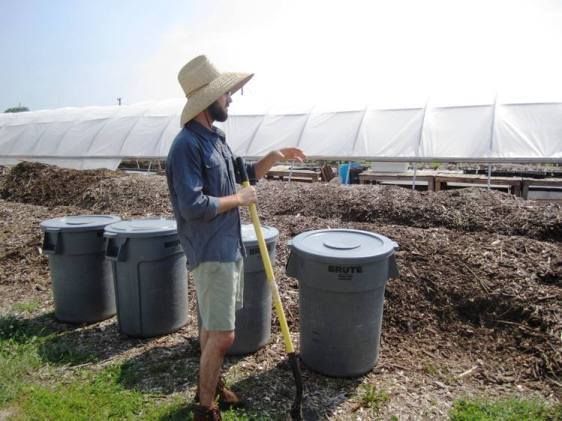
George Marshall, Linda’s intern, showed us around the farm, where mounds of wood chips are not just regular old wood chips but worm habitat.

George

George next to a hoop house that stayed warm all winter from heat given off by decomposition.

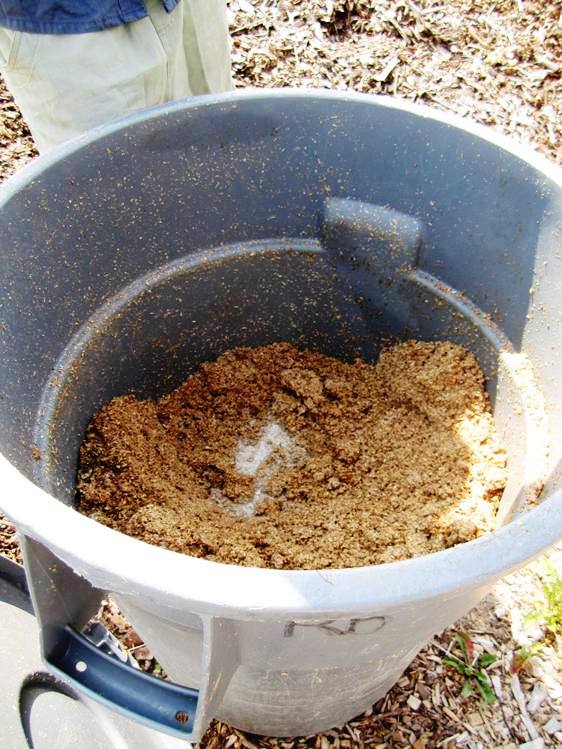
Peaceful Grounds takes beer mash from local brewers like Irvington’s own Black Acre and buries it in mulch to feed the herd of worms.

The spent grain is perfect worm food because barley fits easily into worms' tiny mouths.

The spent grain is perfect worm food because barley fits easily into worms’ tiny mouths.

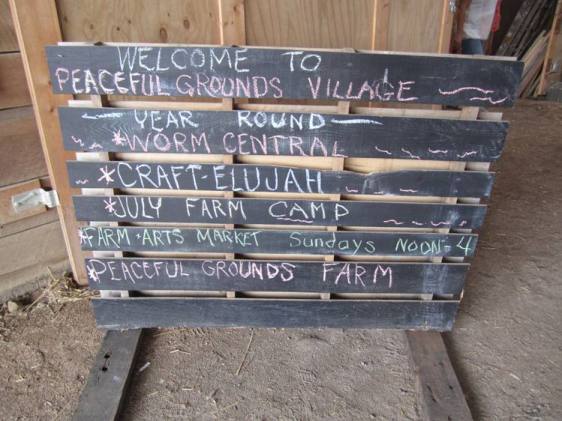
Hand-painted signs that say “Worms at Work” and “Thank a Worm” testify to the importance of these little red wigglers.

IMG_3617

Digging up some of the underground workers to show us.

Volunteers mix 5 to 15 tons of mash with equal amounts of wood chips each week. Another mound incorporates dehydrated food waste from public hospital Eskenazi Health. Over time, these piles and rows are transformed into a viable medium for garden plants.

George showed us where vegetable and herb starts have been set right into these habitats.

broccoli

Broccoli planted in one of many windrows made by worms doing their work on wood chips and beer mash.

In a nifty closing of the loop, Linda has begun to raise hops to supply local brewers.

A few of Peaceful Grounds volunteer-planted crops.

A few more Peaceful Grounds volunteer-planted crops.

While we were walking down the raised beds (“windrows”) of basil and tomatoes, a fair official came up and asked for Linda. He wanted to introduce her to the people in charge of an elephant exhibit, so she could incorporate elephant dung in the farm operation. (“You never met a lady more excited about poop than Linda,” George joked.)

Inside the cattle barn is where kids and adults can come for hands-on fun with art and agriculture. It’s also where artists like Jamie Locke (another Irvington neighbor) demonstrate mandala making and other crafts—and where young volunteers from Handi-Capable Hands take charge of a gigantic tumbler that sifts the worm compost into two grades of product.

Heidi Unger took this photo of the tumbler, which is named Apollo and was donated by a local farmer who saw Linda on TV.

Heidi Unger took this photo of the tumbler, which is named Apollo and was donated by a local farmer who saw Linda on TV.

We went home with the finer grade, which is basically worm poo, to use as a powerful organic fertilizer. One tablespoon per plant will nourish it through a month, Linda says.

Worm castings make an excellent fertilizer. Now there's a local source!

Worm castings make an excellent fertilizer. Now we have a local source!

Before we left, we learned that Will Allen is going to visit the operation, which is a training outpost for his fabulous Growing Power organization. He will speak at 2pm Saturday and lead a workshop at 4pm, and will also preside over a ribbon cutting ceremony at noon on Sunday, when the Peaceful Grounds Farm and Arts Market kicks off.

IMG_3598I’d love to see more interaction between local urban gardeners and this facility, which is just a stone’s throw from Irvington’s back door. Right now the county fair is in full swing, but the possibilities extend beyond its closing date. Linda is running a Farm Camp for kids starting July 7, and is happy to host volunteers at any time.

By the way, she offered to set me up with an interview with Will Allen. I’m thrilled to meet this man I admire so much. I’m crowdsourcing interview questions. What would you ask the grandfather of urban gardening, if you could?

On the Solstice, Contemplating Home

On the longest day of the year, one week after leaving Playa, I’ve been thinking about all that “home” means to me. I loved Oregon’s pristine natural beauty. But I couldn’t wait to come home and walk the tree-lined streets of my neighborhood. Taking my dog Marley for a walk was high on my list on my first morning back.

It’s not perfect here. There’s litter, unlike in Lake County, OR, and sadly many of the neighborhood ash trees are not treated for emerald ash borer, so they are dying—a distressing sight. Poison ivy is rampant in untended corners. Plus it’s really damned humid. But I still walk along with my heart singing “home,” loving the big sycamores and tulip poplars, enjoying all those daylilies and clematis vines, sampling a mulberry here and there.

And getting the latest scoop. Down the street, my big softie neighbor still has the pit bull who wandered into his yard—the one he swore he wouldn’t keep. Farther on, the retiree who always complimented me on my dog (Lord, how that poodle can prance) tells me he and his wife are moving to a condo after 47 years here, but a young family up the street will be moving in. I learn about another neighbor’s dog’s bout with pneumonia. And so on.

Walking is one of the ways I savor my neighborhood, but it’s not the only way. About the second thing I did that day was ride my bike with Judy to the kickoff of the Irvington Folk Festival, a weeklong extravaganza that opened with an outdoor bluegrass concert. I’m no bluegrass aficionado, though I love a good Rocky Top as much as the next person. What I went for, and got, was the people.

In the crowd were Rosemary, and also Laura, two women who helped me found the Irvington Green Initiative years ago. Also our neighbor Pat, who told us of a possible grant for a native plant/foraging project we’ve been scheming.

We sat with Heidi and Mike, longtime gardening buddies who happened to bike up at the same time as we did, midconcert. Behind us were Jerome and his family. That was fortuitous, because I could update him on our sweetgum tree. (Arborist Jerome has a business called Tree-Centric, which I’ve blogged about before. A few weeks ago he assessed our ailing sweetgum, taking soil samples and cutting away girdling roots. The cost of his professional expertise? A loaf of homebaked bread.)

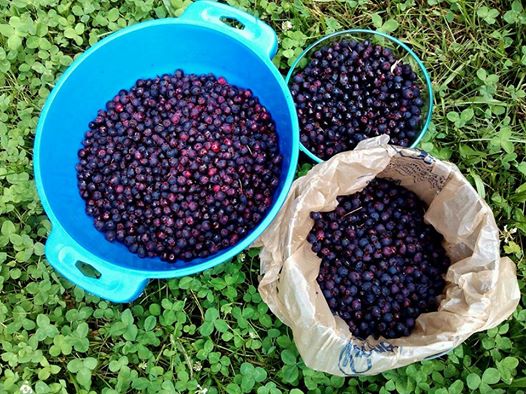
Jerome offered both his strawberry patch and serviceberry grove for picking. Though the strawberries were done, here's the lovely haul of serviceberries my friends and I made that morning.

Jerome offered both his strawberry patch and serviceberry grove for picking. Though the strawberries were done, here’s the lovely haul of serviceberries my friends and I made that morning.

Somehow, over the years, my roots have grown deep in this place. I grieve with friends who lost their 13-year-old German Shepherd, one of a gang of Marley met in the park as a pup. I pick mulberries and serviceberries (some from Jerome’s yard) while chatting with good friends. My yoga buddies welcome me back vociferously. I barter for Thai massage from a neighbor.

All that, plus (last night) hearing local musicians rock out, after eating at the new deli that sources everything it can locally.

How did I get so lucky? I don’t know, but I’ll contemplate the answer while biking to the park for the folk festival’s finale (and, bonus: alternative gift fair).

Inner Transition As Key to Collective Work

First in a series of three

In my last post I suggested that an internal shift is as critical as the external changes we so desperately need. I’d like to explore that idea further in this series.

While in California last fall I had a conversation with Julia Bystrova, who was developing a series of “inner transition” tools with Transition US.

The Transition movement is a worldwide push to bring communities into a relocalized post-oil economy. The idea is to reduce consumption and embrace local energy, while building food security and resilience.

Transition Linithgow. Photo by John Lord, via Flickr Commons.

Transition Linithgow. Photo by John Lord, via Flickr Commons.

Julia told me that this movement suffers from a particular conflict: Some people want to jump right in and work on projects, while others prioritize the internal transformation process. The first camp gets impatient with the second, which has often been marginalized. Working groups often struggle to collaborate effectively, caught up in conflicts and divisions.

The solution is to give “inner tools” their due, Julia says. Both external output and internal process are valid. And as Julia says, the external is a mirror of the internal. “There needs to be group process that accepts both in a way that is complementary, because we need both.”

Mapping the Transition. Photo by Chris Hill

Mapping the Transition. Photo by Chris Hill, via Flickr Commons.

I tend to agree, having been involved in some groups that struggle to find cohesiveness. Group dynamics are tricky. To my mind, conflict is likely to persist until we each are willing to be present to our own emotional states.

If we walk through life largely unconscious of what triggers our pain, we’ll always be in a reactive mode. People push our buttons, we react, and conflicts escalate, all because we can’t take look honestly at the storms raging within us.

And it’s crucial that we find a way to work together.

Julia Bystrova and author Mary Pipher both say that we are all doing important work now. Even if we think we’re removed from the front lines, we’re not. Because the central task of our time is just that: working toward a healthier ecosystem and a just economy.

Julia believes that societal transformation can happen fast. She envisions a cascade effect that will be breathtaking in its global reach.

She told me that a certain threshold of consciousness is already on its way. With each of us lighting the spark of countless others, Julia believes we will see the world transformed.

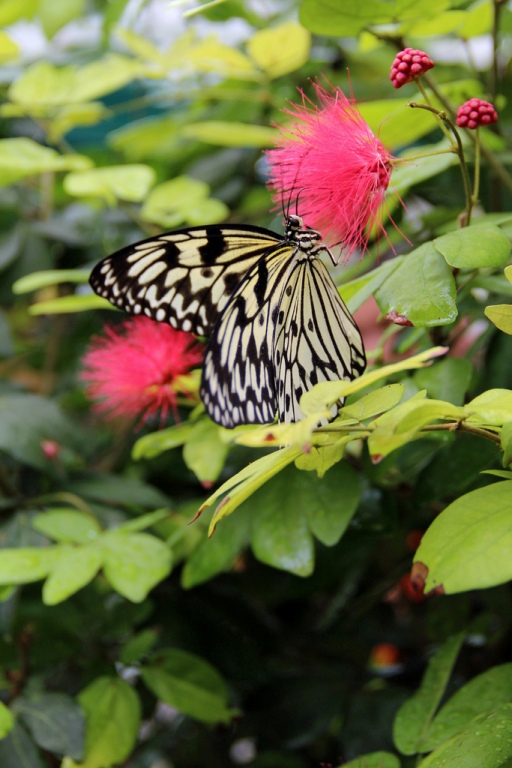
Swallowtail. Photo by Heidi Unger.

Swallowtail. Photo by Heidi Unger.

Mary Pipher also expects widespread transformation. As people open to their deepest feelings about the state of the world, she says a shift in consciousness is inevitable. All those awakening hearts will simply mandate deep change.

So much of the news we hear is bad. In some parts of the world, it’s possible for a woman to be stoned to death, or for schoolgirls to be abducted en masse, while here at home mass shootings no longer arouse outrage. Meanwhile an island nation is projected to be entirely underwater by 2020 as Antarctic shrinks. Monarch butterflies are reaching Mexico in drastically reduced numbers—part of “the sixth extinction.

Stories like these can swamp me in despair. But these women’s vision of transformation holds the antidote to hopelessness.

Next: Confronting the shadow.