Photo by Ginny, via Flickr commons
“The way we are, we are members of each other. All of us. Everything. The difference ain’t in who is a member and who is not, but in who knows it and who don’t.”
—Burley Coulter (a Wendell Berry character I need to get to know)
Tag Archives: Do-it-with-others

“We Must Care About our Public Spaces”
As promised, here is a followup to last week’s post on the value of public art.
At Foundation East’s artist meet-and-greet I met Irvington resident Holly Combs. She’s half of the husband-and-wife duo who painted several traffic signal boxes around Irvington. While I was talking with her, a neighbor stopped to say that she honked and waved whenever she passed the couple working out in the cold on their boxes.
Holly thanked her, saying, “Do you know what it meant to us when people honked and waved? Yeah, it was cold but we didn’t feel it. When you’re joyful in what you do, you’re not even cold.” Then she handed us each a “You are beautiful” sticker.
That seems to sum up Holly, whose passion is obvious when she speaks of her various projects. For example, Street Styles. It’s a youth program she started that uses street art and graffiti as the foundation for exploring art fundamentals.
With her husband Dave, she also founded the Department of Public Words. DPW’s mission is to put uplifting messages in surprising places, all to tell people “they’re awesome, beautiful, worthy, and wonderful,” as Holly puts it.
They first tried it a few years back when the economy tanked and the Combs’ gallery and art magazine were hard hit.

Photo courtesy of Department of Public Words
“When you lose everything, you’re fearless, thinking ‘I can do anything,’” Holly told me. She painted You Are Beautiful in block letters high on a prominent building in the Fountain Square neighborhood because it was a message she herself needed.
Since then they’ve put the same message on a building on East Tenth Street. I pass it often and it never fails to make me smile.

Photo courtesy of Department of Public Words
Sometimes I’ve walked my dog past the Combs’ house in summer (though I didn’t know it was theirs) to find You Are Beautiful scrawled in chalk on the sidewalk.
The You Are Beautiful campaign is part of a global initiative started by Matthew Hoffman (those stickers were the first manifestation). Right now the couple are raising money to continue inspiring people with positive words all over town.
With Street Styles, Holly works with youth in the juvenile justice system, many of whom have illegally painted graffiti. “I tell my juvenile offenders, ‘You go to jail for doing that and I get paid $100 an hour: who’s the boss?’” She brings the disenfranchised youth into the process of creating street art in hopes of channeling their desire for self-expression.
I asked Holly how she felt about the vandalized signal boxes, since one of theirs was targeted. “Yes, our box got paint poured on it. Just out of meanness. Sad. But I see public art as a conversation with the public,” she told me in a Facebook chat.

One of the Combs’ traffic signal boxes. Photo by Vishant Shah.
The offenders in her program say that if a community doesn’t seem to care about a neighborhood, it’s seen as an invitation.
“(We) must care about our public spaces to help encourage others to care about them too. I always say, “Blank walls want me.’”
In fact, my neighborhood started the signal box project after a police officer spoke to our Crimewatch group about Crime Prevention Through Environmental Design (CPTED). Officer Shane Foley talked about CPTED’s landscaping and lighting design principles—and how modifying the built environment can deter criminals.
The group already had a history of litter cleanups and beautification efforts, and CPTED theory made a lot of sense. The traffic signal box art seemed a natural progression.

Another of the Combs’ boxes. Photo by Vishant Shah.
These boxes belong to the whole community, and no setback is going to slow the public art movement now. With the help of a fundraising campaign, Vishant and cofounder Aaron Story plan to have all the boxes protected with a coat of clear coat by May.
Local artists, funders, and dreamers are invited to contact Foundation East about partnering on future eastside Indy public art projects.
Public Art Unites the Community
Public art is one of those things that’s more than the sum of its parts. Here in my neighborhood, the humble traffic signal box—a four-foot-tall aluminum cabinet that had never before registered on my radar—seems to be the start of something big.
In 2012 I was one of the volunteers painting Irvington’s first seven signal boxes as part of the Great Indy Cleanup.
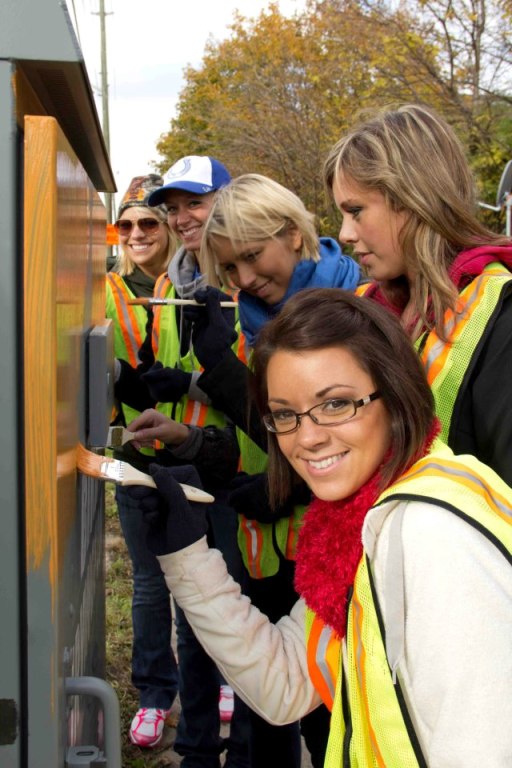
These Colts cheerleaders helped us get the job done. Photo by Heidi Unger.
Each design had been submitted by artists like Morgan Hauth, shown here putting finishing touches on one of her pieces.

Morgan Hauth touching up. Photo by Heidi Unger.
By 2013, Foundation East, the brainchild of Vishant Shah and Aaron Story, had formed with a goal of transforming eastside Indy neighborhoods through public art. Building on the success of the traffic signal box project, the duo enlisted six artists to paint another round.

Oil painter Rita Spalding at work on one of her signal boxes. Photo by Charmaine Edwards.
A total of 19 boxes now brighten the main thoroughfares of my community.
Sadly, some disrespectful souls targeted a couple of these landmarks. Two boxes were vandalized early Dec. 31, prompting outrage among neighbors. A third more recently had a bucket of paint splashed on it.
It’s infuriating, but I take my cue from Rita, who has more reason than anyone to be outraged—her luminous painting was among those defaced. She told the Indianapolis Star that morning, “I’m not angry. It just really makes me think about what’s going on in that kid’s life.”
Later that day she wiped off the graffiti. Several neighbors met her at the box to help out if needed, but it turned out to be easier than she expected, because she’d applied a layer of clear coat finish.
Foundation East founders Aaron and Vishant say the outcry shows how important these boxes have become. They invited the community to meet the artists and show their support this week.
I went to the gathering, finding it packed to the gills with neighbors eager to thank the artists and scribble their ideas on a white board. (Paint the water tower, build a vertical garden structure on the library lawn, install a sculpture on my street!)
Many also chipped in for a “clear coat fund” to give all the boxes the same treatment as Rita’s.
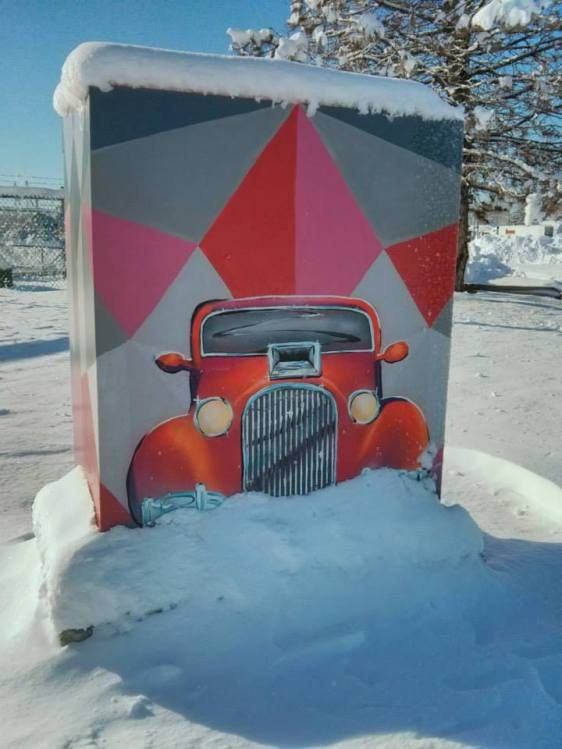
Homage to car culture, by Andrew Severns. Follow this artist at @severnscanon. Photo by Vishant Shah.
I talked to several residents there who mentioned Irvington’s history as a hub of creative and intellectual stimulation, with Butler University’s campus located here until 1928. In the 1920s and 30s, a group of acclaimed painters known simply as the Irvington Group drew national attention.
Apparently our neighborhood’s reputation as a quirky haven for eccentrics also dates back 100 years—Irvington is described in an October 1903 Indianapolis Star article as “the classic suburb which has an interesting way of turning up all kinds of freaks and strange things generally.” (This was before the city grew to swallow up the suburb, but we retain our unique character.)
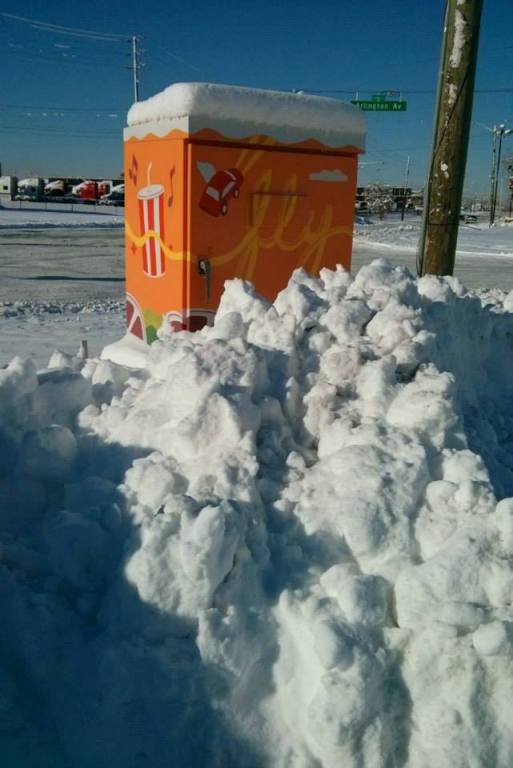
Erin Kelsch’s Signal box in Arctic Vortex aftermath. Photo by Vishant Shah.
Kathleen Angelone, owner of Bookmamas, says that’s exactly the kind of neighborhood she wants—and the art definitely adds to the vibe. “I think public art is vital to any community because it makes it beautiful. It denominates where the community is and gives it character.”
“And it is civilized. I want to live in a civilized community where people are interested in art and music and learning, not just their day to day jobs.”

Dave and Holly Combs’ tribute to farm heritage. Photo by Vishant Shah.
Russian-born Svetlana, an oil painter, told me that public art played a role in her childhood desire to paint. “There are statues everywhere in Russia; you’re just surrounded by art,” she said. “That gave me a lot of creativity and imagination.”
Two years ago she moved to Irvington, where color is starting to pop in unexpected places. “I think it’s wonderful that there is art for people to view without going to a museum.”
Aaron and Vishant invite local artists, funders, and dreamers to contact them about partnering on future eastside Indy public art projects.
My next blog post will have more about the role of public art in placemaking, youth engagement, and crime prevention.
When Crisis Threatens
Thanks to a review in Permaculture Activist magazine, I found a little book called Small Stories, Big Changes: Agents of Change on the Frontlines of Sustainability. It’s a collection of inspiring voices from the community resilience movement. Each chapter is written by someone actively engaged in the world’s remaking.
Here’s a passage from the very first chapter that gives you a taste.

Goat milking, by V Becker, via flickr Commons
“(A) community of busy farmers, gardeners, goat-milkers, trail-builders, engineers, scientists, windmill climbers and solar installers…have led our society’s journey toward sustainability…
They are leaders because their excitement is stronger than their fear.
Logically, when crisis threatens we need to subdue our fear in order to take constructive action. But taking action also somehow diminishes our fear…Once we get busy we’re not as scared any more.
Perhaps we don’t control the forces changing our climate when we grow a few vegetables, but we do influence those forces, and I think the activity profoundly changes our perspective. The situation immediately seems more manageable when we begin to manage.”
—Bryan Welch, publisher of Mother Earth News
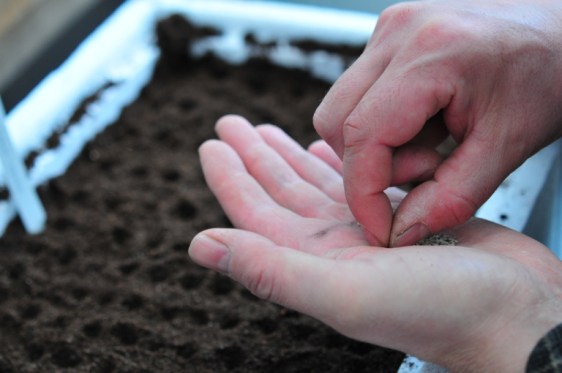
Photo by julochka, via flickr Commons
Have you found this to be true? I have, especially when I’ve gotten “the help of a few believers, supporters, and friends who light the way through the dark nights,” as David Orr describes elsewhere in the book. When I am at my lowest is usually when I’ve fallen away from hands-in-dirt activities for whatever reason, or when I’m feeling isolated. It’s easy to fall into this trap in winter especially.
But when I’m pulling together with neighbors to scheme a project or clean up my block or make a big batch of sauerkraut, I feel ready to face anything.
What about you? I’d love to hear about action you’ve taken—and how it impacts your anxiety level about the state of the world.
Communal
When the sun comes up on these clear mornings, the sky behind the snowcovered trees tints palest tangerine. There’s a beautiful stillness in a frozen world.

Daybreak in the Arctic Vortex
Something about going through an extreme weather event is lovely in its communal nature. For the second day we are snowed in. We can’t drive out of our alley, and any outings on foot are necessarily short because of extreme wind chills.
So we’ve been keeping tabs on the goings-on in our little burg via a Facebook neighbors’ group.
The dangerous cold and deep snow have given us a glimpse of just how neighborly people are in our quirky neighborhood. I have seen many a plea for help go answered, and many an unsolicited offer appear. Just now someone offered to pick up items on her way home from work if anyone is in dire need. Earlier there was a shout-out to “the awesome guy driving a Caterpillar bobcat and helping people dig out their cars from the aftermath of the plows.”
Someone even asked for—and got—advice on how to get her dog to do his business in this brutal weather. I didn’t read the entire thread, but apparently it was a hoot, discussing canine toileting habits in great detail.
People are offering safe havens, rides to emergency rooms and shelters, and space heaters for those whose furnaces are on the blink. They’re doing for each other in large and small ways—taking baked goods over, walking each other through the crises of burst pipes and power outages, helping everyone feel less alone.
I’m sure this behavior is replicated in many places, much of it never posted anywhere. I didn’t post that the fellow on the corner shoveled not just his walk but the neighbor’s between us, and the guy on the alley behind us helped clear our driveway, but they did, and I thank them.

Dangerous and beautiful
Even though I’m tired of being clenched up from cold, tired of the worry over potentially losing power or the furnace konking out (again), part of me relishes these days, both for the astonishing view out my window and for the weird conviviality online.
Part of me wants to put off snowmelt, with its godawful mud and piles of blackened leftover snow. Part of me never wants this communal experience to end.
To Live Passionately
A writer friend and I were talking this morning about our goals for the new year. She said she had but one resolution for 2014: “Forget fear.” Except she used another, shall we say, more pithy F-word for her intention around fear.
Later, scanning through my notebook from the past few months, I came across this passage from Nov. 7, which followed a week of extreme doldrums:
Tired of being unconscious, but scared to wake up! Yet that fear seems foolish in light of the many ways we could bite the dust—globally/regionally/personally, calamitously/suddenly/slowly—oh so many options for becoming vapor, energy, disembodied once more. [I was thinking of the Oct. 25 earthquake off Japan’s coast near Fukushima, among other things.]
So keeping that in mind, how do I live? I want to live passionately.
Did you hear about the child for whom Make-a-Wish is transforming San Francisco into Gotham City, so he can be Batkid?
Photo by Bhautik Joshi, via flickr Commons
You see where I’m going with this. In our dying we become superheroes.

Thinking of the Buddhist injunction to remember the unalterable fact of our own death, I ended up musing: What do we have to lose?—the exact phrase my friend used this morning.
It seems ridiculous to dither about in fear and worry when we could be gone at any moment. And meanwhile all of life is calling us to be a force for good.
So how about it? Shall we create a passionate, conscious, fearless, superheroic 2014?
Let Us Discover Our Wealth

Photo by robleto, via flickr Commons
The opposite of poverty isn’t property. The opposite of both poverty and property is community. For in community we become rich: rich in friends, in neighbours, in colleagues, in comrades, in brothers and sisters.
Together, as a community, we can help ourselves in most of our difficulties. For after all, there are enough people and enough ideas, capabilities and energies to be had. They are only lying fallow, or are stunted and suppressed.
So let us discover our wealth; let us discover our solidarity; let us build up communities; let us take our lives into our own hands, and at long last out of the hands of the people who want to dominate and exploit.
—Theologian Juergen Moltmann
Crowd-funding the New Frontier: Radical Mycology
Here’s a chance to support a radical mycology project seeking to put a potent tool for restoration in many more hands. Mushrooms can break down and eliminate some of the most toxic industrial compounds in the world, representing enormous untapped potential for healing our beleaguered planet.
Not to mention the fact that mushrooms are a phenomenal source of protein, potentially boosting community-level food sovereignty.
Be part of this new frontier by funding this resource for would-be radical mycologists, and/or helping to spread the word!
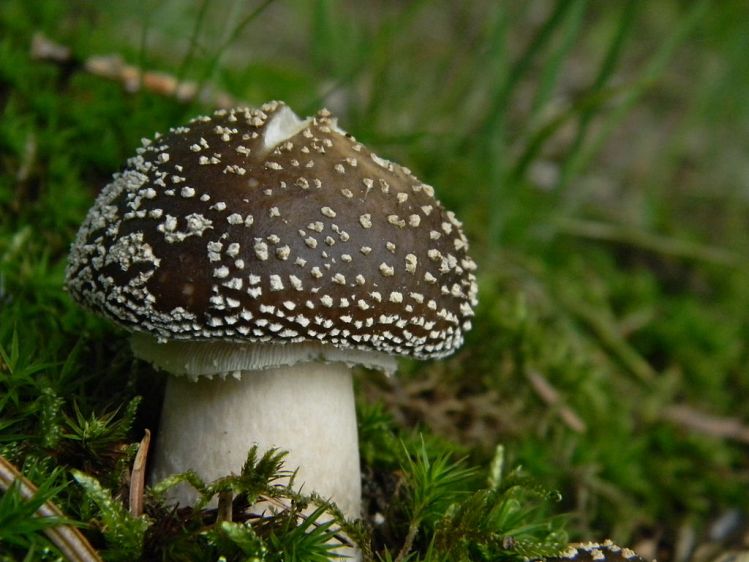
By Alaricmalabry (Own work), via Wikimedia Commons
Below is a note from Peter McCoy, who recently contributed a guest post about the lessons mushrooms have taught him:
The Radical Mycology Book fundraiser is underway! This unique book on the uses of mushrooms and other fungi for personal, societal, and ecological wellbeing will be a powerful resource for the geek and do-gooder inside us all and we are excited to bring this dream to the rest of the world.
You can view the live campaign here:
http://bit.ly/radmycogogoWhether or not you are in a position to donate, one of the most important contributions you can make would be getting more people aware of this fundraiser by emailing your friends and re-posting on your social (mycelial) networks.
Share the campaign on Facebook:
http://bit.ly/rmifbshareOr Tweet it!
http://bit.ly/rmiggtweetThank you so much for contributing to this project and vision!
Mush love!
Peter and The Radical Mycology Collective
To be Fueled by Love
Browsing the shelves of Point Reyes Books last month, I picked up Mary Pipher’s latest book. Her Reviving Ophelia illuminated the struggles of adolescent girls. Now she has a book called The Green Boat: Reviving Ourselves in our Capsized Culture, detailing her progression from despair to activism.
A Nebraskan, Pipher was on the front lines of early campaigns to stop the Keystone XL Pipeline from going through the Sandhills. (Three years later, the pipeline is still in limbo, and has become a symbol of the fossil fuel industry’s disastrous impact on the planet.)

Dismal River, Nebraska Sandhills. Photo by USFWS Mountain Prairie, via Wikimedia Commons
Even before opening it, I knew this book would return me to grounding.
I’d been talking with Richard Heinberg about his book The End of Growth, which describes a trajectory that I understand and yet can’t quite face head-on. Seeing it spelled out and hearing him expound on it left me feeling quite scared.
I know that many are pulling together for a better world. But our governmental policies favor the monied corporations running the show. I was starting to doubt that community action could effect change on that level.
Along comes Pipher, describing an activism that’s joyful and even fun. Example: grandmothers gave weekly “thank you in advance” pies to the Nebraska governor until he agreed to meet. This brand of protesting, fueled by love of the land and concern for tomorrow’s denizens, seems the perfect antidote to despair.
A chapter called All Hands on Deck begins with this quote from Frederick Buechner:
“God calls you to the place where your deep gladness and the world’s deep hunger meet.”
To be glad in the face of the world’s rending sometimes seems impossible. Yet I remember opening the church basement doors on the day of our SkillShare and seeing the space instantly fill with participants, their faces alight with curiosity. I think of the heart-cracking instant when a resonant phrase finds my fingers on the keyboard. I recall the joy of putting a garden trowel in the hands of a preschooler.
There’s an expansiveness when I reflect on these moments, a sense of the heart opening that lifts me from powerlessness.

Explaining vermiculture at the Irvington SkillShare. Photo by Jeff Echols.
Pipher acknowledges the “experts” who downplay the importance of individual actions. They say systemic economic and political changes are necessary to change this trajectory. True enough, but this reasoning is incomplete, says Pipher—for “who is it that is in charge of systemic change?”
She argues that individuals have always been the source of world-changing actions, and what else can one person do but start with herself? And join others in common cause, as did the abolitionists. It’s said that they had no hope of success, at the start.
My small self is quick to tell me what I’m not. I’m no naturalist, no doctor of philosophy, no career activist, no farmer, no wisewoman in a mountain hut. I am just myself. Sometimes I question: What do I have to offer?
I only own this experience, this deep heart of pain and care, grief and fear—and love.
What do I have to offer? All of it. I offer it up.
[More from Mary Pipher: Read her interview on how to wake up and take action on climate change (and stay sane).]
Radical Fungi Are My Favorite Teachers
Guest Post by Peter McCoy
When I get asked why I started the Radical Mycology project, I often say that it was to share the lessons that mushrooms have taught me.

Turkey tail logs
Since I started studying mushrooms as a teenager, I have always seen mycology (the study of fungal biology) as an endlessly fascinating and thought-provoking science. Whether I am using them as a nutritious food source or as a potent medicine, I am always honored to taste their wonderful flavors and alluring textures. Hunting mushrooms in the woods, I love to watch them grow, knowing that they are cleaning the forest soil, protecting plants from disease, and turning decaying matter into fresh topsoil so new plants can thrive.
And using them as remediators, I am awed by the mushrooms’ ability to break down and eliminate some of the most toxic industrial compounds in the world.

Grassroots Bioremediation workshop with Leila Darwish at the Radical Mycology Convergence
Seeing how the densely branched mycelial networks of mushrooms share nutrients among plants, I also find a wonderful example for humans to follow when working to collaborate with their communities. Further, the incredible spore loads that mushrooms drop in the fall are designed to adapt to any given environment, demonstrating the ability to adjust to challenges and remain resilient during hard times.
These same attributes provide a model for how humans can best relate to each other, whether on a personal or societal level. By mimicking mushroom mycelium, cooperative businesses and housing projects work more efficiently by spreading out tasks and networking with affiliated organizations.
Fungi are also highly symbiotic with most organisms on the planet, so we find, yet again, the importance of collaboration among creatures throughout the fungal kingdom. In essence, fungi act in countless ways as grand harmonizers of the Earth, something that humans can aspire toward to live in balance with their surroundings.
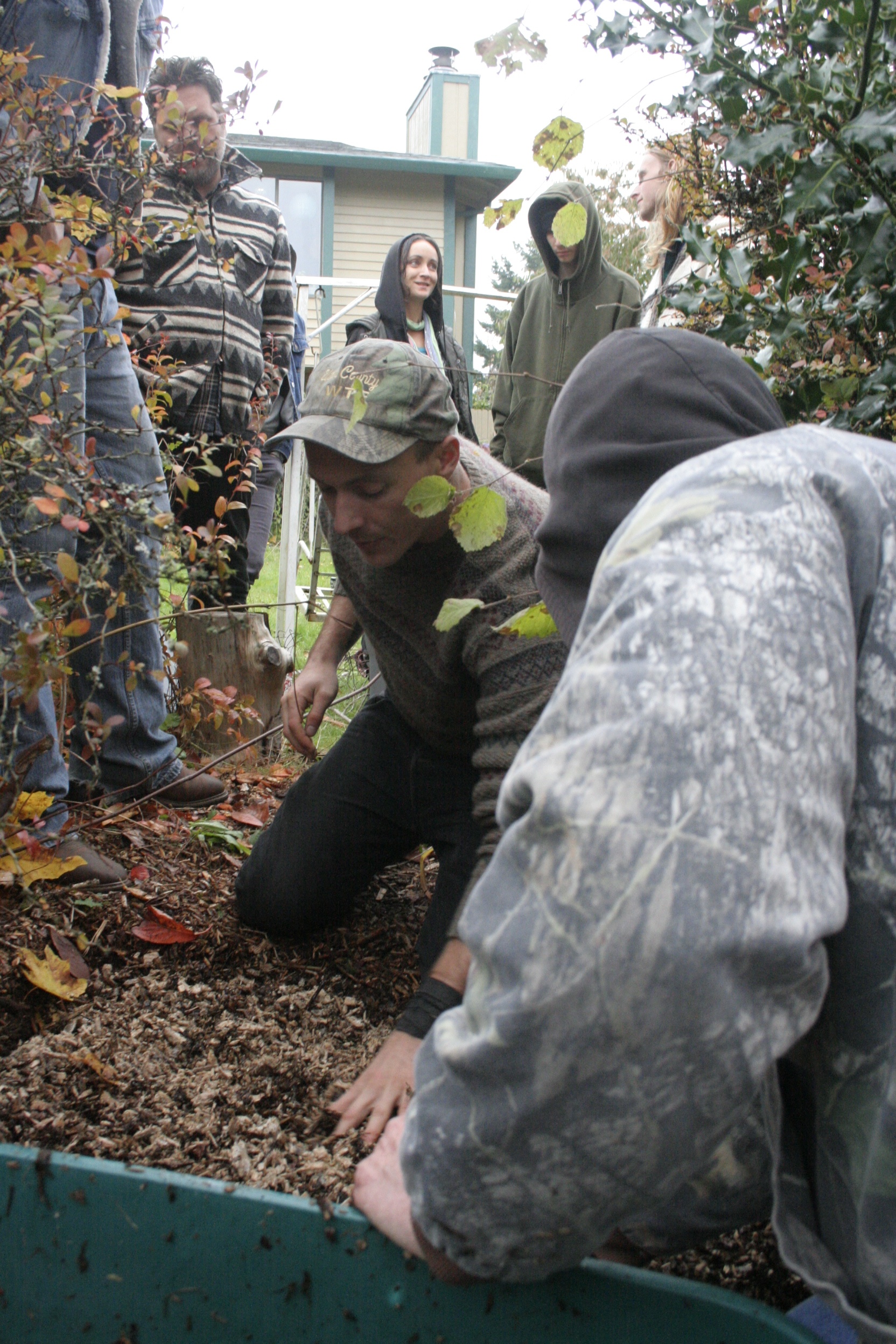
King Stropharia bed installation at Peter’s Mushroom Cultivation & Application Course in Olympia, WA
The Radical Mycology project revolves around just this philosophy: that by studying, working with, and learning from the fungal kingdom, humans can best find solutions to problems of personal, societal, and ecological health. To this end Radical Mycology has put a lot of energy into providing free education to the public on the benefits of fungi.
Our website (radicalmycology.com) is a database of all things mycological. We offer two free publications we have written, Radical Mycology and Mushroom Cultivation For Remediation, as well as instructional videos and protocols for mushroom cultivation.

Nameko Bed installation at Demeter’s Permaculture Garden in Olympia, WA
We organize regular multi-day events on mushroom cultivation and its practical applications (the Radical Mycology Convergences), with another being planned for the spring of 2014. And since 2011, two Radical Mycology-inspired volunteer clubs have sprung up in San Francisco, CA and Olympia, WA. These groups teach free workshops about simple and practical mushroom cultivation and community resilience.
The next and biggest project for Radical Mycology is writing a book exploring the theory, practice, and applications of mushrooms for personal, societal, and ecological change. We are currently in the midst of an Indiegogo crowdfunding campaign to fund the book. Our campaign page will soon be up and running. Stop by the Radical Mycology website to learn more about our work.
Update: The Radical Mycology Book fundraiser is underway! This unique book on the uses of mushrooms and other fungi for personal, societal, and ecological wellbeing will be a powerful resource for the geek and do-gooder inside us all and we are excited to bring this dream to the rest of the world.
You can view the live campaign here:
http://bit.ly/radmycogogo
 Shawndra Miller