Fungi Offer a Model and a Hope

Last weekend’s Radical Mycology Convergence was an eye-opener to the mystery and power of the fungus kingdom.
signDid you know that fungi called endophytes live within plants, lending structure and resilience to the plant? “If we took away the fungal cells, we would see these scrawny, floppy little trees,” said Maia, one of the organizers.

Or that mycorrhizal fungi help plant roots take in nutrients in exchange for sugars? Trees in a forest benefit from this “silent stewardship role,” said Peter, an organizer and earlier contributor to this blog. He explained that the mycelium channels sugars to baby trees deep under the forest canopy to ensure their survival. Perhaps thinking of the “next seven spore generations.”

Or that only 10 percent of our cells is actually human—the rest bacterial and fungal? “We need to stop thinking of ourselves as singular organisms,” said Willoughby, another organizer. “We are walking ecosystems. We need to appreciate and nurture all these cells within us.”

From microscopic fungi, whose ecological role is often overlooked, to the 2500-acre honey mushroom in Oregon (largest living organism in the world), the message is clear: Fungi offer the human race a model and a hope.

Mycelium colonizing a log that's been inoculated with shiitake mushroom spore.

Mycelium colonizing a log that’s been inoculated with shiitake mushroom spore.

What struck me about the Radical Mycology Convergence was the deep respect for nature in general and fungi in particular. Here is a movement that is not about exploitive, extractive approaches to a “natural resource,” but rather: working with fungi as allies for the betterment of all life. That includes cultivating mushrooms for food sovereignty, medicine, and remediation.

The promise of mycoremediation is great, and Radical Mycology is all about spreading the tools for home cultivation. But as Peter emphasized, we need to be humble in our explorations. We don’t want to just burst onto a contaminated scene and “throw oyster mushrooms at it” without first observing the healing already taking place, organically, through the wisdom of the fungi naturally present.

“Who are we to say we know more than nature does?” he said. The time for presumptive action is over. We must first watch, learn, observe.

I learned so much more, but here’s one last thing: When a mushroom gets ready to reproduce, it sends out spores. A spore germinates into a hypha, a filament. It’s one strand of what eventually, with luck, becomes a mycelial network.

But that hypha is only one cell thick, and needs a partner, a genetic match. It works invisibly, underground. You can’t see it. If it comes together with another hypha, that’s when mycelium begins to branch in all directions through its environment. And finally, when conditions are right, it makes a beautiful fruiting body, a mushroom.
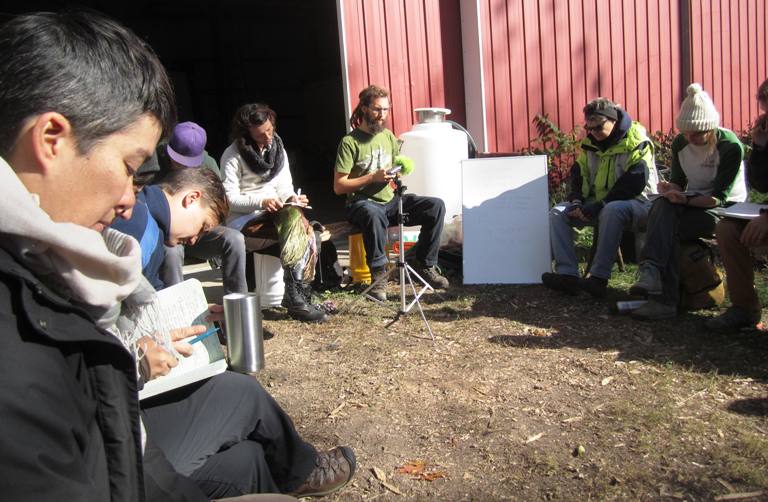
Cultivation workshop at the Radical Mycology Convergence (an event that one organizer likened to "the fruiting body of a mycelial network.")

Cultivation workshop at the Radical Mycology Convergence (an event that one organizer likened to “the fruiting body of a mycelial network.”)

A fitting metaphor for social change work, which is not always visible to the mainstream.

We may feel like we’re laboring in the dark, but when we connect with others—even starting with just one!—the network that results can produce something nourishing and healthy, a powerful gift that seems to show up “overnight.”

Putting the “Radical” in Mycology

Soon I’ll be on my way to this weekend’s Radical Mycology Convergence, an annual gathering of citizen scientists, mushroom enthusiasts, and other earth-loving types. It’s all about learning how to heal the earth by partnering with fungi.

Radical Mycology Collective founder Peter McCoy’s guest post explained how mushrooms become our allies, teachers, and partners.

“The Radical Mycology project revolves around just this philosophy: that by studying, working with, and learning from the fungal kingdom, humans can best find solutions to problems of personal, societal, and ecological health.”

—Peter McCoy

I mentioned before that I had a chance to help Peter and other radical mycologists with an installation of bioluminescent mushroom mycelium this summer in Olympia, WA. Here’s a bit more about that experience to whet your appetite for the convergence.

We used both “plug spawn” and “chip spawn” of a mushroom called panellus stipticus.

Peter holds a jar of "plug spawn"--bits of furniture dowel that he inoculated with mycelium.

Peter holds a jar of “plug spawn”–bits of furniture dowel that he inoculated with mycelium.

Panellus is not known for remediative properties, but for its ability to—seriously—glow in the dark.

I saw this bioluminescence for myself when I took a section of inoculated burlap home. Tiny mushrooms had emerged on the outside of the “chip spawn” bag, and they did indeed glow in the dark. One of the coolest things I’ve seen in a long time.

Checking out the "fruiting bodies" (tiny mushrooms) on the outside of the burlap bag full of inoculated wood chips.

Checking out the “fruiting bodies” (tiny mushrooms) on the outside of the burlap bag full of inoculated wood chips.

We used inoculated wood chips to make a path around an herb garden.

Lining the path with burlap

Lining the path with burlap

The hope is that on dark nights, visitors to the Commons at Fertile Ground will see a faintly glowing path. (And check the size of that rosemary plant in the photo above. That’s the Pacific Northwest for you.)

Spreading inoculated wood chips

Spreading inoculated wood chips

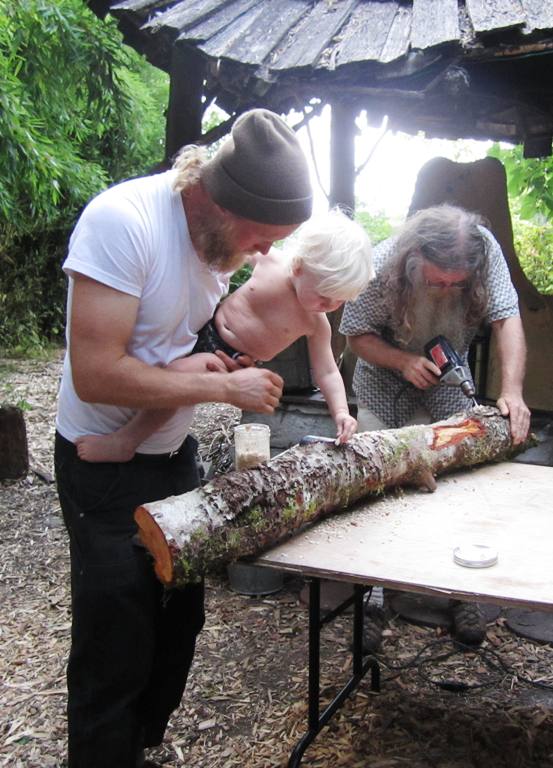
The dowel bits went into a freshly cut red alder log. Eventually the log itself should glow, or it may even pop out with little glowing mushrooms.

Drilling holes (at right) to be filled with plug spawn (left)

Drilling holes (at right) to be filled with plug spawn (left)

Peter emphasized that the same techniques could be used in a mycoremediation project, or to grow mushrooms as food or medicine.

Radical mycologists!

Radical mycologists (with finished alder log)

I’m so looking forward to learning more this weekend—it promises to be a deep immersion in all things mycological. A sampling of workshops:

  • Liquid Culture will Change the World
  • Direct Action for Myco-Activists
  • Permaculture for Radicals

The leaders will be guiding us through several onsite remediation projects. Other attractions: a Passion Show, culture/spore swap, and “forays.” Wahoo!

So to get in the spirit, for the first time ever I tried a mushroom called chicken of the woods. Its beautiful orange folds just called to me from the food co-op bin.

By Kbh3rd (Own work), via Wikimedia Commons

By Kbh3rd (Own work), via Wikimedia Commons

I’ve been sauteeing bits of it up with my eggs every day for lunch. I’m finding it a pretty complement to bright orange egg yolks, and it does taste like chicken. So here’s to trying new things.

Note: Registration is still open for the Radical Mycology Convergence, happening Oct. 9-13 in Orangeville, IL.

Lessons from the Ecovillage

Guest blogger Jami Gaither reports on her recent stay at Dancing Rabbit Ecovillage, located in Rutledge, MO.

Guest post by Jami Gaither

I expected my three-week Visitor Session at Dancing Rabbit Ecovillage to expose me to natural building, cisterns and alternative power. What I didn’t expect were the surprises I encountered.

Photo by Jami Gaither

Photo by Jami Gaither

The first surprise was the amazingly good vegan/vegetarian food. Who knew it could be so tasty, filling and energizing? We had meat for only three meals in three weeks. While I rarely eat fish, at my first dinner back in “concrete world” I ordered Mahi Mahi. This was the most attractive item on the menu and a healthy alternative to my usual chicken or pork. My time at Dancing Rabbit influenced how I see and consume food.

The limited and well-planned use of vehicles was another revelation. Each week, residents review the needed vehicle plans. Seventy people manage to share four vehicles: a Jetta, a Passat, a Leaf, and a large work truck with optional trailer. They do this by planning trips and combining them when possible. The cost for each trip is paid by the member taking it. The $0.65/mile covers the cost of the car, gas, insurance, and maintenance.

For example, a 125-mile round-trip from Dancing Rabbit to the Possibility Alliance, an educational homestead in La Plata, MO, cost me just over $20 ($81.25 divided by 4 riders). This initially seemed pricey to me. But I realized that minimizing the need for travel and sharing rides makes the cost of having a vehicle very reasonable.

The full schedules of members was a third recognition. “Rabbits,” as residents are known, are busy building homes (largely by hand) while raising food (via small-scale organic gardening) and children (some are home-schooled). They do all this in keeping with a commitment to the Dancing Rabbit mission:

To create a society, the size of a small town or village, made up of individuals and communities of various sizes and social structures, which allows and encourages its members to live sustainably. To encourage this sustainable society to grow to have the size and recognition necessary to have an influence on the global community by example, education, and research.

Members and residents spend a few to several hours per week on tasks that keep the community and co-ops functioning. Tasks range from clearing paths and dumping humey (humanure) buckets to cooking a meal for a food co-op. Many also pledge hours to committee work. Since discussions are consensus-based with open/clear/respectful communication by all, this important work can be some of the hardest to do.

Photo by Jami Gaither

Photo by Jami Gaither

This brings me to the biggest surprise of all: the commitment to interact using non-violent communication (NVC) and mediation. My NVC training was eye-opening; it takes much energy, commitment, honesty, and trust.

Some say that living in an intentional community is the most expensive, longest lasting personal development program you’ll ever experience. The community becomes a house of mirrors. Even in my short visit, I learned how my perspective and experience govern my words and deeds. Several interactions indicated I’d hit a nerve or spoken callously…unaware or inconsiderate of the perspective of the other. Working on self-improvement can be a long process.

Some argue that we do not have environmental problems, only communication problems that prevent us from using resources wisely and for the greatest good of the whole. The more we communicate, the closer we feel to others. That sense of connectedness encourages us to take care of others and be less self-focused.

Photo by Jami Gaither

Photo by Jami Gaither

I believe that with some effort, we can each make strides to be more self-aware and considerate. In time, we can interact more effectively and humanely with our fellow beings on Mother Earth.

Ohio native Jami Gaither is a recently retired metallurgical engineer now pursuing a lifestyle based on sustainability, simplicity and fun. While not yet certain of her life path to come, the process of exploring is keeping her enthralled. She lives in Minnesota with her husband Danny.

Before It’s Too Late

Guest Post by Rosemary Spalding, Earth Charter Indiana board president. (Part 2 of 2 of a firsthand report on the Sept. 21 People’s Climate March).

My husband Mark and I stayed  in Newark, NJ the night before the People’s Climate March. Early Sunday morning we began to make our way to 66th and Central Park West to meet a new contact from Earth Charter International. As we rode the train from Newark to NYC and then the subway to Central Park, our excitement built as we joined with dozens of others making their way to the march. Smiling people in T-shirts with names of organizations from all over the country packed subway cars that were standing room only.

Photo by Rosemary Spalding

Photo by Rosemary Spalding

When Mark and I emerged from the subway station at 66th Street, several volunteers welcomed us, directing us to our spot in the march. About 30 minutes before the march was to begin, people flowed into the wide street that borders Central Park on the west, filling it from curb to curb. While we stood in the street waiting, I just looked around, taking it all in. People were lined up behind us all the way to 86th St. and in front of us all the way to Columbus Circle.

Photo of Columbus Circle by Rosemary Spalding

Photo of Columbus Circle by Rosemary Spalding

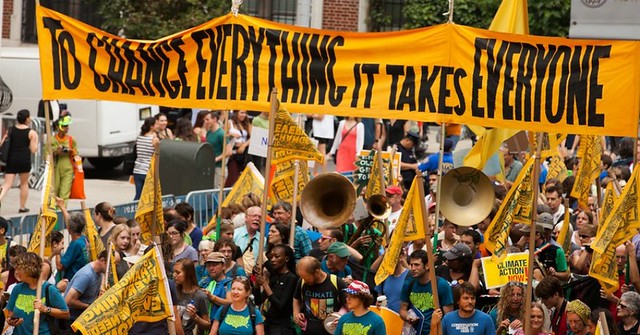
It was crowded, and we learned later that many marchers couldn’t even fit in the street until the march had progressed several blocks. Many people carried homemade signs and some wore costumes. But most were simply there—joining in solidarity with others to demonstrate before our government and other world leaders gathering for the United Nations summit, that we demand action to address this urgent global crisis.

Communities displaced by climate change marched  in the demonstration. Photo by Christine Irvine.

Communities displaced by climate change marched in the demonstration. Photo by Christine Irvine.

And then the most exciting thing happened! I saw someone making his way through the crowd, like a salmon swimming upstream, coming towards me. As he drew closer I realized I recognized him. Like a teenaged groupie at a rock concert, I yelled, “LOOK, IT’S BILL McKIBBEN!”

I immediately felt foolish, but he looked over at me and smiled as he passed, never missing a step. I think I said “thank you” as he walked by. By the time I could get my iPhone out, he had been swallowed up by the upstream crowd that parted to let him pass.

Photo by Emma Cassidy

Photo by Emma Cassidy

As we walked the two miles past famous landmarks and through Times Square, hundreds of supporters on the sidewalks waved us by. We never saw a single person who challenged our message. Every so often throughout the march, a thunderous “sound wave” would come from in front of or behind us, and we would raise our voices and play musical instruments as the wave passed through on its way to the beginning or end of the march. Goosebumps!

At the end of the march people gathered for entertainment at several stages. I watched the Raging Grannies as they sang their versions of “On Top of Old Smokey,” “Roll Back the Barrels,” and “The Climate—It is A-Changin’.” Music and humor—welcome relief for such a serious subject.

Over 400,000 people marched in New York City that Sunday. Add to that the thousands attending local climate marches all over the country and the world, and you know that we cannot be dismissed as radical tree-huggers.

To the contrary—the People’s Climate March was mainstream. We witnessed an incredibly diverse collection of people of all ages and from all walks of life; people from every state and many nations; people of every color and culture; labor unions and healthcare workers; youth groups, college students and professors, parents and grandparents. All marching, singing and chanting for a common purpose—to say that we, the citizens of the world, recognize the direness of our situation and unite to convince our leaders to change course before it’s too late.

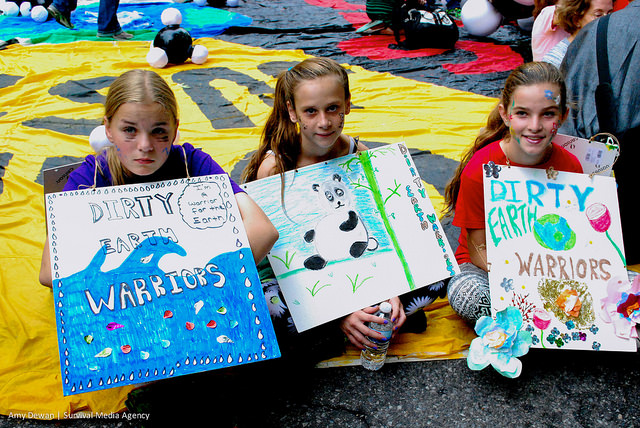
Photo by Amy Dewan

Photo by Amy Dewan

As Mark and I traveled back to Newark, exhausted but exhilarated from the day’s experience, I wondered—did we make a difference? I said a silent prayer: This time let those in power take notice; let meaningful change finally occur.

Rosemary Spalding is board president of Earth Charter Indiana and a founding member of the Irvington Green Initiative. She is an attorney with Spalding & Hilmes, PC, which is located in Irvington and concentrates its practice in environmental law.

Why I Marched in the People’s Climate March

Guest Post by Rosemary Spalding, Earth Charter Indiana board president. (Part 1 of 2).

Like most folks, I am concerned about a number of serious issues, but when it comes to climate change, my passion has turned into a kind of internal panic. My panic builds when I read reports that it is happening much faster than scientists were predicting less than 10 years ago.

Atmospheric greenhouse gas concentrations have increased so much that we’re no longer talking about avoiding tipping points or reversing global warming. We’re now talking about slowing the process as much as possible and adapting to the inevitable.

I think about the beautiful, bright children of my nieces and nephews and about the grandchildren I hope to have someday, and I am terrified for them. To what kind of existence are we condemning them and their children?

Photo of young NYC activists by Rosemary Spalding.

Photo of young NYC activists by Rosemary Spalding

Most of my votes, letters, and phone calls to government leaders at all levels have been completely ineffective. Earth Charter Indiana recently petitioned the Indiana Environmental Rules Board (ERB) to adopt a rule to develop a climate action plan for Indiana.

Despite the fact that over a thousand Hoosiers have signed the petition, the board dismissed it at their last meeting. Board members thought a climate action plan was someone else’s job—certainly not their job.

The ERB would not even grant a public hearing on the petition (which Earth Charter Indiana believes it is required to do under Indiana’s law permitting citizen rulemaking petitions).

Photo By Shadia Fayne Wood

Photo By Shadia Fayne Wood

That citizen petition (with extensive supporting documents) took months to prepare. The articulate and passionate young people of Youth Power Indiana respectfully submitted the petition to the ERB. But board members were unmoved.

I must confess that the ERB’s casual dismissal has shaken my fundamental belief in the integrity of our democracy. We are disheartened—but we are not done advocating for change. See the note at the end of this post to lend your support.

In the meantime, I had hoped to go to New York City to participate in the People’s Climate March—but the ERB’s cavalier rejection of a citizen petition cemented my resolve. I wanted to join with others to tell our government and world leaders gathering for the United Nations summit that we demand action—NOW.

Photo By: Emma Cassidy

Photo By Emma Cassidy

I have participated in lots of climate change rallies in Indianapolis as well as the march in Washington, DC last February, when 40,000 people turned out in the frigid cold to protest the proposed Keystone XL pipeline. But those experiences did not prepare me for what we experienced at the People’s Climate March last Sunday…

(To be continued in Part 2).

Note: If you are an Indiana resident dismayed by the Environmental Rules Board’s lack of attention to a citizen petition, please consider attending the next ERB meeting in support of a climate action plan.

When: Wednesday, November 12, 1:30-4:00 p.m.
Where: Indiana Government Center South – Conference Room A (check for meeting or room changes here.)
RSVP: julielrhodesconsulting@gmail.com or 317.371.2788

Want to do more? Contact Indiana Environmental Rules Board Members today to urge them to hold a hearing on the Petition for a Climate Action Plan for Indiana! Find contact information for board members here.

Rosemary Spalding is board president of Earth Charter Indiana and a founding member of the Irvington Green Initiative. She is an attorney with Spalding & Hilmes, PC, which is located in Irvington and concentrates its practice in environmental law.

A Sacred Act

“Healing the wounds of the earth and its people does not require saintliness or a political party, only gumption and persistence. it is not a liberal or a conservative activity; it is a sacred act. It is a massive enterprise undertaken by ordinary citizens everywhere…”

—Paul Hawken, in Blessed Unrest

People's Climate March 2014 NYC
Some 400,000 people demonstrated for climate action in New York City last weekend. (A friend and I went to the youth-led Bloomington rally to help “raise the alarm” about climate change; the best part after the hooting and hollering was singing “We’ve got the whole world in our hands.”)

Stay tuned for a guest post from someone who joined the NYC demonstration.

To Look Up

It hit me hard last week when the Audubon Society reported that half of North American birds’ migratory routes are threatened by climate change.

If loons find it too hot to summer in Minnesota, then what? You’d think they should just aim farther north, but will they find the food and cover that matches their needs? Are they supposed to migrate higher and higher till they fly right off the planet’s roof?

By Pete Markham, via Wikimedia Commons

By Pete Markham, via Wikimedia Commons

The scenario is not confined to some far-off future. It’s now. Southern California saw 90 to 95 percent of raptor nests failing because of drought. No nests, no procreation. How long can a species survive climate disruption?

I find I can’t stay with this topic; it’s too painful.

I felt the same last month, learning about a gigantic crater that opened in the Siberian permafrost. Scientists link the melting to warmer-than-normal summers the last two years, and say such sinkholes release vast amounts of methane.

Methane gas is more efficient at trapping radiation than carbon dioxide, with 20 times the impact on climate change, according to the EPA.

In Eaarth: Making a Life on a Tough New Planet, Bill McKibben describes a number of self-reinforcing feedback loops that lead to a faster and faster rate of climate change. The crater is just one example. He explains the feedback loops in this video.

Here we are, immersed in our lives, going around feeling one minute one way, the next another. I feel despondent. I cheer up. My writing goes well. My writing goes poorly. I help someone. I say something dumb. I worry over my sick cat. I celebrate her recovery. I walk around my neighborhood and love the trees. I come home and feel lonely, pleased, scared, self-satisfied, hopeless, and on and on.

I’m a dizzying universe. As are we all. Most of us barely keep it together, doing what needs to be done to meet the day-to-day demands of life.

And all the while, this other thing is winging above us. This bigger picture of demise.

Rise up...

And to look up invites so much pain, which we already have aplenty.

Two things help me face the times we live in. One is external, the other internal.

On the external side, I reach out, take action, make something, do something. I connect with neighbors who care as deeply as I do. Or join a demonstration, like this Sunday’s People’s Climate March in New York City. (I will join a crowd closer to home, at the People’s Climate Gathering in Bloomington.)

I plant a seed. I get moving.

On the internal side, I stay still and connect with what endures. I remind myself that matter is just slow energy, and energy can’t be destroyed. Feeling into my energy body takes me to a place beyond fear. Whatever the future brings, it will be better if I stay in this moment.

“Look up and see the light from the sun. And now see everything beneath it, everything around you. You are in the garden.”

—Karen Maezen Miller, Paradise in Plain Sight

Note: If you’re on the fence about joining this weekend’s events, read Rebecca Solnit’s new essay. “Only great movements, only collective action can save us now,” she writes.

Reconnecting

Today I enjoyed time with two friends in two separate food-related endeavors. One of them crazy enough to get up early and go questing for a supposedly killer purslane haul. The other tenacious enough to spend several hours shredding produce in my kitchen to make two varieties of sauerkraut.

Two crocks of veggies are fermenting on my table right now.

A batch we made together another time.

A batch we made together another time.

The purslane was a little “gone by,” but we are salvaging it as chicken feed.

And in both cases, we had a great time together, reconnecting.

It made me think of something I just read in an e-newsletter from an eco-village called Dancing Rabbit.

Relearning harmony with the earth at this time in existence is a great undertaking, in a world where bug spray, Big Macs, smartphones, and petroleum are readily available.

Young Thoughtful

It is a great undertaking, I agree. Everything in our culture pulls in the opposite direction. But friends can ease the way. They make swimming upstream companionable.

What about you? In what ways do your friends join you in living a bit more lightly on the planet?

How I Spent my Summer Vacation

After traveling for nearly a month, this homebody is glad to be back to my little haven of domesticity. This time I visited Washington State with a side trip to British Columbia.

If you follow the blog, you know a little bit about my adventures, but here are some more highlights.

In Bellingham I learned about Sustainable Connections’ Think Local First campaign. This ingenious program rewards local businesses for earth-friendly business practices by raising their profile in the community.

We decided to experience this local biz thing for ourselves.

Checking out goat cheese options (that's our old friend Laurie in the foreground.)

Checking out goat cheese options at the Bellingham Farmers Market (that’s our old friend Laurie in the foreground.)

Craft beer, ice cream made from local berries, a killer bookstore, and a festive Saturday farmers market showed us a bit of the region’s specialties.

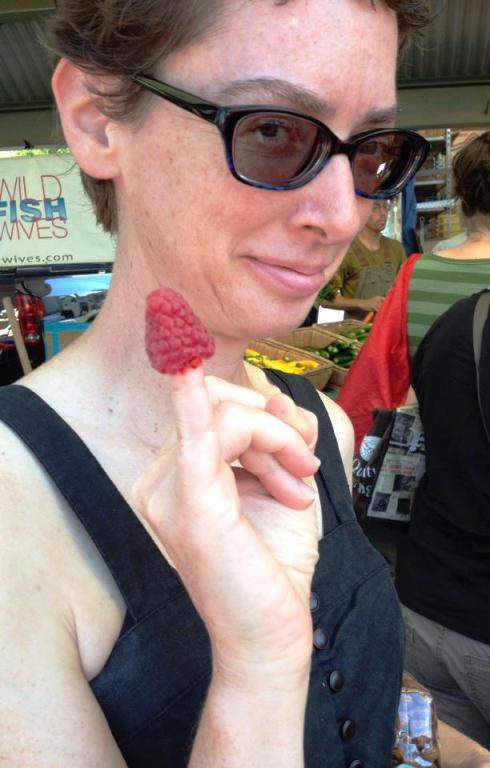
Biggest raspberry evah

Biggest raspberry evah

From Bellingham we ventured north to Denman Island in British Columbia for the Mudgirls workshop.

My new friend Millie, tamping slip straw at the Mudgirls workshop.

My new friend Millie, tamping slip straw at the Mudgirls workshop.

Then it was back to the U.S. for a two-week writing residency at Hypatia-in-the-Woods in Shelton, WA. This experience was a bit different from previous residencies which I shared with other artist types: I was the sole resident of a lovely cottage nested deep in the cedar forest.

The labyrinth on the grounds, a magical place

The labyrinth on the grounds, a magical place to commune with deer, birds, trees, and insects

The solitude gave me lots of focused time to write. I also learned how much I value having someone within hollering distance, as I had a few challenging moments in the intense isolation. I was thankful for the board, who kindly made sure I had some conviviality to balance out the quiet.

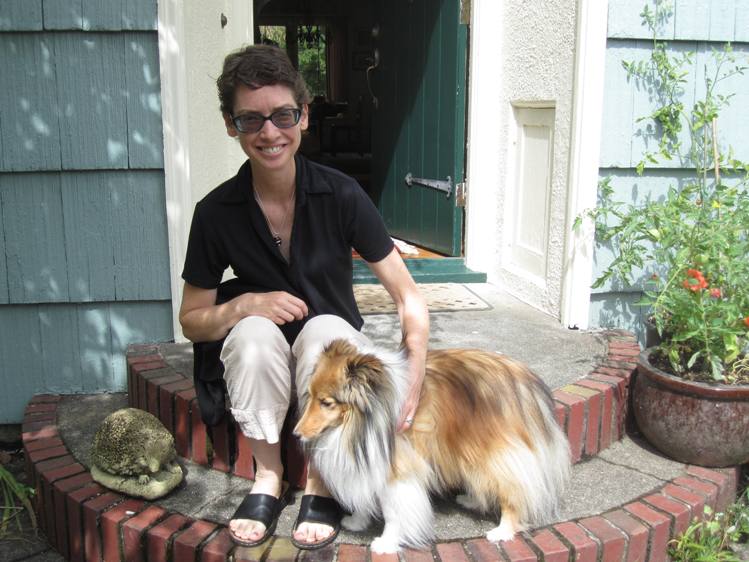
Other people's dogs, such as the director's Sheltie, Ceela, helped me deal with the lonesomeness of not having my dog with me.

Other people’s dogs, such as the director’s Sheltie, Ceela, helped me deal with the lonesomeness of not having my dog with me.

A high point: connecting with Olympia Mycelial Network, a group I’ve admired from afar. I helped them with an installation of bioluminescent mushroom mycelium, which was a thrill.

We gathered by the cob oven on the Commons at Fertile Ground. After a quick tutorial, we created a path from wood chips inoculated with panellis (bitter oyster) mycelium. The hope is that this path will glow in the dark as the mycelium gets established.

Peter McCoy, who blogged here about starting the Radical Mycology project, walked us newbies through the process for growing mycelium.

Peter showing me grain spawn and mycelium sugar that he propagated at home. Now I want to try it!

Peter showing me grain spawn and mycelium sugar that he propagated at home. Now I want to try it!

After that inspiring evening, I had to visit Olympia Food Coop, where the group earlier helped install mycelium that consumes petrochemicals.

I feel so lucky to have had the chance to learn from such innovative people and projects. I’m glad to be back to my laundry-hanging, solar-cooking, dog-walking routine though. I have several fun writing assignments coming up that I’ll tell you about later.

Note: Speaking of solar cooking: We’re offering a workshop this Sunday from 2-3pm at Pogue’s Run Grocer on that very topic. RSVP here if you can make it!

A Little Help from the Fungus Kingdom

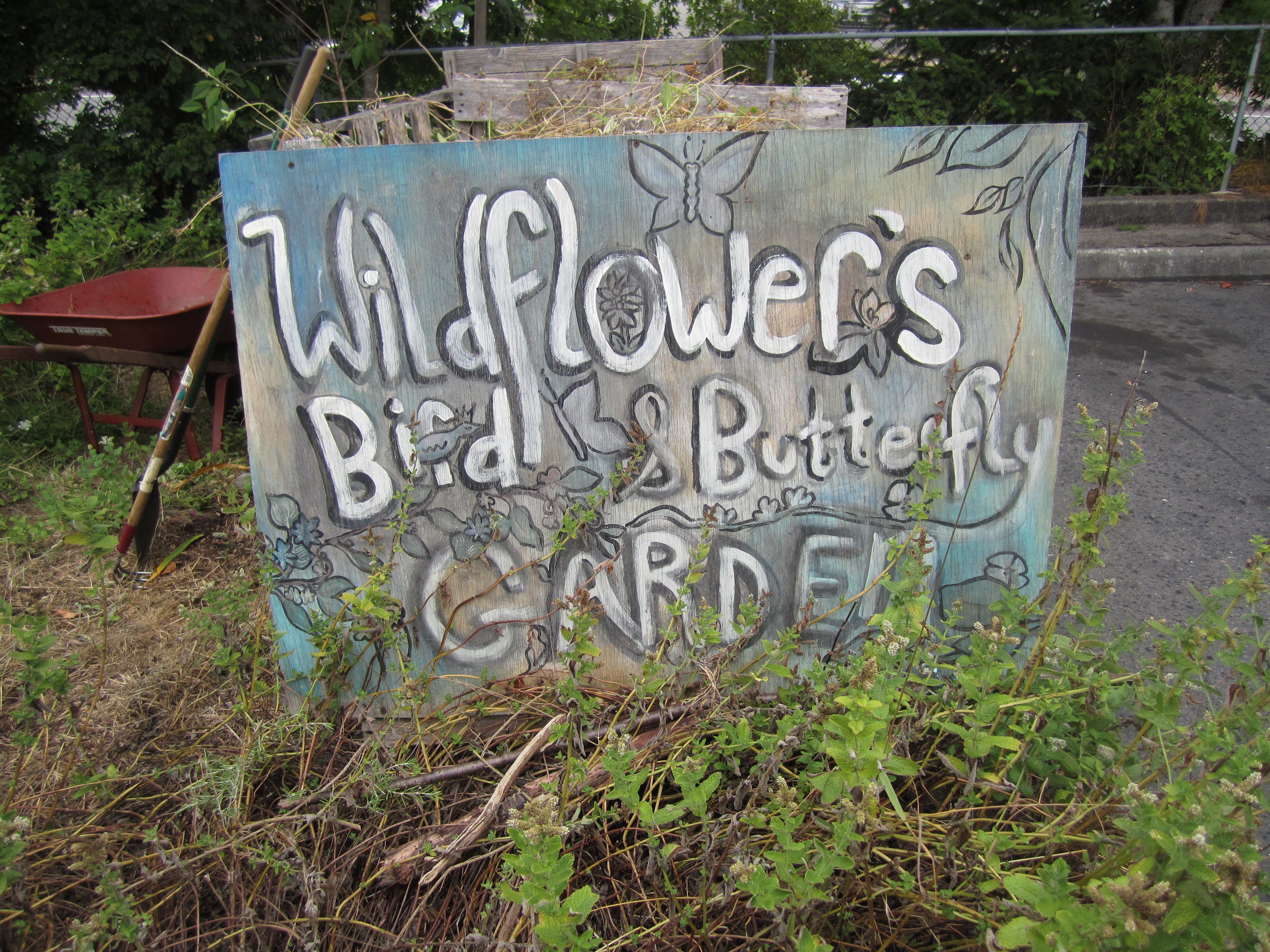
Yesterday I went on a quest for the fabled fungus that’s been mopping up petrochemicals from a food co-op’s parking lot. Olympia Food Co-op‘s eastside store was the place. I timed my visit just right, happening upon a crew of landscapers working the butterfly and bird garden.

The grounds of this food co-op include a sweet garden meant to attract pollinators.

Outside the food co-op is a sweet garden meant to attract pollinators (and people).

Sarika, the co-op’s landscape coordinator, jumped at the chance to tell me about the project. The mycoremediation began five years ago in partnership with Olympia Mycelial Network. Oyster mushrooms are able to digest petrochemicals into harmless compounds. So the drainage ditch of the parking lot contains several burlap bags full of oyster mushroom mycelium.

Bags filled with oyster mushroom mycelium.

Bags filled with oyster mushroom mycelium.

The idea is to filter the oil before it hits the drain down by the sidewalk.

Ever wonder where the runoff disappears to when it enters a drain like this?

Ever wonder where the runoff disappears to when it enters a drain like this?

I also met Brittany and Jordan, two young Louisiana-born “WWOOFers” volunteering with Sarika. They are traveling around the country with another friend, exploring farming innovations and learning how they can be of use to our beautiful planet. (Check out their adventures at Traveling Tripod.)

Jordan, Sarika, and Brittany

Jordan, Sarika, and Brittany

Brittany waxed eloquent about the role of mushrooms—this critical work is all about ensuring “clean water for everyone.”

Signage showing the overview of the mycoremediation

Signage showing an overview of the fungi’s work

Having been in the Pacific Northwest for almost a month, I’m beginning to grasp the extreme sensitivity of Puget Sound. This project represents just one small but significant effort to right the wrongs of our polluting ways.

Hood Canal, a basin of Puget Sound, as seen from Potlatch Beach on a moody day.

Hood Canal, a basin of Puget Sound, as seen from Potlatch Beach on a moody day.

The possibilities are staggering. Peter McCoy, who last year contributed a guest post about radical mycology, first told me about this project over a year ago. Finally seeing those humble mushroom bags doing their work brought tears to my eyes.

Sarika is looking into funding to pursue farther-reaching remediation. And the Radical Mycology Collective, of which Olympia Mycelial Network is a part, is launching its fall tour today. I can’t wait till the big Radical Mycology Convergence, taking place in Orangeville, IL this October!