Good to Grow

Guest post by Luke Taylor, who started a business called Good to Grow with his wife, Emily

Luke and Emily Taylor

Luke and Emily Taylor

Based out of Irvington, on the east side of Indianapolis, Good to Grow aims to harness the power of community to revolutionize the way we interact with overlooked natural resources.

What does it look like to “harness the power of community?” And what are these overlooked natural resources?

The power of community is a shared vision, and many hands. Our vision is one that makes it easy for neighbors to make choices that not only benefit their community, but also themselves. Choices like saving their food waste to create compost—and collecting rainwater to reduce water bills and strain on municipal utilities.

Good to Grow's custom-built water barrel towers enable urban gardeners to save large amounts of rainwater.

Good to Grow’s custom-built water barrel towers enable urban gardeners to save large amounts of rainwater.

Some might call this “being green,” or recycling. I am happy thinking of it as purely selfish.

If you have altruistic notions of saving the world one recycled cardboard box at a time, great! Continue seeking out ways to heal your part of the world through changes large and small. Your community needs more people like you.

Many in your community, however, need a layup. (Editor’s note: a layup, for the basketball-uninitiated, is the easiest of shots, more difficult to miss than make.) These folks will only choose to recycle if they are standing next to a bin or a forest ranger is looking in their direction.

Or if they receive something free as a reward. In short, they need incentive.

Developing an incentive framework to support behavior change is our goal at Irvington’s Good to Grow.

A bucket ready to receive a neighbor's vegetable scraps.

A bucket ready to receive a neighbor’s vegetable scraps.

One such framework is Irvington’s composting program. Already being championed by 16 households, this initiative’s ultimate goal is to collect compostable food waste and distribute finished compost (a valuable organic fertilizer) at the very same time. The idea is to connect beneficial behavior as seamlessly as possible with valuable incentive and convenience.

It is my hope that this idea encourages communities to create incentive frameworks of their own!

Luke Taylor moved to Irvington, Indianapolis with his wife Emily in early 2013. They chose this neighborhood mostly because of its strong sense of community. The Taylors wanted to be a part of it, and to encourage its growth. With Good to Grow as the vessel for delivery, they have a vision for Irvington that will amplify and enrich our local resources, bringing together an already blossoming Indianapolis community. One day, they dream to be able to enrich other Indianapolis communities in the same way by sharing the Good to Grow framework.

Going Soil-Friendly

Do you ever think about the importance of the innumerable tiny creatures living underground, right under your feet? In just one tablespoon of soil, according to North Carolina State University’s Cooperative Extension Service, some 50 billion microbes are working away.

That’s if the soil is healthy.

By NoNomme (Own work) [CC0], via Wikimedia Commons

By NoNomme (Own work) [CC0], via Wikimedia Commons

I remember a conversation with an Ohio woman active in the environmental movement. She told me a story about a farmer who decided to switch his (conventionally farmed) cornfields to chemical-free produce. His seeds sprouted, but grew stunted and deformed.

The land had been blasted with petrochemicals year after year. Now there was nothing left to support a plant. No microbes. No nutrients.

But it doesn’t have to be that way.

My most recent Farm Indiana piece concerns a small agricultural fertilizer business called Sterling Formulations, led by a young man aptly named Vince Plowman.

Sterling Formulations’ team assesses farm fields and recommends soil-friendly additives depending on the particular needs of each field. They apply microbes and micronutrients to balance and nourish the soil that nourishes us.

Filling a container with earth-friendly fertilizer concentrate at Sterling Formulations' Shelbyville, IN plant.

Filling a container with earth-friendly fertilizer concentrate at Sterling Formulations’ Shelbyville, IN plant.

The team includes an Amish farmer who offers knowledge based on generations of experience. (My people!)

“The Amish have been farming organically for centuries, and quite successfully,” Vince told me. “They treat their soil right, and guess what, they’re getting yields comparable to conventional.”

He was surprised to learn that conventional farmers are as receptive to this message as organic growers. He said, “We found, in talking to a lot of conventional farmers, that so many of them are curious.”

Corn Field

Though he half-expected a derisive response from the conventional agribusiness side, so far that has not been the case. “What we found is they’re absolutely afraid…They don’t know how to do it (transition off chemicals), and they don’t have anyone to step them through the process of going to organics without absolutely killing themselves. They’re used to getting 200 bushels an acre, and they’re afraid they’re going to get 50 next year” if they stop using chemicals.

What comes next in that scenario isn’t pretty: they’d likely lose their farm. And many in that arena are supporting multiple families on the farm.

But Sterling Formulations is stepping into the gap. The goal is to help heal beleaguered soil through tailored applications of microbes and kelp-based fertilizers. Instead of petrochemicals that artificially prop up crops, these nutrients and tiny creatures create a living medium for plants.

This is one of the most exciting developments I’ve heard about in a long time. Farmers who want to stop using chemicals can get support in the switch—and stay profitable during the transition.

You can read more about Sterling Formulations in my Farm Indiana story.

Celebrating the Promise

The highlight of my Fourth of July? It was not the fireworks nor the pretty paper lanterns floating up and glowing orange against the deepening dusk. No, the high point came during the drive home.

photo by Ian Kluft, via Wikimedia Commons

photo by Ian Kluft, via Wikimedia Commons

Our downtown viewing spot was a friend’s porch. Through the trees we could see the beautiful fireworks like flowers in the sky. But we left before the show was over, not being a fan of traffic. So we had fireworks in the rearview window while driving down the main east-west artery towards home. Here’s what struck me: the folks who came out all along the street to catch a glimpse of the fireworks.

It moved me to see the good people of eastside Indy taking over parking lots and green lawns, perching on guard rails and idling on off ramps, clustered in doorways and on sidewalks. All along the street, all the way to my neighborhood, they looked the same way. People of all ages and races and walks of life sat on their lawn chairs, blankets, and tailgates with their faces to the downtown skyline on a mild summer evening.

Maternal on the Fourth

I found it so tender to envision this scene replicated in small towns and municipalities and big cities all over the nation. My countrymen and -women seeing beauty in the sky, children gasping in delight (and dogs ducking in terror), all on the same night. That peaceful slump of bodies—lovers holding each other, parents pushing strollers, children racing around—just as they had on so many Fourth of July nights during my childhood.

I felt a rush of love for everyone celebrating the promise of our young country, and that may be as patriotic as I get.

Homegrown “Superfruit”

I saw this item for sale at my food co-op, Pogue’s Run Grocer, and it cracked me up.

Turkish Superfruit! Check it!

White mulberries, a “Turkish Superfruit,” only $5.99 for 4 ounces. What. A. Steal!

Just a week ago I spent a pleasant morning bicycling around the neighborhood with a friend. We stopped to pick from the mulberry trees that grow wild along the creek, meanwhile catching up on each others’ lives.

Mulberries are great in smoothies and crisps, and they are abundant, free, and nutritious (apparently a Superfruit, no less!). My friend and I were delighted with our harvest. Along with the usual purple, we found a white mulberry tree. It might be my imagination, but I always think the white berries are particularly sweet (though a bit less appetizing in appearance).

Superfruit from the hood. Free of charge. Bring your own bucket.

Superfruit from the hood. Free of charge. Bring your own bucket.

I once blogged about how homesteading (even on my modest scale) can make me feel like a chump because of all the extra work it takes to live “simply.” And how other times, I feel the tiniest bit smug, because—look! So much wealth on so little money.

Yeah, this is one of those smug times.

Peaceful Grounds

Monday morning a group of gardeners from the neighborhood had a private tour of Peaceful Grounds, Linda Proffitt’s endeavor at Marion County Fairgrounds, where the county fair is going on. (See my earlier post about her work here.) The vision and scope of this Global Peace Initiatives project astounded and inspired us.

The cattle barn at the Marion County fairgrounds is home to this volunteer-driven initiative.

The cattle barn at the Marion County fairgrounds is home to this volunteer-driven initiative.

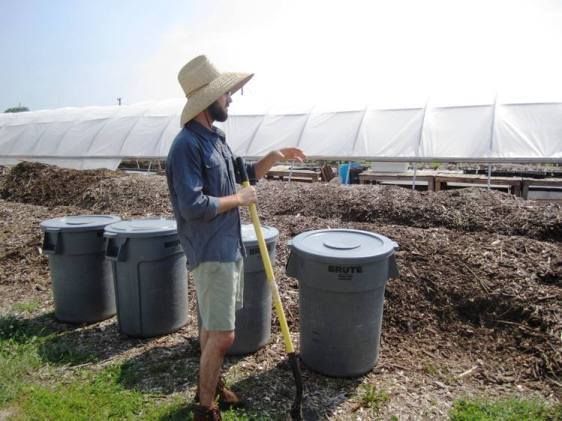
George Marshall, Linda’s intern, showed us around the farm, where mounds of wood chips are not just regular old wood chips but worm habitat.

George

George next to a hoop house that stayed warm all winter from heat given off by decomposition.

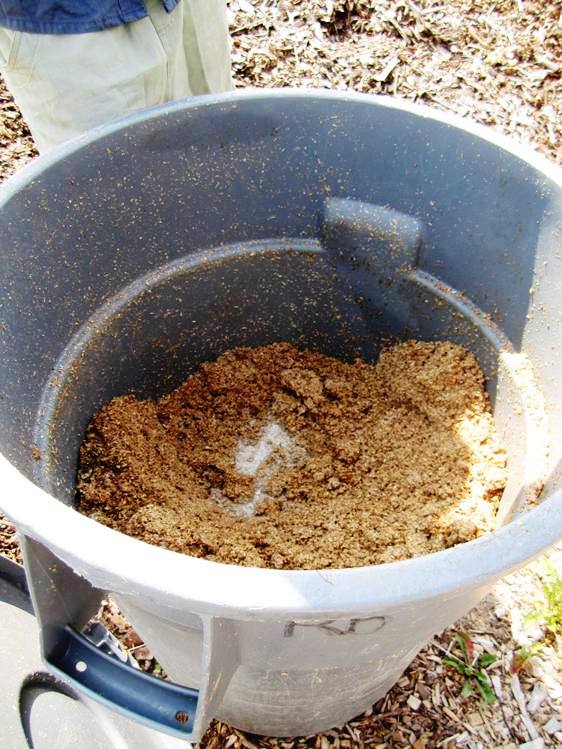
Peaceful Grounds takes beer mash from local brewers like Irvington’s own Black Acre and buries it in mulch to feed the herd of worms.

The spent grain is perfect worm food because barley fits easily into worms' tiny mouths.

The spent grain is perfect worm food because barley fits easily into worms’ tiny mouths.

Hand-painted signs that say “Worms at Work” and “Thank a Worm” testify to the importance of these little red wigglers.

IMG_3617

Digging up some of the underground workers to show us.

Volunteers mix 5 to 15 tons of mash with equal amounts of wood chips each week. Another mound incorporates dehydrated food waste from public hospital Eskenazi Health. Over time, these piles and rows are transformed into a viable medium for garden plants.

George showed us where vegetable and herb starts have been set right into these habitats.

broccoli

Broccoli planted in one of many windrows made by worms doing their work on wood chips and beer mash.

In a nifty closing of the loop, Linda has begun to raise hops to supply local brewers.

A few of Peaceful Grounds volunteer-planted crops.

A few more Peaceful Grounds volunteer-planted crops.

While we were walking down the raised beds (“windrows”) of basil and tomatoes, a fair official came up and asked for Linda. He wanted to introduce her to the people in charge of an elephant exhibit, so she could incorporate elephant dung in the farm operation. (“You never met a lady more excited about poop than Linda,” George joked.)

Inside the cattle barn is where kids and adults can come for hands-on fun with art and agriculture. It’s also where artists like Jamie Locke (another Irvington neighbor) demonstrate mandala making and other crafts—and where young volunteers from Handi-Capable Hands take charge of a gigantic tumbler that sifts the worm compost into two grades of product.

Heidi Unger took this photo of the tumbler, which is named Apollo and was donated by a local farmer who saw Linda on TV.

Heidi Unger took this photo of the tumbler, which is named Apollo and was donated by a local farmer who saw Linda on TV.

We went home with the finer grade, which is basically worm poo, to use as a powerful organic fertilizer. One tablespoon per plant will nourish it through a month, Linda says.

Worm castings make an excellent fertilizer. Now there's a local source!

Worm castings make an excellent fertilizer. Now we have a local source!

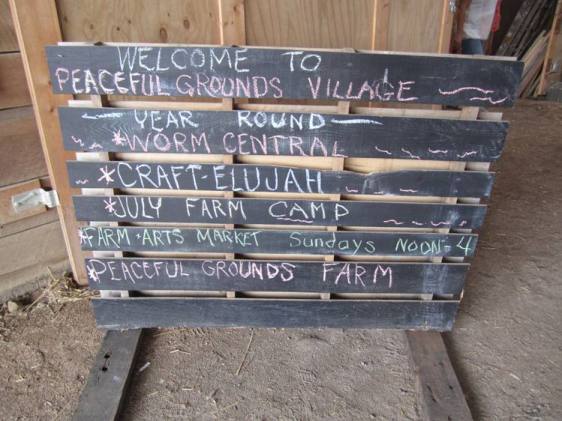
Before we left, we learned that Will Allen is going to visit the operation, which is a training outpost for his fabulous Growing Power organization. He will speak at 2pm Saturday and lead a workshop at 4pm, and will also preside over a ribbon cutting ceremony at noon on Sunday, when the Peaceful Grounds Farm and Arts Market kicks off.

IMG_3598I’d love to see more interaction between local urban gardeners and this facility, which is just a stone’s throw from Irvington’s back door. Right now the county fair is in full swing, but the possibilities extend beyond its closing date. Linda is running a Farm Camp for kids starting July 7, and is happy to host volunteers at any time.

By the way, she offered to set me up with an interview with Will Allen. I’m thrilled to meet this man I admire so much. I’m crowdsourcing interview questions. What would you ask the grandfather of urban gardening, if you could?

On the Solstice, Contemplating Home

On the longest day of the year, one week after leaving Playa, I’ve been thinking about all that “home” means to me. I loved Oregon’s pristine natural beauty. But I couldn’t wait to come home and walk the tree-lined streets of my neighborhood. Taking my dog Marley for a walk was high on my list on my first morning back.

It’s not perfect here. There’s litter, unlike in Lake County, OR, and sadly many of the neighborhood ash trees are not treated for emerald ash borer, so they are dying—a distressing sight. Poison ivy is rampant in untended corners. Plus it’s really damned humid. But I still walk along with my heart singing “home,” loving the big sycamores and tulip poplars, enjoying all those daylilies and clematis vines, sampling a mulberry here and there.

And getting the latest scoop. Down the street, my big softie neighbor still has the pit bull who wandered into his yard—the one he swore he wouldn’t keep. Farther on, the retiree who always complimented me on my dog (Lord, how that poodle can prance) tells me he and his wife are moving to a condo after 47 years here, but a young family up the street will be moving in. I learn about another neighbor’s dog’s bout with pneumonia. And so on.

Walking is one of the ways I savor my neighborhood, but it’s not the only way. About the second thing I did that day was ride my bike with Judy to the kickoff of the Irvington Folk Festival, a weeklong extravaganza that opened with an outdoor bluegrass concert. I’m no bluegrass aficionado, though I love a good Rocky Top as much as the next person. What I went for, and got, was the people.

In the crowd were Rosemary, and also Laura, two women who helped me found the Irvington Green Initiative years ago. Also our neighbor Pat, who told us of a possible grant for a native plant/foraging project we’ve been scheming.

We sat with Heidi and Mike, longtime gardening buddies who happened to bike up at the same time as we did, midconcert. Behind us were Jerome and his family. That was fortuitous, because I could update him on our sweetgum tree. (Arborist Jerome has a business called Tree-Centric, which I’ve blogged about before. A few weeks ago he assessed our ailing sweetgum, taking soil samples and cutting away girdling roots. The cost of his professional expertise? A loaf of homebaked bread.)

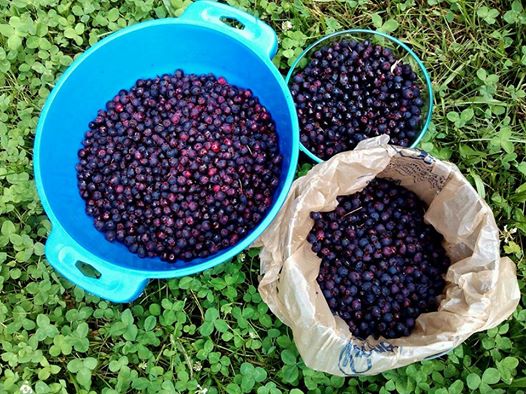
Jerome offered both his strawberry patch and serviceberry grove for picking. Though the strawberries were done, here's the lovely haul of serviceberries my friends and I made that morning.

Jerome offered both his strawberry patch and serviceberry grove for picking. Though the strawberries were done, here’s the lovely haul of serviceberries my friends and I made that morning.

Somehow, over the years, my roots have grown deep in this place. I grieve with friends who lost their 13-year-old German Shepherd, one of a gang of Marley met in the park as a pup. I pick mulberries and serviceberries (some from Jerome’s yard) while chatting with good friends. My yoga buddies welcome me back vociferously. I barter for Thai massage from a neighbor.

All that, plus (last night) hearing local musicians rock out, after eating at the new deli that sources everything it can locally.

How did I get so lucky? I don’t know, but I’ll contemplate the answer while biking to the park for the folk festival’s finale (and, bonus: alternative gift fair).

Building Soil, Growing Food, Nurturing Relationships

I just listened to a podcast interview with Linda Proffitt, founder and executive director of Global Peace Initiatives here in Indianapolis. I’ve known Linda since the days I was responsible for Nuvo Newsweekly’s monthly social justice calendar. Back then I called her regularly to find out about GPI’s peace hikes and other activities, and I was always impressed with her programming.

Since that time GPI’s work has exploded onto the local resilience scene. They started by helping church groups grow food for the hungry, bringing countless volunteers together to experience the transformational power of service initiatives.

peasIn 2011, the organization began a new partnership with one of the most influential forces in the urban farming movement. Will Allen and his team at Growing Power designated GPI as a regional training center for Central Indiana. Spring of 2012 saw a well-attended “From the Ground Up” workshop at Peaceful Grounds, GPI’s newly formed center for agriculture and sustainability.

If you have a chance to listen to the podcast, you might be struck (like me) by the idea that produce is just one output of Peaceful Grounds. There’s also soil, which is foundational. And then there’s relationships.

People coming together to cooperatively grow food can form some powerful ties. And that’s what it’s all about at Peaceful Grounds.

Sharing worms with youthful visitors

Sharing worms with youthful visitors

Now at the Marion County Fairgrounds, Peaceful Grounds is about to start a weekly farm and arts market, Sundays from noon to 4 starting June 1.

GPI’s work is featured in a chapter of the new book Deep-Rooted Wisdom by Augustus Jenkins Farmer. The chapter is called “Stop Tilling the Soil”—and worm composting is a big part of the system at Peaceful Grounds. (I was thrilled learn that the worms eat brew mash from my local microbrewery, Black Acre, located right here in Irvington.)

Linda will be the guest speaker at next Tuesday’s Green Hour, a project of the Irvington Green Initiative. If you’re in town, come out and join us to hear all about this vital work.

Photos courtesy of Global Peace Initiatives.

Farming Females

Last month I enjoyed interviewing several women for a special section in Farm Indiana on women in agriculture. While some didn’t consider themselves farmers, all had valuable perspectives about what it means to bring a female sensibility to agriculture.

Many spoke of women’s connection to the earth as something deep and primal. Several compared the nurturing of plants and animals to caring for children.

And Kay Niedenthal, an urban farmer in Indianapolis, might have been talking about our procreative power when she said, “It’s like magic to make something from nothing. To start with dirt and a seed and then have a meal.”

Anna Welch of Fields of Agape in a field being prepared for hull-less oats.

Anna Welch of Fields of Agape in a field being prepared for hull-less oats. (The periodical has a much better photo of Anna by the terrific photographer Josh Marshall.)

I was intrigued by the fact that Anita Spencer of Homestead Growers didn’t start out growing organically. She and her husband were Miracle-Gro fans at the start. When a friend asked if they’d ever considered going organic, she said, “We laughed at her!”

But that question planted a seed all its own. They took a look at the contents of the famed formulation and realized they didn’t want all those chemicals in their bodies and those of their children. Nor did they want to sell produce grown that way.

Now Anita is proud to offer high-quality, chemical-free food to her customers through both Homestead Growers and its spinoff line of tomato sauces, Local Folks Foods.

(As a side note, this anecdote showed me how questions can spur behavior change, even the questions don’t seem well-received. I resolve to ask more questions!)

For the full story, including seven mini-profiles of women in agriculture and Josh Marshall’s beautiful photos, see the current issue of Farm Indiana (page A8).

A Remedy for Nature Deficit Disorder

Guest blogger Dawn Slack wrote the following piece about Letha’s Fund, a terrific program of Indiana Native Plant and Wildflower Society (INPAWS). The fund facilitates schoolchildren’s nature-based excursions and youth-led projects. I am always happy to hear the latest on Letha’s Fund, because my Dad, Donovan Miller, was instrumental in setting it up. Check it out, and lend your support in his name if you feel so led.

Guest Post by Dawn Slack, Youth Outreach Chair for Indiana Native Plant and Wildflower Society (INPAWS)

garlicmustardpull_Ingraham

Kids initiated a garlic mustard pull with the help of Letha’s Fund

Knowledge Is Power

An essential INPAWS role is teaching our youth the value of our natural world, and connecting them to nature. Our members understand how nourishing it is to watch the sun rise and set, to set your hand in a riffle and watch water course downstream, to witness a flower blossom, or glimpse a dragonfly skimming the water’s surface.

We understand that experiencing nature enhances our ability to reason and solve problems. We know how being immersed in nature relieves our stress and energizes us.

We need our youth to understand these things too.

School outing at Winterhaven Wildflowers and Monarch Preserve

School outing at Winterhaven Wildflowers and Monarch Preserve

We Save Only What We Love

Our youth have little opportunity to bond with nature. Bombarded with technology that, sadly, discourages outdoor activities, they need encouragement and assistance getting outside.

In 2013 Letha’s Fund enabled almost 2,000 youth to visit natural areas or participate in outdoor experiences. And over the past five years Letha’s Fund has facilitated approximately 6,800 youth to learn about our amazing natural world.

Cold Spring students dig in, planting 400 plugs of forbs and sedges

Cold Spring students dig in, planting 400 plugs of forbs and sedges

Help Us Empower More Youth

Help us invest in a healthy future for our environment, one full of diversity and natural splendor, understood and loved by its future caretakers. Take a moment to learn about Letha’s Fund, share the flyer, and spread the word about such a wonderful program that is possible because of your aid.

Learn about Letha’s Fund on our website or send us your questions at lethasfund@inpaws.org or call us. Remember, knowledge is power. So pass it along, and help us help the next generation get into nature.

Harshman_kids_Ford

Harshman kids plant seedlings grown by Cold Spring School students with the help of INPAWS stalwart Donovan Miller (my dad!)

We will save only what we love;
We will love only what we understand;
We will understand only what we have been taught.

Senegalese environmentalist Baba Dioum

All photos courtesy of INPAWS.

Postscript: To read my dad’s invitation to INPAWS members to share their love of nature with children, click here and search on “Expertise Not Required.”


The Face of Resilience

Guest post by Anna Welch

Anna Welch is a farmer in Rush County, Indiana. With her husband and business partner, she owns Fields of Agape, growing organic grain, beans, and seed. Now she’s working to establish a cooperative mill in Carthage that would allow many more organic and transitional farmers to bring their products to niche markets. After we had a conversation about some of the barriers she’s faced, she sent me this reflection.

I think of the many times I wanted to quit, that it felt impossible to go forward with the limited resources and lack of support around me. I’ve been through periods of deep depression, anger, hopelessness, and resentment. I’ve been humbled many times over since committing my life to stewardship of the land and its fruit.

Anna Welch with friends at the entrance of the Carthage Mill. The historic Tweedy Lumber Mill is now the site of a sustainable ag business incubator.

Anna Welch with friends at the entrance of the Carthage Mill. The historic Tweedy Lumber Mill is now the site of a sustainable ag business incubator.

I had two choices: quit and return to the workforce, or retreat to a place of rest, and pray, reflect, journal, and wait to see who or what changed around me. Someone spoke words of encouragement, or a visitor stopped by the Carthage Mill and said how this place is necessary and will come to pass.

One of my greatest encouragers here at Carthage was my friend Allen, who came daily with his dog Rusty. The first day he stopped by, I was cleaning golden flax seed. He heard the machine and the gate was open, so he stopped. I’m so glad he did.

Allen had Lou Gehrig’s disease, but every day he drove his wheelchair on a route around Carthage, observing bean and corn fields, enjoying wildlife, and stopping by the mill, his favorite place. He worked the Alaskan pipeline in his younger years and lived in a teepee in Montana. He loved the mill, and he encouraged me to keep doing what I was doing.

I realized that if Allen could be in the state he was in and encourage me, then I needed to think outside of myself and look at what I could do to make a difference. Allen died this past October, and I officially formed The Carthage Mill, LLC with help from Hoosier Organic Marketing Education. I know he is pleased.

Regardless of the negative circumstances that we may be facing, there is always hope, always a divine purpose awaiting each of us—if we can turn our focus away from self and focus on those around us, on what needs exist, then determine what gifts and resources we have to overcome the challenge, or to serve someone. Nothing can stop us from fulfilling our purpose if we are on the right path.

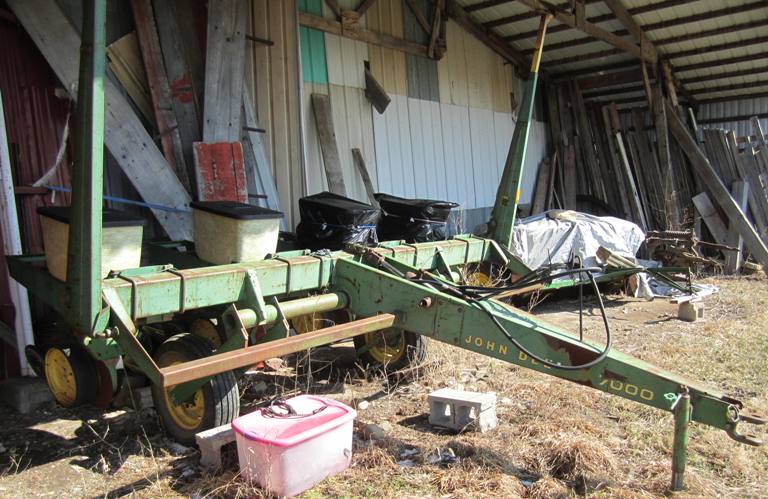
Equipment used to plant Fields of Agape grain and beans.

Equipment used to plant Fields of Agape grain and beans.

I have found that the success in life is how we learn to handle adversity and challenges. If we can grasp how to press on through adversity with humility and unconditional love for others (regardless of how they treat us), we will find our way.

When we find like-minded people whose passion is a good fit with our own, whose hearts are for others, then within that group each person can reach their potential quicker.

Encouragement, sharing of resources, being driven by the passion to serve rather than by personal gain—all of this brings about magnificent changes in communities large and small.

I’m never going to stop believing that it can happen.