Deep Learning Continues at Avon OLC

Guest blogger Jennifer Davies updates us on her work at Central Indiana’s Avon Outdoor Learning Center. We first posted about this phenomenal program last February, in Portal to the Wider World.

Guest post by Jennifer Davies

For those of you who have been following me and my stubborn refusal to walk away from my job teaching at and coordinating the Avon Outdoor Learning Center since our funding was cut in 2011, I have some good news! I first should point out that Carol Ford and I basically made up this position when I stumbled across the place, back when I moved to Indiana in 2006…and they let us, just to see what we had in mind.

We had just planted the garden (built with grants & volunteers), and hosted more than 7,000 students for the year, when a town referendum failed and the district had to shave $9 million from its budget. Since then I’ve relied on grants, fundraising and donations for my salary. Last year we served 9,100 children with programs designed to supplement classroom instruction with active, outdoor activities.
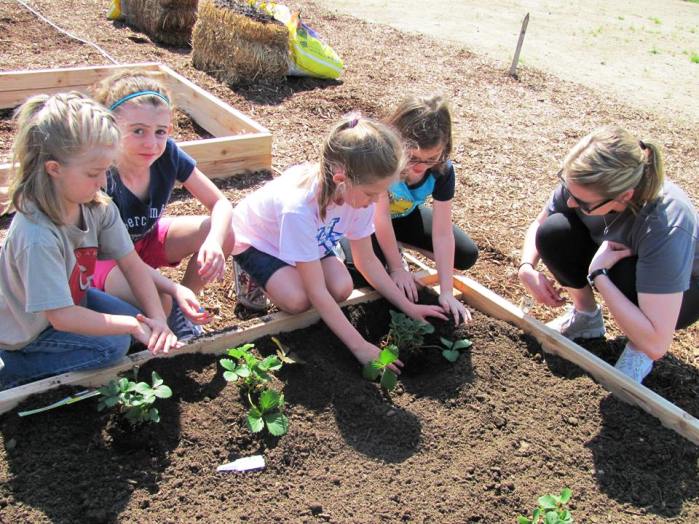
Planting garden at Avon Outdoor Learning Center

Planting garden at Avon Outdoor Learning Center

We’ve had fantastic community support, with students literally giving me their piggy banks and tooth fairy money. A new Superintendent is behind us. We have a rock solid belief that this patch of earth shows how public education can inspire lifelong learning—and a deep connection to one’s community. (And by “community” I mean local and global, human and otherwise!)

With the current administration turning over every rock, squeezing every penny, and encouraging this community to urge changes in recent school funding legislation, positive change is afoot: The district will be able to hire 20+ teachers to ease classroom sizes, and they are going to fund two-thirds of my position. I’ll still need to raise the remaining one-third, again looking to this community for their help in doing so.

A career path I’d recommend? Probably not. Job satisfaction? HIGH. I had a kiddo tell me two days ago that he tried three new foods (radish, green onion and spearmint) during his visit and he liked them all. Can you test that? Nope. But I’d be willing to bet the experience will be with him for a lifetime and might even help shape the way he looks at the world around him and his place in it.
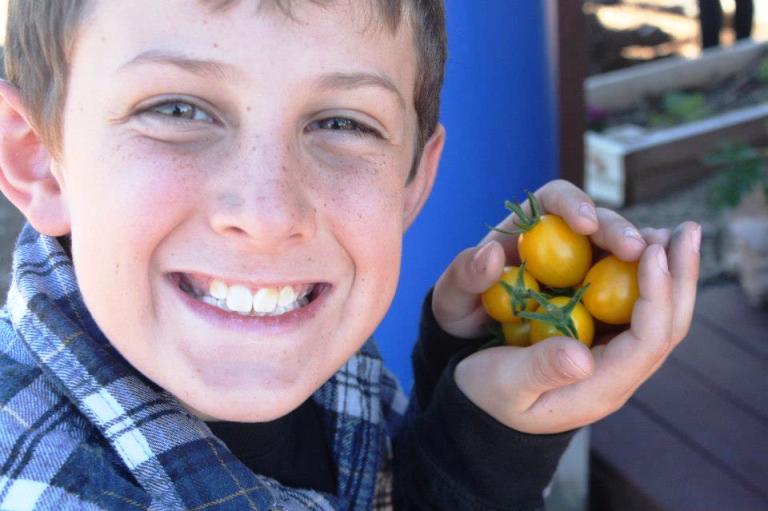
Harvest time at Avon Outdoor Learning Center

Harvest time at Avon Outdoor Learning Center

For those of you who have mixed your blood, sweat and tears with mine over the past few years—couldn’t have done any of it without you. For my family, for putting up with me and my loopy path—BIG Love. And for those cheering from a distance—Thanks! Can’t wait to see what next year brings!

If you need me, or have an idea for fundraising, I’ll be in the garden…

Note: To contribute volunteer time, fundraising ideas or donations to Avon OLC, email olc@avon-schools.org

Photos courtesy of Avon Outdoor Learning Center.

Fomenting the Ferment

Fermentation on Wheels rolled into town over the weekend. Tara Whitsitt has been driving her mobile fermentation lab cross country since October 2013. As soon as I heard she was coming to Indy, I knew I had to make it to one of her events.

Fermentation on Wheels, a 1986 International Harvester school bus converted to a mobile fermentation lab

Fermentation on Wheels, a 1986 International Harvester school bus converted to a mobile fermentation lab

Tara’s mission is to initiate more people into the wonderful world of fermented foods (like sourdough breads, kefir, sauerkraut, wine, and kombucha). So far her tricked-out bus has traveled over 12,000 miles to share the love.

Tara with pawpaw vinegar

Tara with pawpaw vinegar

Saturday she did a fermentation workshop, which I hear was fabulous. Sunday evening, Seven Steeples Urban Farm (see my earlier blog post about them here) hosted a potluck and culture exchange. That’s where we met Tara and her beautiful kitty.

Tara's cat Franklin is her traveling companion.

Tara’s cat Franklin is her traveling companion.

We had a terrific meal together that included loads of fermented drinks and veggies, some from the pros: Joshua Henson of Fermenti Artisan brought cultured ramps and daikon radishes, along with water kefir lemonade and a bunch of other delicious stuff. There was also a popular fermented drink called beer.

After we ate, it was time to check out the bus.

Inside the bus, where all kinds of groovy stuff ferments!

Inside the bus, where all kinds of groovy stuff ferments!

“I really want to spur the movement of getting back in the kitchen and doing things with our own hands instead of relying on other people to do it for us,” Tara told us.

All across the country, she’s been partnering with farmers and homesteaders to turn local harvests into something out-of-this-world delicious. People give her their home-canned peaches, for example, and bushels of chili peppers. She dried the chilis and used them in kim chee, and they are also a key ingredient in her peach-habanero mead.

Peach habanero wine-in-the-making

Peach habanero mead-in-the-making, with blackberry mead at left

We sampled kombucha, miso, and a mysterious drink of Tibetan origin called “jun.” (Instead of the black tea and sugar that make up kombucha, jun favors green tea and honey.)

We sniffed three types of sourdough starter, each with a different backstory. For example, the Alaskan sourdough came from a person in Portland whose great-grandmother had made it in the 1900s in Alaska. White flour and milk were the original ingredients, and that’s what Tara feeds it to this day. The starter is a key ingredient in creamy sourdough hotcakes favored by Alaskans.

No wonder she calls her starter cultures “heirloom” cultures: They’re completely different from something purchased online, typically made in laboratories.

Eating food from a starter passed down for generations is like wrapping your grandmother’s Afghan around you. Versus a Kmart coverlet. One is imbued with love and history. The other with factory threads and who-know-what labor injustice.

IMG_4728I wish I could say I had something terribly cool to swap with Tara, but she wasn’t all that keen on my dairy kefir grains (of unknown origin: a friend of a friend gave them to me). So, I purchased a rye starter that hails from Brooklyn. As we speak, I’ve got sourdough rye bread dough fermenting on the counter. I’m using Tara’s instructions and recipe: Fingers crossed!

The Miracle of Seeds

I’ve been thinking about how tenacious life is, encapsulated in a tiny seed. Some seeds I plant, but others sprout all on their own.

I’m probably the only person on my block who gives a cheer when she sees these coming up.

Lamb's quarters

Lamb’s quarters

These are lamb’s quarters, considered a weed, but deliberately planted two years ago in my garden. This is the second year they will have reseeded, and I can’t wait to taste them again when they get a little bigger. (They’re terrific fried crispy in my cast-iron skillet, with a couple eggs cracked over them. And incredibly energizing, as all edible weeds are.)

Here is part of another patch of self-sowing plants that are on their third (or fourth?) year of growing freely in my garden: arugula.

Arugula volunteers in leaf mulch

Arugula “volunteers” in leaf mulch

I wasn’t sure they would come up this year because I mulched so heavily last fall with shredded leaves. But lo: I pull away the top layer and find them rooted right in the leaf mold.

Miracles like these show up all the time, if we know to look.

“There is no way to re-enchant our lives in a disenchanted culture except by becoming renegades from that culture and planting the seeds for a new one.”

Thomas Moore, author and psychotherapist

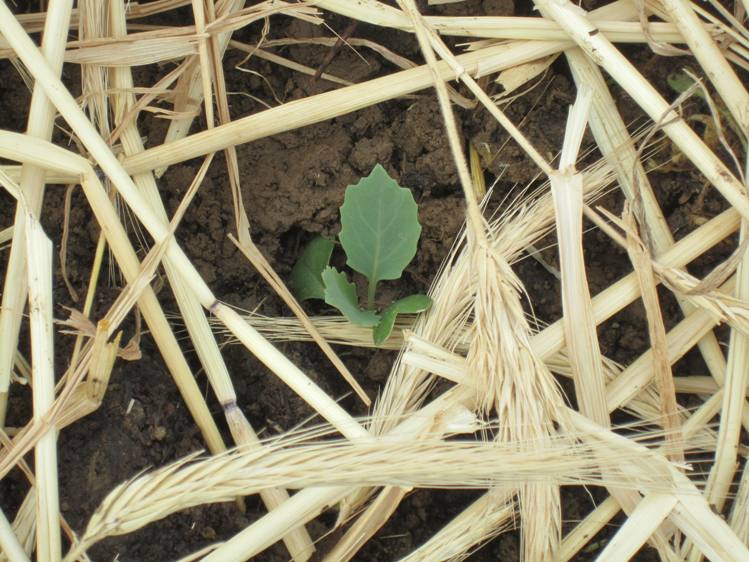
Perhaps growing food for people in need would fall under this “renegade” notion? Here is a seedling started by a southern Indiana farmer and planted by a volunteer for the Hoosier Hills Food Bank.

Cabbage seedling planted by a volunteer at a food bank garden

Cabbage seedling planted by a volunteer at a food bank garden

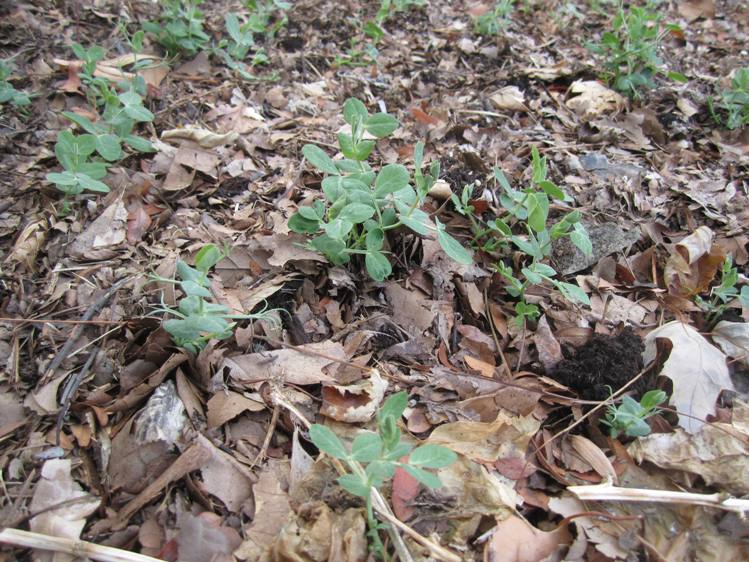
And one more: Late last fall I blogged about starting Austrian winter peas and my happiness at their growth in cold weather. They are generally not grown for a pea harvest, but intended as a cover crop with benefits—pea shoots are sweet and tender.

They didn’t do much during the winter, but this spring they are the healthiest of plants in my garden. I have snipped them nearly every day as salad and smoothie additions, and they are growing as fast as I can cut!

Austrian winter peas in spring

Austrian winter peas in spring

With seeds on my mind, no wonder this statement in a new mother’s Facebook post snagged my attention:

“I did not know until I got pregnant that the first organ to develop is the heart. It’s as if a heart seed gets planted and from the heart grows the human.”

Laura Henderson, founder of Growing Places Indy

Miraculous.

Love Where You Live

I asked for a magnifying glass in my Christmas stocking this year. I’d just read Lyanda Lynn Haupt’s excellent book Crow Planet, in which she advocates becoming a “citizen naturalist.” I aspire to that: to take the time to look closely at nature, right here in the urban habitat. (She takes up a similar theme in The Urban Bestiary, which I enjoyed just as much.)

I wish I’d had the magnifying glass with me the other day when I was walking my dog and spotted the first yellow crocuses popping up. I could have fallen on my knees in front of them. I love the beauty of winter, but after days on end of white/gray/black/brown, that splooch of color just about knocks me out.

Photo by Vincent de Groot, via Wikimedia Commons

Photo by Vincent de Groot, via Wikimedia Commons

Wendell Berry has written of the importance of “backing out of the future into the present, where we are alive, where we belong.” As we make this shift, he says, we also move our focus from an abstraction called “the environment” into the places where we actually live.

This makes sense. When I co-founded the Irvington Green Initiative some years back, we settled on the tagline “Love Where You Live.”

The notion was echoed by my friend Maggie Goeglein Hanna, executive director of Fall Creek Gardens Urban Growers Resource Center. In a recent conversation, she said:

“I feel like you can’t really expect people to care about the natural world if they have no investment in their own place … In my mind, environmental solutions aren’t going to come if we’re only concerned about the pandas in China or the rainforest in the Amazon. Those are important things, but so is our own place, and it won’t ever get better if we all don’t take care of our own place.”

She went on to say that organic gardening in a community setting, as at Fall Creek Gardens, is a way of “opening up the conversation.” Finding earthworms in ground that used to be compacted dirt, watching a family of mockingbirds, planting seeds—all of these root us in the soil that nurtures us.

So with spring officially just hours away (wahoo!) (at least in the northern hemisphere), I’m doing more than planning this year’s garden. I’m renewing my commitment to enjoying the place where I live, and to observing the creatures and plants that share it with me.

What about you: What does it mean to love where you live?

A Mycological Field Trip

Yesterday we drove down to southern Indiana to visit Magnificent Mushrooms, Eric Osborne’s hub for all things mycological. Located outside of Paoli, IN, this growing business offers products and information for the would-be home mushroom cultivator.

That turns out to be us: we came home with three kinds of spawn to put to work here on our wee homestead: “old faithful” shiitakes, Lion’s Mane, and King Stropharia (winecaps).

I will keep you posted on our efforts to expand our food production into the fungal kingdom! I’m a bit concerned about keeping Kitley (our outdoor cat) and his pals away from the logs and woodchips we’ll use as substrate. As I understand it, mushrooms are tolerant of many things…but they probably wouldn’t want to drink cat pee or get all clawed up, any more than I would.

Old Faithful is a strain of shiitake that is slightly furry. Here it is growing off a block of sterilized, inoculated grain.

Old Faithful is a strain of shiitake that fruits in a slightly furry mushroom. Here it is growing off a block of sterilized, inoculated grain.

I’m most excited about attempting to grow winecaps, also known as “the garden mushroom” for its friendly affinity for the vegetable garden.

Bags of King Stropharia spawn

Bags of King Stropharia (winecap) spawn

We plan to try starting it not only in our backyard beds, but also in a low-lying place in the front yard. A natural bowl beneath the sweetgum tree is often waterlogged, and Eric said this kind of spot is perfect for winecaps.

As for Lion’s Mane, I’ve never eaten it, but Eric says it tastes like “heaven on earth.” It’s a pale blobby mushroom that looks a bit like some oceanic organism. Or maybe a cartoon nose.

Eric and I petting a Lion's Mane mushroom.

Eric and I petting a Lion’s Mane mushroom.

Eric sells his harvest to area chefs, so if you’ve eaten a mushroom dish at a Bloomington restaurant, you may have sampled his wares.

He also offers cultivation workshops and consultations. In partnership with the Hoosier Mushroom Society and the state department of health, he’s developed a certification course for wild mushroom hunters, which would allow them to comply with regulations around selling their harvest.

Speaking of: Know any good morel hunting spots?

Seven Steeples Farm

Last month I got to meet Justin Berg and Mike Higbee, who are doing something I admire: turning unused urban land into an agricultural oasis. As with many such endeavors, they glean local materials to build soil—leaves from curbside refuse, manure from the police department’s Mounted Patrol stables.

What’s unique about this urban farm, though, is that it’s being built atop the pulverized remains of an old mental institution.

Seven Steeples Farm

Seven Steeples Farm

To anyone growing up in Indy, as I did, “Central State” was synonymous with the loonybin. We all knew that it was an insane asylum, back in the day, and as late as 1994 it was still operating as a psychiatric facility.

The enormous campus fell into disuse after Central State Hospital closed, but recently the site has been redeveloped into Central Greens urban village. Part of the project includes Seven Steeples Farm, so-called because the 5-acre parcel being farmed is on the footprint of a building called Seven Steeples, where women were institutionalized.

The building was demolished midcentury, and apparently is now buried under the vast lawn area where Justin and Mike have begun growing produce for the past year. Sheltering old trees that must have borne witness to all kinds of pain still stand, shading the chicken run and outdoor classroom area.

I have to say, this thing has lit my imagination in surprising ways. I’ve read The Yellow Wallpaper and other stories of “madwomen in the attic.” How easy it was to cart women away for any infraction back when this asylum was established (1850s.) I can think of several reasons why I myself, in an earlier era, could have gotten myself tossed in there.

And what sort of “treatment” did the women undergo, inside the walls of Seven Steeples?

It feels to me like a major healing of an old wound to have an urban farm there. Community volunteers (and patrons) enjoy a peaceful setting smack in the middle of a somewhat sketchy part of town. The food is accessibly priced so that people living in the middle of a food desert can have a decent choice of nourishment.

Justin Berg, farm manager, and Mike Higbee, project coordinator, with lady friend

Justin Berg, farm manager, and Mike Higbee, project coordinator, with lady friend

Visitors love to sit on the stumps next to the chicken run and just get on “chicken time.”

The farm has announced 2015 CSA (community supported agriculture) plans, and will also have a weekly farm stand to sell eggs and produce. (More info: info@sevensteeplesfarm.com or 317-713-9263.)

Justin says, “Call to set up a tour, and everyone’s more than welcome to come by the farm stand if they’re in the area. They can grab up some produce and come check out what a rural setting could look like in the city.”

See my Farm Indiana piece for more on this project.

Peas and the Possible

“The Possible’s slow fuse is lit

By the Imagination.”

—Emily Dickinson

Austrian winter peas planted in my garden

Austrian winter peas planted in my garden

We have already had snow and single digit wind chills here. Yet these Austrian winter peas, planted very late, still grow.

My friend Dawn gave me a couple generous handfuls of seed to play with. I’d never heard of this hardy cover crop that doubles as a tasty wintertime salad green. But Mother Earth News had the full scoop on  planting Austrian winter peas. So somewhere between transplanting herbs and cooking up harvest stews, I threw those seeds in the ground.

I’m so glad I did!

This is the time of year when nighttime slams down on us pretty hard. A time for diving deep and dreaming. Those tender sprouts remind me that sweet tendrils of possibility can thrive in this liminal space.

I’ve been spending a fair amount of time in a space of unknowing. Allowing guidance to emerge organically, and playing with a deeper trust than I’ve ever had before.

And I love walking out my back door and seeing my little crop. If I never get to eat the shoots, I’ll be perfectly happy just with the view.

Thanks to Yes Magazine‘s Winter 2015 issue for the stunning Dickinson quote.

Neighborliness in a Soup

An email came into my inbox a few weeks ago announcing an initiative called City Suppers. The goal of the program—co-sponsored by City Gallery, Harrison Center for the Arts, and Indiana Humanities—was simply to promote neighborliness by way of soup. On a particular night, everyone citywide was encouraged to sign up to host their neighbors for a simple dinner.

Of course, I loved this idea.

As it turned out, my spouse and I had been talking about having a casual neighborhood get-together for a while. City Suppers gave us the impetus to actually do it—not to mention a deadline to get the house clean.

In my neck of the woods, we define “neighbor” rather loosely as “anyone else who lives in Irvington or thereabouts.” So we invited an assortment of folks—some from just around the corner and some from further afield.

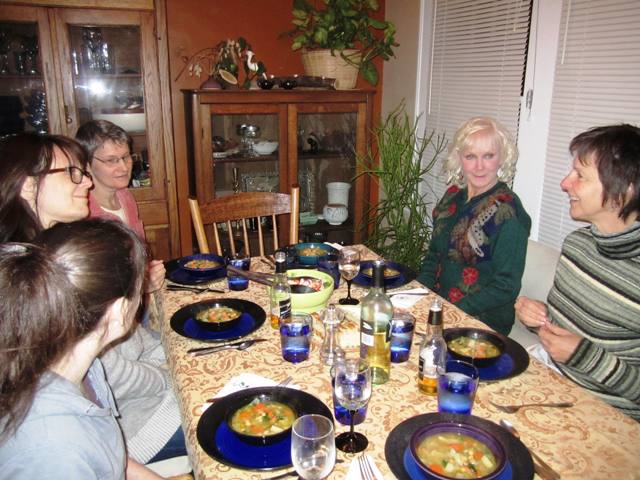
Around our table

A few of those who gathered around our table

Some had never met each other, and others had known each other a long time. Ages ranged from 1 year old to “I’ll never tell.”

We gathered around our table for a convivial evening. I made minestrone and bought some locally made focaccia and cheese. (Everyone seemed terrifically happy with the soup, which we call “peasant food” at our house—nothing all that fancy, but hearty, economical, and flavorful.) Guests brought wine, salad, and desserts. Truly mouthwatering desserts.

But the tasty, nourishing meal was really just an excuse for conversation and connection.

Life can be a full plate most of the time. So full that it seems hard to find the time for this kind of thing. In our neighborhood we have often socialized around shared projects. It was a novel change of pace to connect over a meal instead of at a meeting or work party.

We enjoyed it so much that we’re making more peasant food tonight and having different neighbors over. We’ll go to Russia instead of Italy, with borscht, rye bread, and beer. (Incidentally I traded with another neighbor—my chili peppers for her beets—for the starring veggie of the borscht. Our version of the “cup of sugar.”)

And bonus: the house is still pretty clean. Not that that matters—I figure if we waited till the perfect time to have people over, it would never happen. So why not just do it?

How about you—what’s your favorite way to connect with your neighbors? Is there something you’d like to initiate with the people living near you, but have been putting off? Why not get it going? It could be just the thing to warm a chilly winter night.

Expanding the Medicine Chest with Herbs

Last week I spent a sunny afternoon working an herb garden while learning more about the uses of medicinal herbs. My friend Greg Monzel is a community herbalist who’s helped many (including me) with natural medicines that he grows, gathers, and prepares. Another friend, Dawn Ryan, also helped with Greg’s culinary herb garden in exchange for several transplants.

We started with homemade herbal tea in the kitchen, where Greg’s son charmed the socks off us.

Ready for action

Ready for action

Since moving to this property, Greg’s had all his herbs in the “back 40.” Our goal was to help transplant culinary herbs to a kitchen garden right outside the back door.

To the back 40, with Greg's dog Timber eager to show us the way.

To the back 40, with Greg’s dog Timber eager to show us the way.

His ingenious plan: to keep a slight trench running the length of the bed, starting near the hose and slanting slightly toward the opposite end. With cornstalks laid in as slowly-decomposing organic matter, the trench will allow for ease of watering. Prepping the bed was our first task.

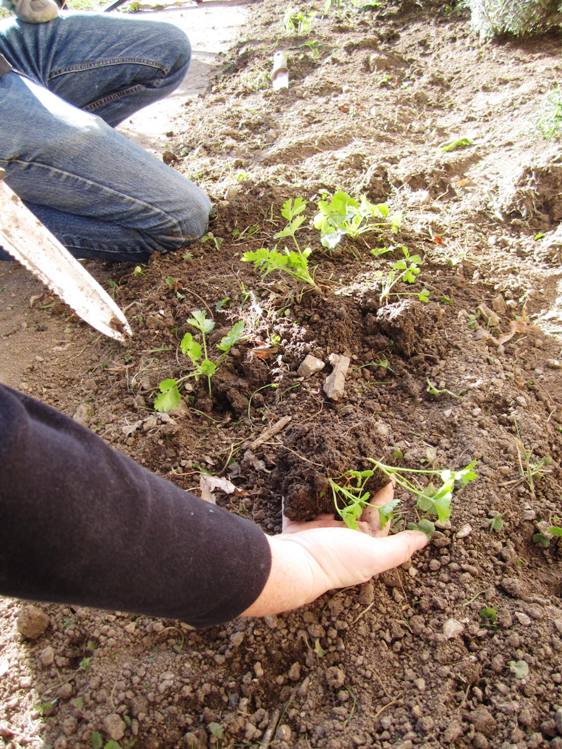
Planting cilantro in front of the trench

Planting cilantro in front of the trench

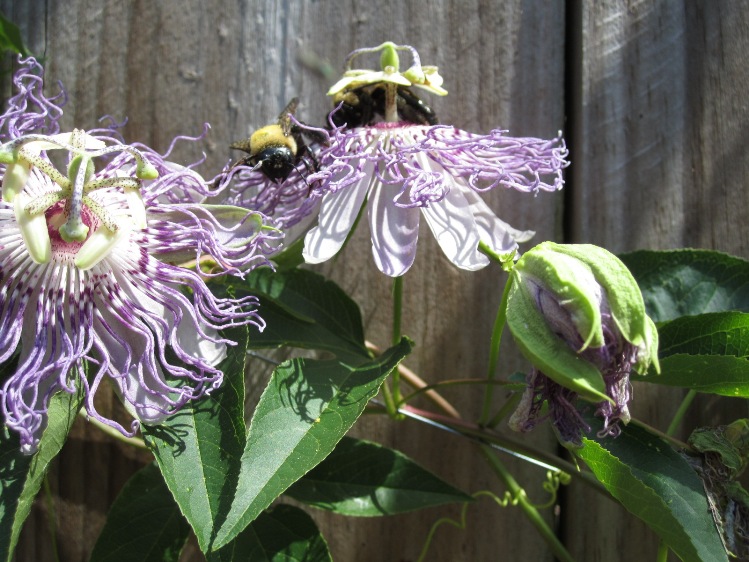
Then, over lunch of butternut squash soup and salad straight out of the garden, we talked about medicinal herbs. Greg produced a book called The Herbal Medicine-Maker’s Handbook, which included a list of the most useful herbs. I realized I already have several of these in my garden, though I only actively use one. (We have a passionflower growing up our fence. I cut the vines in fall to dry into a calming tea. That’s after we—and the bumblebees—enjoy the blooms all summer.)

A maypop planted along our fence, one of many plantings inspired by permaculture

Passionflower in summer. We thought we were growing it  for its fruit, but for me, it’s all about the tea!

And did you know that many culinary herbs also have medicinal function? Greg gave the example of sage: It dries up things like colds and post-nasal drip. This makes me happy to host three large sage “bushes,” which we periodically snip for seasoning and smudging.

Later, after we’d dug up and moved sage, lavender, thyme, parsley, and the like, it was time to make our selections from Greg’s herbs. I chose creeping thyme, feverfew, valerian, motherwort, pennyroyal, spearmint, yarrow, and a lovely wild mint that has been going strong for a couple generations now. Greg’s Dad first brought it into his garden, and Greg took starts of it, and now is giving starts away.

Herbalist and son showing us medicinal herbs

Herbalist and son showing us medicinal herbs

That’s the way of gardeners, isn’t it? In fact, the day reminded me an awful lot of hanging out with my Dad in his garden on a fall day. He’d divide plants and offer them to me and any of my friends who expressed the slightest interest.

Dawn and I worked together the next day, figuring out where to tuck in our new babies, giving them a good start. It felt great to expand the resilience of my home medicine chest, especially in such good company. And maybe someday soon I will have starts to give away myself.

diggin

DIY Food, Medicine, Soil: There’s a Shroom for That

I am still thinking about the Radical Mycology Convergence, an incredibly enriching experience. My last post covered mainly big picture inspiration. Here’s some more hands-on stuff.

For someone who likes to pick wild berries and weeds, I’m terribly ignorant of wild mushrooms. I had no idea that I could eat the puffball mushrooms that occasionally pop up right here in urban yards (my own included).

By Nowa (Own work), via Wikimedia Commons

By Nowa (Own work), via Wikimedia Commons

In a workshop called “Foraging for Five Foolproof Fungi” we learned about morels, maitake, chicken of the woods, puffballs, and oyster mushrooms. I now desperately want to go mushroom hunting.

But fungi offer us way more than food. As anti-tumor agents and immune boosters, certain mushrooms are powerful medicine. I was excited to hear Peter McCoy speak about home cultivation techniques as a way to make these therapies more affordable.

He said that capsulated versions of medicinal mushrooms are simply mycelium grown on brown rice and dehydrated, with an expensive price tag slapped on them. He passed around a bag of myceliated grains—I think it was cooked rye that had been inoculated with a type of medicinal mushroom mycelium—that kind of looked like white popcorn all mashed together. This is home-cultivated medicine that you can eat (although it probably doesn’t taste like popcorn!)

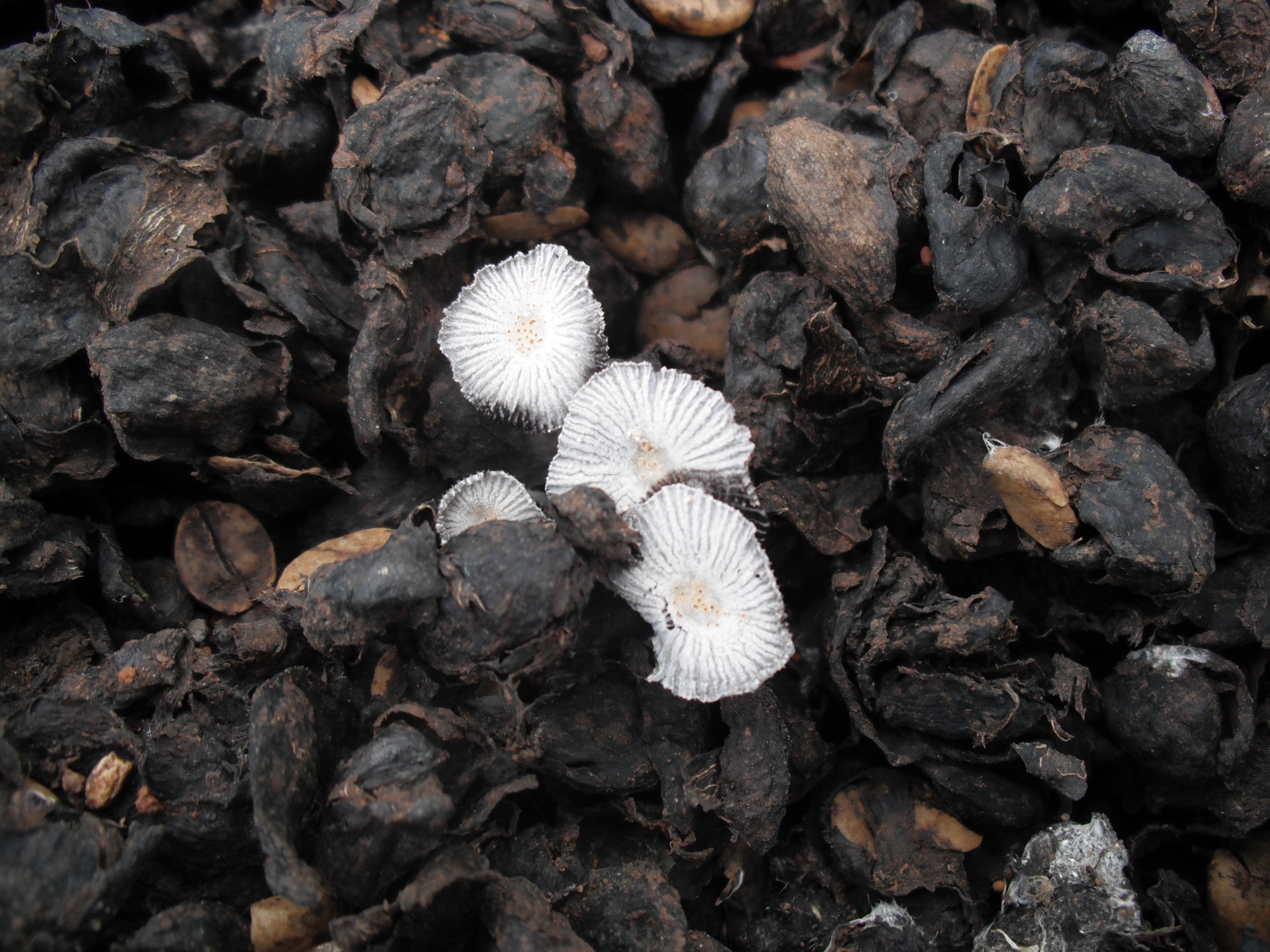
Then there’s the way fungi can turn waste products into food. I blogged about an example of this last year—how coffee plantation waste, normally burned, can be fed to mushrooms.

Coffee_pulp_mushroom

A mushroom growing on coffee pulp in south-west Rwanda, via Wikimedia Commons

It’s mind-boggling that a nutrient-dense superfood has so few demands; oyster mushrooms, for example, are 30 percent protein and can grow on cardboard! Even citydwellers with limited time and space can grow myceliated grains as a healthy, immune-boosting food.

And as soil helpers, fungi are critical. Below the soil surface many species of fungi are working their magic. But one species in particular, known as wine caps, has double benefit: They fruit with a deliciously edible mushroom, and they build soil tilth. They’re known as the garden mushroom for the way they can be cultivated right alongside garden vegetables.

"Stropharia aurantiaca". via Wikimedia Commons

“Stropharia aurantiaca,” via Wikimedia Commons

The upshot: My spouse and I have moved from this feeling of “it’s too overwhelming to take on a new project” to “let’s grow some mushrooms!”

We came home with plug spawn for chicken of the woods, and I’ve talked to my arborist friend about sending some logs my way this winter. (He said he’d love a few bits of spawn in exchange, and I’m happy to share!) We also want to try growing some winecaps in our garden beds. And since these are both spring projects—and who wants to wait?—we’ll probably grow oysters indoors from a kit this winter.

Stay tuned for reports on our experiments!

Can’t get enough radical mycology? Check out this interview with Peter at Permaculture Voices—the link has several videos showing hands-on home cultivation steps as well.