Fomenting the Ferment

Fermentation on Wheels rolled into town over the weekend. Tara Whitsitt has been driving her mobile fermentation lab cross country since October 2013. As soon as I heard she was coming to Indy, I knew I had to make it to one of her events.

Fermentation on Wheels, a 1986 International Harvester school bus converted to a mobile fermentation lab

Fermentation on Wheels, a 1986 International Harvester school bus converted to a mobile fermentation lab

Tara’s mission is to initiate more people into the wonderful world of fermented foods (like sourdough breads, kefir, sauerkraut, wine, and kombucha). So far her tricked-out bus has traveled over 12,000 miles to share the love.

Tara with pawpaw vinegar

Tara with pawpaw vinegar

Saturday she did a fermentation workshop, which I hear was fabulous. Sunday evening, Seven Steeples Urban Farm (see my earlier blog post about them here) hosted a potluck and culture exchange. That’s where we met Tara and her beautiful kitty.

Tara's cat Franklin is her traveling companion.

Tara’s cat Franklin is her traveling companion.

We had a terrific meal together that included loads of fermented drinks and veggies, some from the pros: Joshua Henson of Fermenti Artisan brought cultured ramps and daikon radishes, along with water kefir lemonade and a bunch of other delicious stuff. There was also a popular fermented drink called beer.

After we ate, it was time to check out the bus.

Inside the bus, where all kinds of groovy stuff ferments!

Inside the bus, where all kinds of groovy stuff ferments!

“I really want to spur the movement of getting back in the kitchen and doing things with our own hands instead of relying on other people to do it for us,” Tara told us.

All across the country, she’s been partnering with farmers and homesteaders to turn local harvests into something out-of-this-world delicious. People give her their home-canned peaches, for example, and bushels of chili peppers. She dried the chilis and used them in kim chee, and they are also a key ingredient in her peach-habanero mead.

Peach habanero wine-in-the-making

Peach habanero mead-in-the-making, with blackberry mead at left

We sampled kombucha, miso, and a mysterious drink of Tibetan origin called “jun.” (Instead of the black tea and sugar that make up kombucha, jun favors green tea and honey.)

We sniffed three types of sourdough starter, each with a different backstory. For example, the Alaskan sourdough came from a person in Portland whose great-grandmother had made it in the 1900s in Alaska. White flour and milk were the original ingredients, and that’s what Tara feeds it to this day. The starter is a key ingredient in creamy sourdough hotcakes favored by Alaskans.

No wonder she calls her starter cultures “heirloom” cultures: They’re completely different from something purchased online, typically made in laboratories.

Eating food from a starter passed down for generations is like wrapping your grandmother’s Afghan around you. Versus a Kmart coverlet. One is imbued with love and history. The other with factory threads and who-know-what labor injustice.

IMG_4728I wish I could say I had something terribly cool to swap with Tara, but she wasn’t all that keen on my dairy kefir grains (of unknown origin: a friend of a friend gave them to me). So, I purchased a rye starter that hails from Brooklyn. As we speak, I’ve got sourdough rye bread dough fermenting on the counter. I’m using Tara’s instructions and recipe: Fingers crossed!
The Urban Forest

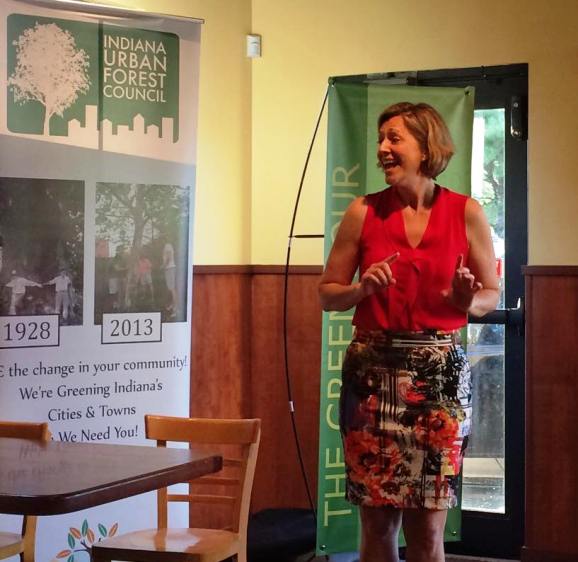
Holly Jones grew up considering trees as relatives. A Native American (“though I might not look like it!”) she sees the world populated with winged people, creeping people, branching people. “A lot of different people are considered sacred in my circle.”

As director of the Indiana Urban Forest Council, she brings that sense of interconnection to her advocacy.

Holly spoke to a group of treehuggers in my neighborhood this week at the Irvington Green Hour.

Holly Jones at the Indiana Urban Tree Council

Holly Jones at the Indiana Urban Tree Council. Photo by Jeff Echols.

She asked us to consider the sounds we might take for granted, the chickadee’s call and other songs of the urban forest. “These sounds are a part of you whether you realize it or not,” she said. “And these sounds are quietly going away.”

With landscapes devoted to specimen plants that hail from a completely different part of the world, it’s no wonder that native species are struggling. Jones said a turnaround will require a different mentality than purchasing random flowering plants from the big box store. Choosing native plants is the only way to feed and shelter the insects and birds that evolved alongside them.

Basically, the foundation of life is in our hands, even we urbanites sitting here on our postage-stamp lots.

“If you want to see life happen, and magic happen, that takes time,” she said, telling the story of planting her first rain garden. As the plants matured, her sense of wonder expanded beyond expectation. “I had to go out and get new guide books! There were so many new species I’d never seen before.”

Holly told us that trees offer their biggest bloom when they’re dying. Some might point to the prolific blooms and deny that a tree’s under stress (from climate change, insect infestation, or pollution) but that’s not the case. “That tree’s giving it all she’s got. She’s saying, ‘It’s my last chance to get my seed out there.’”

In a state where 98 percent of our forests are gone, caring for the remaining trees is essential. Street trees give back 600 times what we invest, with the biggest return coming after the first 10 years.

Average lifespan of a street tree? Seven years.

There are ways to cost-calculate a tree’s service to humans. My streetside sycamore, according to the National Tree Benefit Calculator, will do all this in 2015:

  • intercept 2,015 gallons of stormwater runoff
  • raise the property value by $47
  • conserve 55 Kilowatt / hours of electricity for cooling
  • absorb pollutants through its leaves, while releasing oxygen
  • reduce atmospheric carbon by 299 pounds

According to the model, this adds up to $68 in annual benefits provided by my 11-inch diameter sycamore.

By Jakec, via Wikimedia Commons

Photo by Jakec, via Wikimedia Commons

Considering that the tree is 40-plus years old, according to this site, that’s a significant dollar amount over its lifespan.

This is all great information for people who need numbers to support a pro-tree position. And it’s not even counting some of the benefits Holly spoke of at the Green Hour. Higher percentage tree canopies correlate to greater health, better school grades, improved sense of community, and more.

To my mind, though, the unquantifiable might be the most powerful thing of all. Trees are wise, restful, gracious spirits. They root deep and stretch high, giving them access to information we humans are not privy to. This sycamore’s presence in my life is a gift.

And that’s just one tree among the urban forest that I love so much.

Want to take action? For locals, here are some ideas:

The Miracle of Seeds

I’ve been thinking about how tenacious life is, encapsulated in a tiny seed. Some seeds I plant, but others sprout all on their own.

I’m probably the only person on my block who gives a cheer when she sees these coming up.

Lamb's quarters

Lamb’s quarters

These are lamb’s quarters, considered a weed, but deliberately planted two years ago in my garden. This is the second year they will have reseeded, and I can’t wait to taste them again when they get a little bigger. (They’re terrific fried crispy in my cast-iron skillet, with a couple eggs cracked over them. And incredibly energizing, as all edible weeds are.)

Here is part of another patch of self-sowing plants that are on their third (or fourth?) year of growing freely in my garden: arugula.

Arugula volunteers in leaf mulch

Arugula “volunteers” in leaf mulch

I wasn’t sure they would come up this year because I mulched so heavily last fall with shredded leaves. But lo: I pull away the top layer and find them rooted right in the leaf mold.

Miracles like these show up all the time, if we know to look.

“There is no way to re-enchant our lives in a disenchanted culture except by becoming renegades from that culture and planting the seeds for a new one.”

Thomas Moore, author and psychotherapist

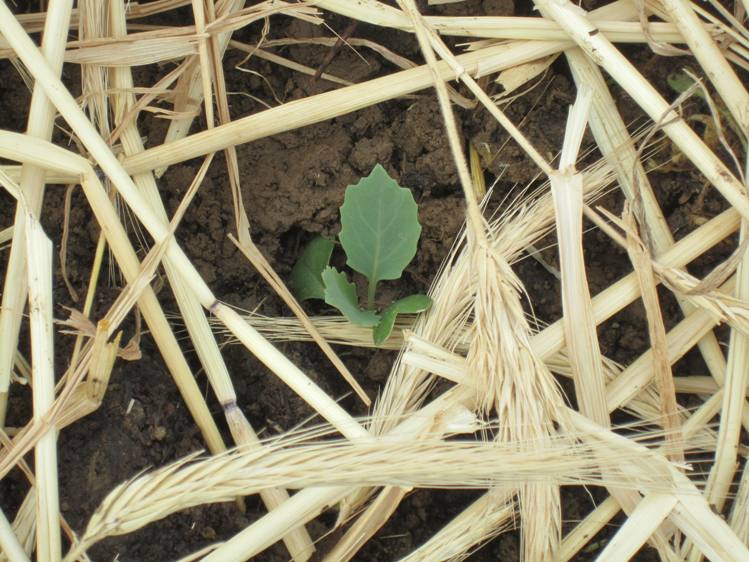
Perhaps growing food for people in need would fall under this “renegade” notion? Here is a seedling started by a southern Indiana farmer and planted by a volunteer for the Hoosier Hills Food Bank.

Cabbage seedling planted by a volunteer at a food bank garden

Cabbage seedling planted by a volunteer at a food bank garden

And one more: Late last fall I blogged about starting Austrian winter peas and my happiness at their growth in cold weather. They are generally not grown for a pea harvest, but intended as a cover crop with benefits—pea shoots are sweet and tender.

They didn’t do much during the winter, but this spring they are the healthiest of plants in my garden. I have snipped them nearly every day as salad and smoothie additions, and they are growing as fast as I can cut!

Austrian winter peas in spring

Austrian winter peas in spring

With seeds on my mind, no wonder this statement in a new mother’s Facebook post snagged my attention:

“I did not know until I got pregnant that the first organ to develop is the heart. It’s as if a heart seed gets planted and from the heart grows the human.”

Laura Henderson, founder of Growing Places Indy

Miraculous.

The Ground Rules

Meet “renegade researcher” Nance Klehm. She’s on a mission to transform our thinking about waste—and to transform our waste into healthy soil.

Reader_Nance_Klehm_3174

Nance Klehm

I first met Nance at last October’s Radical Mycology Convergence, which she hosted on her rural land in Illinois. She divides her time between rural and urban—growing native trees, plants, and mushrooms on her land, and nurturing innovative community projects in Chicago.

As a fifth generation horticulturist, she has a passion for working in partnership with nature and enjoying the abundance that results. She has worked on graywater systems, humanure, and soil fertility for years, both in the U.S. and abroad. She was even invited to Haiti to assist with composting toilets after the devastating 2010 earthquake.

She works on composting policy at the state and local level, and teaches “Composting 401” to people who really want to get down and dirty.

“When people say, ‘what’s possible?’ I’ve done it,” she told me. “I have photographs and data and anecdotal experience from living in Chicago for 25 years.” She envisions a widespread scale-up of composting efforts that would shift how cities handle sanitation.

Nancy removing husks from walnuts grown in her food forest.

Nance removing husks from walnuts grown in her food forest.

Recently she was the featured guest on the Root Simple Podcast, talking about her work with community bioremediation in Chicago.

The project, called The Ground Rules, has multiple community-run soil centers working on bioremediation. Urban soils are often contaminated with heavy metals and other toxins. Klehm and her volunteers are addressing this problem by diverting waste into compost.

By bicycle and truck, they pick up discards from restaurants and businesses: uneaten food, vegetable trimmings, and paper towels, for example. Nearby soil centers are where they convert this “slop” into a high-powered soil amendment.

"It's crazy fun to work with food slop," says Nancy.

“It’s crazy fun to work with food slop,” Nance says.

The waste is kept local, put to work in service of the longterm goal of remediating the soil. Bacteria in the compost help to break down inorganic chemicals. The teams also use plants and fungi to help with this goal. So, four biological kingdoms—animal, bacterial, fungal, and plant—partner in this vision.

Here’s a great video about the project:

The Ground Rules from nance klehm on Vimeo.

Nance has a book due out this fall, based on her conversations with others invested in the life of the soil. (Note: It isn’t only farmers who care about the ground under our feet!)

Currently she’s writing a manual for others interested in community bioremediation. She blends practical, technical information with anecdotes from the soil centers, because they are all different. Each site has its own issues and challenges. Nance says the social component of this work is the trickiest part, so it’s important to address that along with the how-to aspect.

She’s running a crowdfunding campaign to support this important work. Any small amount helps.

And of course, if you’re in Chicago, consider volunteering. If you want to hang with fun and funky folks while learning a whole bucketload about advanced composting, she would welcome you, I’m sure!

Update: For more on The Ground Rules project, check out my Acres USA profile of Nance Klehm.

“What the World Needs”

I can always tell when I’m overloaded with the news; that’s when I start to despair. So much mess to clean up. It seems ridiculously tangled-up and tiresome, painful to look at.

In my own state we are attempting to disentangle from newly passed legislation designed to show my GLBT brothers and sisters that we are not welcome. Elsewhere, of course, there’s worse news. In Kenya suicide bombers caused untold anguish. In California the drought is now so severe that the governor mandated water restrictions. Then there’s the German pilot who decided to fly a planeful of people into the side of a mountain. For what?

Time to turn off NPR. When I get overwhelmed, this timeless advice from theologian Howard Thurman is a comfort:

“Don’t ask yourself what the world needs. Ask yourself what makes you come alive and then go do that. Because what the world needs is people who have come alive.”

By psyberartist (amaryllis  Uploaded by russavia) via Wikimedia Commons

By psyberartist (amaryllis Uploaded by russavia) via Wikimedia Commons

Definitely the needs of the world are bottomless, and the conflicts seem never-ending. So this question is a good barometer, an antidote to paralysis: What renews my heart? For me it is things like making meaning, being of service in small ways, reflecting, putting some hard-won learnings to use for others.

Sometimes, though, all that seems ever so small, and the question becomes: How do we renew ourselves, in this season of renewal, to continue with our chosen work?

Then a member of my extended family gives me a tremendous gift. She tells me that she regularly shares my reflections with her four teenagers. Some years back when I coauthored a book called Sudden Spirit: A Book of Holy Moments, she started the tradition of reading aloud from this work and discussing it with her children. Now that the kids are older, she’ll print thought-provoking blog posts and passages (mine among them) and ask them to initial when they’ve read them.

You can bet I was touched when I heard that! (And maybe she had told me before but I forgot; sometimes it’s hard for me to receive stuff like this.)

Knowing this totally refuels me. Because so much of what I do is basically invisible, it’s hard to know what kind of impact I’m having. But apparently, my little musings are helping the next generation of leaders.

Note to self: Remember to tell people I appreciate their work! (I think I’ll start with Roy Ballard and Michael Morrow, the men behind Hoosier Harvest Market. This online virtual farmers market brings me lovely salad greens, eggs, quail eggs, apples and so on—all locally grown and delivered to order to a business near my home.)

Because maybe it’s less a matter of renewing ourselves than renewing each other. Maybe then we can remember what exactly it is that makes us come alive, and have the courage to pursue it. Who in your life could use some of that fuel?

The Reimagining

Scott Russell Sanders, one of Indiana’s sagest voices for social and ecological justice, led a workshop Sunday called Writing While the World Burns.* His books, from Writing from the Center to A Conservationist Manifesto, have inspired me and countless other readers.

Before I even read the workshop description, I knew I needed to be there.

Untitled

I wasn’t disappointed. Scott has a generosity, thoughtfulness, and grace about him that may be a product of his years, or perhaps he’s just built that way. He brought together a disparate group of deeply passionate people and got us talking about where our work and lives fit into the bigger picture.

I know I’ve been on a bit of a Wendell Berry kick of late, but Scott’s the one who gave a Berry quote as context for that exercise:

“The significance—and ultimately the quality—of the work we do is determined by our understanding of the story in which we are taking part.”

Where do we fit? What is our important piece of the puzzle?

In my case, my larger story has to do with lighting the Lights—spreading the word about the tremendous work being done on so many fronts. And not only that, but being a Light, in my own small way.

Earth Hour moment at home - Córdoba Argentina

In fact, “story” is an apt word, because I see all of these efforts as a grand transition to the Story of Reunion (in Charles Eisenstein’s words)—leaving the defunct Story of Separation behind.

As writers, Scott told us, (and as teachers, artists, visionaries, and the like) we enlarge people’s vision of what’s possible. We write a new language that can supplant that tired old ethic of economic gain at any cost. We expand people’s understanding of humanity by sharing our knowledge of those they might consider “other.”

In short, we reimagine the world, and invite others to join us.

*Many thanks to the Indiana Writers Center for offering this tremendous workshop.

A Mycological Field Trip

Yesterday we drove down to southern Indiana to visit Magnificent Mushrooms, Eric Osborne’s hub for all things mycological. Located outside of Paoli, IN, this growing business offers products and information for the would-be home mushroom cultivator.

That turns out to be us: we came home with three kinds of spawn to put to work here on our wee homestead: “old faithful” shiitakes, Lion’s Mane, and King Stropharia (winecaps).

I will keep you posted on our efforts to expand our food production into the fungal kingdom! I’m a bit concerned about keeping Kitley (our outdoor cat) and his pals away from the logs and woodchips we’ll use as substrate. As I understand it, mushrooms are tolerant of many things…but they probably wouldn’t want to drink cat pee or get all clawed up, any more than I would.

Old Faithful is a strain of shiitake that is slightly furry. Here it is growing off a block of sterilized, inoculated grain.

Old Faithful is a strain of shiitake that fruits in a slightly furry mushroom. Here it is growing off a block of sterilized, inoculated grain.

I’m most excited about attempting to grow winecaps, also known as “the garden mushroom” for its friendly affinity for the vegetable garden.

Bags of King Stropharia spawn

Bags of King Stropharia (winecap) spawn

We plan to try starting it not only in our backyard beds, but also in a low-lying place in the front yard. A natural bowl beneath the sweetgum tree is often waterlogged, and Eric said this kind of spot is perfect for winecaps.

As for Lion’s Mane, I’ve never eaten it, but Eric says it tastes like “heaven on earth.” It’s a pale blobby mushroom that looks a bit like some oceanic organism. Or maybe a cartoon nose.

Eric and I petting a Lion's Mane mushroom.

Eric and I petting a Lion’s Mane mushroom.

Eric sells his harvest to area chefs, so if you’ve eaten a mushroom dish at a Bloomington restaurant, you may have sampled his wares.

He also offers cultivation workshops and consultations. In partnership with the Hoosier Mushroom Society and the state department of health, he’s developed a certification course for wild mushroom hunters, which would allow them to comply with regulations around selling their harvest.

Speaking of: Know any good morel hunting spots?

Seven Steeples Farm

Last month I got to meet Justin Berg and Mike Higbee, who are doing something I admire: turning unused urban land into an agricultural oasis. As with many such endeavors, they glean local materials to build soil—leaves from curbside refuse, manure from the police department’s Mounted Patrol stables.

What’s unique about this urban farm, though, is that it’s being built atop the pulverized remains of an old mental institution.

Seven Steeples Farm

Seven Steeples Farm

To anyone growing up in Indy, as I did, “Central State” was synonymous with the loonybin. We all knew that it was an insane asylum, back in the day, and as late as 1994 it was still operating as a psychiatric facility.

The enormous campus fell into disuse after Central State Hospital closed, but recently the site has been redeveloped into Central Greens urban village. Part of the project includes Seven Steeples Farm, so-called because the 5-acre parcel being farmed is on the footprint of a building called Seven Steeples, where women were institutionalized.

The building was demolished midcentury, and apparently is now buried under the vast lawn area where Justin and Mike have begun growing produce for the past year. Sheltering old trees that must have borne witness to all kinds of pain still stand, shading the chicken run and outdoor classroom area.

I have to say, this thing has lit my imagination in surprising ways. I’ve read The Yellow Wallpaper and other stories of “madwomen in the attic.” How easy it was to cart women away for any infraction back when this asylum was established (1850s.) I can think of several reasons why I myself, in an earlier era, could have gotten myself tossed in there.

And what sort of “treatment” did the women undergo, inside the walls of Seven Steeples?

It feels to me like a major healing of an old wound to have an urban farm there. Community volunteers (and patrons) enjoy a peaceful setting smack in the middle of a somewhat sketchy part of town. The food is accessibly priced so that people living in the middle of a food desert can have a decent choice of nourishment.

Justin Berg, farm manager, and Mike Higbee, project coordinator, with lady friend

Justin Berg, farm manager, and Mike Higbee, project coordinator, with lady friend

Visitors love to sit on the stumps next to the chicken run and just get on “chicken time.”

The farm has announced 2015 CSA (community supported agriculture) plans, and will also have a weekly farm stand to sell eggs and produce. (More info: info@sevensteeplesfarm.com or 317-713-9263.)

Justin says, “Call to set up a tour, and everyone’s more than welcome to come by the farm stand if they’re in the area. They can grab up some produce and come check out what a rural setting could look like in the city.”

See my Farm Indiana piece for more on this project.

Wild Geese Wisdom

From Wendell Berry’s poem “The Wild Geese” comes this steadying stanza:

…And we pray, not
for new earth or heaven, but to be
quiet in heart, and in eye
clear. What we need is here.

I found his poem in a new essay collection called Sustainable Happiness, edited by the staff of Yes! Magazine. It reminded me of my introduction to the poet Mary Oliver, whose poem “Wild Geese” begins:

You do not have to be good.
You do not have to walk on your knees
for a hundred miles through the desert repenting.
You only have to let the soft animal of your body
love what it loves…

This was my first Mary Oliver experience years ago: having this poem recited just for me by my Rolfer while he worked the fascia of my feet to smithereens. (Rolfing is a super-intense type of bodywork that pairs well with poetry.)

I give you the lovely Mary Oliver, reading her poem.

Real Security

Last week I heard an NPR story about an interesting social study. Researchers surveyed residents of Palestinian towns before and after dismantling certain checkpoints that had been set up by Israeli forces.

In areas where the checkpoints were removed and people had greater freedom to move about their towns, the local Palestinians expressed much greater support for a peace process with Israel. Not only that, but there was a corresponding behavior change, with a decrease in Palestinian violence against Israelis in these areas.

It seems like a no-brainer that people would soften their attitudes if restrictions are lifted. The report noted that humiliation is a big driver of anger and violence, per numerous other social studies.

But the point the researchers made was this: Checkpoints put in place to increase security for Israelis actually had the effect of decreasing security.

Real security was achieved by dismantling them.

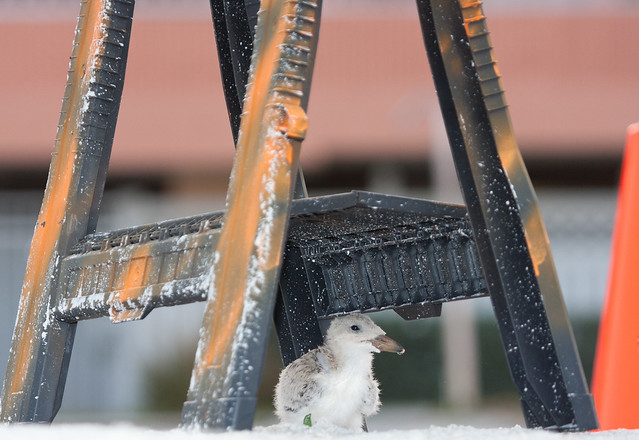
Baby Black Skimmer Barricade

Hearing the story made me think of a workplace dynamic that had upset a dear friend who’s otherwise happy in her job. Her manager had reacted harshly to a decision my friend had made, and expressed a need to control future such decisions. My friend felt hurt and angry, interpreting this as a lack of faith in her judgment.

The manager’s intent may have been to control an outcome, but the end result was employee dissatisfaction. By enforcing her will, the manager stands to lose the contributions of an innovative thinker. Instead of making the team’s work stronger, she’s created insecurity and mistrust.

A security checkpoint, a squelching of autonomy: It feels the same to me, energetically.

I see everything as an opportunity for self-reflection, and I also believe that anything healed within me helps to heal the world. So these stories prompt me to ask where I have played out a similar story within myself.

Have I posted a guard where it’s not needed, cutting me off from people perceived as “other”? Have I jerked the reins of my creativity in an effort to produce? Have I impeded the flow of inner wisdom with my expectation of a particular outcome?

Wisdom (62/365)

How can I personally move from this old story of control and domination to a new story of trust, openness, and listening? What does it take to nurture that movement in myself and others?