Book Offers a Vision of the Possible

I’ve had this book out from the library the past few weeks, but after test-driving it, I just emailed Kathleen at Bookmamas to ask her to order it for me. It’s a keeper. Here’s my review:

Wendy Tremayne’s The Good Life Lab: Radical Experiments in Hands-on Living gives a powerful example of a reimagined world in the shape of one couple’s desert homesteading adventures.

Prickly pear, an example of the desert bounty gathered by Tremayne. Photo by Jon Sullivan [Public domain], via Wikimedia Commons

Prickly pear, an example of the desert bounty gathered by Tremayne. Photo by Jon Sullivan [Public domain], via Wikimedia Commons

Many of us work toward self-sufficiency (or better, community-wide resilience, broadening the circle from homestead to neighborhood). But we’re hampered by the need to make money to prop up our lifestyles, cutting into the time we have to learn and practice new skills. Wendy and partner Mikey demonstrate what is possible by leaping into a completely new way of life. They cash out their retirement accounts (a prescient move, before the crash) and transplant themselves into Truth or Consequences, NM to build a new life.

And build they do: using waste materials and nature’s bounty, they craft a beautiful, abundant, interconnected home base that allows them to live their deepest values.

In contrast to some “green lifestyle” books that focus on giving up luxuries for the earth’s sake, this book offers an exuberant romp through the reclamation of life’s biggest gifts: time, beauty, creativity, connection, purpose. More than just a memoir, it is an invitation to adopt the “maker” mindset. Tremayne’s lyrical descriptions of the spiritual aspects of this journey, coupled with the gorgeous, whimsical artwork and photographs, make this an inspirational book.

The author (who founded Swap-O-Rama-Rama, a community-based textile repurposing/skill sharing extravaganza) observes, “When all of life is for sale, it is a revolutionary act to become a maker of things.” She describes “life in the waste stream” as the ultimate freedom.

“By relying on waste, on what nature provides, and on ourselves, we gave the world a chance to demonstrate abundance. By becoming makers of things, we let our creativity become a transformative link between the free materials available to us and the finished goods that made our lives better.”

She notes that mistakes are part of this process, and describes combatting the inevitable “I can’t do that” by simply taking the next step. For those of us who consider ourselves less than handy (ahem), the book offers both challenge and a roadmap. The last section, in fact, provides concrete steps toward reclaiming the building blocks of life, covering food, power generation, fuel, and shelter.

The physical book itself embodies the new world by its very design, in which art and joy and utility are married into a brilliant manifesto.

In short: Stop what you are doing and order one now from your local independent bookstore, people!

(Can’t wait till your book arrives? Hungry for more after reading it? Check out Wendy and Mikey’s blog at Holy Scrap.)

From the Low Food Chain Chronicles

Weeks ago, months really, I pledged to try sardines in an effort to eat lower on the food chain. I went out and bought a tin of skinless, boneless sardines. I asked for your serving suggestions. I browsed recipes. I learned that you can fry them (“the bones get crispy!” said food blogger friend Melissa, which gave me pause), or put them in a potato salad, or mix them into pasta. Or just eat them on a cracker.

I got inspired.

Then I put the tin in the pantry. And there it sat. And whenever I reached in for baking powder or pasta or whatnot, I would think, Oh yeah, sardines, I promised I would eat those. For the blog. And then I would close the door again posthaste.

I am proud to tell you that yesterday I actually pried that sucker open. And I didn’t stop there. I actually ate sardines.

Yesterday's lunch.

Yesterday’s lunch.

I’m here to report that these little fishies, which feed the farm-raised fish so many of us prefer…really aren’t that bad! The smell is a bit oceanic, but taste is mainly salty, at least when mashed in small (microscopic) amounts on a lovely sesame rye cracker.

I was worried the mouthfeel would be slimy, because just look at the sheen on those puppies. But they were actually quite palatable.

I had lactofermented veggies on the side, figuring two strong flavors would cancel each other out. You can never have too many cultured veggies, and these collards and cabbages were homegrown and -cultured.

Unfortunately I had to move indoors to eat because my cat was so interested in the meal.

"I'd be happy to finish those sardines off for you." --Kitley

“I’d be happy to finish those sardines off for you.” –Kitley

I told myself that if lunch turned out to be a train wreck, I’d put a good taste back in my mouth with dessert: zucchini cornbread baked in the solar cooker. Not just any cornbread but blue cornbread. Over homemade yogurt with organic Indiana blueberries.

Sorry I don’t have a photo for you. I was too excited about eating it to pause and snap.

Meanwhile the salad balanced the sardine experiment nicely. I’ve said it before: I know this isn’t a food blog, but still I must share the ingredients of this super-duper salad:

  • Grated zucchini, because it’s summer and everything we eat must include zucchini from the garden in some form.
  • Oxalis, purslane, sorrel leaves, chives, catnip, young dandelion leaves, and possibly other things I can’t remember, gathered from the yard (and the neighbor’s yard, but who’s looking?)
  • Sungold cherry tomatoes, first of the season and sweet as can be. I’ve waited all year!
  • Pumpkin seeds toasted in the solar cooker.
  • Nettle seeds. Herbalist Greg Monzel says these are “one of the only herbs that can restore compromised kidney function,” not that I really need that. And they’re too small to give much more than the teeniest little crunch. But I like using every part of the nettle patch, so I can tell Judy, “I’m still harvesting from it!” when she threatens to whack it down.

What culinary adventures are you having this summer?

KI EcoCenter: Transforming Education

Second in a series on education
KI EcoCenter, or Kheprw Institute, has been making change for nearly a decade in my hometown. In recent years, educator Khalil MwaAfrika came on board the community empowerment center to start an independent school. He was tired of discussing school reform while watching the educational system destroy African-American children, particularly boys.

Khepri, by Jeff Dahl via Wikimedia Commons

Khepri, by Jeff Dahl (GFDL or Creative Commons) via Wikimedia Commons

Instead of reform, he is invested in nothing less than education’s complete transformation. As  mentioned in a previous post, “Kheprw” was an Egyptian god with a scarab beetle head. This beetle was a symbol of rebirth in Egypt—so the center is fittingly named.

KI’s school offers a rigorous program for African-American students. Classes are very small, allowing a high degree of mentorship. Community members interact with the students every day in this intergenerational model.

MwaAfrika emphasizes that igniting a passion for learning is key. Instead of promoting a particular ideology, faculty create space for discourse and dialogue. In that environment the children learn critical thinking skills. They are encouraged to puzzle things out themselves.

In contrast with the traditional school system, here there is no need for the youngsters to feel they must give up their own rich culture in order to succeed.

This issue came up repeatedly at the center’s recent Real Talk Summit on urban education. Because our dominant culture is white/upper middle class, racism is the water we all swim in—leading to schools that don’t believe in children from other races and classes.

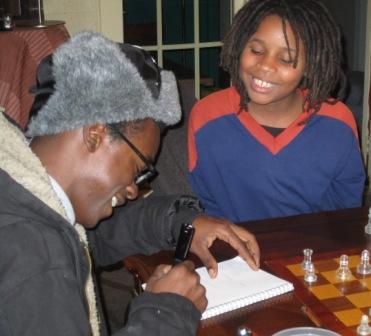
A faculty member and student at KI EcoCenter Community School

A faculty member and student at KI EcoCenter Community School

But KI is different. “We’ve set up an environment where (black students) can be themselves, where they can learn exponentially, where they never have to compromise who they are,” MwaAfrika says.

KI founder Imhotep Adisa notes, “The primary purpose of education is indoctrination. It’s not liberation.”

Part of that indoctrination is the consumerism that is jeopardizing the earth. “We’re at a very ugly place in the history of the planet,” he says. “Regardless of gender, race, and class, the old paradigm has accelerated this…We have to develop new tools for a new paradigm. We have to have the courage to say, ‘That’s not the world we want for ourselves and our children.’”

KI’s adults model that courage every day. Teaching youth to interface with the culture of power while retaining their identity is a critical aspect of their work.

Social enterprises are part of this, as the students work with KI’s bootstrappers (young adults) to develop the skills needed to thrive in a resource-strapped world.

Barrel at left is via KI's Express Yourself Rainbarrels enterprise, with my chosen artwork

Barrel at left is via KI’s Express Yourself Rainbarrels enterprise, with my chosen artwork

Above (at left) is the rainbarrel made by bootstrappers and students for my urban homestead, via the Express Yourself Rainbarrels enterprise. My partner added it to our rain catchment setup, just in time for big rains.

(Indy-area readers, check it out: Save on your water bill, display your artwork, and support a great organization all at the same time.)

Read more about KI’s work in my Indiana Living Green story.

Next: Bloomington’s homeschooling cooperative, exploring the homestead as learning environment.

Birthing a New Story

Does it ever seem to you like an age of innocence is past? I’ve been thinking about this since reading Charles Eisenstein’s brilliant article, 2013: The Space Between Stories.

He describes a nostalgia for the cultural myth of his youth, “a world in which there was nothing wrong with soda pop, in which the Superbowl was important, in which the world’s greatest democracy was bringing democracy to the world, in which science was going to make life better and better. Life made sense.”

By Simon Q from United Kingdom (Rusting Sherman Hull Uploaded by High Contrast) via Wikimedia Commons

By Simon Q from United Kingdom (Rusting Sherman Hull Uploaded by High Contrast) via Wikimedia Commons

He talks about how we used to believe that the good folks in charge had things all under control, but of course it’s clear now that isn’t true. Our eyes are opening. We can’t ignore the perpetuation of global poverty and extreme inequity. We’re waking up, painfully, to the destruction wrought in the name of commerce and greed. We see that things are falling apart, and the institutions and experts we used to trust are not going to fix it.

And we can never get back to that old cultural story. We’re birthing the new story now, but we’re in a between-time. Our lack of shared cultural myth makes this a turbulent and often frightening time, with the extreme death throes of the old story showing us the worst of the worst.

Or that’s what Eisenstein thinks anyway, and it rings true for me.

Joanna Macy says it this way:

This is a dark time filled with suffering, as old systems and previous certainties come apart.

Like living cells in a larger body, we feel the trauma of our world. It is natural and even healthy that we do, for it shows we are still vitally linked in the web of life. So don’t be afraid of the grief you may feel, or of the anger or fear: these responses arise, not from some private pathology, but from the depths of our mutual belonging.

Bow to your pain for the world when it makes itself felt, and honor it as testimony to our interconnectedness.

So instead of running from our pain in this chaotic between-time, we can turn toward it, with compassion. We can grieve what’s passing away, mourn what’s lost to us forever. We can acknowledge the emotions that arise as we awaken, even the ones we’ve been taught are best kept locked down.

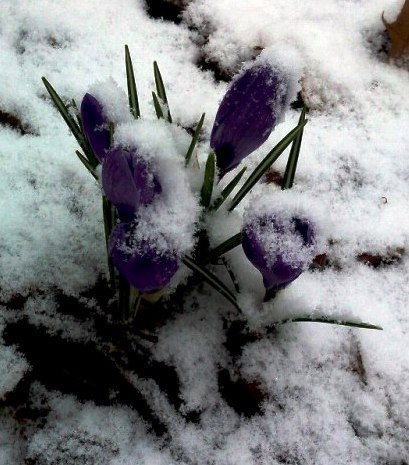
Crocus blooms under snow

Crocus blooms under snow

Instead of cutting off the feeling parts of ourselves, we can invite our whole selves to help dream the new story.

What story shall we create?

On Earth Day and Every Day

“The eyes of the future are looking back at us and they are praying for us to see beyond our own time. They are kneeling with clasped hands that we might act with restraint, leaving room for the life that is destined to come.

We have it within our power to create merciful acts.”

— naturalist and author Terry Tempest Williams

Cheselden_t36_prayer(Thanks to Orion Kriegman of Jamaica Plain New Economy Transition for bringing this quote by one of my favorite authors to my attention.)

The Shadow Side

Here’s a thought for a gorgeous spring day when the shovel is about as high-tech as I’d like to get.

© Phil Date | Dreamstime Stock Photos

© Phil Date | Dreamstime Stock Photos

For all the successes of Western civilization,
the world has paid a dear price in terms of the most crucial component of existence–
our human spirit.

The shadow side of high technology–

modern warfare
& thoughtless homicide and suicide,
urban blight,
ecological mayhem,
cataclysmic climate change,
polarization of economic resources–

is bad enough.

Much worse, our focus on exponential progress
in science and technology has left many of us

bereft

in the realm of meaning and joy, and of knowing
how our lives fit into the

grand scheme

of existence for all eternity.

From Proof of Heaven, by Eben Alexander

An Appeal Denied

Update: Community Access Television has posted a video of the April 3 Board of Zoning Appeals meeting. Minutes have not been posted on the BZA site yet.

Last night I met up with friends to drive to Bloomington, IN for a Board of Zoning Appeals meeting. We were among 80 others there championing permaculture designers/teachers Peter Bane and Keith Johnson, who were pursuing variances for their small suburban lot. Since last summer, they’ve been mired in a conflict with Monroe County, primarily about placement and square footage of structures at Renaissance Farm.

The main issue was that they didn’t follow proper procedures, but they were under the impression that agricultural buildings are exempt from the process. I won’t go into detail about the legalities as that’s not the purpose of my blog—but you can refer to the meeting materials.

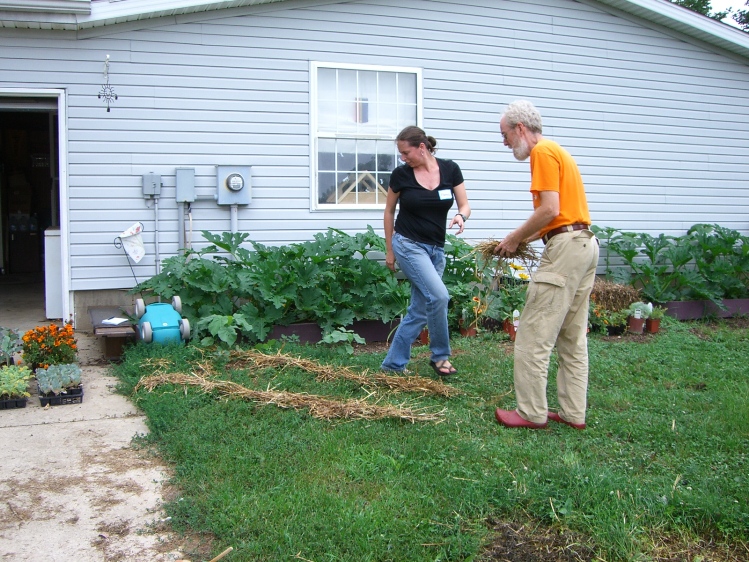
Peter Bane with co-teacher Rhonda Baird laying out a garden path during 2007 permaculture class

Peter Bane with co-teacher Rhonda Baird laying out a garden path, 2007 permaculture class

It was moving to hear the 30-plus testimonies of Peter and Keith’s impact. (I first met Peter in 2007 at a one-day permaculture overview class, and his passion infected me with the need to come right home and plant my entire lot in food.)

The intergenerational crowd was made up of neighbors, IU profs and grads, pastors, farmers, small business owners, a newspaper editor, a City Councilman, and young Bloomington natives who moved away and then returned, largely because they wanted to learn from these luminaries.

Neighbor after neighbor told of the duo’s generosity in sharing both knowledge and produce. Many have started gardening themselves. One said she travels all over the country; when she tells people she lives on the same street as these renowned Permaculture designers, “they are in awe.”

A sampling of comments:

“Everything they are doing is a practical and immediate way of changing the world for the better.”

“They are showing that young people can have a viable future in spite of the climatic, economic, environmental, and other issues facing us.”

“It’s beyond sustainable, it’s regenerative.”

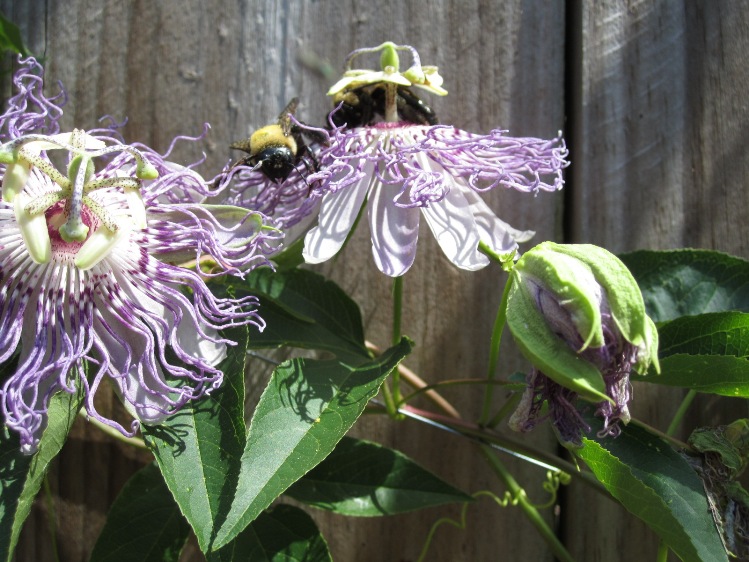
A maypop planted along our fence, one of many plantings inspired by permaculture

A maypop planted along our fence, one of many plantings inspired by Keith and Peter’s work

There seemed to be an understanding in the room, even among officials, that we are at a crossroads. One supporter told them, “I am sympathetic to you who must uphold laws that support suburban sprawl and ignore what the future requires of us.” Another said, “We are living in a world where the rules are changing.” Another warned that big timber, big ag, and mining will dominate rural areas if we don’t change our ways.

But apparently these are not the concerns of a body pledged to oversee existing laws, faulty as they are.

After four hours the board approved all but one variance—a critical one. The barn must be moved about 10 feet from its current position to be in compliance.

It was a shock. Especially after board member Jerry Pittsford, who expressed dismay that Peter and Keith had circumvented the process, had said, “I like rules, but I’m finding very little that tells me the rules need to be followed here.”

There were a number of reasons to approve the variance and only one to deny it—the fact that they did not consult with the county and submit the proper paperwork. Even as the board expressed admiration for Peter and Keith’s work, they could not get past that lapse.

It’s unclear what the next step is for Renaissance Farm, but whatever comes, I hope these two visionaries were bolstered by the outpouring of love and appreciation from neighbors, former students, and admirers.

I’ve Got a Tin of Sardines…

…and I’m not afraid to use it!

By jules (Flickr: sardines in a can) via Wikimedia Commons

By jules (Flickr: sardines in a can) via Wikimedia Commons

Actually, I am, a little. I bought the tin weeks ago at the Co-op in hopes of eating lower on the food chain. I have not yet worked up the nerve to peel back that shiny lid and peek inside. I may need a clothespin for my nose when I do. Little fishies can be so…fishy.

But I’m determined to conquer my fear of the little fishies and make them part of my diet. Or at least ingest them once and see if it’s possible to consider…one day…loving them as much as I love salmon. Why? Efficiency of dining, mainly. If I eat a sardine instead of the big fish that eats the sardine–no matter how much more appealing said big fish might be–I reduce my impact.

It seems I know too much. And I can’t un-know what I know. What we eat has consequences. In the case of seafood, overfishing is rampant, and then there’s pollution, climate change, habitat destruction, and ocean acidification. Leaving us with a “system in crisis,” according to the National Geographic.

All that knowledge makes my fallback choice on any restaurant menu, salmon, seem a bit fraught.

Though according to the National Geographic Seafood Decision Guide, salmon–at least wild-caught Alaskan salmon–is actually one of the better choices in the ocean-going protein buffet. It is “abundant, well-managed, and caught or farmed in ocean-friendly ways.” Three cheers for that.

But sardines are equally well rated, equally low in mercury, and equally high in omega-threes. Then there’s the fact that it takes five pounds of forage fish to produce a pound of farm-raised fish. So I still feel bound to try these little fishy-fishes.

By TANAKA Juuyoh Uploaded by Jacopo Werther) via Wikimedia Commons

By TANAKA Juuyoh (Uploaded by Jacopo Werther) via Wikimedia Commons

It strikes me, unpleasantly, that they’re kind of like the worms and grubs of the ocean world. Grubs are food for birds; sardines are food for bigger fish, and for chickens and pigs too.

No matter: I’m sure they’re deelish. (Just like grubs, which, after all, are food for people all over the world. I wrote a piece about that once, and fully expect to one day venture bugward in my dining.)

Helpfully, in the meantime Slow Food International has begun a push for upping human consumption of anchovies, complete with recipe contest. (Nate at the Co-op shook his head at my sardine purchase and advised anchovies next time.)

Oh faithful readers, do you eat sardines or anchovies, those humble fishies known as forage fish? If so, pray, how do you fix them? Give me some ideas to go with Slow Food’s and Rachael Ray’s suggestions. I promise to report back after my first foray into this brave new culinary world.

Inspiration from Across the Pond

© Scott Patterson | Dreamstime Stock Photos

© Scott Patterson | Dreamstime Stock Photos

I just found out about a forthcoming book called Stories of the Great Turning, which features first-person accounts of Brits who are transforming their lives in inspiring ways. According to Vala Publishers:

“These are the stories of just a few people who decided to act, in their own lives, in response to the challenges of climate change and environmental degradation, and found their own way to make a difference. They are not stories about celebrities, environmental geeks or gurus but honest accounts from people who…’just got on with it.’

It is a book that takes the question, ‘What can I do?’ and sets out to find some answers using one of our species’ most vital skills: the ability to tell stories in which to spread knowledge, ideas, inspiration and hope.”

Kindred spirits if there ever were. And there’s a foreword by beloved eco-activist Joanna Macy, and I think you know how much I adore her. (“Now is the time to clothe ourselves in our true authority.” –from the Foreword.)

I’m invited to the book launch next month. Exciting! It’s in Bristol, England, so I won’t be there, but still!

A Whole New Earth

Nuvo Newsweekly has published my piece responding to Barbara Kingsolver’s novel Flight Behavior.

“It’s an elegy to the beauty of the familiar world, the world that is soon to be a thing of the past. Kingsolver invites us to begin the process of grieving, embodying that lost beauty in the form of the monarch butterfly…”

© Cinc212 | Dreamstime Stock Photos

© Cinc212 | Dreamstime Stock Photos

Indy-area folks can pick up Nuvo for free, or you can read the rest of the article here.

Have you read the book? What was your response?