Time to shout “STOP”…..March Against Monsanto.

“My own reason for supporting this movement is because I believe in freedom. Freedom to grow my own food, food that I feel happy to eat. Freedom to save seeds from the plants that I grow. Freedom to distribute them as I please among other growers. Monsanto wants to curtail these freedoms, because these freedoms don’t put money in their pockets.”

Well said, Bridget.

I’ll be attending the March Against Monsanto in my own town–will you?

bridget's avatarfromacountrycottage

017

On May 25th of this year a great event is happening. Where is it happening?  Everywhere! If you check out  http://www.march-against-monsanto.com   you will find marches organised to protest against the giant corporation that is Monsanto. All over the World marches are scheduled. We must make our feelings felt. Not only to Monsanto but also to our governments, for they are the ones allowing Monsanto to infiltrate our farms, gardens and allottments.

019

Tami Monroe Canal, creator or the now viral Facebook page March Against Monsanto, says she was inspired to start the movement to protect her 2 daughters. “I feel Monsanto threatens their generations health, fertility and longevity. I could’nt sit by idly, waiting for someone else to do something.”

My own reason for supporting this movement is because I believe in freedom. Freedom to grow my own food, food that I feel happy to eat. Freedom to save seeds from the…

View original post 242 more words

Birthing a New Story

Does it ever seem to you like an age of innocence is past? I’ve been thinking about this since reading Charles Eisenstein’s brilliant article, 2013: The Space Between Stories.

He describes a nostalgia for the cultural myth of his youth, “a world in which there was nothing wrong with soda pop, in which the Superbowl was important, in which the world’s greatest democracy was bringing democracy to the world, in which science was going to make life better and better. Life made sense.”

By Simon Q from United Kingdom (Rusting Sherman Hull Uploaded by High Contrast) via Wikimedia Commons

By Simon Q from United Kingdom (Rusting Sherman Hull Uploaded by High Contrast) via Wikimedia Commons

He talks about how we used to believe that the good folks in charge had things all under control, but of course it’s clear now that isn’t true. Our eyes are opening. We can’t ignore the perpetuation of global poverty and extreme inequity. We’re waking up, painfully, to the destruction wrought in the name of commerce and greed. We see that things are falling apart, and the institutions and experts we used to trust are not going to fix it.

And we can never get back to that old cultural story. We’re birthing the new story now, but we’re in a between-time. Our lack of shared cultural myth makes this a turbulent and often frightening time, with the extreme death throes of the old story showing us the worst of the worst.

Or that’s what Eisenstein thinks anyway, and it rings true for me.

Joanna Macy says it this way:

This is a dark time filled with suffering, as old systems and previous certainties come apart.

Like living cells in a larger body, we feel the trauma of our world. It is natural and even healthy that we do, for it shows we are still vitally linked in the web of life. So don’t be afraid of the grief you may feel, or of the anger or fear: these responses arise, not from some private pathology, but from the depths of our mutual belonging.

Bow to your pain for the world when it makes itself felt, and honor it as testimony to our interconnectedness.

So instead of running from our pain in this chaotic between-time, we can turn toward it, with compassion. We can grieve what’s passing away, mourn what’s lost to us forever. We can acknowledge the emotions that arise as we awaken, even the ones we’ve been taught are best kept locked down.

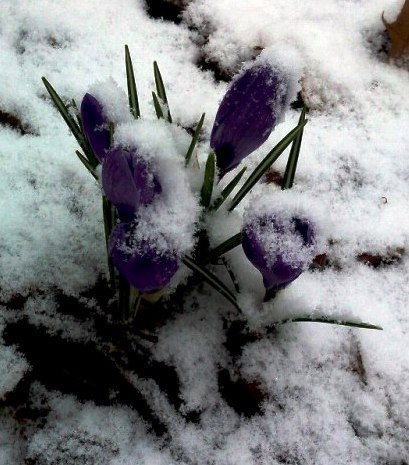
Crocus blooms under snow

Crocus blooms under snow

Instead of cutting off the feeling parts of ourselves, we can invite our whole selves to help dream the new story.

What story shall we create?

Meet the Mudgirls

I’m always intrigued by people who are able to take the more complicated aspects of modern life into their own hands. Maybe that’s because outside of your basic paring knife and garden trowel, my own hands are pretty fumbly. The realm of natural building just amazes me.

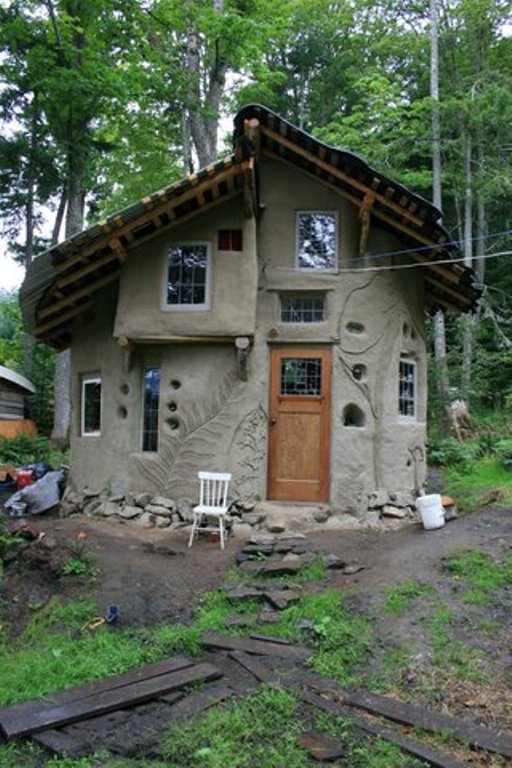
Round Cob House Built by the Mudgirls

Round cob house built by the Mudgirls

Natural building involves using materials occurring in nature (and sometimes recycled materials) to construct homes and outbuildings. For example, back in Too Many Tons I posted a video featuring a DIY builder from Indiana making bricks from mud. Materials are sourced locally—perhaps clay from a neighbor who’s digging a pond, sand from a nearby excavation, straw from a local farmer.

Recently I discovered a British Columbia-based women’s collective specializing in cob building (using a mix of clay and straw). Meet the Mudgirls.

The Mudgirls are a collective of women builders on the west coast of British Columbia, Canada

The Mudgirls are a collective of women builders on the west coast of British Columbia, Canada

For the past seven years they’ve worked together as independent builders, doing seasonal work throughout the Vancouver Island area. Though they started with only about 10 days of work in the early years, many now make their main summer income from this work.

They’ve build cob ovens, cabins, sheds, fences, and outhouses. They also take their craft into conventional homes, using earthen plaster with beautiful results.

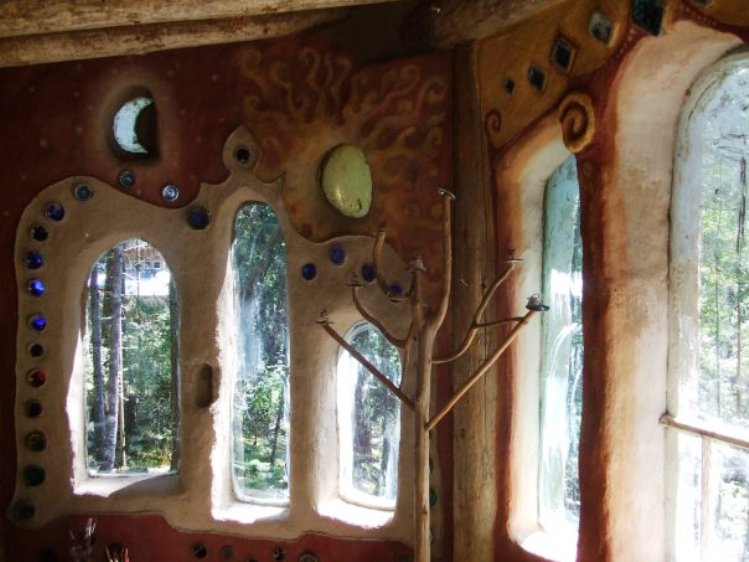
Interior of a Mudgirl-built home.

Interior of a Mudgirl-built home.

As a consensus-run group, they are trailblazing in other ways as well, showing a more egalitarian way to operate than the dominant paradigm’s business-as-usual. And they offer workshops at the most affordable rates in North America ($200 or less).

Mudgirl Rose Dickson, one of the founding members, was drawn to the collective because of her outlook as a feminist/environmentalist/artist. From the photos,* it’s clear that the Mudgirls’ work offers a creative outlet.

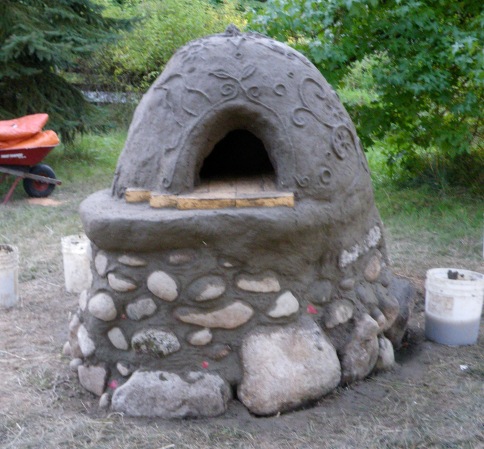
Cob Oven Made by Mudgirls

Cob oven made by Mudgirls

And these round structures are built to last, as witnessed by many such homes in England, still standing hundreds of years after their construction.

Not too long ago, a four-ton tree fell on a Mudgirl-built cob house—crashing through a bump-up of windows and earthen plaster and stopping at the cob wall. Rose reports, “No cracks in the wall from impact, and the guy who came to clear it off said a wooden house would have been crushed by the tree.”

A four-ton tree fell on this Mudgirl-built cob home, stopping at the cob wall

A tree fell on this Mudgirl-built cob home, stopping at the cob wall

Cob building is physically demanding and sometimes uncomfortable work (imagine a chilly spring day when you’re working in cold mud from sunup to sundown). But Rose relishes the chance to be outside, away from a desk, making something with her hands in the company of her dearest friends.

Mudgirls at work

Mudgirls at work

“If the weather’s cold, it can be kind of miserable,” she admits. “But if you’ve got a couple friends there who you’ve known for years and you’re joking and laughing, it makes it. That’s actually one key with natural building is the community. It takes more time, so the labor is a factor. But that’s part of why people do it together.”

This strikes me as the ultimate in do-it-with-others (DIWO). Has anyone out there had experience with communal natural building? I’d love to hear about it.

*Photos provided by Mudgirls.

On Earth Day and Every Day

“The eyes of the future are looking back at us and they are praying for us to see beyond our own time. They are kneeling with clasped hands that we might act with restraint, leaving room for the life that is destined to come.

We have it within our power to create merciful acts.”

— naturalist and author Terry Tempest Williams

Cheselden_t36_prayer(Thanks to Orion Kriegman of Jamaica Plain New Economy Transition for bringing this quote by one of my favorite authors to my attention.)

Things That Can’t Be Rushed

Those of us who are bathed in technology much of our lives, that is to say most of the Western world by now, have grown accustomed to having everything happen in a hurry. Speed is the ultimate. Efficiency is king.

I am prone to this, feeling impatient with the rate of change.

Even in gardening, I value a relatively quick turnaround: Plant a bunch of lettuce seedlings, and a month later I can be snipping salad from my own raised bed.

But some things take time, and move in a crooked line, and require great patience to see results.

Photographer: Kessner Photography

Photographer: Kessner Photography

I’m reminded of this when I visit a farmer friend who lives in my neighborhood. Her family farm is called Artesian Farm. It’s in the next county over, where Anna and her farm partners raise grassfed beef.

When she talks about farming, she thinks in terms of decades. For example, the process of transitioning the farm to organic—which her parents wanted to do long before there was any infrastructure of support—has barely begun, and the beginning itself is taking years.

It’s been nearly 10 years of preparation, and a very small portion of the crop acreage is just beginning the transition to organic.

To grow corn and beans organically, and to be certified as such, farmers undergo an elaborate process. One of Artesian Farm’s first steps was adding more cattle. It seems an odd thing: what do corn and beans have to do with the beef side of the business?

But Anna explains that crop rotation is key in organic farming. Hay is their chosen rotation crop. “It’s common wisdom that if you grow hay and sell it off your farm, you’re taking all the nutrition off your farm.” So more cattle were needed to make use of the hay.

A 200-page plan has taken about six years to complete. It would cost $2500 to have an outside agency prepare this plan, on top of the $1000 for certifying. Anna opted for the DIY approach.

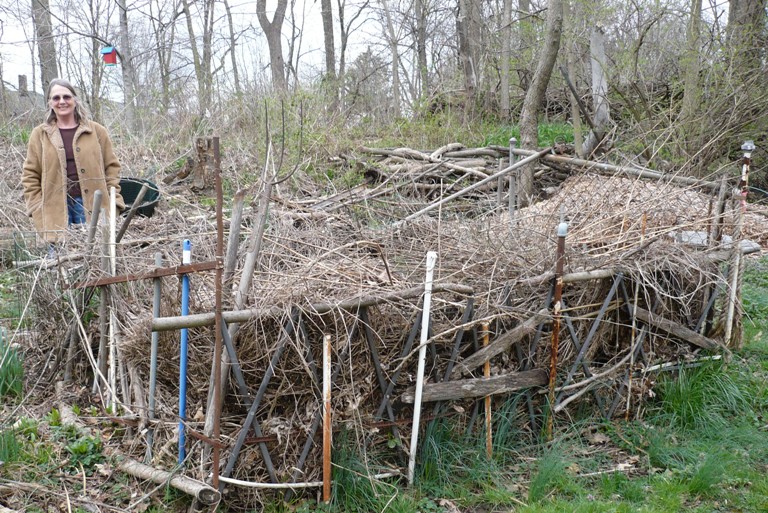
During my visit Anna cuts me some lemon balm, which is near an imposing compost heap about the size of a mobile home. It looks like a small sod house was plunked down in the middle of her modest “back 40.” “How do you turn it?” I ask, thinking of our own compost pile—a midget compared to this—and how it never gets hot enough to kill weed seeds, because we don’t turn it, though we always say we will.

“Oh, I don’t bother turning it. Nature doesn’t turn it, in the woods.”

Anna and her compost bin, which she created “free-hand” with odd broom sticks, twigs, mop handles, rusty pipes, and other finds.

Anna and her compost bin, which she created “free-hand” with odd broom sticks, twigs, mop handles, rusty pipes, and other finds. Photo by Danny Chase.

Walking me back to my car, Anna reflects on the passage of time, how long it takes to make a change, to heal the land, to see results. Those of us who don’t spend as much time with our feet on the soil and hands in the dirt might expect results in a much shorter time frame than the decades that are really required.

Like the compost, like building the humus of the forest floor, there are things that can’t be rushed.

KI EcoCenter Leading in the Green Economy

A local community group near and dear to my heart will be represented at a national event next week. The executive director of Indy’s own KI EcoCenter, also known as Kheprw Institute, will be among the presenters at the Good Jobs, Green Jobs 2013 Conference in Washington, D.C.

About KI: When I first visited, I learned that “Kheprw” is a reference to an Egyptian god represented by a man with a scarab beetle head. The scarab beetle was a symbol of rebirth in ancient Egypt.

It seems a fitting title for this community empowerment center, which works at the intersection of social justice and environmental stewardship in the heart of an economically distressed neighborhood. Here it’s all about nurturing an ecologically sound way of life while creating economic opportunity through community engagement. The programming includes an eco-film series, job creation panels, open mic nights, youth empowerment events, and so much more.

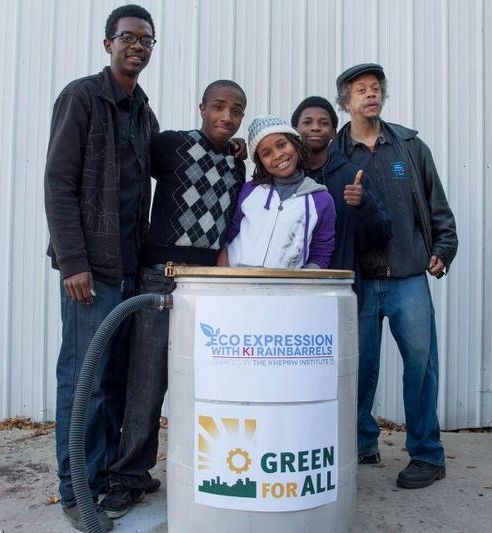
Mat, Rasul, Asli, William, and Imhotep show off an Express Yourself Rainbarrel

Young people in the KI school and mentorship program gain critical thinking skills as they practice social entrepreneurship.

I’ve met many of KI’s children and young adults and they’re not just tomorrow’s leaders—they’re today’s. They know firsthand that with the help of your community, your creativity, and your drive, you can make something from nothing. They’ve built garden beds and aquaponics tanks. They’ve started a paint store, a web services/graphic design enterprise, and a fair trade coffee shop. KI’s work has inculcated in them the confidence and skills they need to navigate the relationship-based economy—whether the goal is a money-maker or a service project or, better yet, both at once.

About the Conference: The theme for the three-day conference is “Let’s Get to Work: Climate Change, Infrastructure and Innovation.” Over 80 workshops will illuminate the possibilities of job creation through green infrastructure. (How refreshing: You mean we don’t have to unleash holy hell in the form of Canadian tar sands in the name of “job creation”?)

KI’s director Imhotep Adisa is a panelist for a workshop highlighting successful sustainable water infrastructure projects. He’ll share KI’s experience in the green economy and its latest social enterprise, Express Yourself Rainbarrels. (I absolutely love this project: The KI crew will customize a rainbarrel with your logo, design, or photograph. I can’t wait to see mine!)

I’ve written a piece for Indiana Living Green about the center that will be out next month. In the meantime, check out this video featuring their work. (Start at minute 3:50 for the segment on KI).

An Appeal Denied

Update: Community Access Television has posted a video of the April 3 Board of Zoning Appeals meeting. Minutes have not been posted on the BZA site yet.

Last night I met up with friends to drive to Bloomington, IN for a Board of Zoning Appeals meeting. We were among 80 others there championing permaculture designers/teachers Peter Bane and Keith Johnson, who were pursuing variances for their small suburban lot. Since last summer, they’ve been mired in a conflict with Monroe County, primarily about placement and square footage of structures at Renaissance Farm.

The main issue was that they didn’t follow proper procedures, but they were under the impression that agricultural buildings are exempt from the process. I won’t go into detail about the legalities as that’s not the purpose of my blog—but you can refer to the meeting materials.
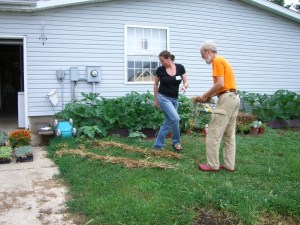
Peter Bane with co-teacher Rhonda Baird laying out a garden path during 2007 permaculture class

Peter Bane with co-teacher Rhonda Baird laying out a garden path, 2007 permaculture class

It was moving to hear the 30-plus testimonies of Peter and Keith’s impact. (I first met Peter in 2007 at a one-day permaculture overview class, and his passion infected me with the need to come right home and plant my entire lot in food.)

The intergenerational crowd was made up of neighbors, IU profs and grads, pastors, farmers, small business owners, a newspaper editor, a City Councilman, and young Bloomington natives who moved away and then returned, largely because they wanted to learn from these luminaries.

Neighbor after neighbor told of the duo’s generosity in sharing both knowledge and produce. Many have started gardening themselves. One said she travels all over the country; when she tells people she lives on the same street as these renowned Permaculture designers, “they are in awe.”

A sampling of comments:

“Everything they are doing is a practical and immediate way of changing the world for the better.”

“They are showing that young people can have a viable future in spite of the climatic, economic, environmental, and other issues facing us.”

“It’s beyond sustainable, it’s regenerative.”

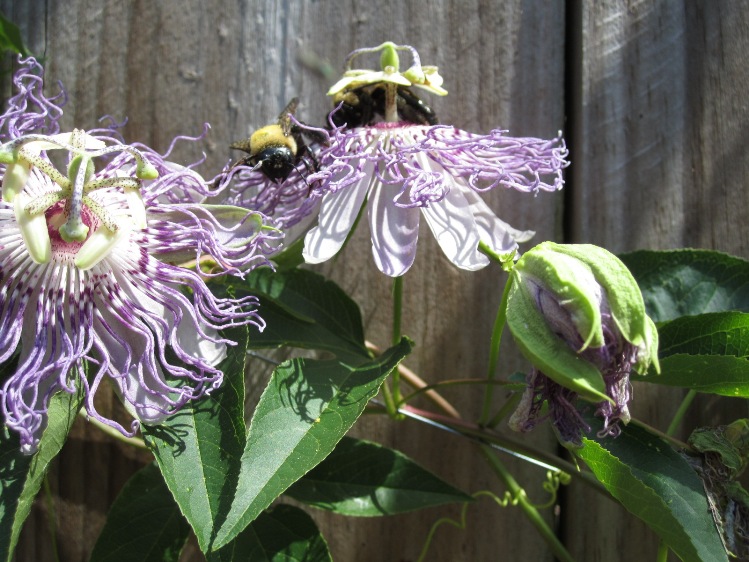
A maypop planted along our fence, one of many plantings inspired by permaculture

A maypop planted along our fence, one of many plantings inspired by Keith and Peter’s work

There seemed to be an understanding in the room, even among officials, that we are at a crossroads. One supporter told them, “I am sympathetic to you who must uphold laws that support suburban sprawl and ignore what the future requires of us.” Another said, “We are living in a world where the rules are changing.” Another warned that big timber, big ag, and mining will dominate rural areas if we don’t change our ways.

But apparently these are not the concerns of a body pledged to oversee existing laws, faulty as they are.

After four hours the board approved all but one variance—a critical one. The barn must be moved about 10 feet from its current position to be in compliance.

It was a shock. Especially after board member Jerry Pittsford, who expressed dismay that Peter and Keith had circumvented the process, had said, “I like rules, but I’m finding very little that tells me the rules need to be followed here.”

There were a number of reasons to approve the variance and only one to deny it—the fact that they did not consult with the county and submit the proper paperwork. Even as the board expressed admiration for Peter and Keith’s work, they could not get past that lapse.

It’s unclear what the next step is for Renaissance Farm, but whatever comes, I hope these two visionaries were bolstered by the outpouring of love and appreciation from neighbors, former students, and admirers.

I’ve Got a Tin of Sardines…

…and I’m not afraid to use it!

By jules (Flickr: sardines in a can) via Wikimedia Commons

By jules (Flickr: sardines in a can) via Wikimedia Commons

Actually, I am, a little. I bought the tin weeks ago at the Co-op in hopes of eating lower on the food chain. I have not yet worked up the nerve to peel back that shiny lid and peek inside. I may need a clothespin for my nose when I do. Little fishies can be so…fishy.

But I’m determined to conquer my fear of the little fishies and make them part of my diet. Or at least ingest them once and see if it’s possible to consider…one day…loving them as much as I love salmon. Why? Efficiency of dining, mainly. If I eat a sardine instead of the big fish that eats the sardine–no matter how much more appealing said big fish might be–I reduce my impact.

It seems I know too much. And I can’t un-know what I know. What we eat has consequences. In the case of seafood, overfishing is rampant, and then there’s pollution, climate change, habitat destruction, and ocean acidification. Leaving us with a “system in crisis,” according to the National Geographic.

All that knowledge makes my fallback choice on any restaurant menu, salmon, seem a bit fraught.

Though according to the National Geographic Seafood Decision Guide, salmon–at least wild-caught Alaskan salmon–is actually one of the better choices in the ocean-going protein buffet. It is “abundant, well-managed, and caught or farmed in ocean-friendly ways.” Three cheers for that.

But sardines are equally well rated, equally low in mercury, and equally high in omega-threes. Then there’s the fact that it takes five pounds of forage fish to produce a pound of farm-raised fish. So I still feel bound to try these little fishy-fishes.

By TANAKA Juuyoh Uploaded by Jacopo Werther) via Wikimedia Commons

By TANAKA Juuyoh (Uploaded by Jacopo Werther) via Wikimedia Commons

It strikes me, unpleasantly, that they’re kind of like the worms and grubs of the ocean world. Grubs are food for birds; sardines are food for bigger fish, and for chickens and pigs too.

No matter: I’m sure they’re deelish. (Just like grubs, which, after all, are food for people all over the world. I wrote a piece about that once, and fully expect to one day venture bugward in my dining.)

Helpfully, in the meantime Slow Food International has begun a push for upping human consumption of anchovies, complete with recipe contest. (Nate at the Co-op shook his head at my sardine purchase and advised anchovies next time.)

Oh faithful readers, do you eat sardines or anchovies, those humble fishies known as forage fish? If so, pray, how do you fix them? Give me some ideas to go with Slow Food’s and Rachael Ray’s suggestions. I promise to report back after my first foray into this brave new culinary world.

Inspiration from Across the Pond

© Scott Patterson | Dreamstime Stock Photos

© Scott Patterson | Dreamstime Stock Photos

I just found out about a forthcoming book called Stories of the Great Turning, which features first-person accounts of Brits who are transforming their lives in inspiring ways. According to Vala Publishers:

“These are the stories of just a few people who decided to act, in their own lives, in response to the challenges of climate change and environmental degradation, and found their own way to make a difference. They are not stories about celebrities, environmental geeks or gurus but honest accounts from people who…’just got on with it.’

It is a book that takes the question, ‘What can I do?’ and sets out to find some answers using one of our species’ most vital skills: the ability to tell stories in which to spread knowledge, ideas, inspiration and hope.”

Kindred spirits if there ever were. And there’s a foreword by beloved eco-activist Joanna Macy, and I think you know how much I adore her. (“Now is the time to clothe ourselves in our true authority.” –from the Foreword.)

I’m invited to the book launch next month. Exciting! It’s in Bristol, England, so I won’t be there, but still!

Placemaking in the City

It’s hard to imagine right now, with a spring storm threatening to deposit up to 10 inches of snow on us, but in a few weeks my neighborhood will come together for an annual spring cleanup. Volunteers will fan out to pick up a winter’s worth of litter, with the support of Keep Indianapolis Beautiful.

I love my neighborhood for many reasons–one of which is the dedicated cadre of people who work tirelessly to pull us together for the greater good. It’s amazing what this group can pull off: tree plantings, rain gardens, murals, pocket parks, public art projects, greenspaces galore.

A local artist paints a traffic signal box as part of a public art project. Photo by Heidi Unger.

A local artist paints a traffic signal box as part of a public art project.

Working together on projects has meant lots of neighbor-to-neighbor bonding time. When you’re trying to see past your poncho hood to pull soggy candy wrappers from a ditch, the person standing in the rain with you to hold a trash bag open becomes a good pal.

There’s a sense of solidarity and shared ownership, and civic pride out the wazoo. That leads to more ambitious community endeavors, like painting local artists’ designs on all the major intersections’ traffic signal boxes.

Similarly, in my book research I’ve learned of a group called City Repair, out of Portland, OR. This group works to reclaim urban spaces through placemaking. Rather than waiting for someone in charge to come along and “fix” a neighborhood, City Repair takes a DIY approach (or really DIWO – do it with others!).

Placemaking is all about creating gathering spots, or areas that support other community functions–composting, bike parking, safety, resource sharing, etc.  Examples in Portland:

  • public squares
  • meeting houses
  • community kiosks/benches
  • “solar-powered and artistic innovations”

With its emphasis on ecological and artistic transformations, City Repair is an inspiration. Their site offers placemaking resources. Check them out, and let me know what kinds of community endeavors are happening in your neck of the woods.

Postscript: Just as I was finishing this post, I found this great story of transforming a vacant lot into a public space – simply by adding seating.