A Little Time-out

Being human is feeling all kinds of stuff we’d rather not. It’s easy to run away from “bad” feelings, to try to Facebook / eat / drink them away. Or we might get stuck in a trough, and end up thinking the feeling is who we are. “I am an anxious/depressed/angry person.”

But how about experimenting with falling into whatever “bad feeling” arises? It can be interesting to explore and befriend an emotional state, without attaching to it.

I briefly befriended a tiny unhappy girl in pink snow boots last week, and later I realized the parallels. Small girl, small inner feeling. (My own feeling states usually start out small, and if I notice and tend to them early enough in their unfolding, I can often shift them before they get big.)

388408962_d50b59e660_b

Photo by Gunnar Sigurður Zoega Guðmundsson, via Flickr Commons

The girl was one of about 10 children in a child care group I assisted for a short time. (How I, the easily overstimulated introvert, ended up in this unaccustomed space is another story!) This girl ran and laughed with the bigger boys for a while, but then I noticed she had withdrawn. Her forehead had gone all puckery.

Say this little girl is the feeling, hankering for attention. The first thing is simply to notice the feeling arise. And it might not be obvious in the noise and clang of life. Maybe it’s just a furrowed forehead or the absence of a smile or the sudden need to pull back.

I could relate, as a formerly small and often overwhelmed girl myself. So I went and sat with her.

The second thing is to go and be with the feeling. It’s not helpful to chide the little girl for withdrawing, or feed her food she doesn’t need, or cajole her into playing again before she’s ready. But we can go and sit. Be in solidarity.

I saw that she tugged at the Velcro of her boots. So I helped her take them off. The day was warm. Her feet had gotten hot.

So that’s another thing: to address physical discomfort, or bring some air to something constricted. It wouldn’t do to holler at the little girl for having those boots on in the first place, or to ignore her discomfort, or to tell her to just keep marching.

That’s pretty much my process, not that I always do it. (I do my share of eating-for-distraction!) Basically: Paying attention, opening some space. I find that just by focusing in on what hurts, I can get valuable information. Not only that, but just attending with kindness is often enough to soften constrictions and transform pain.

By the way, I did play with the girl then. I tried different silly things to see what would catch her fancy. She just looked at me all sad-eyed. What finally got some movement from her was a beanbag toss game. Sitting next to her, I grabbed a bowl and beanbags and threw them in at very close range. Then gave them to her. She basically set them in the bowl one by one, very tentatively. I cheered each one. A tiny smile. (I felt like such a genius at this point, as I am more used to playing with animals than children!) We kept it up, with me moving the bowl around and acting goofy. She finally leaned in close to grab the bowl in one hand and hold it still. By this time she was laughing and I felt like I’d won the lottery, seeing those eensy teeth again, hearing that infectious sound.

So to continue the analogy…Maybe starting a tiny “job”—after sitting with the feeling and bringing comfort—is a way back from feeling stuck. Some easy thing that can be built upon, that can end up feeling like play.

After a while, she scampered off to play with the boys some more. (Me: “My work is done.”)

No matter how we deal with our emotions, the bottom line is: There’s nothing wrong with a little time-out to care for a tender underbelly.

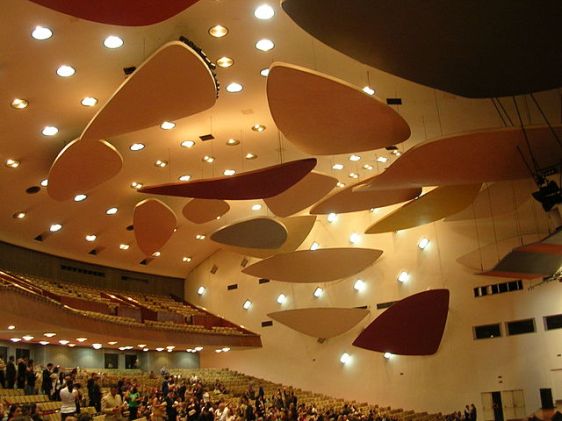
The Calder Conundrum, or Lack Thereof

Artist Alexander Calder is the subject of a homegrown musical—written, choreographed, designed and directed by local talent. Calder was an artist who played with movement—in wire figures, sculptures, and mobiles. His whimsical work brought joy and wonder to people in troubled times, particularly during the Depression.

mobile

By Alexander Calder via Wikimedia Commons

I absolutely loved the uplift of the musical, which was fun and campy as well as inspiring. The show offered a celebration of artistic commitment.

Here’s something that struck me as I watched the show: Calder (as depicted onstage) feared his work was juvenile, and at times he internalized other people’s disdain. Self-doubt, the enemy of creativity. A state familiar to many of us.

What struck me also was the way the co-directors of this musical framed our evening as an “escape” from today’s tense times. When I thought about it later, this felt like an extension of the “juvenile” indictment.

I felt that by connecting Calder—and this gorgeous production—to escapism, we did him and his art an injustice. I thought to myself: Joy is not an escape. Joy is fuel. And wonder is not distraction. Wonder is an engine.

640px-aula_magna-calder-ucv

By Caracas1830 – Own work, CC BY 3.0, via Wikimedia Commons

I wanted to declare that art is not optional, nor is wonder, nor is joy, nor is love. That these are essential pieces in an activated human’s soul.

The next morning I read Nikki Giovanni’s poem “Poets” in Chasing Utopia. It says in part:

Poets shouldn’t commit suicide. That would leave the world to those without imaginations or hearts. That would bequeath to the world a mangled syntax and no love of champagne…

I thought, yes! For a poet, certain activities are suicide.

My mind went to a sentiment I’ve seen expressed: “People need to stop complaining and run for office if they are serious about change.” For some of us, running for office—let alone holding an office—would be death.

My inner argument ended up here: There are many ways to make change, and we all have our part to play. Some of us will create art that brings joy, or show people a different way of living. Let’s respect and praise and enjoy each other for the countless ways our souls shine while we do our best work, whatever that may be.

Postscript
Interestingly, after I drafted this argument, I mentioned my thoughts to my spouse on the dismissiveness of the term “escape.” (“Escapist drivel” is what I judgmentally “heard.”)

She responded that she doesn’t think of escape in that vein at all. To her, it evokes a pleasant place to go in one’s mind. Nothing negative or demeaning about it.

Apparently I got all up in arms over something that was in my own head. There I go again, doing battle when there’s nothing to battle.

Now, of course,  I realize that this internal argument has everything to do with feeling OK about myself and the level of activism I choose to undertake. With the new administration in the White House, every day there are new actions that pain me. And I want to take part in righting wrongs.

The many requests to call decision-makers…flat out drain me. It’s been tricky to figure out where to direct my time and energy. And I’m constantly judging and pressuring myself.

An underlying story informs my need to prove that I’m good enough through activism. It’s what Charles Eisenstein calls the cultural myth of Separation. The story that says I’m separate from you (whether better—if I make more calls than you!—or worse—if you are one of my many super-engaged friends whose activism goes beyond a mere phone call).

This idea of “I’m bad/wrong for not doing x” leads to …

“I’ll force myself and then I will be worthwhile” which leads to…

“I’m better than you because I care more, and look at what I forced myself to do.”

Basically, I’ve been using the master’s tools (of domination, control, force, separation) in an attempt to bring down the master’s house, to paraphrase Audre Lorde.

This underlying Story of Separation, Eisenstein would say, gets to the root of the interlocked problems we face. It’s the same root that underlies the very problems I do or don’t call about. A sense of humanity as separate from nature, from each other, from the magic of an intelligent cosmos. Which we know now isn’t true.

Now we’re getting somewhere. We’re talking about a cultural shift from old story to new story.

alexander_calder-_mobile

By Manuelarosi – Own work, CC BY-SA 3.0, via Wikimedia Commons

It’s funny how keying into this bigger picture brings me back to a place of joy, wonder, and activation. So that even if I choose do the exact same actions I previously forced myself to do, the energy behind the tasks feels different. More spacious.

The Impossible

“It always seems impossible until it’s done.”

—Nelson Mandela

cell

Nelson Mandela was imprisoned here for 18 years of his 27 years of captivity. This is his jail cell on Robben Island, Cape Town, South  Africa. When he stretched out on the floor, he could touch both walls. Photo by Judy Hostetler.

Puzzling

A mystic is someone who has the suspicion that the brokenness, discord & discontinuities of everyday life conceal a hidden unity.”

~Rabbi Lawrence Kushner

What do you do when you have no roadmap to follow as you’re puzzling?

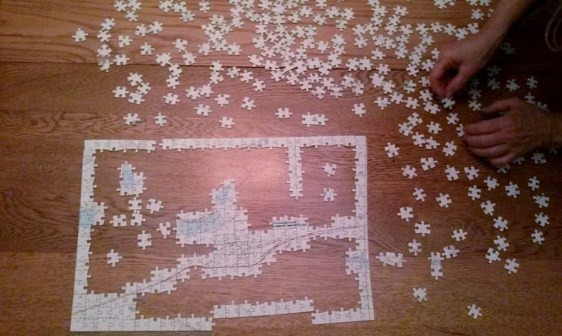
Friends posted this photo on Facebook, showing how far they’d gotten on a puzzle created from a map of the old homeplace. The box had no picture to guide their efforts.

barb-and-puzzle-958x574

A puzzle made from a map of home.

At the same time, Judy and I were working on this “jigsaw puzzle mystery” that came with a story and a mystery to solve. We didn’t realize until we began that the photograph on the box didn’t match the puzzle itself.

img_5505-1024x766

A mystery puzzle. (Spoiler: the solution to the  mystery is an anachronistic cat in the cave painting.)

At first the mismatch was disorienting, then frustrating, then a good challenge. Looking at shapes and colors and piecing the thing together was a great exercise for my sometimes-too-wordy brain.

In Finding Your Way in a Wild New World, Martha Beck reframes problem-solving as “puzzle-cracking.” Conceiving of something as a serious problem immediately brings up rigidity and judgement—which shut down the imaginative flow needed to arrive at creative solutions.

Whether we’re looking at big societal problems (er, puzzles!) or humble homey ones, it’s the same: Play, not work, is key to the process, she says.

Also, a sense of the bigger picture that we may not see, but that we know we can add to, piece by piece, by aligning ourselves with what wants to be born into the world.

In a world of brokenness and discord, how do we map our way home before we can see “the big picture?” I think it comes down to trust that a picture will emerge.

Transforming an Old Habit

Recently I asked a group of people: “What or how do you want to transform in 2017?” Their answers, so heartfelt and true, got me thinking of my own answer. What emerged as my “thing” was this: A pattern of having “too much to do,” of constantly slipping toward feeling overwhelmed by life.

I thought it might be useful to share how I am beginning to transform that old habit into my chosen reality: a sense of ease and joy with the smorgasbord of life.

Let me attempt to reconstruct some of that inner work. Below is an approximation—I find it hard to exactly translate this type of exploration unless I’m taking notes every step of the way.

I began by examining my feelings. I realized they stem from old programming, dating back to childhood, when I overidentified with school achievements to make myself OK. It makes sense that that would come up now, because I’m working with a business shaman/coach who gives weekly assignments. Homework! I’m a good student; I do my homework.

Even though the program is grounded in ease and bodily wisdom, as we began to set business objectives for the coming year, I found all my old mental gears revving up. Must prove myself, must pile on more and more, create loads of stress just to show I’m really worth something! (“I have a talent for making things difficult,” I told my coach yesterday.)

Of course I ended up crashing. My body rebelled against an overambitious schedule. My mind grew muzzy and obsessive. My emotional state plummeted too. It was hard to imagine finding joy or ease in any of my goals (which had previously seemed so exciting).

I found, when I sat with my overwhelmed-and-down self and asked for guidance, that there is a surfer within me. She artfully rides the waves, finetuning balance in each moment. Balance is not a once-and-done thing, the guidance suggested. Life can be approached with playful skill.

4969562312_6ce1afb19f_z

Photo by Daniel D’Auria, via Flickr Commons.

I might just have to let go a tiny bit and find a way to dance with the rolling waves.

I asked to be released from the need to prove myself. That felt huge.

I also realized that I had willfully constructed a reality in which I was not in charge of my to-do list—subliminally I blamed others for what I had to do. I still felt like that child working for a good grade, though no one grades me now.

Curiously, I found that I held onto the payoff of this dynamic—a wiggly sense of not being fully responsible for my choices, because I could always say that these assignments came from an external place. This resonance with “I am powerless” allowed me to stay safely in my comfort zone.

I found, digging deeper, a fear of people disliking me if I didn’t perform at a high level. Beneath that, a fear of disliking myself if I slacked off: because clearly I am not enough if I don’t at least try to “do it all!”

I worked with myself as I would a client, loving these old programs, asking for their release, inviting the newly created space to be filled with light and love.

Then it was time for what ThetaHealing practitioners call “downloads,” which  basically means asking for Divine perspective and understanding through specific statements or affirmations. These are some of the things I pulled into my field while resting in an expanded state:

Show me what it feels like to take full conscious responsibility for my choices.

Show me what it feels like to live in joy and ease.

Show me how to ride the waves creating balance moment to moment.

I forget what else I downloaded, because I was in a theta brainwave state where words and images are ephemeral. It’s a bit like trying to remember dream fragments. But you get the idea.

Now I can set business goals with less baggage—and I can align more easily with my mission of holding space for personal and planetary transformation.

How Shall We Meet Ourselves?

A friend tells me that the biggest thing she learned in 2016 was that through any turmoil and pain, “I meet myself.”

The year rocked many of us, that’s for sure. Collective decisions like Brexit and Trump’s election shook foundational values we thought we could count on. We’ve been forced to look straight into the ugly face of racism, misogyny and xenophobia. We feel a worldtilting sense of shock, anger, and sadness, a literal and physical vertigo. And looking ahead, we fear what “we” have chosen for our future and the world’s future.

My Facebook feed is rife with “eff you, 2016” sentiments. People have declared 2016 to be exceptionally sucky, with an inordinate number of celebrity deaths. Not to mention the election, and its accompanying decline of civil discourse.

There’s much that feels out of our control. People die, pundits yammer, a president-elect tweets vitriol (and intent to expand nuclear weaponry) …

We grieve, we vent, we obsess or step away from the 24-hour news cycle as our constitutions dictate. We might sign petitions, write letters, make plans to march. (Or none of the above. Maybe we go numb, maybe we carry on as before.)

Still, we only meet ourselves. Who are we in this moment? Are we awake? Are we alive? Are we triggered, reactive, stuck in fight-flight-freeze mode?

For myself, I can say that paying close attention to my inner landscape is the only way that I can regain my footing these days. When I find myself in free fall, as soon as I remember to, I breathe into the moment and see if I can tend to the triggered place within me. Then I can move into speech or action (or no-action, as needed) with my energy clear.

9009347111_8a67844205_z

Photo by Vivian D Nguyen, via Flickr Commons

I think 2016 was the year that shook us out of our slumber. We have yet to see the full unleashing of a wide-awake (so rudely awakened!) populace. But if the sacred activism at Standing Rock is any indication, spiritually grounded action is a powerful antidote to the corporate greed that runs America.

Most of us won’t take part in grand protests, myself included (most likely). But our actions hold power nonetheless. I was reminded recently to show up in my “home frequency” with authenticity, and let go of outcome.

I think of that fantastically well-written TV show from a few years back, Friday Night Lights. “Clear eyes, full hearts: Can’t lose!” was the mantra of Coach and his high school football players.

How shall we meet ourselves?

Do we go into 2017 embittered, feeling victimized or triggered? Or do we clear our eyes, fill our hearts, and walk into the New Year unfettered?

Shine in Me

Such a deep, dark time of year. It’s hard to believe that the days (since Thursday) have already begun lengthening ever so slightly, a minute or so each day.

From the seasons’ turning, we know that an extended darkness doesn’t spell the end of everything. It’s just a cycle. And we ourselves have the agency to find and nurture the light.

On Wednesday night a Solstice fire gave us a chance to turn within. The flames reduced our scribbled papers and sage sprigs to ash as we released ourselves from the weight of the previous year.

3161883549_46e7338725_z

Photo by rahul rekapalli, via flickr commons.

Tonight my Jewish friends light the Menorah for the first day of Hanukkah. Meanwhile many Christian folks will go to church for a traditional Christmas Eve candlelight service.

Tomorrow, Christmas Day, we ourselves will celebrate with turkey and dressing shared around our table, and some modest gift-giving afterwards. The lights in our front windows will stay on all day and into the evening, a symbol of welcome.

These traditions call on our highest selves to be kind, to be intentional, to be generous, to be grateful.

Light of the World, Shine on Me, the song says.

I suggest a small change. Shine IN Me. After all, we all carry the seed of Divinity within.

Consider this Facebook post from Jul Bystrova, founder of Era of Care, who just returned home from supporting the water protectors at Standing Rock Indian Reservation:

I find myself often comparing this time to the Lord of the Rings. The darkness grows, destroys and seems impossible to stop. But we do well to remember that we were returned to the light by simple hobbits with tremendous courage. We are those simple hobbits.

Whatever your spiritual tradition: shine on, my friends.

No One Unreachable

We are so schooled in separateness. Wired, the scholars say, to see first our differences, though 99 percent of our DNA is the same. What if we begin to see the world differently, not me/us/mine vs. those others—but all of us?

Might this lead to questions like “What is it like to be you?” instead of “Are you like me? Could I love you?” or even “What is wrong with you?” or worse?

The way to reach people, it seems to me, is not to hector and judge and shame—but to listen and share.

It’s a generous and muscular act, listening with respect while opening to the possibility of transformation.

And what if we don’t leave anyone out of the equation, even those who appear to be despicable, beyond redemption? I think of an audiobook we listened to on a road trip a few years back. (I wish I could remember the title and author, or find it online, but I’ve had no luck.) It concerned the mystical kabbalah tradition. I still remember the large-heartedness we encountered in the listening.

The writer said that in this tradition, no one is out of reach: In the deepest darkness, there is always a sliver of light that can be contacted.

8541398947_5ed3942d77_b

Tree of Life, by Andrea Terzini, via Flickr Commons

Think about that. No matter how evil or cruel their behavior, they contain a spark of light. Staying aware that we all carry this spark—and that it can be fanned into a steady flame, at any moment surprising us—changes how we might deal with those we’d like to demonize.

I once read about a KKK man who took up a phone harassment campaign against a Jewish rabbi who moved to his community in Nebraska. The rabbi and his wife could have contracted into hatred or fear. Instead, they expanded with love into the hateful man’s arena.

“There’s a lot of love out there. You’re not getting any of it. Don’t you want some?” the rabbi said into the man’s answering machine. The congregation prayed for him.

One night the man’s swastika rings began to burn and itch, and he took them off. Eventually he called the rabbi in tears, saying, “I want to get out of what I’m doing and I don’t know how.” They became friends. The man converted to Judaism, renouncing the Klan and making amends to many of his targets. The couple took him in when he needed care and had nowhere to go.

In the end the people he’d despised became his family.

What do you make of that? That level of love? Could you do as the rabbi did? I’m not sure I could. But I aspire to.

To keep beaming love at each other no matter what—while still honoring our own process and pain: Through that courageous act we might begin to understand, deep in our marrow and in the whirling energy of our molecular movement, the truth of oneness.

How

“How do we apologize to the plants, the oceans, the air? The Mexicans?”

Asked by a dear friend who came to this country decades ago, wearing skin that makes her a target to some—and now more than ever.

I don’t know the answer.

I can say a mantra learned from the Hawaiian healing tradition of ho’opono pono. I take full responsibility. Please forgive me. I love you. Thank you.

Everything that comes up to confront me is a part of me already, says this tradition. So I take responsibility for it all.

With this mantra comes a sense of settling, and sometimes a bit of clarity. Perhaps an idea arises that may or may not by Divinely inspired: I will join the local Amnesty International group and write letters on behalf of prisoners of conscience. I will volunteer with Exodus Refugee, which works to resettle displaced people in my community. I will look up what Charles Eisenstein  and Starhawk have to say.

Or sometimes it’s an idea like: I will take my dog to the park and reconnect to trees and earth and sky.

img_20161111_150100764

Opal and the Wise Old Oak.

Or simply: I will sit and feel into my body. I will allow my heart to be heard.

I will take this deep breath in, and let it go, and know that no one can steal my peace from me, because I make it myself and receive it as I ask.

Yes, all of these and more. And I still don’t know the answer.

Affiliation

This came out of my pen a while ago, and I just found it again. It seems timely.

Humans need to feel ourselves as part of a whole. We build our belonging in so many ways. By joining a fantasy football league, or playing games online, or joining a militia, or marching in anti-war demonstrations (or anti-Monsanto, which some would say amounts to the same thing). We join a political party and cling to it.

That’s what we do—as humans we can’t live without affiliation.

What if our affiliation took the form of something much grander, and more lasting, than any of these? What if our affiliation were to the whole of the earth, and its affiliation were to the whole of the universe, and all the galaxies were aligned in some grand plan?

Well it seems foolish to suggest it when so much is going wrong today, but a chill in my scalp, a prickle up and down the roots of my hair, says yes, you are on the right track here.

So it’s just that easy? How quickly, when I get up from my desk, do I forget that All is One. I bump my elbow and curse the wall. I have too much to do and hate all of it. I don’t want to be uncomfortable or cold or pressured. I cringe at the things I say. I knee-jerk at the things others say, my buttons pushed.

I forget who I am, a small but seriously important child of the universe, like everyone around me, like every single ant larva buried in the wee hill that showed up in the compost my neighbor spread for me under the hydrangeas. All of us.

It matters not how big the brain or how advanced the architecture or how wordy the language. All of us are children of the same divine womb.

We never know what we are part of. We are just one tiny life form in the Milky Way galaxy. Here we are, a light among lights. Lit by sunlight, lit by spirit.

Beatuiful lights

Photo by Rory MacLeod, via Flickr commons

And we don’t always realize this, we don’t realize that our light can be part of a greater force that is gathering, that is gaining momentum, because all we see are images of the sad and mean and painful and violent. The people doing small good things every day do not get much of a mouthpiece.

I don’t even mean environmental actions and the like. The briefest smile of connection might light someone else’s heart. I’ve written this before, many times. I am happy to think it. Not because it lets me off the hook for the big things but because it means every moment of my day can have an impact. It gives me something to do about the pain that crashes at my door every day. I can breathe it and love it. I don’t need to turn away and I don’t need to feel helpless anymore. I am a part of the healing force of nature now. That’s my affiliation.

And I do know it, some of the time. I don’t know what impact I’m really having. But it doesn’t matter.

We never know what we are part of until we just ride the wave to the shore and crash with our friends in a pile of floppety fish.