Pay It Local

In Ball State University’s Down to Earth documentary about sustainable food systems, renegade farmer Joel Salatin makes a key point about the importance of spending food dollars locally. A small amount of cash spent at the farmers market or local food store might make a huge difference to the vendors there. You never know what kind of difficulties they face, and where they stand on the thin line between a manageable load and giving up.

It’s kind of like paying it forward, only you’re “paying it local.”
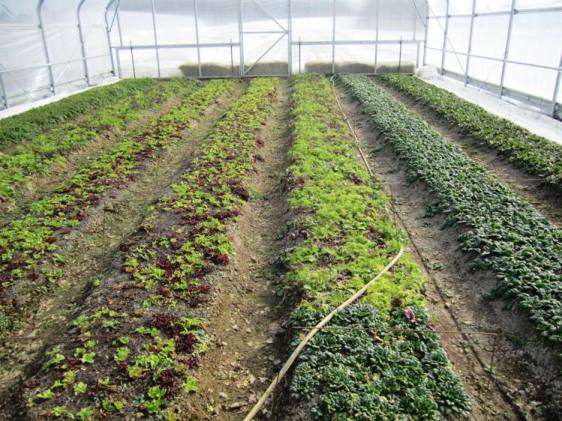
Freedom Valley Farm's high tunnel beds.

Freedom Valley Farm’s high tunnel beds.

It reminded me of something I blogged some months back:

The row we plant might be just the encouragement our elderly neighbor needs to start seeds on a windowsill. Which might nudge her granddaughter to visit a farmers market and buy a farmer’s tomatoes, and one of those funny-looking squashes while she’s at it. Maybe she’ll come back in ensuing weeks and bring her children and a friend, buying more locally grown food. Which shows the farmer that his produce is desired, and keeps him from throwing in the towel after a tough summer.

Since I wrote that I’ve talked to many small farmers as part of my freelancing job, and I’ve learned that farming is more difficult than any nonfarmer could ever imagine. What they do requires a lot of faith. And people to buy what they’re selling.

When I interviewed Hoosier Organic Marketing Education (HOME) founder Cissy Bowman for a Farm Indiana story, she emphasized the critical role of the nonfarmer ally. “Never feel disempowered,” she told me. “As a consumer your opinion is the most important, because you’re the one who buys it.”

Our consumer choice is not even just about food. It’s also about keeping land out of developers’ hands. If farmers can earn a living wage, fewer properties will be snatched up and turned into subdivisions and shopping malls. That means more acreage for wildlife, native plants, and pollinators.

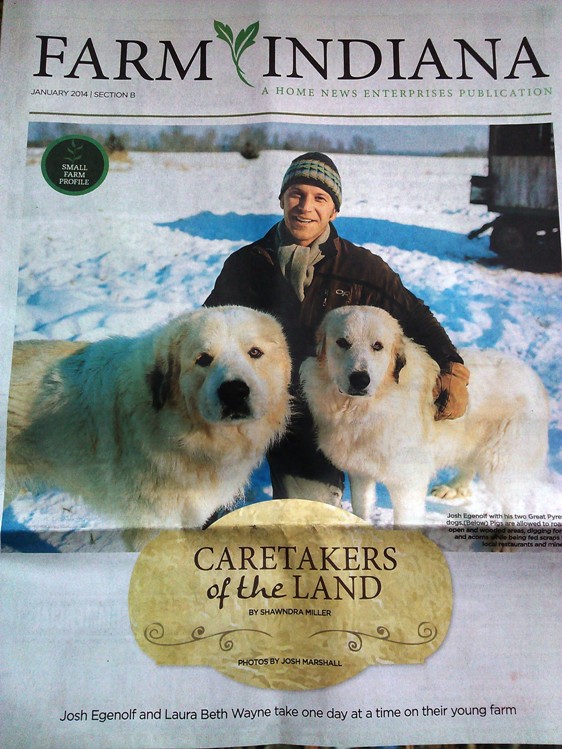
From the front page of Farm Indiana

From the front page of Farm Indiana

The current issue of Farm Indiana contains two stories I wrote. One is about Cissy and HOME, a terrific nonprofit organization that helps farmers like Anna Welch with rural development projects and educates everyone about the importance of organics. The other is about Freedom Valley Farm, an Owen County operation that I thoroughly enjoyed visiting.

Jim Baughman showed me around his farm on a February day.

Jim Baughman showed me around his farm on a February day.

I can testify that Jim’s winter produce is among the best I’ve tasted. We’re talking melt-in-your-mouth spinach and juicy-crisp carrots. This guy is good at what he does, and he does it all without chemicals.

To read the stories, click here.

A Beautiful Thing

As the Intergovernmental Panel on Climate Change gathers in Japan to finalize their report on the status of global warming, I’m thinking about hope. Hope as choice and saving grace. Here’s a piece I wrote some time back.

My spouse and I recently watched a library DVD of the HBO series Enlightened, in which Laura Dern plays a woman seeking to expose the wrongdoing of her corporate employer.

Photo by manyhighways.com, via Flickr Commons

Photo by manyhighways.com, via Flickr Commons

The show is a mix of humor and pathos and drama, with the main character, Amy Jellicoe, revealed as both tender-hearted and colossally insensitive. She’s self-centered, obnoxious, impulsive—and, at times, luminous in her dreaming of a different world.

By the last episode, Dern’s character has discovered the cost of being a whistleblower, having lost her job and her love interest. The last blow comes when Amy’s mother says she is no longer welcome to live in her house.

The final scene finds her knocking at the door of her ex-husband Levi, who knows her best. Sitting next to Levi on his front stoop, Amy asks him, “Am I crazy?”

What a question. I’ve asked it of myself so many times. Am I crazy to think that this world can transform, that we can evolve as a species? Am I crazy to believe that we can pull each other to a higher vibration—one that would usher in a new era of equity and resilience?

Am I insane to believe that we can still thrive, even in the face of this terrible and seemingly irreversible mess we’ve made?

In the final words of the series, Levi, played by Luke Wilson, turns to her and says, “No.”

He says, “You’re just full of hope. You got more hope than most people do.”

He tells her, “It’s a beautiful thing to have a little hope for the world, you know?”

Photo by ZeHawk, via Flickr Commons

Photo by ZeHawk, via Flickr Commons

I’ve come to believe that to be hopeful is rarely foolish, or naïve, or crazy. Or if it is all of those, perhaps it doesn’t matter.

Hope is a choice I make for the sake of my own soul and soul of the world, for the health of those around me. I regularly renew my decision to be a holder of hope.

I choose to believe that it’s possible to live in such a way that doesn’t steal from the impoverished on the other side of the world, that doesn’t rape the earth. I choose to envision the possibility of healing this beleaguered planet.

Maybe I am crazy.

But I still believe. This better world is on its way.

Relocalizing the Food System

I love writing stories about food and farming. The people I meet are so passionate about their work. Almost everyone I interview is invested in reforming the broken food system. Bonus: They give me tasty things to eat.

Here’s a rundown of the treats I’ve sampled just in the past few weeks.

  • Cissy, a woman who’s long been the vanguard of Indiana’s organic movement, gave me some intensely flavorful pickles she made from cucumbers raised in her kitchen garden. I washed it down a glass of homemade kombucha that couldn’t be beat.
  • Jim, a farmer in Owen County, sent me home with a bunch of carrots he pulled from the wet earth like a late winter miracle.
  • Anna, a farmer in Rush County, gave me a huge jar of rolled wheat that her cooperative had grown and milled. (I used some in banana bread I baked for my weekly writing date—my writer buddies pronounced it wonderful.)
Checking out a display of LocalFolks Foods at Moore Corner Store while on assignment

Checking out a display of LocalFolks Foods at Moore Corner Store while on assignment

And a couple weeks ago, at Moore Corner Store, proprietor Jasen Moore offered me a taste of ketchup made by Indiana’s own LocalFolks Foods.

I’m no ketchup connoisseur, and in fact we never purchase it. But if I were a fan of this most American of condiments, I would never buy a national brand again. LocalFolks’ is sweetened with sugar, not the genetically modified scariness that comprises high-fructose corn syrup.

I happened to be in the natural food store when Hoosier Microgreens’ Alex Sulanke came along to introduce his product. So I got to munch uber-fresh sprouts of radish, cabbage, kale, arugula, and mustard from “the smallest farm in Indiana” (120 square feet).

Moore Corner Store is in the business of connecting small farmers and food entrepreneurs to the consumer. Though its hours are limited at present, this shop and others like it fill a critical role in relocalizing our food system.

For Jasen and his wife Sara, Moore Corner Store is more than just a business. It’s a mission. Jasen told me the enterprise arose out of concern for the state of our economy. Big box stores have fragmented communities and hurt the little guy.

Moore2“But a store like this…supports the local economy, minimizes carbon footprint, puts actual nutritious food on your plate, and it’s close to home.” The Moores live just up the street from the shop, though both must spend time elsewhere to make ends meet.

I just saw a documentary called Down to Earth in which the iconoclastic farmer Joel Salatin (made famous in Michael Pollan’s Omnivore’s Dilemma) made an important point: Your purchase of a farmer’s product might be the thing that keeps that farm afloat another week.

Is it worth changing our habits to spend a little more of our money at a farmers’ market or a shop like the Moores’? I would say yes. What about you? Have you connected with a small farmer, producer, or locally owned shop lately?

Check out my piece on Moore Corner Store here.

Localizing the Winery

When is a winery more than a winery? When it contributes to revitalizing a rural community, putting the local economy at the forefront of its mission. Owen Valley Winery, which I discovered on assignment for Farm Indiana, is just such a place.

IMG_20140301_135319

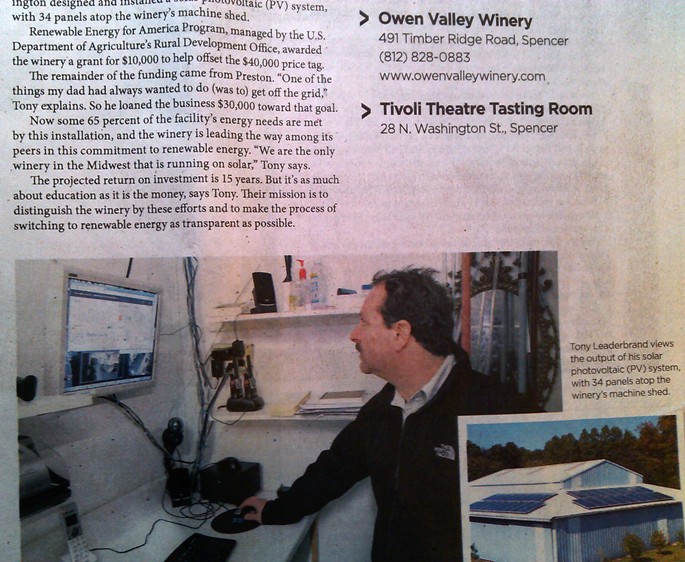
Here’s a look at the piece I wrote for this month’s issue of Farm Indiana.

I thoroughly enjoyed my conversation with Tony Leaderbrand (pictured above), who told me the whole story of the family-owned business’s evolution. Aside from their commitment to showcasing Owen County’s locally grown and made products, the winery is unique in another respect. It is the first Midwestern winery to run on solar power.

IMG_20140301_135602

A grant from the Renewable Energy for America Program helped pay for the solar panels that now produce a large portion of the winery’s energy needs.

Locally grown persimmons are among the fruits used in Owen Valley Winery’s products. I was moved by stories of people bringing their excess fruit in shoeboxes and buckets every fall to sell to the winery. Tony made me see that winemaking is truly a local ag-based endeavor. (Due to demand for dry wine, they also use some California-grown grapes as well.)

photodune-1133279-wine-s

Photo by groceris, via PhotoDune

Tony told me all about the repurposed items that went into construction of the tasting room and production facility. In fact, the second tasting room is kind of an upcycling project in itself: It’s located in the renovated Tivoli Theatre, a historic building in Spencer, IN.

On a personal note, Tony talked about how eating produce from local farms is a winner both in terms of health benefits and reduced packaging. Not to mention the benefits of keeping dollars circulating in the local community.

“I think there’s such a need for us all to come full circle on purchasing,” he said. “We have to break these old habits of going to these superstores. You’ve got to know where everything you buy comes from.”

You can read the full article here (do a search on Owen Valley Winery to jump to the piece.)

A Loved World

I heard two interviews in the last few days with Elizabeth Kolbert, author of The Sixth Extinction: An Unnatural History. While listening to the Fresh Air interview I was making pizza. And I must have decided—or the part of my brain that can’t process too much scary information decided—that making pizza required all my faculties, because I kept zoning out.

But I did hear that 25 percent of all mammals on the earth are endangered, and 40 percent of amphibians.

Photo of critically endangered Panamanian Golden Frog By Tim Vickers [Public domain], via Wikimedia Commons

Photo of critically endangered Panamanian Golden Frog By Tim Vickers [Public domain], via Wikimedia Commons

I did hear that the Great Barrier Reef is on track for full-scale collapse, and that we can expect the oceans to eventually look like “the underwater equivalent of a vacant lot.”

No asteroid is to blame this time. The driver for this extinction wave is humankind.

That’s a heavy load to bear, even if I knew it already. With our tailpipe emissions and our moving from continent to continent and our wildly inventive minds, we are rapidly bringing about the demise of millions of species.

The author makes the point that our impact on other species isn’t (always) intentionally malevolent. It’s the very nature of our speedy brains and dextrous hands. It’s the fact that, as Kolbert says, we don’t have to wait for evolution to create change. We just make a tool. Which makes life difficult for creatures that change at the pace of evolution.

What does this mean? I don’t know. It feels bleak. I like to take the long view, the esoteric/spiritual/energetic view that focuses on evolution of souls, a realm beyond the physical. Still, here on the physical plane, it’s a devastating trajectory.

Self-preservation requires that this knowledge fade in and out of my consciousness. I go about my days, doing what I do, worrying about small things. Then it’s like the moment my dad was diagnosed with inoperable, terminal cancer. Suddenly all that trivia fades in importance. I’m pierced by pain. A loved one, a loved world, is in jeopardy.

© Cinc212 | Dreamstime Stock Photos

© Cinc212 | Dreamstime Stock Photos

I don’t know what to do or say in the face of such hideous information. Just the fact of the dwindling numbers of monarch butterflies alone makes me want to weep.

I find myself wanting to check email, check Facebook, call a friend, watch the Olympics. To do anything but stay with this knowledge.

I can say that all things happen for a reason and everything is unfolding exactly as it should and we are holding the light whether we know it or not and we were always meant to get to this point—but is all that just a bandaid for unendurable grief and fear?

___

I wrote the words above last night. Today, I feel different, grateful, open. I took time to sit in love and awareness this morning. It seems the metaphor of a terminal diagnosis fits better than I first realized.

In the face of horrifying news, sometimes there is an opening to the sacred. Suddenly you savor life more than ever. You don’t take anything for granted. You give what you can. You do what you must. Your love expands.

When Crisis Threatens

Thanks to a review in Permaculture Activist magazine, I found a little book called Small Stories, Big Changes: Agents of Change on the Frontlines of Sustainability. It’s a collection of inspiring voices from the community resilience movement. Each chapter is written by someone actively engaged in the world’s remaking.

Here’s a passage from the very first chapter that gives you a taste.

Goat milking, by V Becker, via flickr Commons

Goat milking, by V Becker, via flickr Commons

“(A) community of busy farmers, gardeners, goat-milkers, trail-builders, engineers, scientists, windmill climbers and solar installers…have led our society’s journey toward sustainability…

They are leaders because their excitement is stronger than their fear.

Logically, when crisis threatens we need to subdue our fear in order to take constructive action. But taking action also somehow diminishes our fear…Once we get busy we’re not as scared any more.

Perhaps we don’t control the forces changing our climate when we grow a few vegetables, but we do influence those forces, and I think the activity profoundly changes our perspective. The situation immediately seems more manageable when we begin to manage.”

—Bryan Welch, publisher of Mother Earth News

Photo by julochka, via flickr Commons

Photo by julochka, via flickr Commons

Have you found this to be true? I have, especially when I’ve gotten “the help of a few believers, supporters, and friends who light the way through the dark nights,” as David Orr describes elsewhere in the book. When I am at my lowest is usually when I’ve fallen away from hands-in-dirt activities for whatever reason, or when I’m feeling isolated. It’s easy to fall into this trap in winter especially.

But when I’m pulling together with neighbors to scheme a project or clean up my block or make a big batch of sauerkraut, I feel ready to face anything.

What about you? I’d love to hear about action you’ve taken—and how it impacts your anxiety level about the state of the world.

Restoring the Land

IMG_20140110_101420

Cover page of my Farm Indiana profile of WE Farm

Dr. Lisa Harris remembers well the first conversation with the young man who would come to farm her land—they talked for hours, almost an entire day. “I was so impressed with how deliberate and thoughtful he was,” she told me.

Dr. Harris is Eskenazi Health’s medical director, a vegetarian with a lifelong interest in eating healthy food. As I learned when I wrote about WE Farm for Farm Indiana, she leases her Owen County property to Josh Egenolf and Laura Beth Wayne’s pastured beef cattle, poultry, and pork operation.

“Most people in the United States do eat meat,” she said. “So if I can be part of something that gives people access to meat from animals that have lived well, it seems like a perfect opportunity.”

Like many of us, Dr. Harris tries to live as lightly as possible, and Josh’s plans to make her land productive really spoke to that goal. “What Josh is doing,” she said, “is in every sense helping to improve the land.” WE Farm’s integrated, rotational grazing plan means the animals work in concert with nature to restore pastureland—all the while sequestering carbon and nitrogen in the soil.

The day I visited the farm last November in preparation for my Farm Indiana story, four happy dogs ran in front of the pickup truck as we drove up the lane to tend the livestock. Owen County is picturesque, with wooded hills and deep valleys. Josh showed me the steep woodlot where the hogs are periodically turned loose to forage for acorns and pawpaws. They also help him clear out understory invasives, just by doing what pigs do.

Breeder pigs enjoying their mineral rations on a frosty November morning.

Breeder pigs enjoying their mineral rations on a frosty November morning.

Josh was raised on a farm just a few miles up the road, and he treasures the richness of his a rural childhood. Giving that experience to his own child (and another on the way) is a big reason why he moved back to the area after pursuing his doctorate in ecology at the University of Georgia.

Also, he wanted to be put what he’d learned there into practice. Agriculture, he told me, has enormous potential for creating meaningful environmental change.

He said, “In 2007 I read The Omnivore’s Dilemma. Before that it never occurred to me that there might be anything troublesome about the way meat was produced, other than animal welfare stuff. That’s very clear to me…you shouldn’t treat your animals poorly. They need to be respected. But it didn’t occur to me that there was a single thing wrong with them eating grain and (even) industrial byproducts.”

He knows that many people still don’t realize the environmental and health issues that accompany feeding grain to meat animals, but a growing customer base tells him how many people value pastured meat. “It’s like an awakening that needs to happen.”

Josh and Laura Beth strive to keep the business as local as possible, keeping close to home in all their dealings. For more on their endeavors, check out my Farm Indiana story and the WE Farm website.

A Field to Fork Market

“In Indiana, we can grow so much of our own food. We really could be sustainable now,” says Kevin Logan, MD. Though we can’t grow mangoes or bananas, he believes we could cultivate everything we need for regional self-sufficiency.

INgredients Field to Fork Market, a new shop he opened in partnership with wife Jacqueline and old friend Tom Wiles, is exerting influence on both supply and demand. To stimulate the market for good clean food, the deli demonstrates how to use local produce like bok choy and spaghetti squash. Meanwhile the proprietors are coordinating with the many farmers and producers capable of feeding our region, in anticipation of the 2014 growing season.

I had the pleasure of talking with the three of them when I wrote this Nuvo piece on the store. It’s located in a refurbished Taco Bell, and full of items grown or produced in Indiana.

Pie pumpkins and gourds from local farmers at INgredients.

Pie pumpkins and gourds from local farmers at INgredients.

“I feel like we’re going to have to get back to community,” Logan says. “And food choices are one way that we do that.”

The trio plan to hold classes on every stage of food growing, storing, cooking, and preserving, to help people gain garden knowhow and kitchen skills. Both fermenting and cheese making classes are in the offing.

All in all this shop is a great addition to community resilience efforts in my town.

To be Fueled by Love

Browsing the shelves of Point Reyes Books last month, I picked up Mary Pipher’s latest book. Her Reviving Ophelia illuminated the struggles of adolescent girls. Now she has a book called The Green Boat: Reviving Ourselves in our Capsized Culture, detailing her progression from despair to activism.

A Nebraskan, Pipher was on the front lines of early campaigns to stop the Keystone XL Pipeline from going through the Sandhills. (Three years later, the pipeline is still in limbo, and has become a symbol of the fossil fuel industry’s disastrous impact on the planet.)

Dismal River, Nebraska Sandhills. Photo by USFWS Mountain Prairie, via Wikimedia Commons

Dismal River, Nebraska Sandhills. Photo by USFWS Mountain Prairie, via Wikimedia Commons

Even before opening it, I knew this book would return me to grounding.

I’d been talking with Richard Heinberg about his book The End of Growth, which describes a trajectory that I understand and yet can’t quite face head-on. Seeing it spelled out and hearing him expound on it left me feeling quite scared.

I know that many are pulling together for a better world. But our governmental policies favor the monied corporations running the show. I was starting to doubt that community action could effect change on that level.

Along comes Pipher, describing an activism that’s joyful and even fun. Example: grandmothers gave weekly “thank you in advance” pies to the Nebraska governor until he agreed to meet. This brand of protesting, fueled by love of the land and concern for tomorrow’s denizens, seems the perfect antidote to despair.

A chapter called All Hands on Deck begins with this quote from Frederick Buechner:

“God calls you to the place where your deep gladness and the world’s deep hunger meet.”

To be glad in the face of the world’s rending sometimes seems impossible. Yet I remember opening the church basement doors on the day of our SkillShare and seeing the space instantly fill with participants, their faces alight with curiosity. I think of the heart-cracking instant when a resonant phrase finds my fingers on the keyboard. I recall the joy of putting a garden trowel in the hands of a preschooler.

There’s an expansiveness when I reflect on these moments, a sense of the heart opening that lifts me from powerlessness.

Explaining vermiculture at the Irvington SkillShare. Photo by Jeff Echols.

Explaining vermiculture at the Irvington SkillShare. Photo by Jeff Echols.

Pipher acknowledges the “experts” who downplay the importance of individual actions. They say systemic economic and political changes are necessary to change this trajectory. True enough, but this reasoning is incomplete, says Pipher—for “who is it that is in charge of systemic change?”

She argues that individuals have always been the source of world-changing actions, and what else can one person do but start with herself? And join others in common cause, as did the abolitionists. It’s said that they had no hope of success, at the start.

My small self is quick to tell me what I’m not. I’m no naturalist, no doctor of philosophy, no career activist, no farmer, no wisewoman in a mountain hut. I am just myself. Sometimes I question: What do I have to offer?

I only own this experience, this deep heart of pain and care, grief and fear—and love. 

What do I have to offer? All of it. I offer it up.

[More from Mary Pipher: Read her interview on how to wake up and take action on climate change (and stay sane).]

Book Offers a Vision of the Possible

I’ve had this book out from the library the past few weeks, but after test-driving it, I just emailed Kathleen at Bookmamas to ask her to order it for me. It’s a keeper. Here’s my review:

Wendy Tremayne’s The Good Life Lab: Radical Experiments in Hands-on Living gives a powerful example of a reimagined world in the shape of one couple’s desert homesteading adventures.

Prickly pear, an example of the desert bounty gathered by Tremayne. Photo by Jon Sullivan [Public domain], via Wikimedia Commons

Prickly pear, an example of the desert bounty gathered by Tremayne. Photo by Jon Sullivan [Public domain], via Wikimedia Commons

Many of us work toward self-sufficiency (or better, community-wide resilience, broadening the circle from homestead to neighborhood). But we’re hampered by the need to make money to prop up our lifestyles, cutting into the time we have to learn and practice new skills. Wendy and partner Mikey demonstrate what is possible by leaping into a completely new way of life. They cash out their retirement accounts (a prescient move, before the crash) and transplant themselves into Truth or Consequences, NM to build a new life.

And build they do: using waste materials and nature’s bounty, they craft a beautiful, abundant, interconnected home base that allows them to live their deepest values.

In contrast to some “green lifestyle” books that focus on giving up luxuries for the earth’s sake, this book offers an exuberant romp through the reclamation of life’s biggest gifts: time, beauty, creativity, connection, purpose. More than just a memoir, it is an invitation to adopt the “maker” mindset. Tremayne’s lyrical descriptions of the spiritual aspects of this journey, coupled with the gorgeous, whimsical artwork and photographs, make this an inspirational book.

The author (who founded Swap-O-Rama-Rama, a community-based textile repurposing/skill sharing extravaganza) observes, “When all of life is for sale, it is a revolutionary act to become a maker of things.” She describes “life in the waste stream” as the ultimate freedom.

“By relying on waste, on what nature provides, and on ourselves, we gave the world a chance to demonstrate abundance. By becoming makers of things, we let our creativity become a transformative link between the free materials available to us and the finished goods that made our lives better.”

She notes that mistakes are part of this process, and describes combatting the inevitable “I can’t do that” by simply taking the next step. For those of us who consider ourselves less than handy (ahem), the book offers both challenge and a roadmap. The last section, in fact, provides concrete steps toward reclaiming the building blocks of life, covering food, power generation, fuel, and shelter.

The physical book itself embodies the new world by its very design, in which art and joy and utility are married into a brilliant manifesto.

In short: Stop what you are doing and order one now from your local independent bookstore, people!

(Can’t wait till your book arrives? Hungry for more after reading it? Check out Wendy and Mikey’s blog at Holy Scrap.)