Inner Transition As Key to Collective Work

First in a series of three

In my last post I suggested that an internal shift is as critical as the external changes we so desperately need. I’d like to explore that idea further in this series.

While in California last fall I had a conversation with Julia Bystrova, who was developing a series of “inner transition” tools with Transition US.

The Transition movement is a worldwide push to bring communities into a relocalized post-oil economy. The idea is to reduce consumption and embrace local energy, while building food security and resilience.

Transition Linithgow. Photo by John Lord, via Flickr Commons.

Transition Linithgow. Photo by John Lord, via Flickr Commons.

Julia told me that this movement suffers from a particular conflict: Some people want to jump right in and work on projects, while others prioritize the internal transformation process. The first camp gets impatient with the second, which has often been marginalized. Working groups often struggle to collaborate effectively, caught up in conflicts and divisions.

The solution is to give “inner tools” their due, Julia says. Both external output and internal process are valid. And as Julia says, the external is a mirror of the internal. “There needs to be group process that accepts both in a way that is complementary, because we need both.”

Mapping the Transition. Photo by Chris Hill

Mapping the Transition. Photo by Chris Hill, via Flickr Commons.

I tend to agree, having been involved in some groups that struggle to find cohesiveness. Group dynamics are tricky. To my mind, conflict is likely to persist until we each are willing to be present to our own emotional states.

If we walk through life largely unconscious of what triggers our pain, we’ll always be in a reactive mode. People push our buttons, we react, and conflicts escalate, all because we can’t take look honestly at the storms raging within us.

And it’s crucial that we find a way to work together.

Julia Bystrova and author Mary Pipher both say that we are all doing important work now. Even if we think we’re removed from the front lines, we’re not. Because the central task of our time is just that: working toward a healthier ecosystem and a just economy.

Julia believes that societal transformation can happen fast. She envisions a cascade effect that will be breathtaking in its global reach.

She told me that a certain threshold of consciousness is already on its way. With each of us lighting the spark of countless others, Julia believes we will see the world transformed.
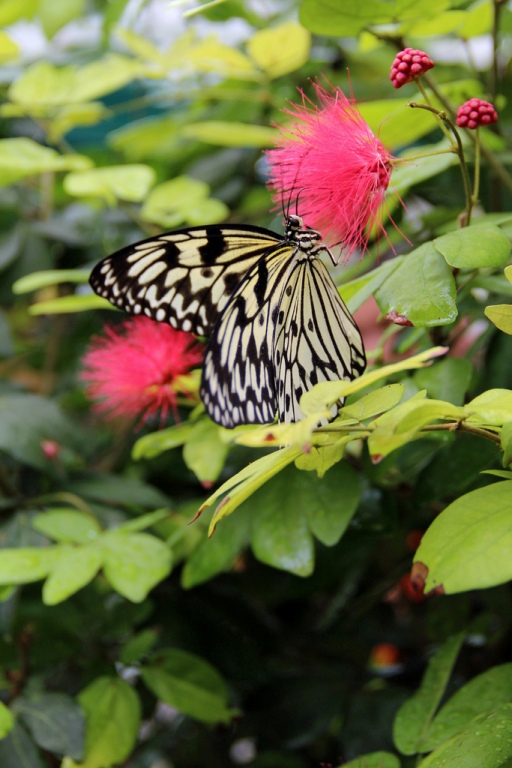
Swallowtail. Photo by Heidi Unger.

Swallowtail. Photo by Heidi Unger.

Mary Pipher also expects widespread transformation. As people open to their deepest feelings about the state of the world, she says a shift in consciousness is inevitable. All those awakening hearts will simply mandate deep change.

So much of the news we hear is bad. In some parts of the world, it’s possible for a woman to be stoned to death, or for schoolgirls to be abducted en masse, while here at home mass shootings no longer arouse outrage. Meanwhile an island nation is projected to be entirely underwater by 2020 as Antarctic shrinks. Monarch butterflies are reaching Mexico in drastically reduced numbers—part of “the sixth extinction.

Stories like these can swamp me in despair. But these women’s vision of transformation holds the antidote to hopelessness.

Next: Confronting the shadow.

Stop Collaborating

Photo by Mark Notarim, via Flickr Commons

Photo by Mark Notarim, via Flickr Commons

“People ought to support mitigation and adaptation within their own line of work…If you’re a butcher, baker, ballerina, banker, or a plumber, envision yourself as the post-fossil-fuel version of yourself, and get right after it.

So…stop co-operating with the status quo. Stop collaborating. Stop being afraid and stop feeling helpless. Just stop all that and start living by entirely other means.”

—Bruce Sterling, from WorldChanging

A Beautiful Thing

As the Intergovernmental Panel on Climate Change gathers in Japan to finalize their report on the status of global warming, I’m thinking about hope. Hope as choice and saving grace. Here’s a piece I wrote some time back.

My spouse and I recently watched a library DVD of the HBO series Enlightened, in which Laura Dern plays a woman seeking to expose the wrongdoing of her corporate employer.

Photo by manyhighways.com, via Flickr Commons

Photo by manyhighways.com, via Flickr Commons

The show is a mix of humor and pathos and drama, with the main character, Amy Jellicoe, revealed as both tender-hearted and colossally insensitive. She’s self-centered, obnoxious, impulsive—and, at times, luminous in her dreaming of a different world.

By the last episode, Dern’s character has discovered the cost of being a whistleblower, having lost her job and her love interest. The last blow comes when Amy’s mother says she is no longer welcome to live in her house.

The final scene finds her knocking at the door of her ex-husband Levi, who knows her best. Sitting next to Levi on his front stoop, Amy asks him, “Am I crazy?”

What a question. I’ve asked it of myself so many times. Am I crazy to think that this world can transform, that we can evolve as a species? Am I crazy to believe that we can pull each other to a higher vibration—one that would usher in a new era of equity and resilience?

Am I insane to believe that we can still thrive, even in the face of this terrible and seemingly irreversible mess we’ve made?

In the final words of the series, Levi, played by Luke Wilson, turns to her and says, “No.”

He says, “You’re just full of hope. You got more hope than most people do.”

He tells her, “It’s a beautiful thing to have a little hope for the world, you know?”

Photo by ZeHawk, via Flickr Commons

Photo by ZeHawk, via Flickr Commons

I’ve come to believe that to be hopeful is rarely foolish, or naïve, or crazy. Or if it is all of those, perhaps it doesn’t matter.

Hope is a choice I make for the sake of my own soul and soul of the world, for the health of those around me. I regularly renew my decision to be a holder of hope.

I choose to believe that it’s possible to live in such a way that doesn’t steal from the impoverished on the other side of the world, that doesn’t rape the earth. I choose to envision the possibility of healing this beleaguered planet.

Maybe I am crazy.

But I still believe. This better world is on its way.

Relocalizing the Food System

I love writing stories about food and farming. The people I meet are so passionate about their work. Almost everyone I interview is invested in reforming the broken food system. Bonus: They give me tasty things to eat.

Here’s a rundown of the treats I’ve sampled just in the past few weeks.

  • Cissy, a woman who’s long been the vanguard of Indiana’s organic movement, gave me some intensely flavorful pickles she made from cucumbers raised in her kitchen garden. I washed it down a glass of homemade kombucha that couldn’t be beat.
  • Jim, a farmer in Owen County, sent me home with a bunch of carrots he pulled from the wet earth like a late winter miracle.
  • Anna, a farmer in Rush County, gave me a huge jar of rolled wheat that her cooperative had grown and milled. (I used some in banana bread I baked for my weekly writing date—my writer buddies pronounced it wonderful.)
Checking out a display of LocalFolks Foods at Moore Corner Store while on assignment

Checking out a display of LocalFolks Foods at Moore Corner Store while on assignment

And a couple weeks ago, at Moore Corner Store, proprietor Jasen Moore offered me a taste of ketchup made by Indiana’s own LocalFolks Foods.

I’m no ketchup connoisseur, and in fact we never purchase it. But if I were a fan of this most American of condiments, I would never buy a national brand again. LocalFolks’ is sweetened with sugar, not the genetically modified scariness that comprises high-fructose corn syrup.

I happened to be in the natural food store when Hoosier Microgreens’ Alex Sulanke came along to introduce his product. So I got to munch uber-fresh sprouts of radish, cabbage, kale, arugula, and mustard from “the smallest farm in Indiana” (120 square feet).

Moore Corner Store is in the business of connecting small farmers and food entrepreneurs to the consumer. Though its hours are limited at present, this shop and others like it fill a critical role in relocalizing our food system.

For Jasen and his wife Sara, Moore Corner Store is more than just a business. It’s a mission. Jasen told me the enterprise arose out of concern for the state of our economy. Big box stores have fragmented communities and hurt the little guy.

Moore2“But a store like this…supports the local economy, minimizes carbon footprint, puts actual nutritious food on your plate, and it’s close to home.” The Moores live just up the street from the shop, though both must spend time elsewhere to make ends meet.

I just saw a documentary called Down to Earth in which the iconoclastic farmer Joel Salatin (made famous in Michael Pollan’s Omnivore’s Dilemma) made an important point: Your purchase of a farmer’s product might be the thing that keeps that farm afloat another week.

Is it worth changing our habits to spend a little more of our money at a farmers’ market or a shop like the Moores’? I would say yes. What about you? Have you connected with a small farmer, producer, or locally owned shop lately?

Check out my piece on Moore Corner Store here.

A Loved World

I heard two interviews in the last few days with Elizabeth Kolbert, author of The Sixth Extinction: An Unnatural History. While listening to the Fresh Air interview I was making pizza. And I must have decided—or the part of my brain that can’t process too much scary information decided—that making pizza required all my faculties, because I kept zoning out.

But I did hear that 25 percent of all mammals on the earth are endangered, and 40 percent of amphibians.

Photo of critically endangered Panamanian Golden Frog By Tim Vickers [Public domain], via Wikimedia Commons

Photo of critically endangered Panamanian Golden Frog By Tim Vickers [Public domain], via Wikimedia Commons

I did hear that the Great Barrier Reef is on track for full-scale collapse, and that we can expect the oceans to eventually look like “the underwater equivalent of a vacant lot.”

No asteroid is to blame this time. The driver for this extinction wave is humankind.

That’s a heavy load to bear, even if I knew it already. With our tailpipe emissions and our moving from continent to continent and our wildly inventive minds, we are rapidly bringing about the demise of millions of species.

The author makes the point that our impact on other species isn’t (always) intentionally malevolent. It’s the very nature of our speedy brains and dextrous hands. It’s the fact that, as Kolbert says, we don’t have to wait for evolution to create change. We just make a tool. Which makes life difficult for creatures that change at the pace of evolution.

What does this mean? I don’t know. It feels bleak. I like to take the long view, the esoteric/spiritual/energetic view that focuses on evolution of souls, a realm beyond the physical. Still, here on the physical plane, it’s a devastating trajectory.

Self-preservation requires that this knowledge fade in and out of my consciousness. I go about my days, doing what I do, worrying about small things. Then it’s like the moment my dad was diagnosed with inoperable, terminal cancer. Suddenly all that trivia fades in importance. I’m pierced by pain. A loved one, a loved world, is in jeopardy.

© Cinc212 | Dreamstime Stock Photos

© Cinc212 | Dreamstime Stock Photos

I don’t know what to do or say in the face of such hideous information. Just the fact of the dwindling numbers of monarch butterflies alone makes me want to weep.

I find myself wanting to check email, check Facebook, call a friend, watch the Olympics. To do anything but stay with this knowledge.

I can say that all things happen for a reason and everything is unfolding exactly as it should and we are holding the light whether we know it or not and we were always meant to get to this point—but is all that just a bandaid for unendurable grief and fear?

___

I wrote the words above last night. Today, I feel different, grateful, open. I took time to sit in love and awareness this morning. It seems the metaphor of a terminal diagnosis fits better than I first realized.

In the face of horrifying news, sometimes there is an opening to the sacred. Suddenly you savor life more than ever. You don’t take anything for granted. You give what you can. You do what you must. Your love expands.

Viva Optimism

Art made by my spouse Judy for our first solar cooker

Art made by my spouse Judy for our first solar cooker

Optimism is a political act. Those who benefit from the status quo are perfectly happy for us to think nothing is going to get any better. In fact, these days, cynicism is obedience.

—Alex Steffen, The Bright Green City, The Sun Magazine

When Crisis Threatens

Thanks to a review in Permaculture Activist magazine, I found a little book called Small Stories, Big Changes: Agents of Change on the Frontlines of Sustainability. It’s a collection of inspiring voices from the community resilience movement. Each chapter is written by someone actively engaged in the world’s remaking.

Here’s a passage from the very first chapter that gives you a taste.

Goat milking, by V Becker, via flickr Commons

Goat milking, by V Becker, via flickr Commons

“(A) community of busy farmers, gardeners, goat-milkers, trail-builders, engineers, scientists, windmill climbers and solar installers…have led our society’s journey toward sustainability…

They are leaders because their excitement is stronger than their fear.

Logically, when crisis threatens we need to subdue our fear in order to take constructive action. But taking action also somehow diminishes our fear…Once we get busy we’re not as scared any more.

Perhaps we don’t control the forces changing our climate when we grow a few vegetables, but we do influence those forces, and I think the activity profoundly changes our perspective. The situation immediately seems more manageable when we begin to manage.”

—Bryan Welch, publisher of Mother Earth News

Photo by julochka, via flickr Commons

Photo by julochka, via flickr Commons

Have you found this to be true? I have, especially when I’ve gotten “the help of a few believers, supporters, and friends who light the way through the dark nights,” as David Orr describes elsewhere in the book. When I am at my lowest is usually when I’ve fallen away from hands-in-dirt activities for whatever reason, or when I’m feeling isolated. It’s easy to fall into this trap in winter especially.

But when I’m pulling together with neighbors to scheme a project or clean up my block or make a big batch of sauerkraut, I feel ready to face anything.

What about you? I’d love to hear about action you’ve taken—and how it impacts your anxiety level about the state of the world.

Restoring the Land

IMG_20140110_101420

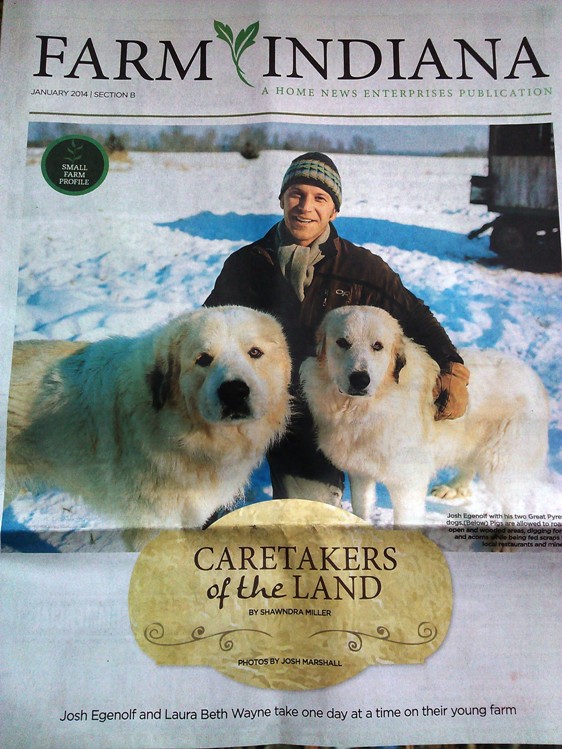
Cover page of my Farm Indiana profile of WE Farm

Dr. Lisa Harris remembers well the first conversation with the young man who would come to farm her land—they talked for hours, almost an entire day. “I was so impressed with how deliberate and thoughtful he was,” she told me.

Dr. Harris is Eskenazi Health’s medical director, a vegetarian with a lifelong interest in eating healthy food. As I learned when I wrote about WE Farm for Farm Indiana, she leases her Owen County property to Josh Egenolf and Laura Beth Wayne’s pastured beef cattle, poultry, and pork operation.

“Most people in the United States do eat meat,” she said. “So if I can be part of something that gives people access to meat from animals that have lived well, it seems like a perfect opportunity.”

Like many of us, Dr. Harris tries to live as lightly as possible, and Josh’s plans to make her land productive really spoke to that goal. “What Josh is doing,” she said, “is in every sense helping to improve the land.” WE Farm’s integrated, rotational grazing plan means the animals work in concert with nature to restore pastureland—all the while sequestering carbon and nitrogen in the soil.

The day I visited the farm last November in preparation for my Farm Indiana story, four happy dogs ran in front of the pickup truck as we drove up the lane to tend the livestock. Owen County is picturesque, with wooded hills and deep valleys. Josh showed me the steep woodlot where the hogs are periodically turned loose to forage for acorns and pawpaws. They also help him clear out understory invasives, just by doing what pigs do.

Breeder pigs enjoying their mineral rations on a frosty November morning.

Breeder pigs enjoying their mineral rations on a frosty November morning.

Josh was raised on a farm just a few miles up the road, and he treasures the richness of his a rural childhood. Giving that experience to his own child (and another on the way) is a big reason why he moved back to the area after pursuing his doctorate in ecology at the University of Georgia.

Also, he wanted to be put what he’d learned there into practice. Agriculture, he told me, has enormous potential for creating meaningful environmental change.

He said, “In 2007 I read The Omnivore’s Dilemma. Before that it never occurred to me that there might be anything troublesome about the way meat was produced, other than animal welfare stuff. That’s very clear to me…you shouldn’t treat your animals poorly. They need to be respected. But it didn’t occur to me that there was a single thing wrong with them eating grain and (even) industrial byproducts.”

He knows that many people still don’t realize the environmental and health issues that accompany feeding grain to meat animals, but a growing customer base tells him how many people value pastured meat. “It’s like an awakening that needs to happen.”

Josh and Laura Beth strive to keep the business as local as possible, keeping close to home in all their dealings. For more on their endeavors, check out my Farm Indiana story and the WE Farm website.

We Can’t Afford Coal

This week I attended a meeting to learn more about Indianapolis Power and Light’s Harding Street plant, the largest industrial polluter in the city. IPL has no plans to retire this 55-year-old coal plant, even though the EPA says it’s responsible for 88 percent of industrial toxic releases in Marion County. The plant’s smokestacks annually release 130 pounds of mercury into the air.

That has a devastating public health impact. One attendee spoke of being an asthma sufferer. “I know what it’s like to struggle to breathe and have to go to the ER…It breaks my heart to think that our power is the reason children have to go through that.”

Photo by Karl Anderson, via flickr Commons.

Photo by Karl Anderson, via flickr Commons.

As I found while researching an Indiana Living Green story about the Beyond Coal movement, poor children are disproportionately affected by coal because of where they live—resulting in learning disabilities, asthma, autism, and lowered IQs. They’re effectively trapped into a cycle of poverty, suffering lifelong difficulties linked to our state’s over-reliance on coal.

Two city maps made the plant’s impact visible. One showed asthma-related ER visits in Marion County, and the other depicted mercury levels in waterways and soil. In both cases it was clear how the neighborhoods northeast of the plant (including my own) are burdened as the prevailing winds blow the pollution our way.

I myself can trace some of my health struggles to these toxins. I moved to this neighborhood in 1996 from northern Indiana. I noticed that I got sick more often, and for longer periods, than I used to. By 2000 I was dealing with chronic illness. The origins were complex, but tests for heavy metal toxicity showed elevated levels of mercury in my body.

“If you love your lungs, get out of Indianapolis,” says a real estate blog, fingering my beloved city as the unhealthiest in the nation because of its poor air quality.

And then there’s the coal ash ponds. A nationwide 2011 EPA study identified 11 high-hazard coal ash ponds. Two of them are at the Harding Street plant. These unlined, aging pits are right next to the White River. I don’t even want to think about what would happen in the event of a major flood. Or if an ash dike ruptures, as happened in Kingston, TN, in 2008.

Knoxville News Pic

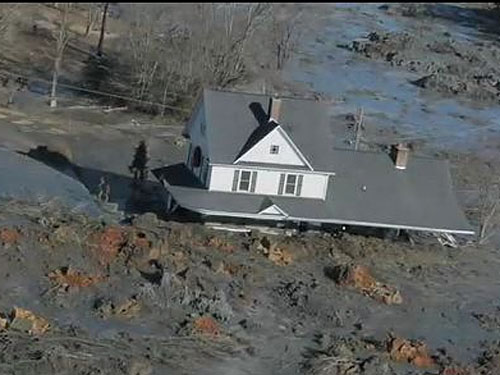
A house sits in the coal ash spill near Kingston, TN in Dec. 2008. Photo by Knoxville News Sentinel.

Apparently IPL doesn’t want to think about it either, even after two coal ash spills at its Martinsville plants sent more than 30 million gallons of toxic coal ash into the White River in 2007 and 2008.

Does it have to be this way? No, it doesn’t. Whether you look at it from a public health perspective, a fossil fuel emission perspective, or even through a financial lens, coal is a bad bet. Rate hikes to retrofit the aging plant are a poor use of our money. For inspiration, we can look to neighboring states. Iowa gets 24 percent of its power from wind—with rates similar to ours and no reliability issues.

The Indiana Beyond Coal campaign is all about making our voice heard. If enough people speak with their city councilmen and -women, write letters to the editor, and engage with IPL’s 20-year energy plan, things can change.

As organizer Megan Anderson said, “It’s as simple as getting together and talking to friends and neighbors.”

To be Fueled by Love

Browsing the shelves of Point Reyes Books last month, I picked up Mary Pipher’s latest book. Her Reviving Ophelia illuminated the struggles of adolescent girls. Now she has a book called The Green Boat: Reviving Ourselves in our Capsized Culture, detailing her progression from despair to activism.

A Nebraskan, Pipher was on the front lines of early campaigns to stop the Keystone XL Pipeline from going through the Sandhills. (Three years later, the pipeline is still in limbo, and has become a symbol of the fossil fuel industry’s disastrous impact on the planet.)

Dismal River, Nebraska Sandhills. Photo by USFWS Mountain Prairie, via Wikimedia Commons

Dismal River, Nebraska Sandhills. Photo by USFWS Mountain Prairie, via Wikimedia Commons

Even before opening it, I knew this book would return me to grounding.

I’d been talking with Richard Heinberg about his book The End of Growth, which describes a trajectory that I understand and yet can’t quite face head-on. Seeing it spelled out and hearing him expound on it left me feeling quite scared.

I know that many are pulling together for a better world. But our governmental policies favor the monied corporations running the show. I was starting to doubt that community action could effect change on that level.

Along comes Pipher, describing an activism that’s joyful and even fun. Example: grandmothers gave weekly “thank you in advance” pies to the Nebraska governor until he agreed to meet. This brand of protesting, fueled by love of the land and concern for tomorrow’s denizens, seems the perfect antidote to despair.

A chapter called All Hands on Deck begins with this quote from Frederick Buechner:

“God calls you to the place where your deep gladness and the world’s deep hunger meet.”

To be glad in the face of the world’s rending sometimes seems impossible. Yet I remember opening the church basement doors on the day of our SkillShare and seeing the space instantly fill with participants, their faces alight with curiosity. I think of the heart-cracking instant when a resonant phrase finds my fingers on the keyboard. I recall the joy of putting a garden trowel in the hands of a preschooler.

There’s an expansiveness when I reflect on these moments, a sense of the heart opening that lifts me from powerlessness.

Explaining vermiculture at the Irvington SkillShare. Photo by Jeff Echols.

Explaining vermiculture at the Irvington SkillShare. Photo by Jeff Echols.

Pipher acknowledges the “experts” who downplay the importance of individual actions. They say systemic economic and political changes are necessary to change this trajectory. True enough, but this reasoning is incomplete, says Pipher—for “who is it that is in charge of systemic change?”

She argues that individuals have always been the source of world-changing actions, and what else can one person do but start with herself? And join others in common cause, as did the abolitionists. It’s said that they had no hope of success, at the start.

My small self is quick to tell me what I’m not. I’m no naturalist, no doctor of philosophy, no career activist, no farmer, no wisewoman in a mountain hut. I am just myself. Sometimes I question: What do I have to offer?

I only own this experience, this deep heart of pain and care, grief and fear—and love. 

What do I have to offer? All of it. I offer it up.

[More from Mary Pipher: Read her interview on how to wake up and take action on climate change (and stay sane).]