Postcard from Hopland, CA

This weekend was the big Building Resilient Communities Convergence in Hopland, CA. I was excited to be there for part of the action.

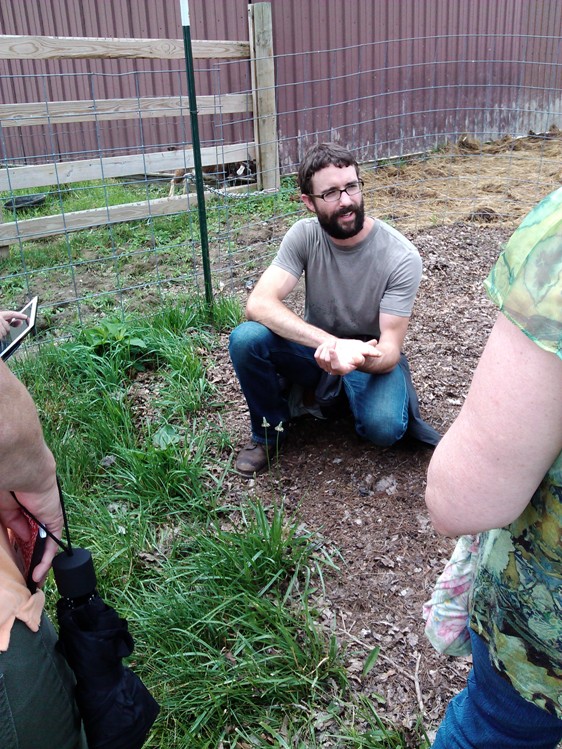
A highlight was the mycology skillshare, during which Fungaia Farm‘s Levon Durr demonstrated several methods for home mushroom cultivation.

Teaching how to cultivate oyster mushrooms at home using the stem butt/cardboard technique to grow your own spawn. Sweet!

I didn’t know until recently that shrooms actually are a source of protein. This makes me even more determined to try cultivating my own.

I thought Levon was going to levitate when he got to the part about mycoremediation. His enthusiasm is not misplaced: Mushrooms can clean petroleum from drainage ditches and aid in riparian zone restoration. They even eat heavy metals and bacteria.

The practice of using fungi to clean our beleaguered earth of toxins is one of the most hopeful stories I’ve heard. It is also the subject of an upcoming guest post from Radical Mycology, so stay tuned.

My Garden Tower, One Month Later

It’s been about a month since Judy and I planted our Garden Tower. I last posted about it the day we picked it up from the Good Earth. Time for a post showing the progression.

After some discussion we sited the barrel just outside our back door. We had to sacrifice a few cabbage and collard plants to clear out the space, but it’s the best spot for it. The light color of the siding will reflect light for the plants growing on the back side (though one friend insists we need to innovate some sort of lazy susan apparatus to be able to spin the whole barrel around!)

Filling the Barrel

Filling the Barrel

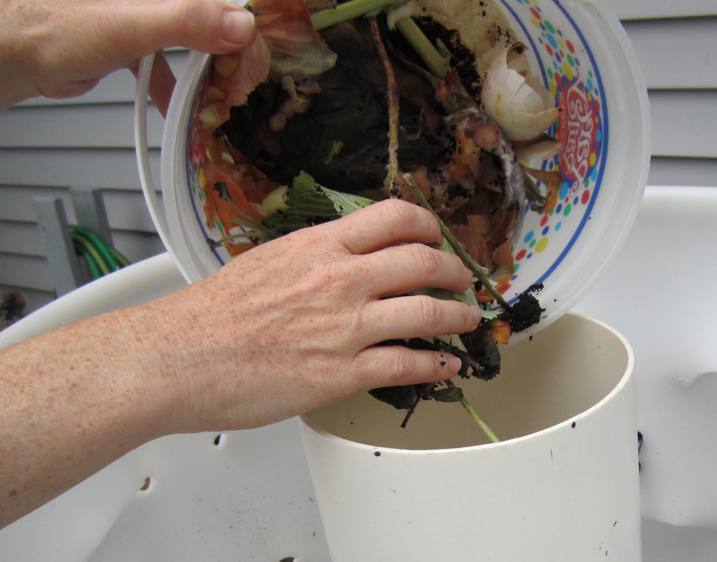
One of the things I love most about the Garden Tower is its built-in worm composting. I could hardly wait to put saved-up kitchen scraps in there. We also added some semi-decomposed stuff from the compost pile to jump start it.

Adding vegetable matter to the center tube

Adding vegetable matter to the center tube

I bought red wigglers at a feed-and-seed shop, and there were also worms in the soil mix since we used some of our own sifted compost.

Just a handful of worms is enough: they reproduce rapidly.

Just a handful of worms is enough: they reproduce rapidly.

I had soaked seeds in water overnight to give them a head start. It was great fun poking them into the soil.

Planting Little Marvel peas on the more shaded side.

Planting Little Marvel peas on the more shaded side.

Plants scavenged from friends and a local nursery helped round it out.

I bought a couple of bell pepper plants that looked like they might survive, and this gorgeous Genovese basil. I also planted parsley starts around the back and a tomato sucker that a gardener friend rooted.

I bought a couple of bell pepper plants that looked like they might survive, and this gorgeous Genovese basil. I also planted parsley starts around the back and a tomato sucker that a gardener friend rooted.

Soon the seeds started to sprout.

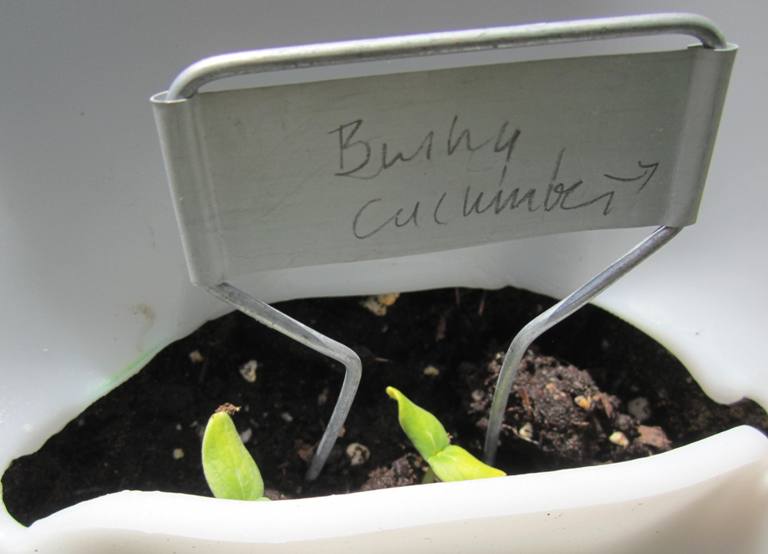
Cucumbers were first to sprout. I don't know if I'll get any cukes having planted them late in the season, but it's fun trying.

Cucumbers were first to sprout. I don’t know if I’ll get any cukes having planted them late in the season, but it’s fun trying.

It was like springtime in July.

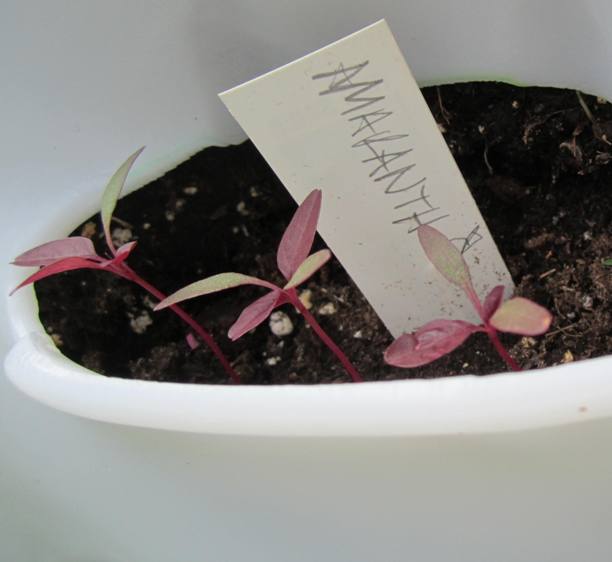
Really excited about the amaranth!

Really excited about the amaranth!

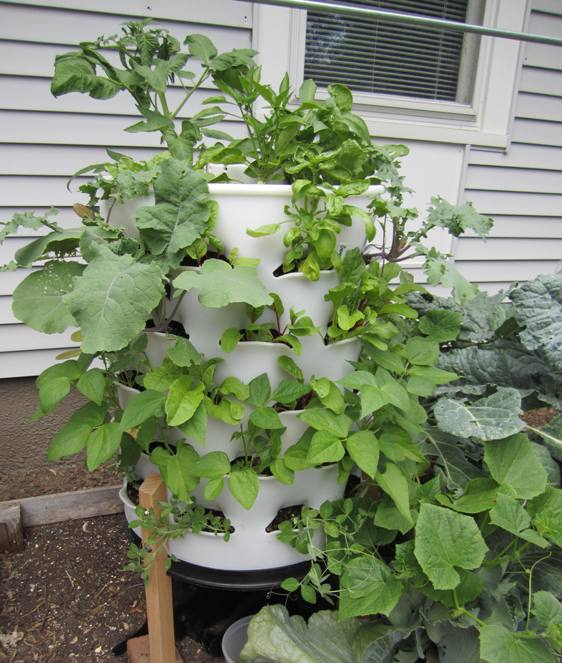
After a couple weeks it looked like this. (The cat loves hanging out in the cool shade underneath the tower.)

About 2 weeks after planting.

About 2 weeks after planting.

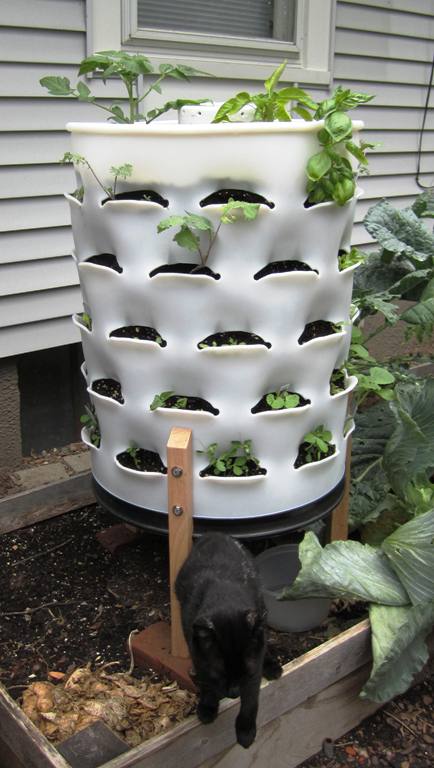
Today it looks like this!

Check out the cucumber vines, lower right. (And yes that is a cat under there.)

Check out the cucumber vines, lower right. (And yes that is a cat under there.)

The tomato “sucker” has suckers of its own now, and soon I’ll have to stake it. I’ve harvested basil, parsley, and a few thinnings of the greens. The worms have been chewing through their food, so in a few months I’ll have a different kind of harvest—worm castings.

We’re thinking of rigging up some sort of covering to extend the season. I hope we can keep snipping kale and chard into the winter.

I love my Garden Tower. Of course, it is not necessary to purchase this product to have a similar vertical garden. “You just need a blow torch and a two-by-four,” says one plucky friend. That seems a little more than I want to do, but this Garden Sack design looks to be a good DIY alternative.

Postcard from FoodCon

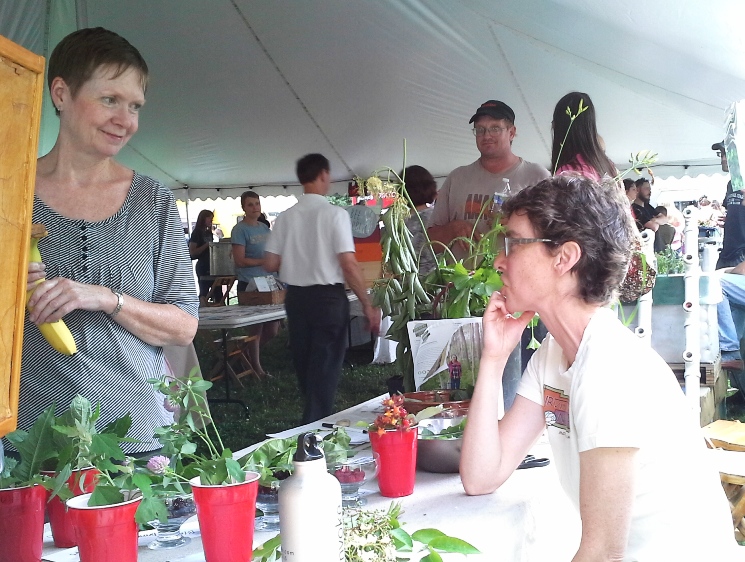
Friday’s FoodCon was a thrill. I haven’t heard the final tally of attendees, but there was a steady stream of bright-eyed folks. I met so many people with interesting stories about foraging (which, as I explained to one non-native English speaker, is like hunting, only for plants).

Swapping foraging stories with a foodcon attendee

Swapping foraging stories with a foodcon attendee

People spoke of making elderberry syrup for winter colds and congestion, of becoming more accustomed to the taste of bitter greens to the point of craving them, and of eating oxalis as kids.

One little girl said she likes to eat clover petals, which brought back my own flower-eating past: My friends and I used to pick the blooms off my dad’s tall phlox and suck the nectar, pretending it was a special elixir.

Most of my exhibit consisted of weeds picked that morning. All are available in the typical urban yard or garden. “If you can’t beat ‘em, eat ‘em,” was my line.

Trees are a source of unexpected nutrition too: Even seasoned foragers were surprised to learn that basswood tree leaves are great in salads.

Trees are a source of unexpected nutrition too: Even seasoned foragers were surprised to learn that basswood tree leaves are great in salads.

I told the uninitiated to start by topping a salad with the tangy, tender oxalis, which is prevalent in urban yards. Then see if, like me, they don’t get completely hooked on picking stuff from their yards to bring in to the dinner table.

Wet tablecloth

My tablecloth got all wet after an early gust of wind blew a few cups over. But it didn’t matter: check that wilty salad!

Japanese wineberries (at the right edge of the above photo) were the star of the show. Though one website calls this bramble fruit a “bio-bully” for being invasive, the berries are dazzling little gems that are sweeter than should be legal. (Last year I learned the identity of this mysterious bramble I’d found just as the buds were forming. I was anticipating some happy picking, then they perished in the drought. This year: bountiful harvest.)

Some were amazed that you can actually eat mulberries, asking incredulously, “What do you do with them?” while others were right there with me on the “nature’s candy” point.

A friend and I had biked around the neighborhood questing for these berries.

A friend and I had biked around the neighborhood questing for these berries.

Things I learned: There’s a “Poke Salad Annie” song, and you can eat milkweed flowers, and four hours of talking makes one hoarse.

The solar cooker got lots of interest too, though generally more as a novelty from what I could gather (my partner Judy fielded most of those questions, bless her).

As far as the other exhibitors, I was able to make a quick circuit late in the evening and talk to the folks from Wolf-Beach Farm, as well as friends at the “dumpster diving/dumpster dining” booth and the “making easy meals in 5 minutes” table. (These were all people I had referred to the organizer.)

I also found a couple standouts in the resilience arena. I’ll report on them in an upcoming post. Some great innovators there, helping people break their dependence on a shaky centralized food system that is wreaking havoc on both planetary and personal health.

Forage Ahead!

Today I joined my friend Greg Monzel of Monzel Herbs on one of his terrific plant walks. The rain held off as we tramped the lanes and fields of Distelrath Farms, an urban farm and the source of my weekly CSA allotment.

As an herbalist, Greg focuses these guided tours on both edible and medicinal plants. After you’ve hung around with him for a little while, you get a new appreciation for the things people normally dig out of their gardens. It seems that everywhere under our feet, there’s nourishment and healing.

Greg teaches us about plantain and its many uses

Greg teaches us about plantain and its many uses

Plaintain, for example, is good for eczema, wounds, and other skin issues, while its seeds are a “poor man’s psyllium.” I doubt I have the patience to collect its seeds, but I like the idea of whipping up a bunch of leaves in the blender with olive oil to make an infusion. I have some off-and-on rashy stuff on my hands, so I might try that.

Amaranth, drought-tolerant and tasty

Amaranth, drought-tolerant and tasty

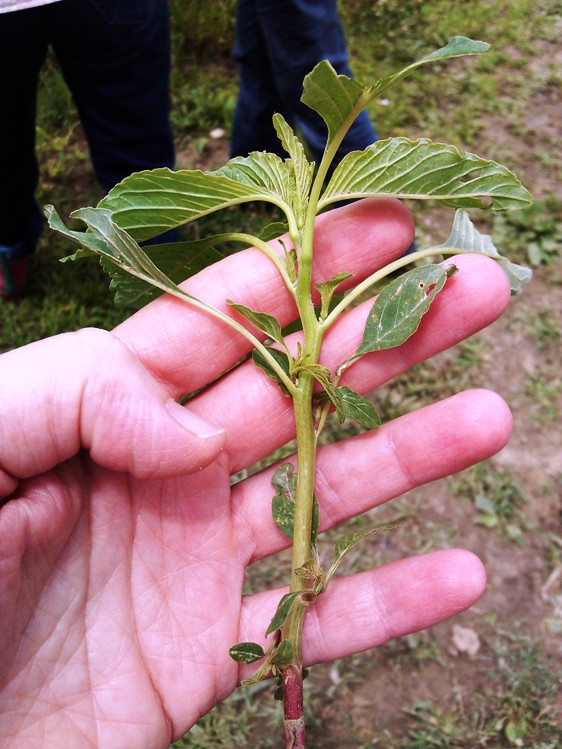
More tasty than the bitter plantain is amaranth. It is an amazingly hardy summer salad green as well as a source of protein-rich “grain” (actually the seeds).

I’ve never collected the seeds, but I adore amaranth as a green. My partner was introduced to it in Tanzania years ago. There it was called red root and sauteed in a dish called Sukuma Weeki.

When the drought hit us last year, amaranth didn’t even notice. So this year I bought amaranth seeds to plant for a steady and convenient supply. As soon as my lettuce is done–any day now–I’m sowing amaranth in preparation for a dryer, hotter July and August. I can almost taste that late summer salad of amaranth and purslane, a heat-loving succulent high in omega-3 fatty acids. Most people pull both as a weed.

Greg, by the way, says weeds are a state of mind. Many of the things we consider noxious weeds were actually brought here because of their usefulness. Now they populate areas where the soil has been disturbed, working as “succession plants” that naturally build soil fertility.

Knotweed, AKA smartweed

Knotweed, AKA smartweed

Here’s knotweed, for example, also known as smartweed. I remember seeing this pretty little bloom in my dad’s raspberry patch and wondering what it was. I learned today that it is in the buckwheat family. Its leaves and seeds are edible and loaded with resveratrol, a potent antioxidant.

And did you know that you can harvest the seeds of the ubiquitous clover and save them in a jar, for indoor sprouting at some later, leaner date? It’s mind-boggling to realize there is free food all around us, even in the city, that could potentially nourish us in good times and bad.

I’ve learned so much from Greg, starting when I interviewed him for an Edible Indy story on gathering wild foods. Though I’m not nearly as experienced as he is, next Friday, July 5, I’ll have a table on foraging at FoodCon IV, a fabulous event that attracts a thousand or more people every year. I’m beyond excited to be part of it.

Real Simple

Still wobbling through Staphland. So here is a bit I dusted off from the archives of Shawndra ravings, for your reading pleasure. Back to the couch.

Some years back this magazine Real Simple caught my eye in the checkout lane at Kroger. Its thickness approximated that of the phone book of the small town where I went to college. It was unlike me to put it in my cart, but I  was attracted by the silky cover, I suppose.

By Jim Clark, via Wikimedia Commons

By Jim Clark, via Wikimedia Commons

Because I remember that cover to this day. It was a tableau of succulent blueberries. Inside were “real simple” ideas for augmenting someone’s perfect life: Make blueberry tea cakes the size of dolly dishes for your brunch guests! Weave a wreath from wheat purchased at such-and-such online store! Festoon it with dried wildflowers you’ve sprayed with hairspray, for colors that last! And so on.

Not one project within those pages would do anything but complicate life. The crafts were Martha Stewart-level hard, the recipes were full of fussy ingredients, and the whole magazine was a waste of $4.95.

Hmph, I thought, I’ll show you real simple.

Call me crazy, but say “real simple” to me and I don’t think of spending oodles of time piping mint icing onto chocolate chip cupcakes. I don’t envision sewing clunky wooden beads onto the placket of my earth-toned Nehru shirt. I don’t have time for fussiness.

But I realize that what I do in the name of the simple life may seem a bit on the fussy side, to people with different priorities. I operate on the premise that the less money I need to live on, the wealthier I am. This leads me down some curious roads.

Here I am leaning way into a wild bramble, getting all scratched up to reach one more black raspberry for my little bucketful.

Or here I am washing onion skins and celery tops to save in a big Ziploc bag in the freezer, for a future stock-making escapade.

Or here I am standing over the stove on a 90-degree August day, stirring sugar into grape pulp—having picked the grapes from my neighbors’ fence—and waiting for the precise moment when it turns to jam, seemingly many sweaty hours later.

There are times I feel rather smug about my gardening and homesteading efforts. Like when homegrown produce turns into a meal made a soleil “for mere pennies!”

Other times, I just feel like a chump. Lugging buckets of water from here to there in 100-degree heat, for example, while my neighbors up the street lounge by their in-ground pool.

Remember that TV show featuring two famous-for-being-rich-and-famous young women who attempted to live among farm folk? It was called The Simple Life. The opener showed the starlets in overalls, with straw in their hair and dirt on their faces, looking aggrieved.

I guess the fun was in watching the high-class duo learn that the simple life ain’t easy. So true, even on my own modest homestead here in town.

Still.

Wouldn’t trade it for a slick magazine.

Solar Cooking Season at Last

Taking a break from the education series for a little joyous yippee-skip, because today? I busted out the solar cooker!

Yep, on this cool, breezy day I solar cooked for the first time this year. It makes me so happy to usher in the season this way. Despite the chill, the sun is high and bright, the sky bluest blue, and in the solar cooker the oven thermometer registered 275 degrees.

I was having so much fun, I neglected to take any photos of my handmade cooker doing its thing.

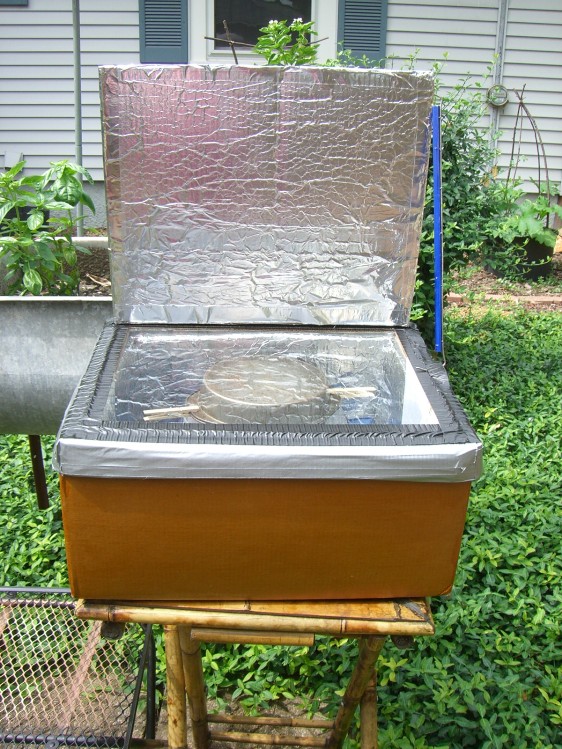
Solar Cooker

This is not a photo from today, but from my very first summer of solar cooking, 5 years ago. Nowadays I know enough to put a dark cloth over my cookware. And I don’t use clothespins anymore, at least not inside the cooker. But you get the idea.

OK this isn’t a food blog… but here is what went into the soup that is just now steaming in my mug after simmering out there all day:

  • leeks from my CSA (community-supported agriculture, a weekly allotment of locally grown vegies, yum)
  • baby carrots, also from the CSA
  • sage and dill, ditto
  • parsley I dried at some point, can’t remember the origin, possibly the back yard
  • corn my partner and I bought at the farmers market and froze during the summer
  • a dried Aleppo pepper from the community garden, given to me by my friend Heidi
  • potatoes purchased at the food co-op
  • celery that really really needed to be used up
  • frozen chicken stock I made during the winter from an Amish-raised chicken
  • salt, pepper, and love, baby!

Tell you what, it hits the spot.

Also from that first year. But I did toast pumpkin seeds today on top of the soup.

Also from that first year. But I did toast pumpkin seeds today in a tray on top of the soup. I’ll put them in my salads this week.

I love cobbling together a dish like that, using produce from the garden or market or CSA, or whatever needs to be used up to make room for fresher stuff. (Time to get that corn all eaten up before it shows up in the markets again.)

I’m so looking forward to another long summer of solar cooking. I can almost taste the plum cobbler now.

There’s more about my solar cooker and how you can make one here.

Meet the Mudgirls

I’m always intrigued by people who are able to take the more complicated aspects of modern life into their own hands. Maybe that’s because outside of your basic paring knife and garden trowel, my own hands are pretty fumbly. The realm of natural building just amazes me.

Round Cob House Built by the Mudgirls

Round cob house built by the Mudgirls

Natural building involves using materials occurring in nature (and sometimes recycled materials) to construct homes and outbuildings. For example, back in Too Many Tons I posted a video featuring a DIY builder from Indiana making bricks from mud. Materials are sourced locally—perhaps clay from a neighbor who’s digging a pond, sand from a nearby excavation, straw from a local farmer.

Recently I discovered a British Columbia-based women’s collective specializing in cob building (using a mix of clay and straw). Meet the Mudgirls.

The Mudgirls are a collective of women builders on the west coast of British Columbia, Canada

The Mudgirls are a collective of women builders on the west coast of British Columbia, Canada

For the past seven years they’ve worked together as independent builders, doing seasonal work throughout the Vancouver Island area. Though they started with only about 10 days of work in the early years, many now make their main summer income from this work.

They’ve build cob ovens, cabins, sheds, fences, and outhouses. They also take their craft into conventional homes, using earthen plaster with beautiful results.

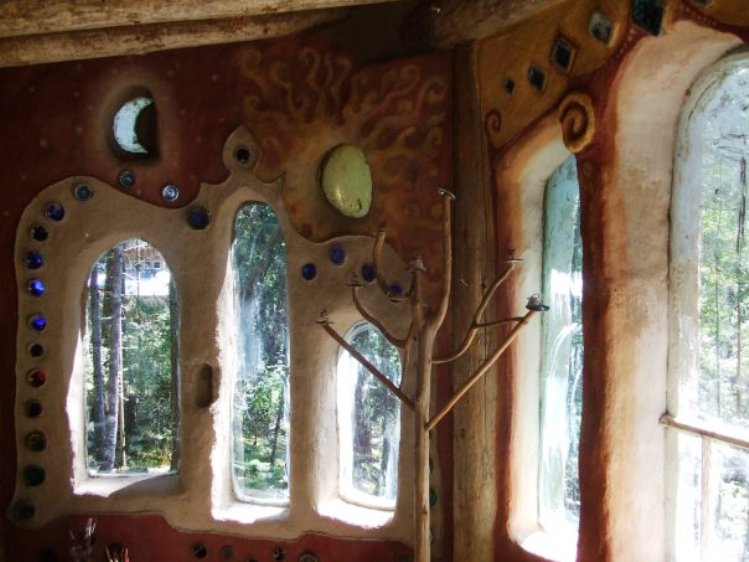
Interior of a Mudgirl-built home.

Interior of a Mudgirl-built home.

As a consensus-run group, they are trailblazing in other ways as well, showing a more egalitarian way to operate than the dominant paradigm’s business-as-usual. And they offer workshops at the most affordable rates in North America ($200 or less).

Mudgirl Rose Dickson, one of the founding members, was drawn to the collective because of her outlook as a feminist/environmentalist/artist. From the photos,* it’s clear that the Mudgirls’ work offers a creative outlet.

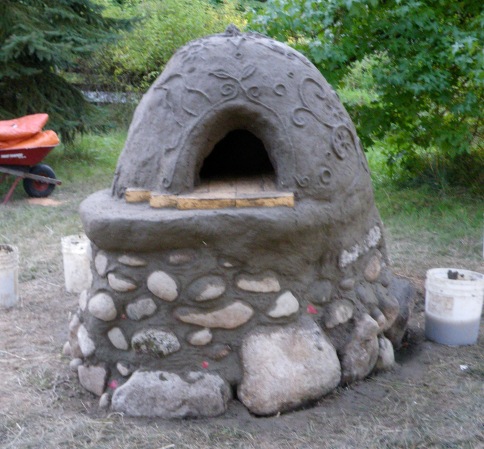
Cob Oven Made by Mudgirls

Cob oven made by Mudgirls

And these round structures are built to last, as witnessed by many such homes in England, still standing hundreds of years after their construction.

Not too long ago, a four-ton tree fell on a Mudgirl-built cob house—crashing through a bump-up of windows and earthen plaster and stopping at the cob wall. Rose reports, “No cracks in the wall from impact, and the guy who came to clear it off said a wooden house would have been crushed by the tree.”

A four-ton tree fell on this Mudgirl-built cob home, stopping at the cob wall

A tree fell on this Mudgirl-built cob home, stopping at the cob wall

Cob building is physically demanding and sometimes uncomfortable work (imagine a chilly spring day when you’re working in cold mud from sunup to sundown). But Rose relishes the chance to be outside, away from a desk, making something with her hands in the company of her dearest friends.

Mudgirls at work

Mudgirls at work

“If the weather’s cold, it can be kind of miserable,” she admits. “But if you’ve got a couple friends there who you’ve known for years and you’re joking and laughing, it makes it. That’s actually one key with natural building is the community. It takes more time, so the labor is a factor. But that’s part of why people do it together.”

This strikes me as the ultimate in do-it-with-others (DIWO). Has anyone out there had experience with communal natural building? I’d love to hear about it.

*Photos provided by Mudgirls.

Things That Can’t Be Rushed

Those of us who are bathed in technology much of our lives, that is to say most of the Western world by now, have grown accustomed to having everything happen in a hurry. Speed is the ultimate. Efficiency is king.

I am prone to this, feeling impatient with the rate of change.

Even in gardening, I value a relatively quick turnaround: Plant a bunch of lettuce seedlings, and a month later I can be snipping salad from my own raised bed.

But some things take time, and move in a crooked line, and require great patience to see results.

Photographer: Kessner Photography

Photographer: Kessner Photography

I’m reminded of this when I visit a farmer friend who lives in my neighborhood. Her family farm is called Artesian Farm. It’s in the next county over, where Anna and her farm partners raise grassfed beef.

When she talks about farming, she thinks in terms of decades. For example, the process of transitioning the farm to organic—which her parents wanted to do long before there was any infrastructure of support—has barely begun, and the beginning itself is taking years.

It’s been nearly 10 years of preparation, and a very small portion of the crop acreage is just beginning the transition to organic.

To grow corn and beans organically, and to be certified as such, farmers undergo an elaborate process. One of Artesian Farm’s first steps was adding more cattle. It seems an odd thing: what do corn and beans have to do with the beef side of the business?

But Anna explains that crop rotation is key in organic farming. Hay is their chosen rotation crop. “It’s common wisdom that if you grow hay and sell it off your farm, you’re taking all the nutrition off your farm.” So more cattle were needed to make use of the hay.

A 200-page plan has taken about six years to complete. It would cost $2500 to have an outside agency prepare this plan, on top of the $1000 for certifying. Anna opted for the DIY approach.

During my visit Anna cuts me some lemon balm, which is near an imposing compost heap about the size of a mobile home. It looks like a small sod house was plunked down in the middle of her modest “back 40.” “How do you turn it?” I ask, thinking of our own compost pile—a midget compared to this—and how it never gets hot enough to kill weed seeds, because we don’t turn it, though we always say we will.

“Oh, I don’t bother turning it. Nature doesn’t turn it, in the woods.”
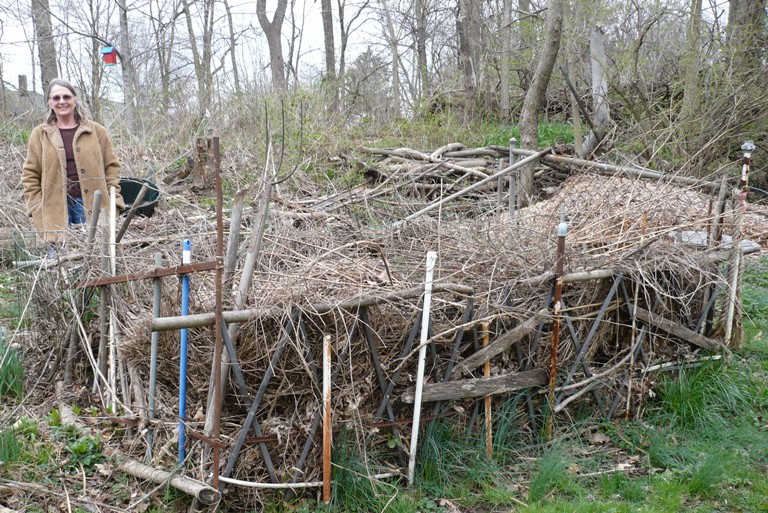
Anna and her compost bin, which she created “free-hand” with odd broom sticks, twigs, mop handles, rusty pipes, and other finds.

Anna and her compost bin, which she created “free-hand” with odd broom sticks, twigs, mop handles, rusty pipes, and other finds. Photo by Danny Chase.

Walking me back to my car, Anna reflects on the passage of time, how long it takes to make a change, to heal the land, to see results. Those of us who don’t spend as much time with our feet on the soil and hands in the dirt might expect results in a much shorter time frame than the decades that are really required.

Like the compost, like building the humus of the forest floor, there are things that can’t be rushed.

Solar Cooking, the Cookprint, and You

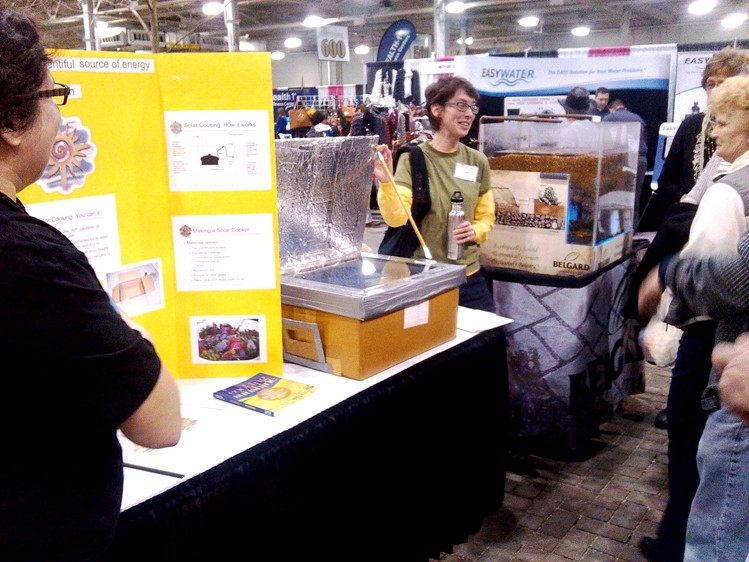
Solar cooker demo at the Flower and Patio Show

Solar cooker demo, Flower and Patio Show

Yesterday I had the chance to bring my well-loved handmade solar cooker to the Urban Homestead exhibit at the Indiana Flower and Patio Show.* I was a little worried that my cooker, made of cardboard, duct tape and aluminum foil, would feel self-conscious in the company of all those gleaming new grills and such. But: We rocked it.

No one seemed to care that the glass has a nice “patina,” as a friend christened the smudges I could not seem to remove with vinegar water. They were too busy peering into it and asking questions about how it works and how it’s made.

This will be my fifth summer of solar cooking. It was a thrill to spend part of a snowy day sharing my cooker with gardener types, a few of whom seemed ready to go right home and make one.

My solar cooker at work

My solar cooker at work

Not only is solar cooking crazy fun, it means we drastically reduce our natural gas use from May to September. And the fact that we can make something so useful from (nearly) all salvaged materials and make it last five years and counting? Well, it kind of feels like getting away with something sneaky.

I’m even prouder of my solar cooker since hearing a radio interview with the author of Cooking Green: Reducing Your Carbon Footprint in the Kitchen, which concerns ways to “shrink your cookprint.”

The local food movement has raised awareness of our “food miles.” But we don’t always consider the impact of another aspect of eating: what we do with the food after we get it home. Anyone who gardens or belongs to a CSA knows that procuring food sustainably is only the first step. Once you have all that produce staring at you, you’ve got to process it. Except for salads, cold soups and the like (raw foodists, holla!), this task generally involves using some form of energy–turning on the burner, heating up the oven, plugging in the crockpot.

I haven’t read the book, so I don’t know if she advocates solar cooking as the ultimate in cookprint reduction. In the interview the author shares tips like this one for pasta-making:

Tip: Bring the water to a boil, then turn the burner off once the pasta is in the covered pot.

gas burnerI imagine pressure cookers are high on her list as well. (Don’t tell my solar cooker, but I’d be lost without my pressure cooker, at least from October through April.)

What about you–have you looked at ways to reduce your “cookprint?” Do you use a solar cooker–or would you like to? Share in the comment section below! (If you’d like more info on solar cooking, contact me for recipes and tips. Find DIY instructions here. You can buy one here–but really, don’t. So easy to make!)

*Still time to check this out if you are in Indy–through March 17. I’m told sheep will be grazing the urban homestead grass at some point in the next few days. Get your coupon here.

Too Many Tons

There’s a moment in Barbara Kingsolver’s devastating new novel, Flight Behavior, where the protagonist realizes the craziness built into our globalized economy. Dellarobia and her husband are in the dollar store, trying to buy a “real Christmas” for their children on $50. Every toy is Chinese-made, plastic, and depressingly cheesy. She tries to find something, anything, that won’t fall apart immediately, and muses:

“There had to be armies of factory workers making this slapdash stuff, underpaid people cranking out things for underpaid people to buy and use up, living their lives mostly to cancel each other out.”

I recently learned something horrifying from this video featuring Society for Organizational Learning founder Peter Senge: It takes a ton of raw materials each day to sustain the American lifestyle. Per person.

extraction

© David Coleman | Dreamstime Stock Photos

I don’t know about you, but it guts me to envision a ton of earthly extraction happening on my behalf—today, tomorrow, and the next day and the next, until the whole house of cards collapses. Or until we demand something different.

Do we really need to buy into this waste?

All that energy that goes into making money to be able to buy stuff? If we could divert a fraction of that into work that sustains us, we might see the merry-go-round start to slow.

I met a young mother recently who had made some changes after asking herself, “Why am I spending money to buy food when I could grow my own? Money doesn’t grow on trees, but food does.” Visionary Charles Eisenstein, Radical Homemaker Shannon Hayes, and countless others have said it: It’s time to rethink, regroup, relocalize.

My partner is cutting her workplace hours this year to spend more time gardening and making things. These projects enrich her life and leave something tangible, and they mean—yes!—fewer trips to the store to buy goods made or grown by someone else.

Sure, we still do our share of purchasing. We’re not immune to the consumer culture. I just got my very first smartphone, after all, with much gnashing of teeth. But we are coming to see ourselves less as consumers and more as small-scale producers, or self-provisioners, or urban farmers. The more we make, produce, grow, and repair with our own hands, the less money we require to live.

One group is working in a big way to break the cycle. Open Source Ecology was started by a young farmer who was frustrated by repeated tractor breakdowns. It bothered him that corporations keep their designs secret and build obsolescence into their products. So he decided to take matters into his own hands.

Now he’s working with others to develop 50 industrial machines to cover every need of a local-level sustainable economy. The open source part is revolutionary: Their designs are available for anyone to use and adapt.

Here’s a three-minute video showing how it all works. There’s a builder from Indiana using one of the machines to make bricks. I love this!

Build yourself. | Tristan Copley Smith from Focus Forward Films on Vimeo.

What about you—how are you slowing the merry-go-round?