How Shall We Meet Ourselves?

A friend tells me that the biggest thing she learned in 2016 was that through any turmoil and pain, “I meet myself.”

The year rocked many of us, that’s for sure. Collective decisions like Brexit and Trump’s election shook foundational values we thought we could count on. We’ve been forced to look straight into the ugly face of racism, misogyny and xenophobia. We feel a worldtilting sense of shock, anger, and sadness, a literal and physical vertigo. And looking ahead, we fear what “we” have chosen for our future and the world’s future.

My Facebook feed is rife with “eff you, 2016” sentiments. People have declared 2016 to be exceptionally sucky, with an inordinate number of celebrity deaths. Not to mention the election, and its accompanying decline of civil discourse.

There’s much that feels out of our control. People die, pundits yammer, a president-elect tweets vitriol (and intent to expand nuclear weaponry) …

We grieve, we vent, we obsess or step away from the 24-hour news cycle as our constitutions dictate. We might sign petitions, write letters, make plans to march. (Or none of the above. Maybe we go numb, maybe we carry on as before.)

Still, we only meet ourselves. Who are we in this moment? Are we awake? Are we alive? Are we triggered, reactive, stuck in fight-flight-freeze mode?

For myself, I can say that paying close attention to my inner landscape is the only way that I can regain my footing these days. When I find myself in free fall, as soon as I remember to, I breathe into the moment and see if I can tend to the triggered place within me. Then I can move into speech or action (or no-action, as needed) with my energy clear.

9009347111_8a67844205_z

Photo by Vivian D Nguyen, via Flickr Commons

I think 2016 was the year that shook us out of our slumber. We have yet to see the full unleashing of a wide-awake (so rudely awakened!) populace. But if the sacred activism at Standing Rock is any indication, spiritually grounded action is a powerful antidote to the corporate greed that runs America.

Most of us won’t take part in grand protests, myself included (most likely). But our actions hold power nonetheless. I was reminded recently to show up in my “home frequency” with authenticity, and let go of outcome.

I think of that fantastically well-written TV show from a few years back, Friday Night Lights. “Clear eyes, full hearts: Can’t lose!” was the mantra of Coach and his high school football players.

How shall we meet ourselves?

Do we go into 2017 embittered, feeling victimized or triggered? Or do we clear our eyes, fill our hearts, and walk into the New Year unfettered?

Shine in Me

Such a deep, dark time of year. It’s hard to believe that the days (since Thursday) have already begun lengthening ever so slightly, a minute or so each day.

From the seasons’ turning, we know that an extended darkness doesn’t spell the end of everything. It’s just a cycle. And we ourselves have the agency to find and nurture the light.

On Wednesday night a Solstice fire gave us a chance to turn within. The flames reduced our scribbled papers and sage sprigs to ash as we released ourselves from the weight of the previous year.

3161883549_46e7338725_z

Photo by rahul rekapalli, via flickr commons.

Tonight my Jewish friends light the Menorah for the first day of Hanukkah. Meanwhile many Christian folks will go to church for a traditional Christmas Eve candlelight service.

Tomorrow, Christmas Day, we ourselves will celebrate with turkey and dressing shared around our table, and some modest gift-giving afterwards. The lights in our front windows will stay on all day and into the evening, a symbol of welcome.

These traditions call on our highest selves to be kind, to be intentional, to be generous, to be grateful.

Light of the World, Shine on Me, the song says.

I suggest a small change. Shine IN Me. After all, we all carry the seed of Divinity within.

Consider this Facebook post from Jul Bystrova, founder of Era of Care, who just returned home from supporting the water protectors at Standing Rock Indian Reservation:

I find myself often comparing this time to the Lord of the Rings. The darkness grows, destroys and seems impossible to stop. But we do well to remember that we were returned to the light by simple hobbits with tremendous courage. We are those simple hobbits.

Whatever your spiritual tradition: shine on, my friends.

No One Unreachable

We are so schooled in separateness. Wired, the scholars say, to see first our differences, though 99 percent of our DNA is the same. What if we begin to see the world differently, not me/us/mine vs. those others—but all of us?

Might this lead to questions like “What is it like to be you?” instead of “Are you like me? Could I love you?” or even “What is wrong with you?” or worse?

The way to reach people, it seems to me, is not to hector and judge and shame—but to listen and share.

It’s a generous and muscular act, listening with respect while opening to the possibility of transformation.

And what if we don’t leave anyone out of the equation, even those who appear to be despicable, beyond redemption? I think of an audiobook we listened to on a road trip a few years back. (I wish I could remember the title and author, or find it online, but I’ve had no luck.) It concerned the mystical kabbalah tradition. I still remember the large-heartedness we encountered in the listening.

The writer said that in this tradition, no one is out of reach: In the deepest darkness, there is always a sliver of light that can be contacted.

8541398947_5ed3942d77_b

Tree of Life, by Andrea Terzini, via Flickr Commons

Think about that. No matter how evil or cruel their behavior, they contain a spark of light. Staying aware that we all carry this spark—and that it can be fanned into a steady flame, at any moment surprising us—changes how we might deal with those we’d like to demonize.

I once read about a KKK man who took up a phone harassment campaign against a Jewish rabbi who moved to his community in Nebraska. The rabbi and his wife could have contracted into hatred or fear. Instead, they expanded with love into the hateful man’s arena.

“There’s a lot of love out there. You’re not getting any of it. Don’t you want some?” the rabbi said into the man’s answering machine. The congregation prayed for him.

One night the man’s swastika rings began to burn and itch, and he took them off. Eventually he called the rabbi in tears, saying, “I want to get out of what I’m doing and I don’t know how.” They became friends. The man converted to Judaism, renouncing the Klan and making amends to many of his targets. The couple took him in when he needed care and had nowhere to go.

In the end the people he’d despised became his family.

What do you make of that? That level of love? Could you do as the rabbi did? I’m not sure I could. But I aspire to.

To keep beaming love at each other no matter what—while still honoring our own process and pain: Through that courageous act we might begin to understand, deep in our marrow and in the whirling energy of our molecular movement, the truth of oneness.

How

“How do we apologize to the plants, the oceans, the air? The Mexicans?”

Asked by a dear friend who came to this country decades ago, wearing skin that makes her a target to some—and now more than ever.

I don’t know the answer.

I can say a mantra learned from the Hawaiian healing tradition of ho’opono pono. I take full responsibility. Please forgive me. I love you. Thank you.

Everything that comes up to confront me is a part of me already, says this tradition. So I take responsibility for it all.

With this mantra comes a sense of settling, and sometimes a bit of clarity. Perhaps an idea arises that may or may not by Divinely inspired: I will join the local Amnesty International group and write letters on behalf of prisoners of conscience. I will volunteer with Exodus Refugee, which works to resettle displaced people in my community. I will look up what Charles Eisenstein  and Starhawk have to say.

Or sometimes it’s an idea like: I will take my dog to the park and reconnect to trees and earth and sky.

img_20161111_150100764

Opal and the Wise Old Oak.

Or simply: I will sit and feel into my body. I will allow my heart to be heard.

I will take this deep breath in, and let it go, and know that no one can steal my peace from me, because I make it myself and receive it as I ask.

Yes, all of these and more. And I still don’t know the answer.

Affiliation

This came out of my pen a while ago, and I just found it again. It seems timely.

Humans need to feel ourselves as part of a whole. We build our belonging in so many ways. By joining a fantasy football league, or playing games online, or joining a militia, or marching in anti-war demonstrations (or anti-Monsanto, which some would say amounts to the same thing). We join a political party and cling to it.

That’s what we do—as humans we can’t live without affiliation.

What if our affiliation took the form of something much grander, and more lasting, than any of these? What if our affiliation were to the whole of the earth, and its affiliation were to the whole of the universe, and all the galaxies were aligned in some grand plan?

Well it seems foolish to suggest it when so much is going wrong today, but a chill in my scalp, a prickle up and down the roots of my hair, says yes, you are on the right track here.

So it’s just that easy? How quickly, when I get up from my desk, do I forget that All is One. I bump my elbow and curse the wall. I have too much to do and hate all of it. I don’t want to be uncomfortable or cold or pressured. I cringe at the things I say. I knee-jerk at the things others say, my buttons pushed.

I forget who I am, a small but seriously important child of the universe, like everyone around me, like every single ant larva buried in the wee hill that showed up in the compost my neighbor spread for me under the hydrangeas. All of us.

It matters not how big the brain or how advanced the architecture or how wordy the language. All of us are children of the same divine womb.

We never know what we are part of. We are just one tiny life form in the Milky Way galaxy. Here we are, a light among lights. Lit by sunlight, lit by spirit.

Beatuiful lights

Photo by Rory MacLeod, via Flickr commons

And we don’t always realize this, we don’t realize that our light can be part of a greater force that is gathering, that is gaining momentum, because all we see are images of the sad and mean and painful and violent. The people doing small good things every day do not get much of a mouthpiece.

I don’t even mean environmental actions and the like. The briefest smile of connection might light someone else’s heart. I’ve written this before, many times. I am happy to think it. Not because it lets me off the hook for the big things but because it means every moment of my day can have an impact. It gives me something to do about the pain that crashes at my door every day. I can breathe it and love it. I don’t need to turn away and I don’t need to feel helpless anymore. I am a part of the healing force of nature now. That’s my affiliation.

And I do know it, some of the time. I don’t know what impact I’m really having. But it doesn’t matter.

We never know what we are part of until we just ride the wave to the shore and crash with our friends in a pile of floppety fish.

On Peace Day

This was my favorite moment of the Peace Day gathering last week at Rivoli Park Labyrinth: when young Elijah piped up with an innocent question. He’s 9, and his mother Alicia Oskay was leading us in some gentle postures and breathing. When she mentioned how yoga brings more peacefulness, in keeping with International Day of Peace, Elijah stage whispered, “Is that a thing?”

img_5090-880x1024

Alicia and her son Elijah modeling hip stretches.

Why yes, young sir. Your mother did not make it up. This Peace Day business is for real. According to the website, “Peace Day provides a globally shared date for all humanity to commit to Peace above all differences and to contribute to building a Culture of Peace.”

International Day of Peace is observed around the world each year on September 21st, ever since it was established in 1981 by a unanimous United Nations resolution. In recent years, people observing the day have begun using the hashtag #peaceday to share stories of random acts of kindness and inspirational quotes on social media.

Locally, about 25 people came together at Rivoli Park Labyrinth to mark the day. This pocket park in a vacant lot, founded by Lisa Boyles, has hosted many other meaningful gatherings.

img_5088-1024x768

View of the labyrinth from my forward bend.

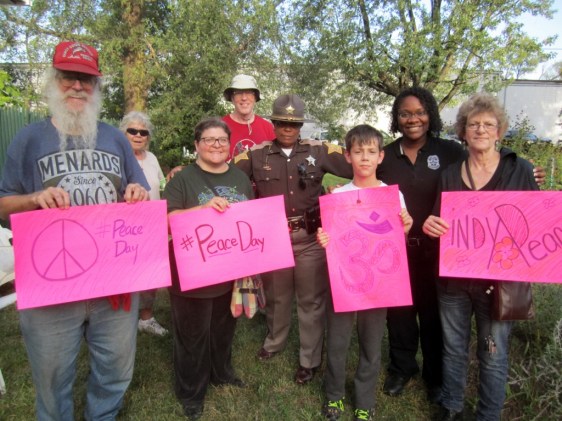
After yoga, Lisa invited all of us to make #PeaceDay signs for our walk through the Rivoli Park neighborhood with local law enforcement. (For everyone making a sign, she banked a half hour on TimeBank Indy, our local hours-bartering exchange network.)

20160921_175955-576x1024

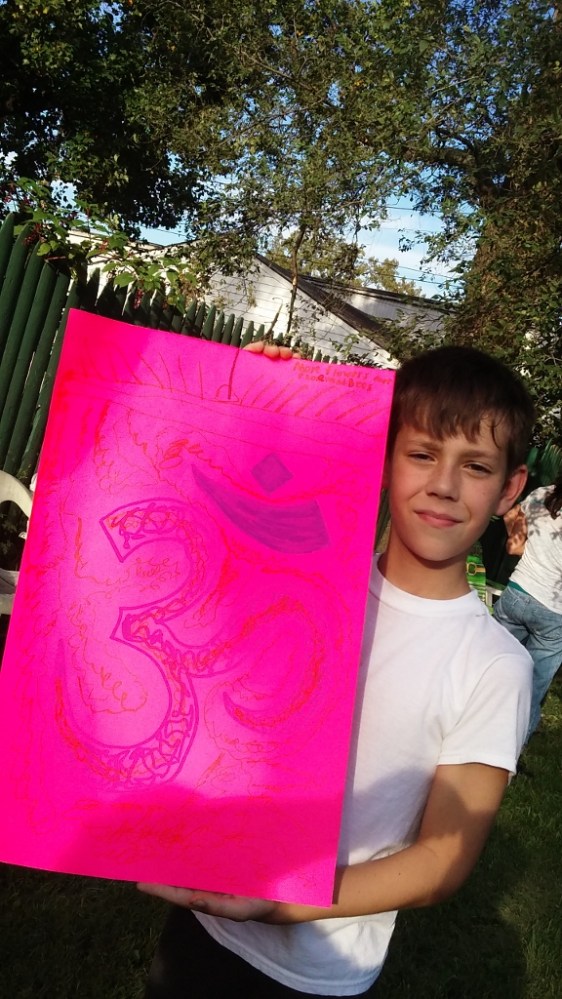
Elijah shows the poster he and his mother created.

Both the Indianapolis Metropolitan Police Department and the Marion County Sheriff’s Department were represented in our little march. We drew honks and waves and fist pumps from passing drivers, and one woman on foot offered several God-bless-yous.

img_5097-1024x768

Getting ready to walk the neighborhood.

We returned to the pocket park to share food and conversation, and walk the labyrinth at our leisure. For more details on the day, find an IndyStar photo essay here.

Lisa has coordinated the labyrinth’s fans into various neighborhood projects over the years. Coming up this week is Indy Do Day—an annual three-day citywide service blitz, set for Sept. 29, 30, and Oct. 1. The Rivoli Park Labyrinth was installed on Indy Do Day on October 10, 2013.

“I would like the tradition of doing service and giving back to continue,” she says, emphasizing that everyone is encouraged to find an Indy Do Day opportunity to spread some good in the community. She herself plans to offer her time packing snack bags for children in a low-income neighborhood alongside a group called #gRoE , Inc.

Projects like these can be found by searching the website of Indy Do Day.

Made of Sunshine

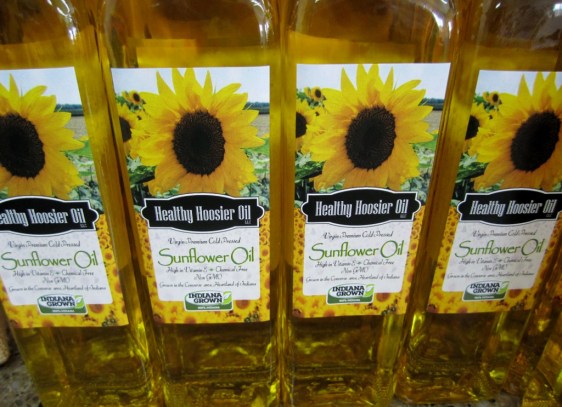
I first heard about Healthy Hoosier Oils when shopping at my food coop, Pogue’s Run Grocer. As a local food enthusiast, I was thrilled to find out that there was a new local alternative for culinary oils. I didn’t know much about how the product was made, but after I took home my first bottle of sunflower oil, I knew it was delicious. Seriously flavorful.

img_5052-1024x743

Once you’ve tried it, you will crave its buttery flavor.

I ended up buying bottle after bottle of sunflower oil as we drizzled it on our salads all through spring and summer. And popcorn popped in the stuff is amazing. It’s great for stir-frying too. Then there’s canola oil, which has a more neutral flavor and a higher smoke point.

Eventually I suggested to my Farm Indiana editor that we do a story on the Boyer farm in Converse, Indiana. That’s where the seed crops are raised and turned into this fantastic staple of my dinner table.

img_5054-1024x755

Sunflower fields forever.

Yes, this is the amazingly fortunate position I find myself in at this stage of my life: I get hooked on a particular foodstuff, and get to go visit with the folks responsible for it. I write a story about them and collect a (smallish) paycheck.

I met Craig Boyer, the 81-year-old patriarch of a family that manages to stay tightknit and geographically close in an age where that is rare. (All of his and wife Nancy’s children, grandchildren, and great-grandchildren live within just a few miles of where the above photo was taken.)

img_5042-727x1024

Craig Boyer with a section of the filtration system for the culinary oils.

The land has been in the Boyer family since 1848, farmed for six generations and counting. The culinary oil enterprise is fairly recent, and arose partly out of Craig’s health crisis. He had to semi-retire after a major cardiac event, and he was supposed to watch his diet. His sons Mark and John experimented with converting their biodiesel operation into culinary oil production, in part because of the market—but also because their dad loved his fried foods.

img_5049-768x1024

Brady Bolen bottles and labels the freshly pressed oil.

I was pleased to hear that the oils are free of solvents and additives. I actually was a bit clueless about how conventional oils are extracted (through a nasty-sounding process involving hexane and high heat). Healthy Hoosier Oils go through a cold press.

The oil crops themselves grow in a minimally-tilled row-crop setup, in rotation with the corn, soybeans, and wheat that the Boyers also raise. “We use zero chemicals,” Mark told me, speaking of the canola and sunflowers. I asked about weed control: “It actually is relatively easy in that both canola and sunflowers eventually will canopy. When they canopy, they cover the ground and protect themselves from invasive weeds to a certain extent.”

Honeybees are key to the Boyers’ strategy too—they partner with a local beekeeper to make sure that honeybees are working their magic on the crops.

img_5053-768x1024

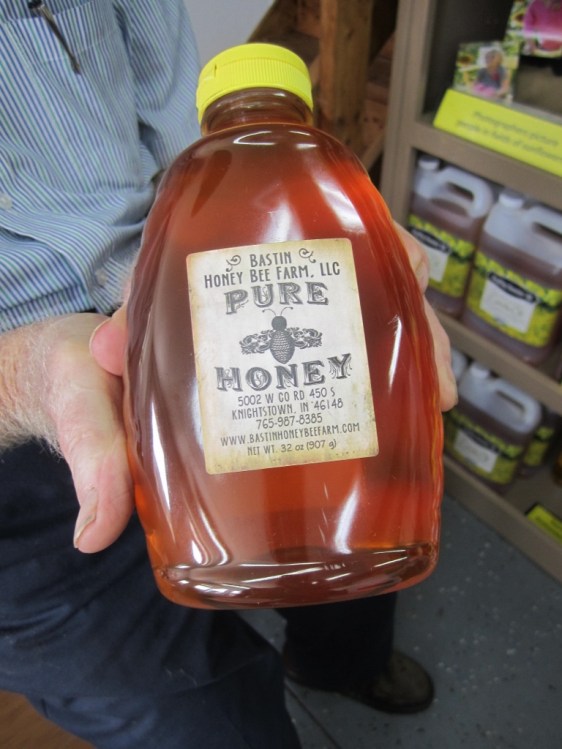
Honey from Bastin Honey Bee Farm of Knightstown is sold onsite along with the oils.


I enjoyed my tour of the operation that July day, even the sweltering 1940s-era corn crib (repurposed to store the oil crops). Here’s the writeup for Farm Indiana, if you’d like to read more. Locally, you can find Healthy Hoosier Oils in Kroger stores, Pogue’s Run Grocer,  and other independent grocers.


Don’t Sneeze It, Squeeze It

My spouse hurt her shoulder last week. So my herbalist friend Greg Monzel (co-founder of the newly opened Wild Persimmon School of Wellness) gave me instructions for a special formulation. I knew I was in trouble when he began with “You know what goldenrod looks like, right?”

Yes, the first step in making this formulation—goldenrod-infused oil, excellent for tissue repair, particularly in the shoulder—is “Gather some goldenrod.” (Most people associate goldenrod with fall allergies, but it turns out to be a a fantastic muscle rub, when infused in oil.)

Fortunately for my foraging aspirations, I had already planned a bike ride with some friends, and it was easy to scout goldenrod along the path.

img_20160904_111317015-1024x576

Not hard to spot as it’s in bloom right now.

Greg said it wasn’t necessary to wash the cuttings unless they were very soiled.

img_5057-1024x731

Our cat Edgar promptly set up shopkeeping next to my gleanings.

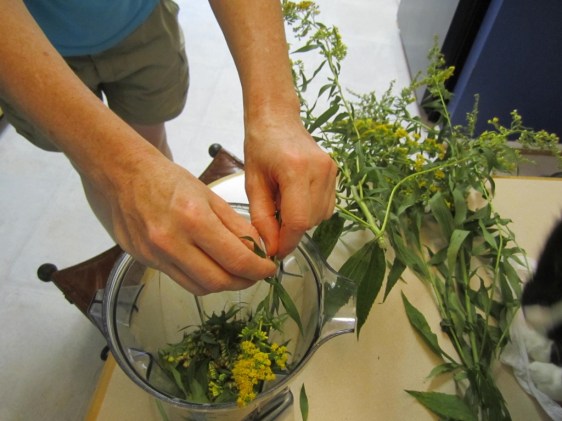
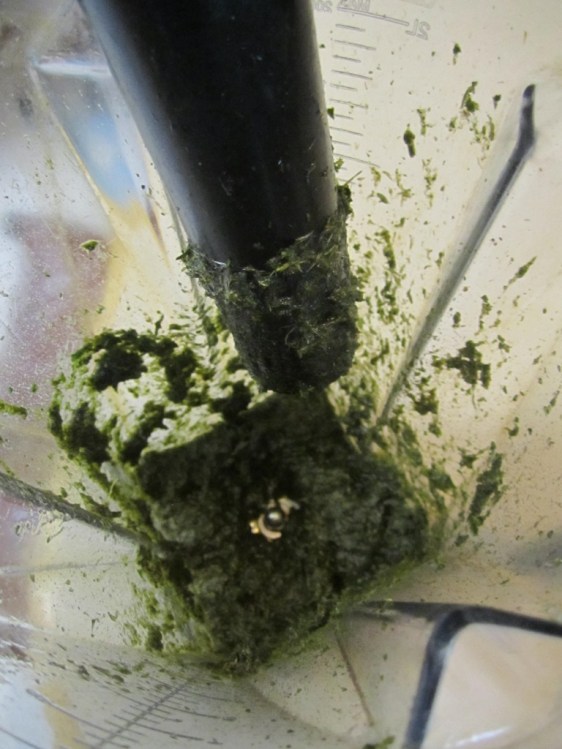
The next step was to pick the leaves and flowers off the stalks and place in a blender.

img_5059-1024x768

This part was less fun than the foraging.

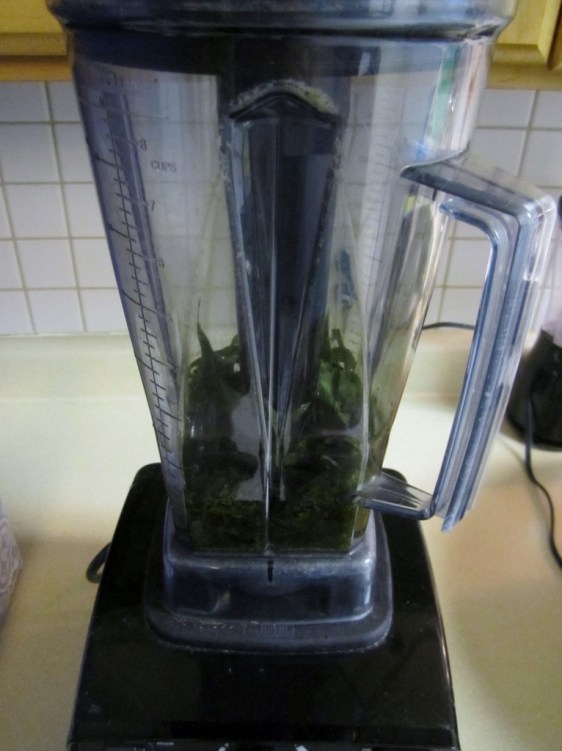
I added oil and started blending.

img_5065-766x1024

Years ago I received a VitaMix as a gift. I echo a friend who says she can’t decide which is more critical: her smartphone or her VitaMix.

It was supposed to be a smoothie-like consistency, so I needed to add more oil.

img_5067-768x1024

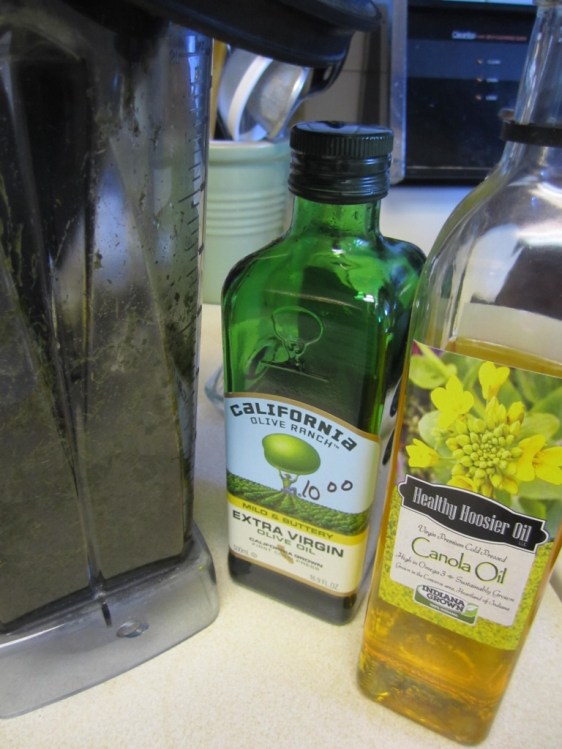
I decided to use some of my Healthy Hoosier Oil canola oil–which is cold-pressed from canola seeds grown just north of where I live.

By now it was more pesto than smoothie, but I quit doctoring it because I didn’t want to use up all my lovely oil.

img_5068-768x1024

I do like my smoothies thick, though.

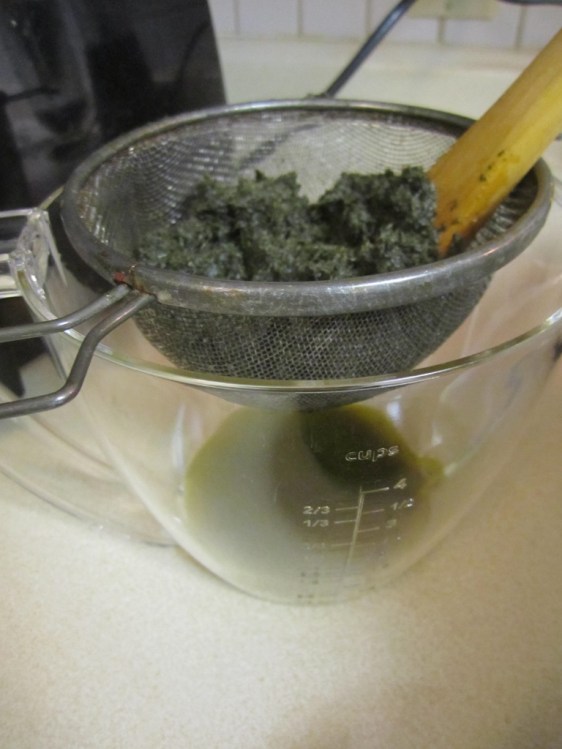
Greg’s instructions were to “strain it,” so I put it in a mesh strainer. The blend was so thick that I had to mash it and stir it to get any oil out.

Round about here is when I texted Greg, “Is it supposed to look like this?”

img_5070-768x1024

This got old pretty fast.

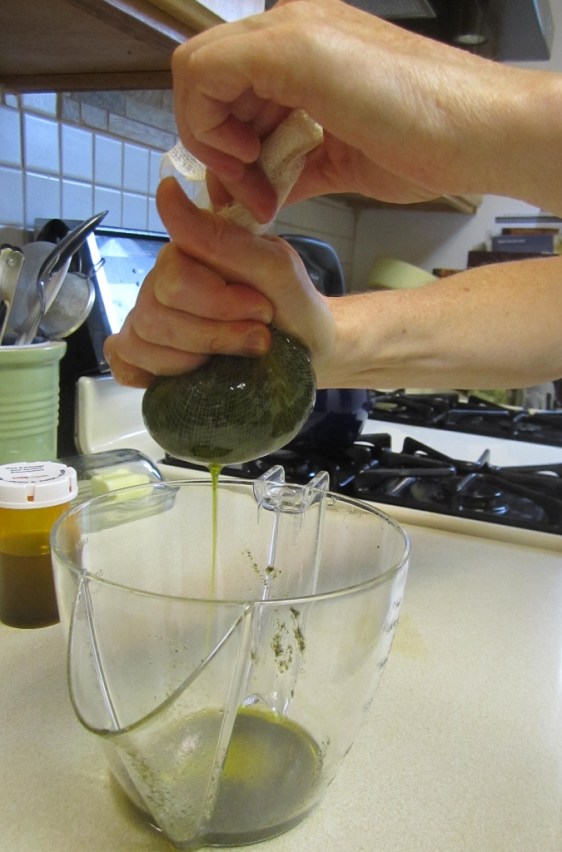
He said to use a cheesecloth. Oh! I dug some out of the back of a drawer.

img_5074-675x1024

That got the last of the oil out of my “pesto.” In the background (pill container) is the amount I had gotten out by mashing with a wooden spoon.

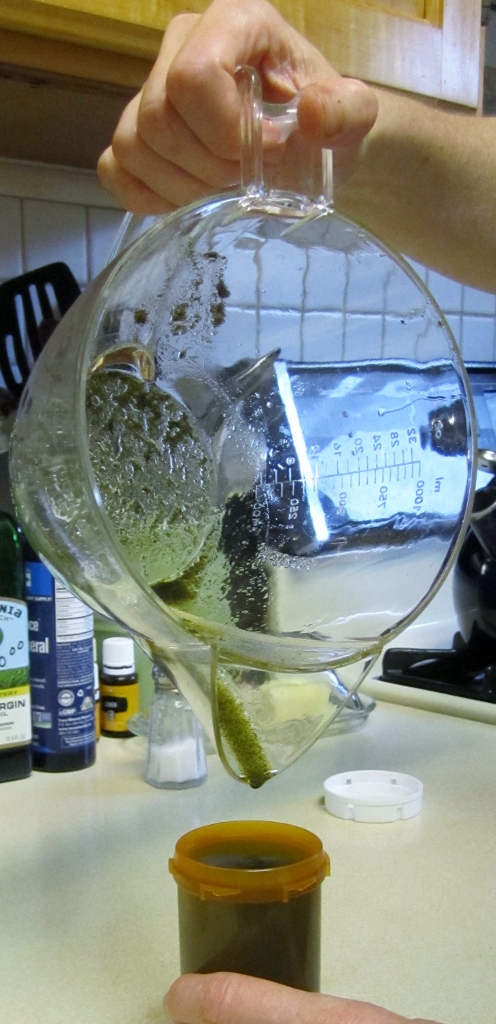
Finally, the strained-off oil (which still contains some solids and water from the plant) gets set aside to separate.

img_5077-496x1024

I wish I’d picked a clear container, but oh well.

I forgot to take pictures the next day when I decanted. This is a fancy word for pouring off the oil from the top after the solids and water have settled to the bottom.

Anyway, below is the result. It smells strong and effective! My spouse was game to try it. So far it hasn’t fixed her painful shoulder, but I’m sure it is helping.

img_20160906_182111163-810x1024

It’s somewhat clearer looking in real life. Cell phone photo, sorry.

Actually, after all that cycling, snipping, picking-of-leaves-and-flowers, mashing, squeezing, and decanting, I am starting to develop a crimp in my own shoulder. Good thing I have plenty of goldenrod-infused oil to rub! And bonus: It feels like I have “leveled-up” in my foraging endeavors, harvesting and processing a medicinal all on my own (with text support from the ever-awesome Greg).

Sing Light

At the International Women’s Writing Guild‘s annual conference, I was drawn to a spiritual warriorship workshop. Here I found women both tender and fierce. From various spiritual backgrounds, we all were seeking to keep our hearts open in the face of the world’s pain. We meditated together, read, wrote and shed tears together.

One day the reading was Wendell Berry’s haunting  Work Song Part 2: A Vision, which speaks of “a long time after we are dead” when “memory will grow into legend, legend into song, song into sacrament.” The future, and what it might look like, if we are wise.

IMG_3691 (767x1024)

Our writing prompt was : What I want to sing into this world is…

Here’s what came from that free write. (Read Wendell’s marvelous poem first!)

What I want to sing into this world is…
That we must breathe our despair and eat our fear. Then allow the alchemy of respiration, digestion, and elimination to work on our pain and terror until a new thing emerges on this earth. I want to sing a song of light—and yet allow darkness to be felt and seen. (Without awareness of what is hard and mean and forced, we forget the impoverished place that births our better future.) Sing light that doesn’t fear the dark but turns toward it, welcoming the whole story of our unfolding humanity. Find a way to rock the darkness like a neglected child, to give it the kind of love it’s never known.


And you: What do you want to sing into this world?