I’ll Meet You There

“It’s been a long time since I felt that sense of wholeness,” she told me. “Just to reconnect to something spiritual feels incredible.” I’d just talked her through a grounding and expanding meditation, one that I use myself to connect to Source.

Sunlight. Revisited.

Photo by Rishi Bandopadhay, via Flickr Creative Commons

This young woman was one of about 30 I worked with Tuesday night at a collaborative “Art and Insight” event. Other participants, upon opening their eyes, said they felt themselves floating, or they gained perspective over their petty concerns, or they felt as refreshed as if they’d had a nice long sleep.

Guiding people to spaciousness was a gift to my own energy. I thought I might feel drained afterward, doing so many consecutive mini-interventions—but instead, I was on a high. (The only thing that would have increased my high? If I’d had time to enjoy my beautiful collaborators’ offerings—spirit animal readings by Elizabeth Camp of Zen Within and reiki from Amy Barr of The Healing Room. Not to mention henna by Carrie of Eastside Gypsies. Next time!)

This work makes me so happy. I never expected to find a vocation that felt as natural as writing. But I love sharing ways that people can regain their footing in a rocky world.

So many of us are walking around in trauma these days as we face up to our collective shadow. Nothing seems certain anymore; institutions that once appeared solid are crumbling one by one. It can feel, as intuitive Lee Harris once put it, like we have lost our handrail.

In troubled times, it’s so helpful to reach out to each other, reach down to the earth, reach beyond to the cosmos, and experience ourselves as intertwined with All That Is.

IMG_3593 (1024x766)

That sense of interconnectedness is what helps me return to a space of possibility and openness instead of shutting down.

I used to consider this kind of thing “self-care,” which seems to relegate it to the “optional, somewhat privileged” category of activities, on a par with green drinks and Pilates. Certainly not mission-critical, like the shovel-in-dirt projects that remake the world.

However, I see now that the world is made up of people on a path, and that clearing out and opening up on an individual level is absolutely critical if we want to thrive here. Before the remaking of the world comes the reimagining, which can’t happen with eyes that see the same old way.

So how do we build a new world—safer, saner, more compassionate, more just, peaceful, resilient? There are so many problems, so many slippery arguments. There’s so much shouting, so much pain.

We can start by opening our hearts and looking into each other’s eyes.

Or in preparation for that, we can look at a flower, or a beetle, or a cat, or a tree.

in shade best

Or in preparation for that, we can feel the marvel of our lungs filling with air as we draw breath.

We can start anywhere. Sweep our little corner.

Out beyond ideas of wrongdoing and rightdoing, there is a field. I will meet you there.

—Rumi

Note: Please sign up for my e-newsletter if you want to receive notices of upcoming similar events. And consider joining me at Empath 101, where I will share energetic tools to manage sensitivity.
Pollination Takes Many Forms

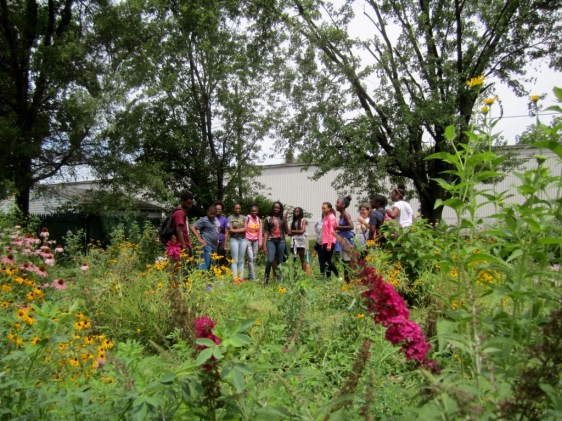
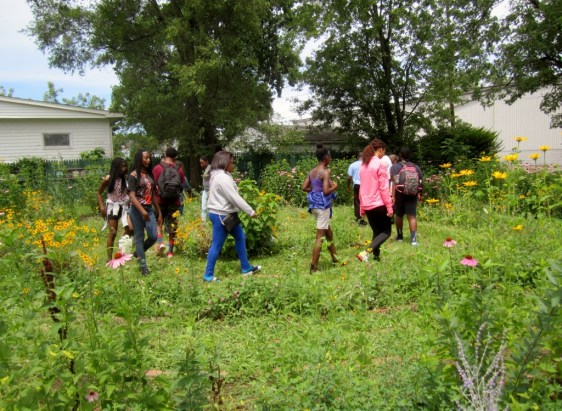
Recently a group of middle-schoolers from Edna Martin Christian Center‘s teen program came to Rivoli Park Labyrinth to find out what the pocket park is all about.

IMG_4988 (1024x749)

Walking the labyrinth

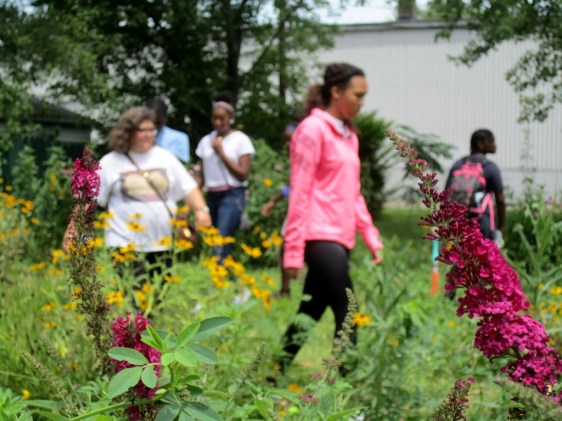
The park’s founder, Lisa Boyles, led the youth on a walk through the labyrinth, which is beautifully ringed by wildflowers this summer.

IMG_4960 (1024x769)

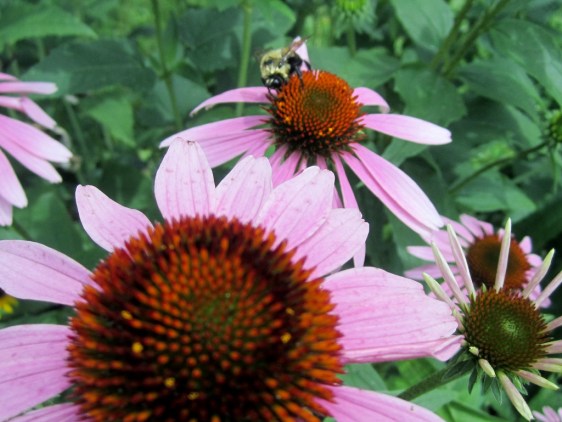
bumblebee

Sharp-eyed kids spotted some of the critters that make the park their home.

IMG_4972 (1024x767)

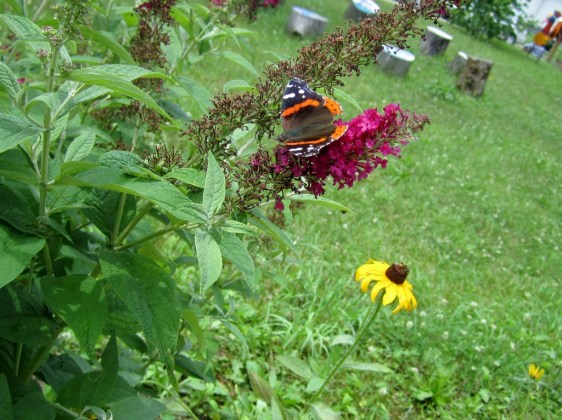
on the butterfly bush

As a certified wildlife habitat, the park provides food, cover, water, and nesting places for creeping and flying insects, toads, birds, and small mammals–and it is managed with sustainable gardening practices that are wildlife-friendly. (Lisa recently saw a falcon with a mouse in its talons, high in one of the trees.)

IMG_4995 (1024x768)

View from the butterfly bush

After the walk we talked about why it’s so important to support pollinators … without which it would be difficult to find actual food. When one of the boys said something about licking a flower, we picked red clover petals so everyone could try a sip of nectar. Tasty!

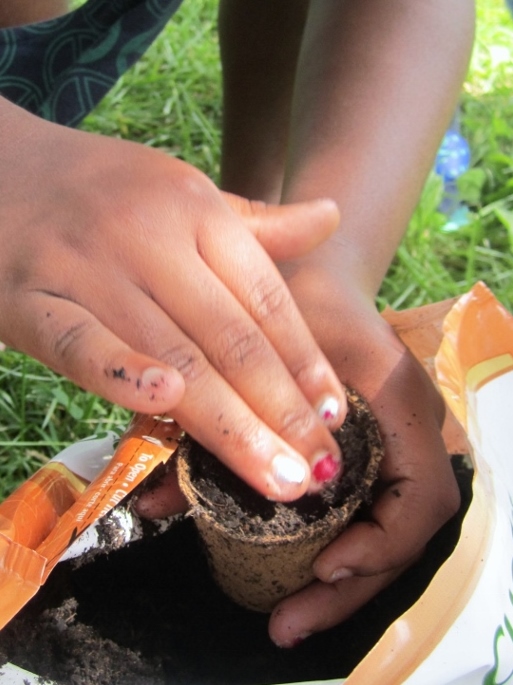
Soon the park will be designated a Monarch Waystation with the addition of milkweed, which monarch caterpillars eat. The kids got to sow milkweed seeds in small pots to take home and start their own monarch-friendly habitats.

IMG_5006 (767x1024)

Starting milkweed seed in peat pots.

Each teen also went home with a kit to make a butterfly feeder and instructions to make more nectar (1 part sugar to 1 part water, heated until sugar dissolves, then cooled).

A simple butterfly feeder.

A simple butterfly feeder.

Lisa notes that you can also attract butterflies with fruit. Butterflies are reported to love oranges, watermelons, mangoes, kiwis and apples. Fruit slices can be put on a plate with some water, or they can also be added to the sugar water feeders for added variety for the butterflies.

Pollination takes many forms. Insects pollinate flowers, while a woman like Lisa pollinates young lives by sharing a quiet space in the middle of the city’s hubbub.

IMG_4993 (1024x768)

A contemplative moment in the center of the labyrinth

All are welcome to explore Rivoli Park Labyrinth’s beauty, spread a blanket for a picnic, or walk the labyrinth anytime between dawn and dusk.

For more information on creating a certified wildlife habitat, see the National Wildlife Federation’s Gardening for Wildlife site.

This is Humanity

Charles Eisenstein, in this interview, challenges me to something more radical than empathy. What if we believe everything we read and hear? Not in the sense of “That’s Absolute Truth,” but in the sense of: This is what’s real for this person.

It’s a difficult assignment, because it requires giving up being right. But practicing it would open up the potential for new learning.

What life circumstances could I imagine that would give rise to the various stories I hear? What enculturation/emotions/experiences underlie people’s opinions? Or the scenarios being played out, which are expressions of the stories people know to be true?

What stories must be firmly in place for so many African-Americans to be brutalized and killed at the hands of authorities, so often with impunity?

As this writer posits, “America has conditioned society to regard us (African-Americans) as beasts, superhuman, faster, and stronger. So when we are killed, it’s easy to rationalize and accept.”

That’s one possible story. A painful one. Giving rise to the need for all of us to say, unequivocally, Black Lives Matter.

This morning in meditation I saw a flower with countless small petals. One bloom, many petals: This is humanity. A flower doesn’t have to be told that it’s insanity to pluck out some petals. It is all one whole, one body.

IMG_4950 (853x1024)

From my journal after one such shooting:

Is it possible that I carry all the permutations of humanity in my cells, in a more literal way than I ever imagined?

What if: I am the police officer who killed the black teenager. And I am the teenager who died. I am the crowd that formed. I am the mother. I am the judge, the jury, the media, the Facebook storm, the Twittersphere.

All of these are within me and I must must must love them now. The young woman wanting to smash up stores in anger. The older folks grieving. The Fox News people spinning. The truckers in the truck stop, the teens at the mall, the babies in wombs ready to be born into a quaking world. The deflection. The pain. The heartache. The horror.

The fear. Everywhere fear. I am that. And I must love that.

I am the return, too. The opening.

Can we imagine a story that would solidify our shared humanity, and our mutuality, and our need for everyone to feel safe and respected as they walk through the world?

Catching Abundance

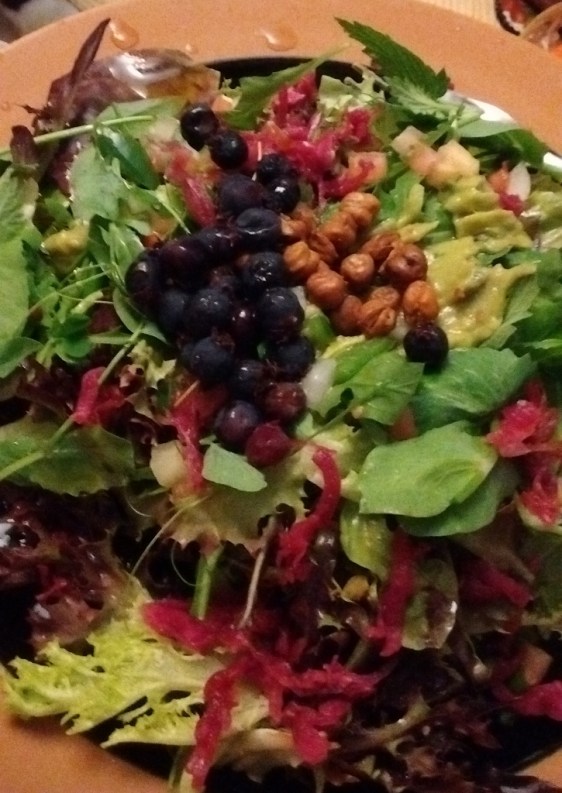
One day early in June, I looked down at my salad plate and realized my good fortune.

IMG_20160613_203841863 (725x1024)

The abundant salad

I saw that an incredible number of friends and acquaintances had contributed to my meal. Here were lettuces I’d purchased as seedlings from a farmer friend. Serviceberries I’d picked from a neighbor’s tree. Roasted chickpeas given to me by another neighbor, and guacamole from yet another neighbor. I dressed it with a drizzle of superspecialyummo high-end olive oil that another neighbor-friend gave me, along with beet kraut from local fermenters Fermenti Artisan.

I mean, seriously now.

And that’s not even mentioning the contributions of all the nonhuman cocreators of my food, the bees and tiny bugs, the sunshine and rain and minerals and fungi and soil itself.

IMG_20160609_200830515 (576x1024)

Dan’s tree was loaded. Enough for birds and neighbors to enjoy, while still filling his freezer.

This time of year especially, the sheer plenitude just delights. That is, if we let it.

Nance Klehm of The Ground Rules calls it “catching abundance”—the idea that our job is to show up and appreciate, and make use of, what we are freely given.

IMG_20160626_185540693 (1024x576)

I picked these yesterday. Blackberries, red raspberries, wild black raspberries, mulberries, and a couple Alpine strawberries.

It can be food, but it can be other things too. Recently I’ve felt grateful for an abundance of ideas, an abundance of encouragement and support, an abundance of beauty, on and on.

One night, at bedtime, I saw the quarter moon reflected in my neighbor’s window. I let myself be awed.

Gratitude opens the door to awe and wonder, two emotions that promote loving-kindness, so essential in this jaded age. (This article posits that “chronic awe deprivation has had a hand in … making us more individualistic, more self-focused, more materialistic and less connected to others… We need to actively seek out awe-inspiring moments in our everyday lives.”)

Contacting this state then, which I also call spaciousness, is not just the icing on the cake. It may be the entire smorgasbord.

Saturday I took a space at a wellness expo, where I asked people where they encounter spaciousness, or what it means to them. Many generously contributed to my inquiry, as you can see.

IMG_20160627_135622548 (1024x668)

I invited people to contemplate spaciousness and add a thought to this board. I caught an abundance of responses!

A few of the answers:

  • Expansion ♥
  • In the green of nature
  • Simplicity
  • Freedom to be me!
  • Contentment ♥
  • Awareness
  • Love!
  • Open heart ♥
  • Unlimited
  • The stillness inside of myself

And my personal favorite, a drawing of a tree. (Yes! Thank you, Tree!)

I bow in gratitude to the people willing to scribble something for me, and to those willing to pause a bit longer and try out my uber-short meditation for grounding and expanding. What a privilege to encounter so many openhearted souls.

What about you? What is your experience of spaciousness,  or where do you encounter awe and wonder? Are you catching the abundance in your life?

My Dad, Who Made the World Better, Take 4

Father’s Day. Let me tell you about my dad, if you didn’t know him.

My dad loved all things plant. Out on a walk, he’d look down, the better to identify the plants at his feet. During his social worker years, he spent as much of his off hours as possible outdoors, tending his raspberry beds, vegetable garden, and native plantings. As a retiree he had time to participate in all kinds of projects that fit his passion, and he was never happier.

One of the pleasures of being the daughter of such a man is introducing myself as “Donovan’s daughter” to his many friends and co-conspirators. Recently I interviewed a “FOD” (friend of Dad) for an article I was writing. I knew Dad had done some volunteer work with this organization, Central Indiana Land Trust. At the end of the phone conversation I mentioned Dad’s name.

The response in my earpiece was immediate. Cliff Chapman, the organization’s executive director, said, “Oh, Donovan! I loved Donovan!”

He started to tell me stories. How Dad was the only one who came out for the first volunteer work day at a nature preserve called Oliver’s Woods. With two feet of snow on the ground, Dad and Cliff together tackled the first bush honeysuckle (an invasive plant that kills off native plants). It was “the size of a VW beetle,” Cliff said.

Since then over 1500 volunteers have cleared a dozen acres of bush honeysuckle. They used to have to wield a hedge trimmers just to be able to drive up the lane. Now native plants are starting to flourish there. Though the site is not open to the public yet, it is on its way.

Cliff still remembers that very first cut that started everything off.

He told me another story that is just so Dad:

“One of the things he had me do—it was when he was in home hospice care and I went to see him—he said, ‘Hey there’s this plant I’ve planted, it’s got a whole bunch of seeds, and I’d love to see these seeds go to good use.’ So I got a big old bag and collected the seeds and went back in and showed him, and told him I would scatter them somewhere special.”

Chapman planted the seeds—sea oats—along the White River at Oliver’s Woods. He started another stand of sea oats from plugs under a big tree along the lane. He says he always thinks of my dad when he sees those grasses waving.

“Some people are different than other people,” he told me. “He really cared about those things, like he really wanted those seeds to be planted.”

Here is a clump of sea oats in my yard that (if memory serves) originated from Dad. Sometime soon I hope to visit Oliver’s Woods, but in the meantime I will find him near at hand, and be grateful.

IMG_20160619_191638076 (1024x734)

Magnify Love

Do your little bit of good where you are; it’s those little bits of good put together that overwhelm the world.

—Desmond Tutu

Here in the U.S., we’re feeling the reverberations of yet another mass shooting. Some call it the deadliest in our nation’s history. Even as I unplug from the news cycle, I’m energetically affected by the pain and anguish, the anger and fear.

Sadness is mostly what I feel when I think of the shooting. When I remember to, I turn toward the sadness, feel it in my body, notice the wish to numb it, alongside the urge to amass information in support of my personal philosophy about these types of tragedies.

I “embrace, allow, include,” as I’ve been coached in mindfulness training. I open up room for all my responses and attend to them with kindness. In that space I can consider right action.

All of which gives me more compassion for others on their own path.

I like to believe that humanity is evolving in a positive direction, appearances (seemingly) to the contrary. The horrible things that happen always grab our focus, fuel our outrage. It’s the same with the inflammatory things said by some pundits and politicians: Our attention gets hooked by ugly things that seem to confirm the awfulness of everything. And the ugliness magnifies.

A wise yoga/meditation instructor recently reminded me that our brains are wired to notice the snake amidst the flowers. Danger! Alert! We fixate on the negative. It’s biological.

Flower (1024x768)

No snake, just flower.

Mindfulness meditation creates an opening for a new practice to emerge. It offers a brief space—the length of a breath—in which we can begin to choose.

I wonder: what if we train our attention on something other than the horror? Not to look away blithely denying injustice, but turning toward the little acts of love and solidarity, small exchanges of soul happening every day. Is it a copout, born of privilege, to even suggest such a thing? Or is it an opening?

Some schools of Buddhism teach that the material world is nothing other than a construct of mind. What mind do I wish to inhabit?

Illusion (768x1024)

What do I choose to magnify with my attention?

We’re Walking Ecosystems: Notes on Collaboration

Lately I’ve been thinking about collaboration. I envision a world where nations, geographic regions, cities, neighborhoods, and affinity groups find an ease and flow in working together.

11285902014_240074a727_z

Photo credit Michael Mayer, via Flickr Creative Commons

Maybe it seems pie-in-the-sky, but we have a model for that kind of collaboration. It’s right here, as close as our own skin. Modern science now confirms that the human body is a collaboration in itself.

Some 90 percent of our cells are—get this—not human. They’re bacterial, or fungal, or even viral. Don’t be afraid! They mean us no harm. We’re their habitat. A walking community. A microbiome.

If we keep balance within the community of our cells—I’m talking happy bacteria and fungi here—we generally enjoy good health, and recover from illness more quickly.

This Brainscape article explains it all so well—the ecosystems within us, each with their own unique microorganisms. These wee “microbiota” do all kinds of things for us in exchange for giving them a suitable environment to thrive. They help with digestion, brain activity, and immune function, just for starters.

Most curiously, our mitochondria—an organelle within cells that is responsible for converting digested food into energy—contains DNA that is…not human. “These organelles came from outside of us, down a separate evolutionary path.”

17104540588_afc2a615dc_z

Mitochondria (red) are organelles found in most cells. They generate a cell’s chemical energy. Credit: NICHD/U. Manor, via Flickr Creative Commons

At the microscopic level, human life depends on a symbiotic relationship.

From the article:

“When Charles Darwin wrote On the Origin of Species, the dominant theory soon came to be survival of the fittest: a rat race for domination and survival. But both of these examples — mitochondria and our internal biota — point toward another means by which life thrives and evolves: symbiosis.”

I find that fascinating, and also telling.

Of course, zoom in tighter on the cells of our body—and what are they? Whirling clouds of particles. There’s nothing solid to us.

We’re made of space, basically. Our lives reliant on organisms we have always vilified or at the very least, ignored.

Knowing that, is it possible to see the human community in a different way?

Walking As One

Walking is a time-honored way to meditate, ruminate, and otherwise seek clarity. Walking a labyrinth gives each footstep even more meaning. And walking in community brings added sweetness to the experience.

On World Labyrinth Day, May 7, people all over the world gathered to “walk as one at 1” in the afternoon. The idea behind this annual event, according to the Labyrinth Society, is to “create a wave of peaceful energy washing across the time zones.”

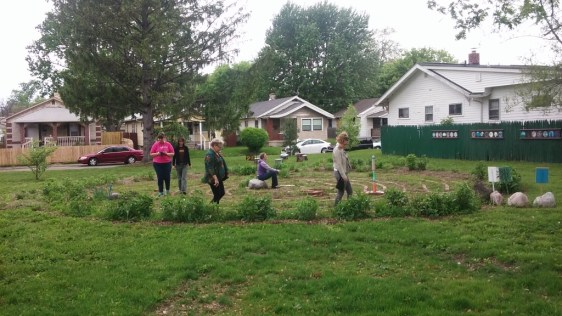
The Rivoli Park Labyrinth hosted a potluck and group walk, representing the local community on a day when some 200 public events took place across the globe. An intermittent drizzle didn’t keep us from sharing soup and salad while we made new connections and renewed old acquaintanceships. At 1 it was time to drift into the circle of the labyrinth as we each felt ready.

20160507_131234 (1024x576)

Walking the labyrinth as one

I had never participated in a communal labyrinth walk before, and I found it quite lovely to share the labyrinth with others. Each in our own space and yet connected, some chatting, some silent. Sometimes meeting on the path and clasping a hand as we passed each other with a smile. At one point I found myself walking next to an acquaintance who gave off motherly vibes, and I impulsively decided to take her hand until our paths diverged.

When I enter the sacred space of a labyrinth, I like to set an intention or ask a question. My intention for this particular labyrinth walk: To take nourishment from all quarters. I was feeling depleted after a busy week and several short nights. The meal we shared was one source of sustenance, and I wanted to see if I could also be nourished by the air, the rain, the soil, the plants, and the beings around me, both human and nonhuman—and the movement of walking itself.

20160507_132217 (1024x576)

The boulder in the center is a perfect resting spot.

Afterwards, I did feel restored.

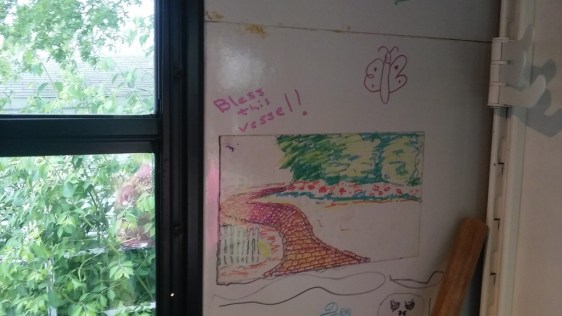
What makes this labyrinth unique is the fact that it is a pocket park situated on a vacant lot in the heart of the city, a public space developed and managed by volunteers. Lisa Boyles, Rivoli Park’s founder, strives to bring people together through art, so the park has numerous community-made art pieces displayed. (Note the paintings on the fence in the photo above.)

20160507_125954 (1024x576)

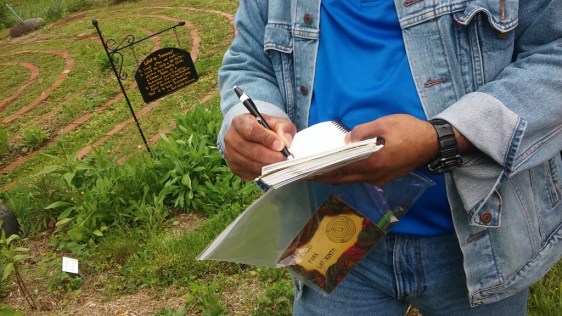
Walkers can record their thoughts in a log book at the start/end point of the labyrinth. Lisa sees the logbook as a way to encourage reflection and sharing, and to build community among solitary walkers as well.

In fact, creative expression is built into the design of the labyrinth itself.

20160507_123049 (1024x576)

The “pole of possibility”

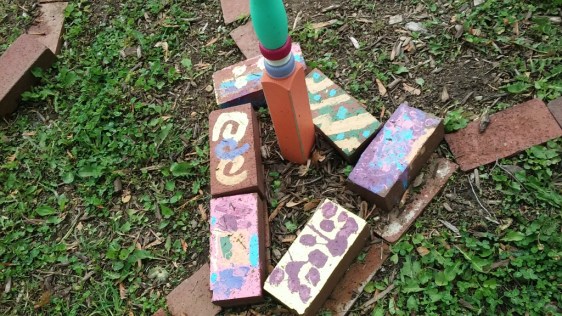
According to Lisa, the pole at the entrance to the labyrinth marks one of three “focus points” in the labyrinth. Volunteers from 2015’s Indy Do Day (citywide service day) decorated the bricks. “The poles at the three focus points,” she says, “were handmade expressly for the purpose they are serving now as delineators of the focus points. This tall one at the entrance of the labyrinth I like to call the ‘pole of possibility.’”

In keeping with the art theme, Lisa invited the “Seeds of Common Sound” music bus to take part. On board the bus, we could add to communal art pieces, play instruments, and get inspired.

20160507_140652 (1024x576)

Communal art on board the music bus

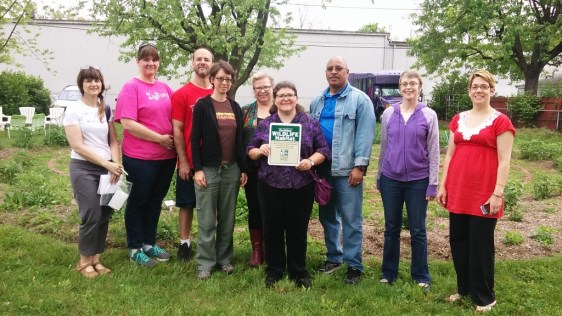
Care for creatures is another role of this labyrinth, as it was just designated a certified wildlife habitat. Here is our little group with the plaque.

20160507_125639 (1024x576)

I plan to visit Rivoli Park often over the growing season to watch the plant, animal, and insect life flourish there. And to seek nourishment for my soul in this place of quiet reflection.

Hiatus!

Time to make official what’s been in the works for a few weeks months now. I’m putting the blog on hiatus for at least the first quarter of 2016. It’s time to retool everything on my to-do list to align better with my current focus (or foci?).

In a nutshell: My work is moving more into the healing arts arena, while I continue to write nonfiction. In both of these areas, I’m part of an ever-growing “Team,” as author Martha Beck calls it—working to bring about a new Story of Connection.

Photo by Michael Lokner, via Flickr Creative Commons

Photo by Michael Lokner, via Flickr Creative Commons

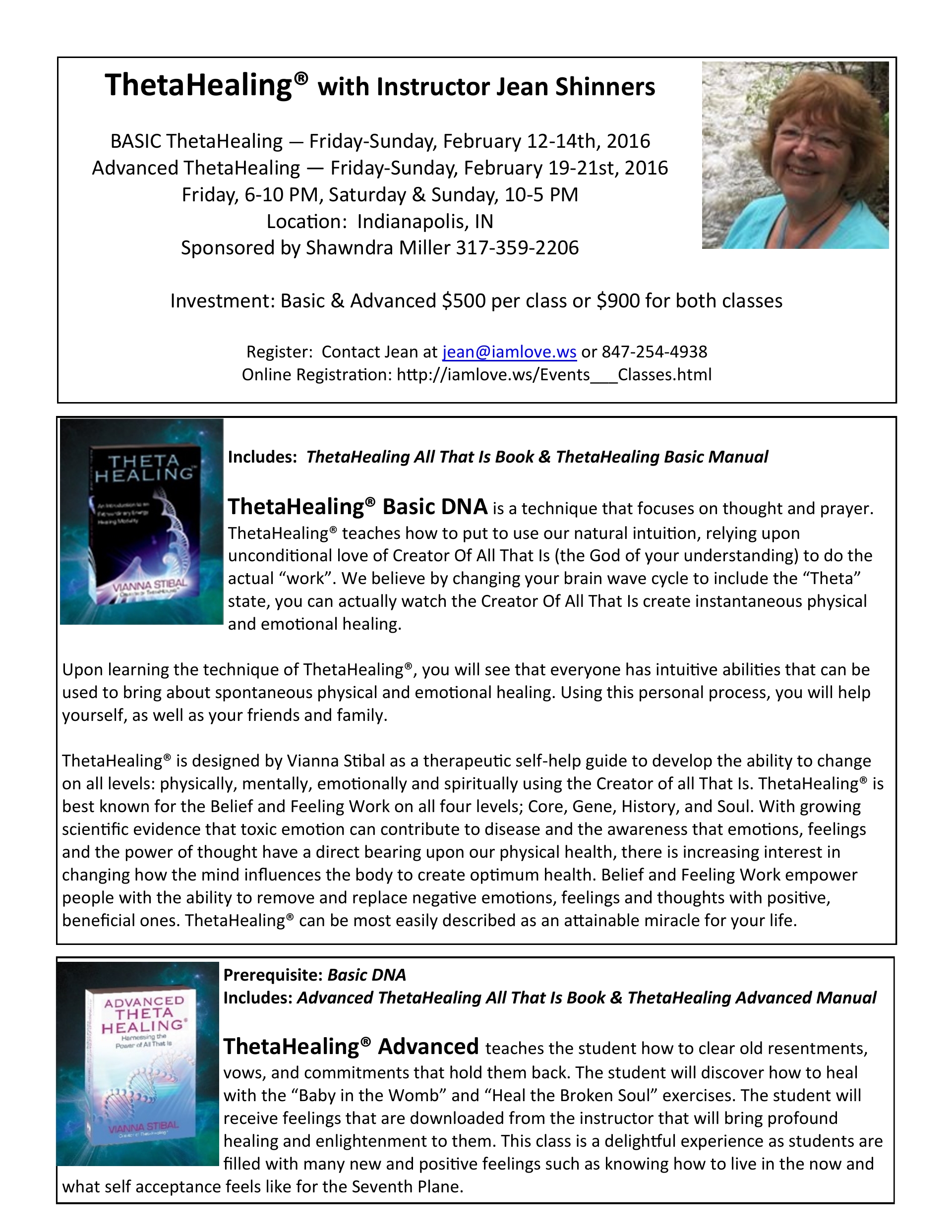
I see energy work as a way to raise our collective vibration, which we need to do—at least if we’re going to birth a  new and resilient future. So I’m getting certified in ThetaHealing, one of the energy techniques I practice.

Here is a workshop series I’m bringing to Indy in February. If you’re interested in joining me, which would be lovely, you can sign up at instructor Jean Shinners’ website.ThetaHealing Flier

I have a series of smaller workshops planned for the coming months in Indianapolis. The first one, Empath 101, will cover how manage being “so dang empathic,” as one of my empath friends puts it.

If you’d like to have a heads-up on these opportunities, or to learn more about my work, please sign up for my (revamped) e-newsletter.

Guest Post on Kindness

Today’s guest post is by my friend Heather Horst, and fits right in with a campaign by Indy Holistic Hub to spread kindness in December. #GetYourKindnessOn is the hashtag we are using to shine a light on compassionate acts we encounter. (I’ve found it quite uplifting, during these fractious days, to tune my radar to kindness. If we watch for compassion, nourish it, and spread it, we can’t help but magnify light.)

Guest post by Heather Horst

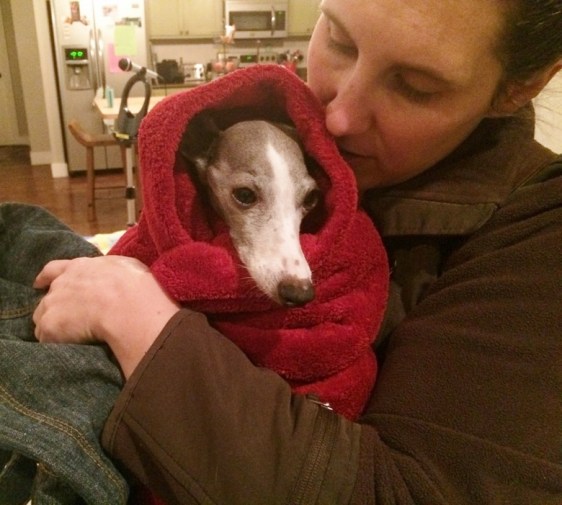
Lately I’ve been fostering a dog who is both gravely ill and incredibly sweet. Her name is Joy, and she’s pictured here.

Joy and Heather (780x701)

Joy and Heather

I’ve also been called out to do massage therapy during a friend’s labor and delivery. Between the two, there has been so much kindness. I’ve experienced so much support in caring for Joy. I’ve witnessed so much kindness and care for my brave friend as she worked hard to bring her baby into the world.

When I glance from my real life to national and world news, it’s culture shock. Because I’m not hearing about kindness. I’m hearing about brutality and a turning-away from the suffering of others, a turning-away from one’s own humanity.

I don’t accept that this is our true nature. It feels like a brokenness, a wound, an illness.

I trust that kindness is our true nature. That one day so many of us will be healed by (and healed to) kindness. So many of us will heal that when brutality or callousness appears among us, we will recognize it as an aberration.

We will surround it and heal it and not give it weapons or money or media attention.

…when brutality or callousness appears among us, we will recognize it as an aberration. We will surround it and heal it and not give it weapons or money or media attention.

I trust that kindness is our true nature. To those of you who have been carrying out these many kindnesses — THANK YOU! You heal my heart.

Heather is a nurse, a massage therapist, a spinstress of hula hoops and an amateur urban farmer. She lives, works, and plays in Goshen, Indiana.