Can you stand one more post about berries? Since we don’t have blueberries growing wild in Indiana, I chose this photo of mulberries to accompany the quote.
“One morning for breakfast I had blueberries covered with dew, picking them from the bushes as I journeyed through the New England mountains.
I thought of my fellow human beings eating various kinds of processed and flavored foods, and I realized that if I could choose my breakfast from all the foods in the world, I could not make a better choice than blueberries covered with dew.”
Author Archives: Shawndra Miller

Going Soil-Friendly
Do you ever think about the importance of the innumerable tiny creatures living underground, right under your feet? In just one tablespoon of soil, according to North Carolina State University’s Cooperative Extension Service, some 50 billion microbes are working away.
That’s if the soil is healthy.
![By NoNomme (Own work) [CC0], via Wikimedia Commons](http://commons.wikimedia.org/wiki/File%3APeanut_Sprout.jpg)
By NoNomme (Own work) [CC0], via Wikimedia Commons
The land had been blasted with petrochemicals year after year. Now there was nothing left to support a plant. No microbes. No nutrients.
But it doesn’t have to be that way.
My most recent Farm Indiana piece concerns a small agricultural fertilizer business called Sterling Formulations, led by a young man aptly named Vince Plowman.
Sterling Formulations’ team assesses farm fields and recommends soil-friendly additives depending on the particular needs of each field. They apply microbes and micronutrients to balance and nourish the soil that nourishes us.

Filling a container with earth-friendly fertilizer concentrate at Sterling Formulations’ Shelbyville, IN plant.
The team includes an Amish farmer who offers knowledge based on generations of experience. (My people!)
“The Amish have been farming organically for centuries, and quite successfully,” Vince told me. “They treat their soil right, and guess what, they’re getting yields comparable to conventional.”
He was surprised to learn that conventional farmers are as receptive to this message as organic growers. He said, “We found, in talking to a lot of conventional farmers, that so many of them are curious.”

Though he half-expected a derisive response from the conventional agribusiness side, so far that has not been the case. “What we found is they’re absolutely afraid…They don’t know how to do it (transition off chemicals), and they don’t have anyone to step them through the process of going to organics without absolutely killing themselves. They’re used to getting 200 bushels an acre, and they’re afraid they’re going to get 50 next year” if they stop using chemicals.
What comes next in that scenario isn’t pretty: they’d likely lose their farm. And many in that arena are supporting multiple families on the farm.
But Sterling Formulations is stepping into the gap. The goal is to help heal beleaguered soil through tailored applications of microbes and kelp-based fertilizers. Instead of petrochemicals that artificially prop up crops, these nutrients and tiny creatures create a living medium for plants.
This is one of the most exciting developments I’ve heard about in a long time. Farmers who want to stop using chemicals can get support in the switch—and stay profitable during the transition.
You can read more about Sterling Formulations in my Farm Indiana story.
Releasing the “Story”

A sycamore on my street in the process of shedding its bark
When the sycamores in my neighborhood begin their annual shedding, I always ask myself, what do I need to release this year to speed my growth?
Perhaps I need to examine the story that constantly loops through my brain. I’m sure some of it can fall away like bark sloughed off a tree trunk.
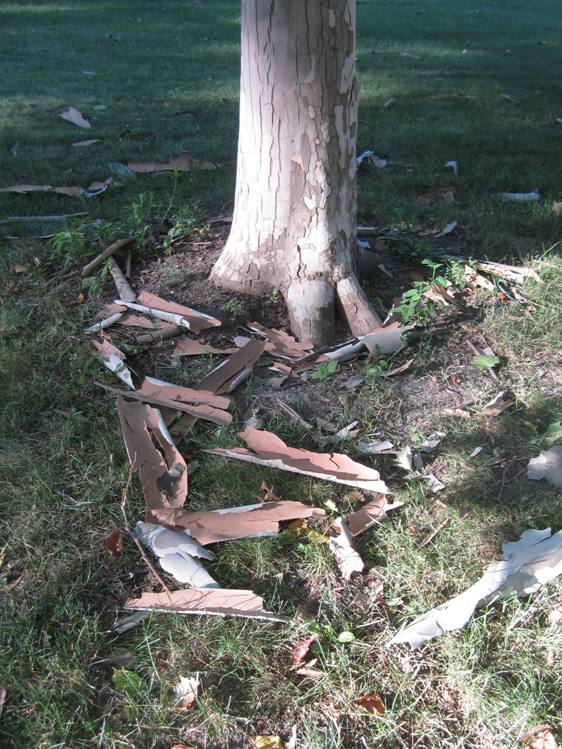
The ground under the trees is strewn with their old skin.
Zen teacher Norman Fischer speaks to this point eloquently.
“We take our point of view so much for granted, as if the world were really as we see it.
But it doesn’t take much analysis to recognize that our way of seeing the world is simply an old unexamined habit, so strong, so convincing, and so unconscious we don’t even see it as a habit.
How many times have we been absolutely sure about someone’s motivations and later discovered that we were completely wrong? How many times have we gotten upset about something that turned out to have been nothing?
Perspective
Our perceptions and opinions are often quite off the mark. The world may not be as we think it is. In fact, it is virtually certain that it is not.”

—from Training in Compassion
Possible
Two quotes from Indian author and activist Arundhati Roy are on my mind tonight. First the disturbing.
“Either way, change will come. It could be bloody, or it could be beautiful. It depends on us.”
I don’t even have to look to the horrifying news out of the Middle East to find us awash in blood. Here in my town, last week two men pulled out guns to shoot each other for the unpardonable crime of bumping each other on the sidewalk.
It seems that people are less and less respectful of life, while the means to do harm are more and more lethal, efficient, and accessible. Where will it end?
And yet.
“Another world is not only possible, she is on her way. On a quiet day, I can hear her breathing.”
Yes, I hear her too. This is why I make a point, every day, to dwell in quiet.

Walking the Labyrinth on World Labyrinth Day in May.
Today I walked the Rivoli Park Labyrinth. I said an invocation before stepping in, and as I wound my way to the center, I imagined transformation happening. The breeze rearranging molecules, my porous body, which is really made of space and light and whirling particles.
I reached the stone at the center, and just as I sat down the sun broke through the clouds. I felt it warm my back.
I listened.
I said, thank you. And: may it be so.
Stories and Sustenance
I’ve been wanting to tell you about some of my creative cohorts at Playa, but first I think I need to speak about ART.
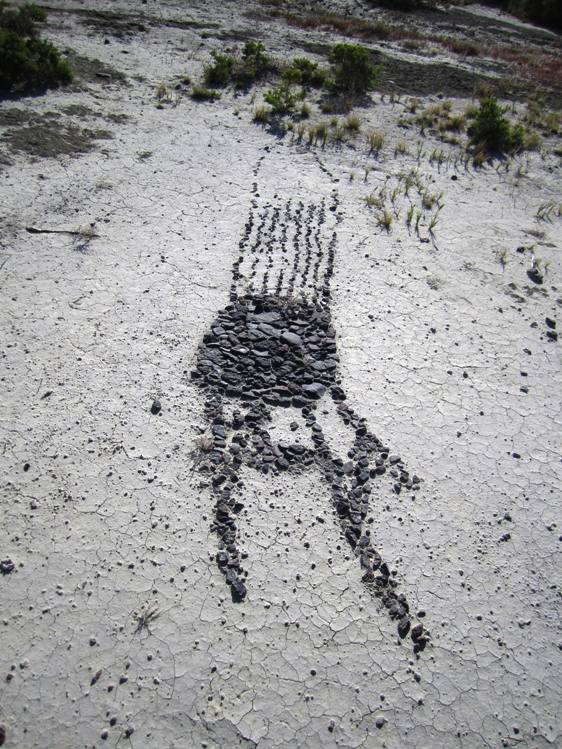
A chair made of pebbles, created by an earlier Playa resident on the dry lakebed.
Art plays a critical role in the world’s remaking. I don’t mean just literary nonfiction depicting stories of people pulling together to build resilience (though that happens to be my particular project).
I mean novels that show us how to be authentic people, teach us to feel deeper into ourselves, open a side of humanity we don’t normally see, or introduce a culture we’ve never encountered.
I mean visual art that cracks the heart wide open for its beauty. I mean performance art that rearranges something inside us. I mean music that connects with something buried deep within.
Art moves us, and movement is much needed—now more than ever.
I once read a book about the state of the world that laid out the problems in great detail, and then listed the titanic changes needed. The author recommended eschewing novels and other “distractions” in favor of educational books addressing the many issues we face.
But I return again and again to the Barbara Kingsolver character who asked, “What is the use of saving a world that has no soul left in it?”
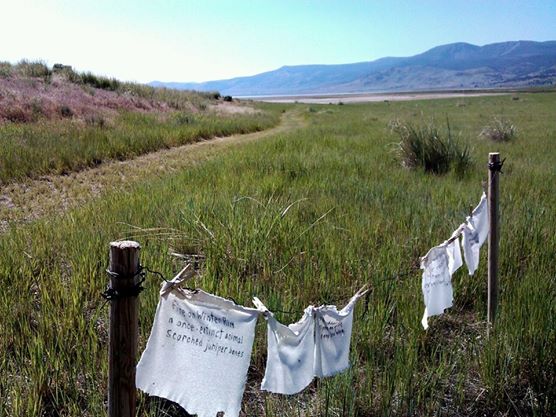
Clothesline poetry in the high desert.
Art is the soul, and artists its keepers. Without this vital work, we are diminished.
As author Barry Lopez has written, “Sometimes we need a story more than food to stay alive.”
During my two weeks at Playa, visual artists, performance artists, poets, and writers of fiction and nonfiction all fed each other stories and sustenance. We gathered around the table to talk about topics great and small. We took in each others’ work, and drew inspiration from it. Just a few who inspired me:
Belle’s poetry brought the world into sharp focus—like her poem “Sacred Cows,” exploring questions of ethics and culture around beef consumption. Hailing from Hong Kong, Belle taught a few of us chi gong one night in the Commons.

Belle after leading us in chi gong.
Portland-based poet Jen created innovative sound recordings and poetry whose shape mirrored landscape. She works for an environmental nonprofit, and her writing possesses a keen eye and ear for the natural world.
That same reverence for life is captured in the visual artists’ work. Susan’s small drawings depict The Ten Thousand Things. In the Tao te Ching, The Ten Thousand Things refers to all of creation. She remembered me snapping a photo of this bird drawing, and kindly gave it to me before we parted. I treasure it.

Susan’s exquisite drawing on rice paper. She makes one a day after walking and observing.
Emily’s watercolors evoke wild desert beauty in both postcard-sized landscapes and largescale topographical representations. She gave me one of her postcard pieces, the view of Playa from her balcony. I can look up from my desk and see that blue sky anytime I want.
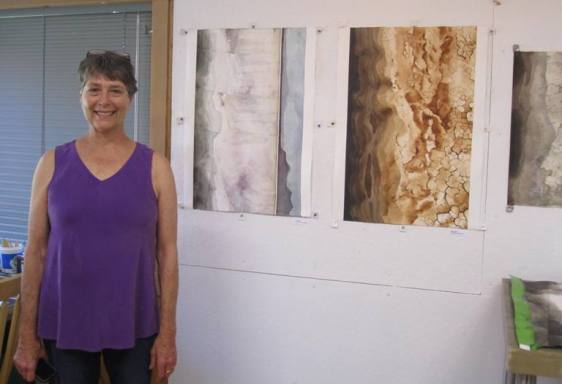
Emily and a few of her gorgeous topographical representations, based on Oregon’s Summer Lake and environs.
All of these and more blessed my stay and affirmed for me yet again that art is not a luxury.
Celebrating the Promise
The highlight of my Fourth of July? It was not the fireworks nor the pretty paper lanterns floating up and glowing orange against the deepening dusk. No, the high point came during the drive home.

photo by Ian Kluft, via Wikimedia Commons
Our downtown viewing spot was a friend’s porch. Through the trees we could see the beautiful fireworks like flowers in the sky. But we left before the show was over, not being a fan of traffic. So we had fireworks in the rearview window while driving down the main east-west artery towards home. Here’s what struck me: the folks who came out all along the street to catch a glimpse of the fireworks.
It moved me to see the good people of eastside Indy taking over parking lots and green lawns, perching on guard rails and idling on off ramps, clustered in doorways and on sidewalks. All along the street, all the way to my neighborhood, they looked the same way. People of all ages and races and walks of life sat on their lawn chairs, blankets, and tailgates with their faces to the downtown skyline on a mild summer evening.

I found it so tender to envision this scene replicated in small towns and municipalities and big cities all over the nation. My countrymen and -women seeing beauty in the sky, children gasping in delight (and dogs ducking in terror), all on the same night. That peaceful slump of bodies—lovers holding each other, parents pushing strollers, children racing around—just as they had on so many Fourth of July nights during my childhood.
I felt a rush of love for everyone celebrating the promise of our young country, and that may be as patriotic as I get.
Will Allen Visits Peaceful Grounds
It was an honor to meet Growing Power founder Will Allen last weekend. The urban farming advocate was in town to support the work of his student Linda Proffitt at Peaceful Grounds. (Here’s my earlier post about this inspiring demonstration farm, which is a regional training center for Growing Power.)

This aphorism hangs on the wall at Peaceful Grounds.
The former pro basketball player told me that he learned how to broadcast seed as a child. He can pick up a handful of seed and not drop one of them. He has the muscle memory for broadcasting those seeds, whether arugula or chard or carrots—and all require different release rates. His sharecropper father taught him as a child, and all these years later, he retains the skill.
Now he sows great swaths of salad greens in his Milwaukee farm operations. Calling himself a “crusty old farmer,” he is the embodiment of Growing Power’s stated vision: “to inspire communities to build sustainable food systems that are equitable and ecologically sound, creating a just world, one food-secure community at a time.”
In 25 urban farm sites, on places like brownfields, school property, and land leased from corporations, the organization models how to get this done. The food is distributed through multiple channels, from Community Supported Agriculture accounts to a major distributor, Sysco. “Just another customer” is how he describes the corporation that ships GPI wares all over southeast Wisconsin.
Though the local food movement continues to make strides, there’s still a long way to go. Despite all the options—the CSAs, the farm stands, the farmers markets, the small mom and pop stores stocking local fare—Allen says up to 99 percent of the food eaten in major cities comes from 1500 miles away. “The vast majority of people will shop square,” he says, referring to big box stores.
Only $13 million of the U.S. food sector is generated by eco-agriculture—about the equivalent of three McDonalds. Growing Power represents 20 percent of that share. To fully transform the food system would require 50 million people to start growing food in their own yards, he says.
Turning the ship around has been the iconic Allen’s life work for the past 21 years.
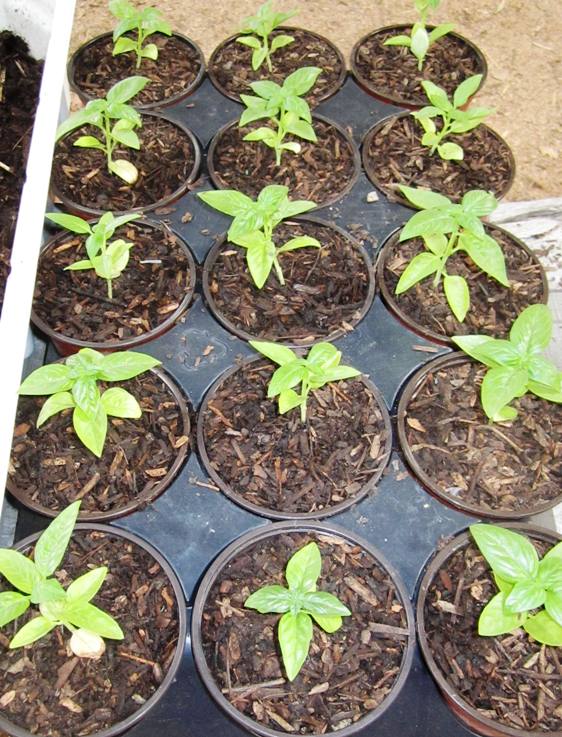
Basil sprouts at Peaceful Grounds, a regional training center for Will Allen’s organization, Growing Power.
He envisions for-profit businesses taking up the charge of urban food security, with nonprofits assuming a training and organizing role.
In his own organization, the people responsible for growing the food are extremely efficient, and training happens as a separate program. That’s a critical point, because farming isn’t easy. Efficiency is the name of the game.
“My crew comes from the community, and they live in the community, but they are professionals. Everybody thinks you can take interns and integrate them with professionals, but you can’t. You’ll lose money hand over fist.”
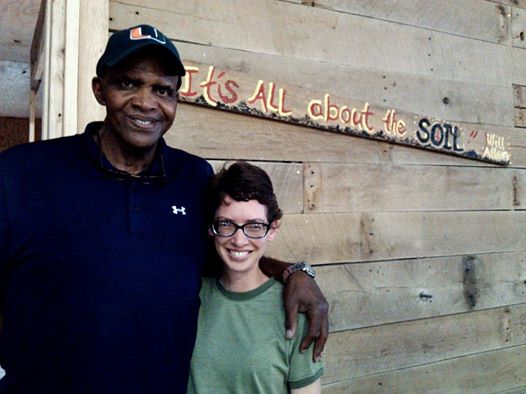
That’s me on the right.
More of my conversation with Will Allen can be found in today’s Nuvo article.
Also check out Robb Smith’s terrific podcast interview over at DIY Food Supply.
Homegrown “Superfruit”
I saw this item for sale at my food co-op, Pogue’s Run Grocer, and it cracked me up.

White mulberries, a “Turkish Superfruit,” only $5.99 for 4 ounces. What. A. Steal!
Just a week ago I spent a pleasant morning bicycling around the neighborhood with a friend. We stopped to pick from the mulberry trees that grow wild along the creek, meanwhile catching up on each others’ lives.
Mulberries are great in smoothies and crisps, and they are abundant, free, and nutritious (apparently a Superfruit, no less!). My friend and I were delighted with our harvest. Along with the usual purple, we found a white mulberry tree. It might be my imagination, but I always think the white berries are particularly sweet (though a bit less appetizing in appearance).

Superfruit from the hood. Free of charge. Bring your own bucket.
I once blogged about how homesteading (even on my modest scale) can make me feel like a chump because of all the extra work it takes to live “simply.” And how other times, I feel the tiniest bit smug, because—look! So much wealth on so little money.
Yeah, this is one of those smug times.
Peaceful Grounds
Monday morning a group of gardeners from the neighborhood had a private tour of Peaceful Grounds, Linda Proffitt’s endeavor at Marion County Fairgrounds, where the county fair is going on. (See my earlier post about her work here.) The vision and scope of this Global Peace Initiatives project astounded and inspired us.

The cattle barn at the Marion County fairgrounds is home to this volunteer-driven initiative.
George Marshall, Linda’s intern, showed us around the farm, where mounds of wood chips are not just regular old wood chips but worm habitat.
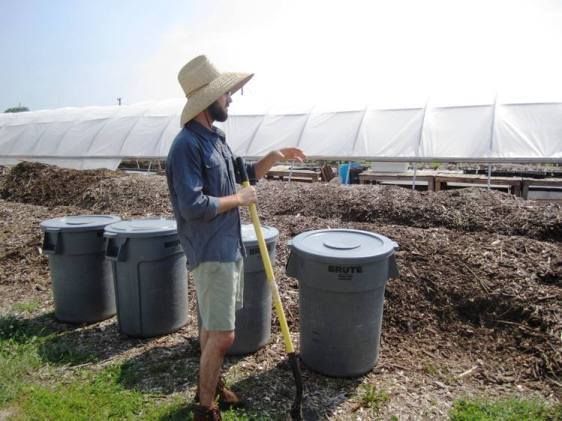
George next to a hoop house that stayed warm all winter from heat given off by decomposition.
Peaceful Grounds takes beer mash from local brewers like Irvington’s own Black Acre and buries it in mulch to feed the herd of worms.
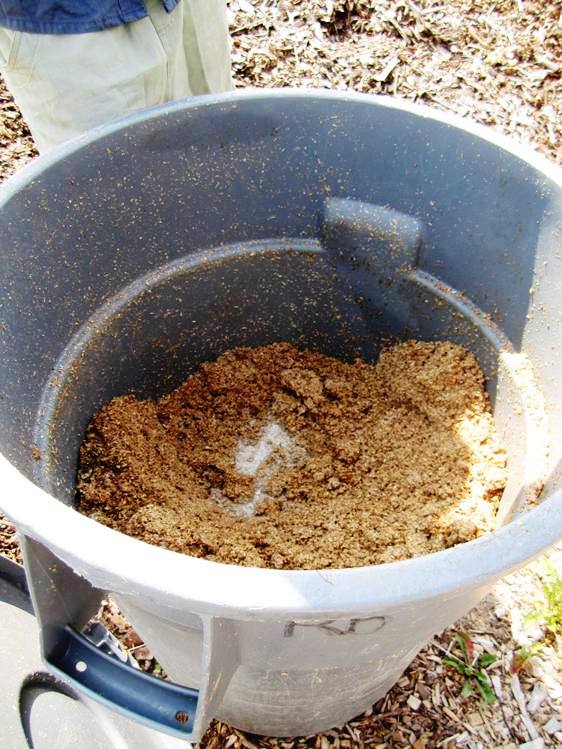
The spent grain is perfect worm food because barley fits easily into worms’ tiny mouths.
Hand-painted signs that say “Worms at Work” and “Thank a Worm” testify to the importance of these little red wigglers.

Digging up some of the underground workers to show us.
Volunteers mix 5 to 15 tons of mash with equal amounts of wood chips each week. Another mound incorporates dehydrated food waste from public hospital Eskenazi Health. Over time, these piles and rows are transformed into a viable medium for garden plants.
George showed us where vegetable and herb starts have been set right into these habitats.

Broccoli planted in one of many windrows made by worms doing their work on wood chips and beer mash.
In a nifty closing of the loop, Linda has begun to raise hops to supply local brewers.

A few more Peaceful Grounds volunteer-planted crops.
While we were walking down the raised beds (“windrows”) of basil and tomatoes, a fair official came up and asked for Linda. He wanted to introduce her to the people in charge of an elephant exhibit, so she could incorporate elephant dung in the farm operation. (“You never met a lady more excited about poop than Linda,” George joked.)
Inside the cattle barn is where kids and adults can come for hands-on fun with art and agriculture. It’s also where artists like Jamie Locke (another Irvington neighbor) demonstrate mandala making and other crafts—and where young volunteers from Handi-Capable Hands take charge of a gigantic tumbler that sifts the worm compost into two grades of product.

Heidi Unger took this photo of the tumbler, which is named Apollo and was donated by a local farmer who saw Linda on TV.
We went home with the finer grade, which is basically worm poo, to use as a powerful organic fertilizer. One tablespoon per plant will nourish it through a month, Linda says.

Worm castings make an excellent fertilizer. Now we have a local source!
Before we left, we learned that Will Allen is going to visit the operation, which is a training outpost for his fabulous Growing Power organization. He will speak at 2pm Saturday and lead a workshop at 4pm, and will also preside over a ribbon cutting ceremony at noon on Sunday, when the Peaceful Grounds Farm and Arts Market kicks off.
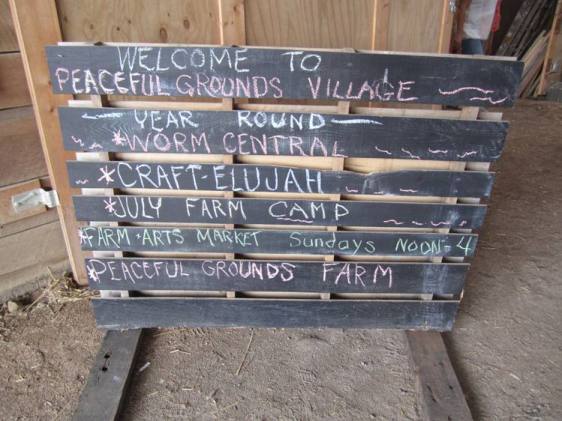 I’d love to see more interaction between local urban gardeners and this facility, which is just a stone’s throw from Irvington’s back door. Right now the county fair is in full swing, but the possibilities extend beyond its closing date. Linda is running a Farm Camp for kids starting July 7, and is happy to host volunteers at any time.
By the way, she offered to set me up with an interview with Will Allen. I’m thrilled to meet this man I admire so much. I’m crowdsourcing interview questions. What would you ask the grandfather of urban gardening, if you could?
On the Solstice, Contemplating Home
On the longest day of the year, one week after leaving Playa, I’ve been thinking about all that “home” means to me. I loved Oregon’s pristine natural beauty. But I couldn’t wait to come home and walk the tree-lined streets of my neighborhood. Taking my dog Marley for a walk was high on my list on my first morning back.
It’s not perfect here. There’s litter, unlike in Lake County, OR, and sadly many of the neighborhood ash trees are not treated for emerald ash borer, so they are dying—a distressing sight. Poison ivy is rampant in untended corners. Plus it’s really damned humid. But I still walk along with my heart singing “home,” loving the big sycamores and tulip poplars, enjoying all those daylilies and clematis vines, sampling a mulberry here and there.
And getting the latest scoop. Down the street, my big softie neighbor still has the pit bull who wandered into his yard—the one he swore he wouldn’t keep. Farther on, the retiree who always complimented me on my dog (Lord, how that poodle can prance) tells me he and his wife are moving to a condo after 47 years here, but a young family up the street will be moving in. I learn about another neighbor’s dog’s bout with pneumonia. And so on.
Walking is one of the ways I savor my neighborhood, but it’s not the only way. About the second thing I did that day was ride my bike with Judy to the kickoff of the Irvington Folk Festival, a weeklong extravaganza that opened with an outdoor bluegrass concert. I’m no bluegrass aficionado, though I love a good Rocky Top as much as the next person. What I went for, and got, was the people.
In the crowd were Rosemary, and also Laura, two women who helped me found the Irvington Green Initiative years ago. Also our neighbor Pat, who told us of a possible grant for a native plant/foraging project we’ve been scheming.
We sat with Heidi and Mike, longtime gardening buddies who happened to bike up at the same time as we did, midconcert. Behind us were Jerome and his family. That was fortuitous, because I could update him on our sweetgum tree. (Arborist Jerome has a business called Tree-Centric, which I’ve blogged about before. A few weeks ago he assessed our ailing sweetgum, taking soil samples and cutting away girdling roots. The cost of his professional expertise? A loaf of homebaked bread.)
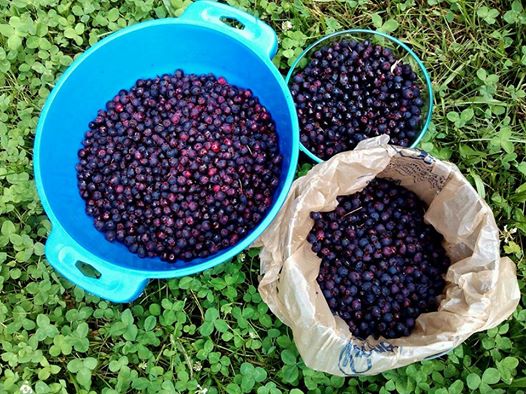
Jerome offered both his strawberry patch and serviceberry grove for picking. Though the strawberries were done, here’s the lovely haul of serviceberries my friends and I made that morning.
Somehow, over the years, my roots have grown deep in this place. I grieve with friends who lost their 13-year-old German Shepherd, one of a gang of Marley met in the park as a pup. I pick mulberries and serviceberries (some from Jerome’s yard) while chatting with good friends. My yoga buddies welcome me back vociferously. I barter for Thai massage from a neighbor.
All that, plus (last night) hearing local musicians rock out, after eating at the new deli that sources everything it can locally.
How did I get so lucky? I don’t know, but I’ll contemplate the answer while biking to the park for the folk festival’s finale (and, bonus: alternative gift fair).
 Shawndra Miller