Home is very much on my mind these days, and turning up in my reading, conversations, and other inputs.
I understand the pull toward home—hearing of people who face decisions about evacuating or hunkering down, returning or staying away, in the wake of natural disasters. Even if your home is the only thing standing for miles around, in dubious shape, it would be hard to stay away from it.
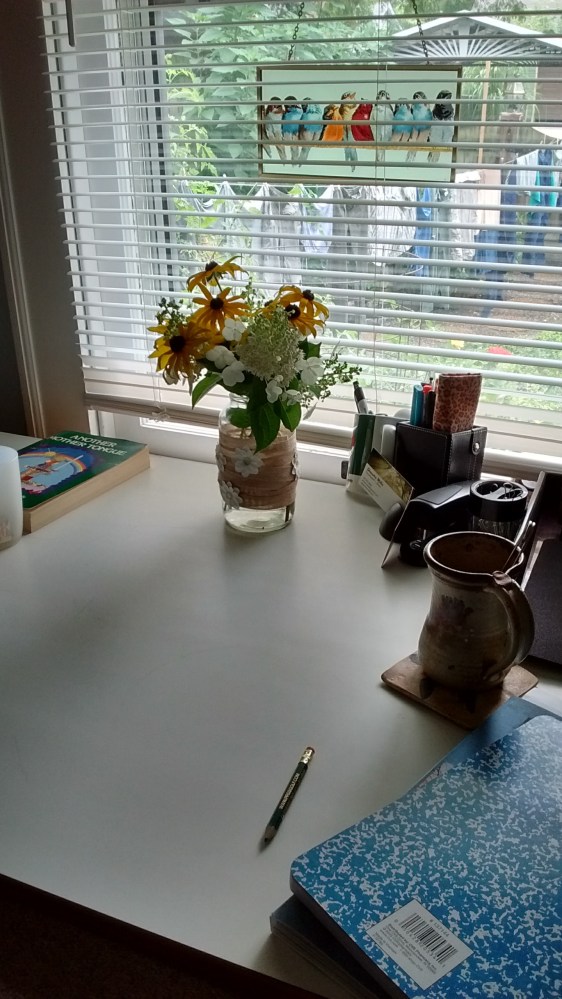
My own home supports my life in a way that feels incredibly juicy, especially in the warmer months when “home” extends to include the back yard, front porch, garden. I feel gratitude every day for the comfort and fruitfulness of home. I love looking out from my writing desk and seeing hummingbirds flit among the plants I’ve tended.
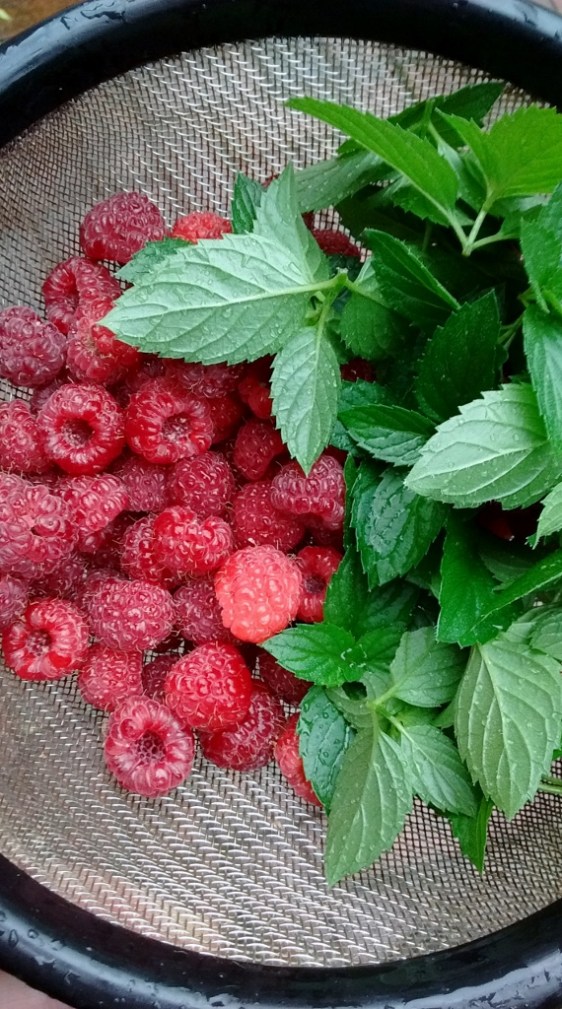
I had a headache till I went out yesterday in the rain to pick raspberries and mint. Home heals.
As someone who is all about hearth-and-home, I feel my heart twinge at the thought of the millions of displaced people all over the world. Whether the cause is climate change, earthquake, war, ethnic cleansing, or something else—I hate to imagine losing the protection of home.
And there but for the grace of God…
I know that all is temporary, that everything is bound to change. And sometimes change happens dramatically and suddenly. I know that this body is temporary and the building I live in is impermanent. So how do I make a home for myself that transcends fixed ideas of safety and security?
I can see my solid relationships as home. Though also impermanent, the people I love (and who love me) create a web of safety. Yes, and…
I can experience this temporary body as home. Sinking into the body brings me to the present moment, which is also my home, and always accessible. Yes, and…
I can see this earth as home, holding me in its vastness. Touching Earth as home feels both tender and precarious at times as fires and fissures continue to spread. Still it gives me a sense of belonging. Yes, and…
None of these can be my truest home. Clinging to relationships can bring pain. Expecting the body to always hold up (and the present moment to always feel delicious) is unrealistic. And watching the earth’s systems besieged distresses me.
Yes, yes, yes. And.
“A cloud can never die. A cloud can become snow, or hail…or rain. But it is impossible for a cloud to pass from being into non-being.” —Thich Nhat Hanh
I can feel my energy as home. Here is where my frequency expresses itself in its unique but universal signature. Here is the eternal part of me that can never perish. It only changes shape.
Thich Nhat Hanh has said that it is unscientific to think that we disappear when we die, because of the scientific principle that nothing is ever created or destroyed.
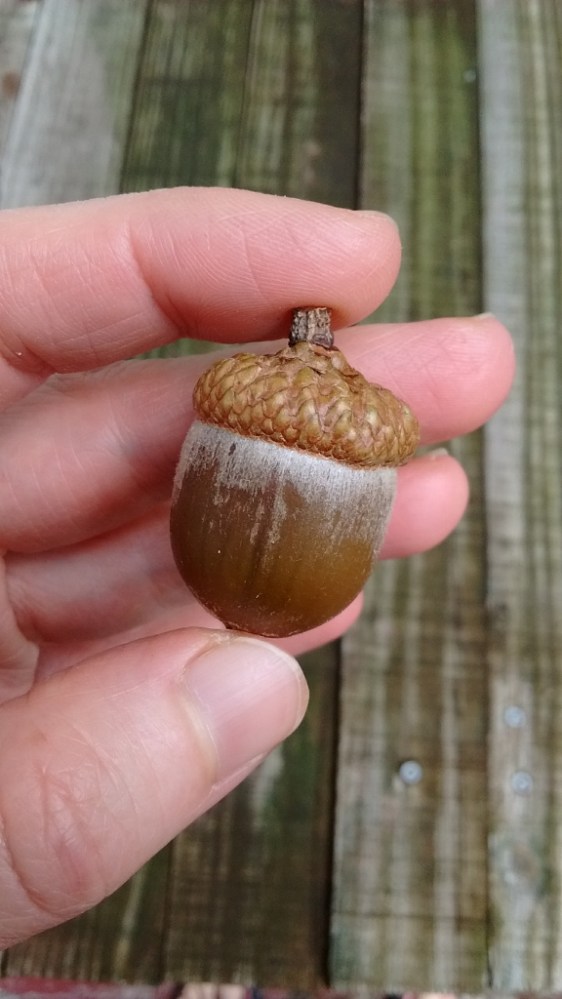
Do you see an oak tree in this acorn?
Energy cannot be destroyed, only re-formed.
My essence, my soul: That is my truest home.
Over and over, I touch this space when I return to my home frequency, as Penney Peirce calls it—that space of wholeness and rightness, that note in the orchestral symphony that brings harmony to the All.
And this, I tell myself, is the deepest security and comfort, a home not dependent on relationships, circumstances, or physical structures.
I heard myself say this in a mock-petulant tone recently when two women friends were gushing over a mutual friend’s dramatic new haircut, the day after I had gotten my own locks styled shorter and cuter than before.
Never mind that I hardly ever notice such things on other people, or that her ‘do was incredibly striking. Dammit, I wanted some attention too!
Well this is embarrassing.
But I am learning something here: I often have this amusing need to be validated, complimented, seen.
I’m figuring out that this seemingly bottomless need is one only I can truly fill, by being with myself in quiet and care, by linking up to All that Is. It’s a need that surely stems from a dearth of self-love.
I don’t mean self-love in the aggrandizing sense of “damn, I’m the greatest thing ever (and so is my hair).” I mean self-love in terms of awareness that I am one with the Source. A Divine being of Light.
I’m talking big-picture self-love. Turns out that it is no different from other-love, because in that expanded state I am All. There’s no separation, and no need to prove anything.
Anita Moorjani calls this the “infinite self” which has no need to please others or gain approval. Since reading her book Dying to be Me, I’m noticing how often I seek validation in even subtle ways. Like spending time obsessing over how to word an email or post in hopes of gaining a positive response. Or agreeing to do something that really doesn’t float my boat, just to feel worthwhile.
I’m not saying I shouldn’t pay attention to messaging, or only do things that please me (though how great that would be!). Rather, I want to look at the motivations behind my actions and decisions. Operating out of a sense of obligation or a need to prove something feels heavy, and it might taint the action, no matter how well-intentioned.
I’d rather act from a space of connection, feeling replete. Feeling light!
That’s the space that has no need of external validation, I suspect.
“A gold medal is a wonderful thing, but if you’re not enough without it, you’ll never be enough with it.” A writing teacher once quoted John Candy’s line from Cool Runnings (a fantastic movie about the Jamaican bobsled team that competed in the Olympics).
My teacher was talking about publication, but we could easily substitute anything that we hold up as a way of gaining that elusive feeling of “enough.”
In truth, we are all more than enough, because we all—at a soul level—represent holograms of that gorgeous Whole.
Remembering that, acting from that place, is the tricky part—but I’m practicing! What else is life for?
Recently I spent some blissful days by Crystal Lake in Michigan, thanks to a dear friend’s hospitality.
This was the sunset that greeted me on arrival. Photo by Julie Stewart.
The reason for my trip was ostensibly research in nearby Traverse City’s 19th century mental institution. My original plan was to spend just a night or two in the haven of my friend’s company and then head out. (On the way home I wanted to tour a Michigan farm that specializes in teff, on assignment for Acres USA. And since the farm lies halfway between home and Crystal Lake, it made sense to find lodging midway.)
But it turned out that the teff farmers were unavailable during that time, so my grand plan fell through. And I’m so grateful.
I needed those restorative days and nights to rest, integrate, and incubate. After touring the asylum as planned, I turned to my project with a fresh eye. I wrote in stints between riding my friend’s bicycle, lying in the hammock, walking along the lakeside, floating in the crystalline water, and other general deliciousness.
In the mornings I sat at the end of the dock and faced into the wind. The wavelets on the lake and the constant breeze made it feel like I was on a boat, moving steadily forward.
I thought about how we can draw to us exactly what we need, even if it feels like we’re sitting still. If we’re aligned with what wants to be born, it’s less about effort than showing up and paying attention.
Driving home, I saw this truism played out again when an audiobook I was playing refused to work. I finally gave up and turned on the radio, just in time to find a program on NPR that spoke exactly to a dilemma I’d been working out in my story.
Now, this was in a semi-remote part of Michigan, where very few stations were coming through clearly. I marveled that I could hear this piece all the way through to the end as I drove along between the evergreens. The station faded just as the next story began and I came to a well-placed rest area.
When I got back in the car, I tried the audiobook again. You guessed it: This time it worked.
It struck me that this synchronicity was a symptom of alignment, proceeding straight from my placement at the end of that dock, where I had given myself the gift of sitting still.
I forget this all the time. Part of me still believes that I have to make things happen. I was taught to keep on pushing, no matter what. Never mind that time and time again—say in a client session or on a writing jag—I find a larger truth. The “I” that I so cherish steps aside for a bit and lets something bigger take over.
When I came back from Michigan, I longed to sequester myself with my writing. I took over the guest room with its sweet view of the garden out back.
I have been spending some time each day there immersed in my work, it’s true. But I still long for more. As the magic of my little Michigan expedition wore off, the usual obligations and distractions started to intrude. I have found myself overbooked and overstimulated.
Earlier this week I dreamt of coaching a pregnant woman through labor. When I woke, I realized that I am in the midst of a contraction. I have thought of “contraction” as a negative, as in “contracted state” opposite “expanded state”—but I understand now that I need to honor my need to contract. I see that turning inward is critical to the process of labor, which is really about so much more than active pushing. I need to allow a natural rhythm to flow.
And I need to pay attention, so I can be ready for those helpful tidbits that come my way as I appear to be sitting still.
In order to cultivate more quiet in my mind and spirit, I plan to sign off social media for the better part of August. This contraction requires that I evaluate every invitation and activity carefully before saying yes. I might not blog much. But I’ll be back.
A few years ago I was working on a book that took me to the west coast and parts of the Midwest to talk to people in the community resilience movement. I wrote a book proposal and shopped it around and had some mild interest from literary agents. I received a grant for research travel, and I was selected a trio of writing residencies, and I wrote a bunch of words.
A photo from one of my sojourns–a Bloomington homeschooling cooperative based around permaculture principles.
I still have those words. Some of them have turned up in posts here and other places. (People seem consistently most intrigued by the Mudgirls natural building collective.) But I have yet to use them in some final-final form of Thrivalists. Every agent who loved the topic ended up declining because of my “thin platform.” They didn’t believe that I would garner enough readership, in other words, to make me worth the risk.
I began to disbelieve it myself. I added that to a bone-deep doubt that anything I could do would ever be good enough or come together coherently enough to produce a book.
I shelved the project, and began to work on another, supposedly interim, nonfiction book. It was supposed to be a six-month jaunt into something different-but-related: I would write of my own healing journey, and how it connected to the buried ruins of a 19th century women’s mental institution (“Seven Steeples”) where I was volunteering at a modern-day farm.
Last week I toured a Traverse City, MI asylum of roughly the same era as Seven Steeples.
Two and a half years later…
Yeah.
Still working on that one. And I received a grant this year to further the project, which feels great! but also kind of heavy and dubious, since the first grant did not (yet) result in publication.
Next month I will hand my manuscript to a professional for editing services, thanks to the Indiana Arts Commission’s generosity.
In the meantime (while still freelancing in the farm profile arena) I periodically send out pieces of each work-in-progress to see if anyone is interested in publishing them as essays. Nope nope nope. (Though I’ve had a few very nice rejection notes!)
Till this month. To meet a shorter word count and fit a theme of “Roots,” I reworked a segment of Thrivalists about the role of fungi in rootedness. I incorporated some newer, slightly woo-woo material (sort of a mashup of both projects), and sent it to Topology Magazine. They published The Gift of the Fungi, which is ostensibly about what I learned at the Radical Mycology Convergence, but is also about coming to embrace a wider sense of possibility.
I felt a curious lack of enthusiasm for the news that the site would publish it. The old “any club that would have me as a member” dilemma? A sense that I could have snagged a higher profile outlet, if I’d persisted? Some of each.
Plus a sense of : “I went to California, British Columbia, Washington, Oregon, Illinois and Ohio and all I got was this lousy T-shirt?”
The end product is supposed to be a book, not a little online article.
Well, then a writing buddy reminded me of something Charles Eisenstein asked in a podcast : Would you write even if you had only one reader, even if you knew that that reader might take your words and change the world… but you’d never get credit for it? He wrote a piece about how this type of loyalty test first arose for him. An excellent read if you have time.
Why do we do what we do? What is our ultimate goal? If it’s about fulfilling our purpose, taking our place in the Divine scheme of things, then words like “platform” and “readership” are less important than resonating our truth.
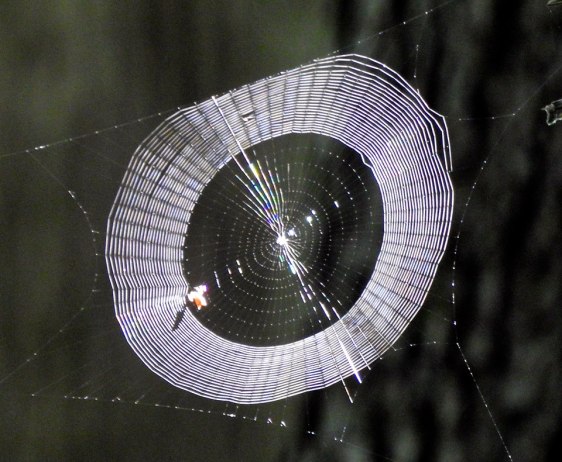
Spiderweb photo by Barbara Jablonski, taken at Eagle Creek Park
In the world we live in, money and fame are gods. What we have to offer doesn’t count unless it brings in income or gains huge exposure. Charles and my writing buddy and I refute that story, and I suspect we’re not alone in that.
Oh and by the way, some ideas are percolating about that old project as I hit the home stretch (?) of the new one. I haven’t seen the last of the inspiring Thrivalists that shared with me. I can tell because of the way my blood hums when I think of putting their stories in a wider frame.
Maybe I just needed to expand (not my platform but my being) before I could put the work out there. We’ll see.
A few years ago my (former) dentist messed up—jabbing a spinning blade into the inside of my cheek while putting the finishing touches on a filling. Yes, I yelled.
She said to her hygienist (after shoving gauze in my mouth, and sort of apologizing), “Let’s get her set up on antibiotics.”
I said (as best I could around the gauze): “No.” Shaking, stunned, but clear.
“But you know your mouth is full of bacteria, and the risk of infection…” She began to lecture.
I realized I was not afraid of my own bacteria, and that I trusted my immune system. I made her understand that I did not want to take antibiotics. No thank you.
Fairly huge moment for someone who had struggled to rebuild her health for so long, who had been subject to catching “everything going around.” I don’t know when exactly it shifted, but I didn’t mistrust my own body anymore.
Among other issues, I had battled candida overgrowth for a decade or so, and had rebuilt my gut flora by consuming vast quantities of sauerkraut. I did NOT want to wipe out the friendly little beasties who had recently recolonized my body to good effect.
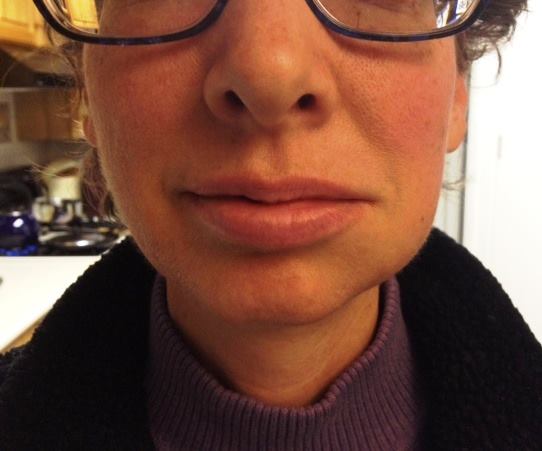
At home, using a natural mouthwash that burned the gouged-out place like blazing heck, I spit blood into the sink. My cheek had already begun to blacken and swell. I spent the evening holding my Triple Warmer* meridian points to return my nervous system to its hard-won state of safety and calm.
Actual shot of my poor swollen jowl the night of the “incident.” Later my lips turned blue at the corner. It was a good look!
Before bed I whispered to my reflection in the mirror, to my swollen cheek, to my wise cells and crafty microbiome, “Thank you for knowing what to do. Thank you for taking care of me. Thank you for protecting me from infection. I trust you.”
My body responded by healing up tout suite—and further rewarded me by no longer requiring a medication I had begun tapering down.
It might sound wacky to some, but the body responds to our love and care, and I believe that respecting our microbes is critical. I’m now reading I Contain Multitudes: The Microbes Within Us and a Grander View of Life, by Ed Yong, and finding all kinds of fantastic information in its pages.
It is fascinating to learn that only 100 species of bacteria can actually make us sick–the vast majority are either neutral or helpful to us. (Even assisting the immune system! “They educate our immune system, teaching it to tell friend from foe,” Yong writes.)
But there’s still this stigma.
“Microbes are now so commonly associated with dirt and disease that if you show someone the multitudes that live in their mouth, they will probably recoil in disgust,” he writes.
I remember hearing: Your mouth is the dirtiest place on your body! (Apparently the mouth was one of the earliest arenas to undergo bacterial study.)
He later points out that shifting from the viewpoint that “all bacteria must be killed” to “bacteria are our friends and want to help us” is…equally wrong. Bacteria are neutral and have their own agendae. Symbiosis only means “living together,” not necessarily harmonious cooperation.
I almost did it again. I almost got caught in an old thought pattern, the one that goes: Foolish child, gazing at birds, loving up trees, singing to streams. Have you seen the news? There’s work to do! Wrongs to right!
Woops, I forgot for a minute. I forgot that wonder and reverence are the very things that bring the old story of separation—source of all the wrongs—to its knees.
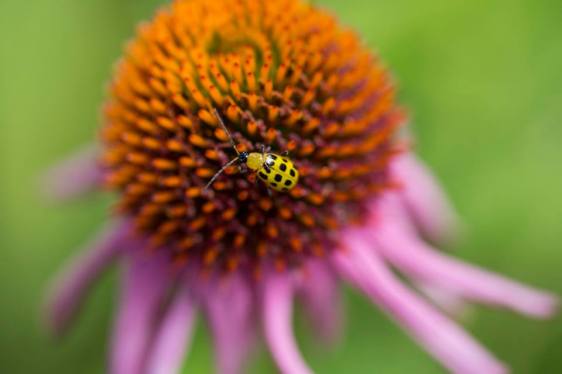
Echinacea photo by Sara Long
The last few nights I’ve watched a little bit of a DVD series loaned to me, called Journey of the Universe: Conversations. I didn’t know that reflecting on the grandeur of the universe would be the antidote to this old thought pattern. But when the late Paula Gonzalez (rad scientist nun!) spoke of “falling in love with the world” and how this changes us, I thought, YES.
Here’s a quote from cosmologist Thomas Berry, whose work inspired the series:
“Our relationship with the earth involves something more than pragmatic use, academic understanding, or aesthetic appreciation. A truly human intimacy with the earth and with the entire natural world is needed. Our children should be properly introduced to the world in which they live.”
—From The Dream of the Earth
I am of the ilk of those who can no longer call a companion animal a “pet,” nor a forest “natural resources.” I don’t see the planet as something outside of myself, to be appropriated. That intimacy Berry speaks of…I feel it developing between me and the spaces I love, and by extension the entirety of the world.
In his portion of the series, poet/activist Drew Dellinger says that reverence for the planet extends to all its people (and ourselves). If we begin to sense our place in the unfolding story of the universe, we gain a sense of wholeness and connectedness that forecloses any idea of exploitation or misuse.
Because make no mistake, the injustices perpetrated on indigenous people and people of color are part and parcel of the same old story that “thingifies” a tree or a waterway.
Yes, much work to be done. And where to start? What thread do I follow if I want to untangle some part of the mess? It’s easy to get confused and overwhelmed, lost in despair or anger.
So I go back to the heart of the matter: the story I want to live.
I bow to reverence once more, and give myself over to wonder.
Photo courtesy of Sara Long. Check her photography website out, or follow her on Instagram at @longacres.
Last week’s Indiana Master Naturalist class has put me into a state a little bit like that dream … the one where you suddenly find a whole section of your house that you didn’t see before. “This was here all this time?”
Since the week-long intensive ended, I’ve been noticing things that previously weren’t on my radar. I’m hearing (sometimes identifying) distinct birdsongs that had largely been a sort of background chitter-chatter. Who knew there were indigo buntings around here? I had never heard of the Kentucky Coffee Tree, which I’ve seen on my walks (if my budding tree ID skills are on target).
Sunfish. Photo by Sara Long.
On one particular day we saw fish in Lawrence Creek that were simply stunning, and a green frog to boot. Now I’m curious what wonders lie under the surface of the creek I cross every morning on my rambles.
Green frog. Photo by Sara Long.
It’s common for Hoosiers to agree with people who denigrate our state. We seem to come at the bottom of every list measuring quality of life, particularly when it comes to environmental issues.
But: It turns out that my state is actually pretty fascinating, geographically and ecologically–with incredible (often unsung) biodiversity.
That’s largely because of a thing called the “ecotone.” This is a place where two edges overlap, such as woodlands and wetlands. More species live in these spaces, naturalist Amanda Smith told us.
And Indiana, I learned, is lousy with edges. We have the Great Lakes edge in the north. Eastern Seaboard forests terminate in Indiana. Prairies had their eastern edge in Indiana. And the swamps of the south begin in Indiana.
Finally, we have glacial edges from retreating Ice Age glaciers. (I did learn this fact as a child as the reason for the way Indiana turns hilly south of here.)
I now have a long list of Places to Visit in my Own State. Part of being a naturalist is simply appreciating the natural world. Another part is sharing wonder, to get other people out and appreciating alongside us, so they can have their own epiphanies.
Another part is dirtying up the hands. A host of volunteers and organizations and nature preserves are working to conserve our ecological heritage—to support the coevolving native plants and bugs that form the foundation of life (not to mention beauty). So much habitat has been lost to development. The wilder corridors are so fragmented and invasive species so pervasive that many native species are imperiled.
The good news is that we can be part of habitat restoration in our own places. Our yards can become “our largest national park,” urban tree advocate Holly Jones told us, quoting native plant proponent Doug Tallamy.
Because, as Holly put it, “if you think your life is independent from the black-capped chickadee*, you are wrong.” (These perky little birds are on the decline in many areas.)
Bumblebee on milkweed. Photo by Sara Long.
“Humans cannot live as the only species on this planet because it is other species that create the ecosystem services essential to us. Every time we force a species to extinction we are encouraging our own demise.”
—Doug Tallamy, author of Bringing Nature Home
Milkweed bug. Photo by Sara Long.
A long time ago, the elderly mother of a friend questioned me about my vegetable garden. “Do you have a lot of BUGS in your garden?” she said, and all but shuddered at the word BUGS. It was sort of comical, but sad too.
Now I want to plant a native garden that will unapologetically attract “bugs” to support the biodiversity that is Indiana’s birthright.
*A classmate just informed me that Black-capped Chickadees are in northern Indiana. South of Lafayette we have Carolina Chickadees.
All photos courtesy of my hugely talented classmate Sara Long. Check her photography website out, or follow her on Instagram at @longacres.
Last week a younger friend, 30something, commented in an email that she needed to work on loving her body. In the note she spoke critically of certain body parts, as she has before in conversations. She didn’t like the way this and that looked.
I emailed back a rant. Of the most supportive and loving kind. I wrote:
Every time I hear you critique your body I just want to SHAKE you, I have to say! My gosh, you are stunning! And healthy! In the bloom of life! Your body works great! Fricking enjoy your fabulous body!
OK, cranky bat’s rant over, lol. Just, I really hate the way this culture trains women to despise our bodies when we are so so lovely in all our gorgeous permutations.
And having come through years of being absolutely decrepit, I feel like the important thing—the only thing—is whether or not we feel good in our bodies. If they work for us, if they’re generally free of pain, then hey. Celebrate.
That about sums up my response to women who diss their bodies. Except: After I sent this, I started to notice the slightest bit of hypocrisy.
Yes, I do feel pretty good in my body, and I do appreciate it working. I’ll wear tights to yoga class and not feel self-conscious. I’ll even wear shorts when I haven’t gotten around to shaving my white-and-hairy legs, with their various scars and divots and bruises. (I don’t care about all that. My legs walk great, and pump my bike pedals quite effectively.)
But do I really love this 50-year-old body as unconditionally as I would hope all women would love their bodies? Isn’t my love contingent upon feeling half decent, remaining trim, and staying active?
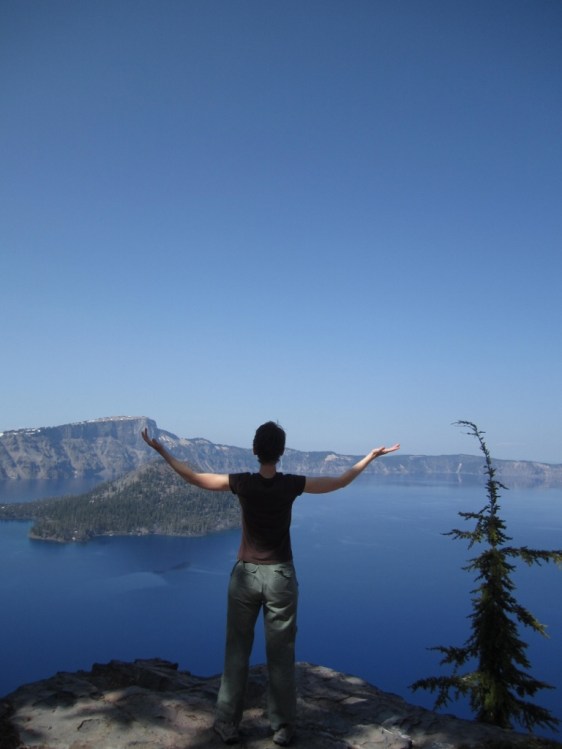
Crater Lake and me. With slight “bat wings” starting to show. (This was a few years ago.)
Back when I was living with chronic illness (the “decrepit” period mentioned mid-rant), I did not love my body much at all. Would I now, if some unexpected health challenge befell me?
Furthermore, why do I sigh at the way my blemish-prone skin is losing its suppleness? Why do I look askance at my newly floppety triceps?
I remember Jan Phillips. last year on a tear at the International Women’s Writing Guild annual conference, grabbing the flesh under her arm and saying, “Don’t waste another minute fussing about THIS.” She wanted us all to focus on getting our creative gifts out there, because “the world needs you.”
I think of Jan whenever I feel a tinge of dislike for my own baby “bat wings.” Jan says don’t worry about it!
Then again, part of loving my body does involve focusing on it—not in a fussy/critical way, but spending time doing what it wants to do. Stretching, walking, dancing, touching, resting, laughing, playing, enjoying good food…
All things that make me feel great. And theoretically make me look great too. Though I stop short of tricep curls and whatnot. So far.
Last night Gaynell ended her yoga class with an invitation, as she often does, to gratitude: “Pause and thank the miracle that is your body. It’s the best and only home that your mind and spirit have.”
That’s the space I want to live in. No matter what, this body is my home.
My plan was to blog about weirdness today. Knowing my weirdness acutely and beginning to embrace it. The afternoon is fine and my neighbor’s mulberry tree beckons and it seems absolute folly to sit here much longer.
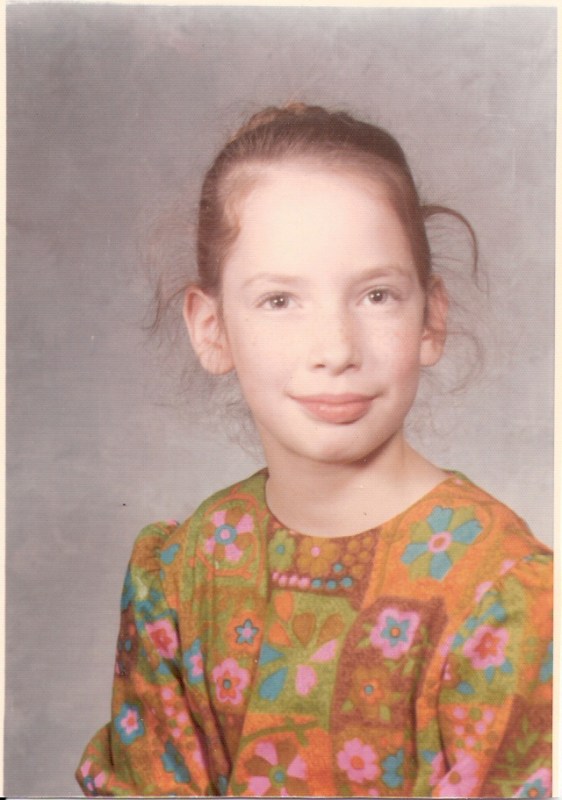
So. To make it quick: I have always felt myself to be The Weird Kid. I didn’t eat paste or anything, but I didn’t really speak to anyone either. Not if I could help it.
Right, I’ll just leave this here, since I can’t find one with my hair in Laura Ingalls braids and my astigmatic eyes hidden behind goofy spectacles. And big buck teeth sticking out.
I’ve gotten over my shyness for the most part, which does help in navigating life. I expect a certain awkwardness at parties, is all.
But sometimes today, people look at me funny, say when I’m picking mulberries or juneberries by the roadside, or when I’m down on my knees harvesting weeds for a salad. When someone gives me That Look, I want to say, “Honey, this is the least weird thing I do all day.”
I mean, I sit at my computer and string words together for little to no remuneration.
I move energy around with my hands.
I talk to trees and bugs and plants and streams.
I ground people for a living.
On occasion a client or friend will tell me something sensitive and then ask, anxiously, “Is that weird?”
I say, No. As someone whose whole body will jerk when some invisible energetic shift takes place, I’m uniquely qualified to judge, and no.
Or rather, possibly, but with me, you can be as weird as you are. To borrow a Martha Beck maxim.
To my tribe: Embrace the weird. In weird is our strength.
One of the few places where people of different races and ages gather to converse about difficult topics is Kheprw Institute. In the atrium where public meetings take place under smudged skylights, we circle folding chairs and introduce ourselves.
“The ignorance of the lives of others is what allows gentrification to happen. … If you ignore the destruction of the lives of the people who’s always mattered the least, things are going great. If you acknowledge that their lives exist and that they matter, then it becomes immediately obvious something is terribly wrong. So what does it mean that we are not only ignoring these people but increasingly erasing their narratives in the name of progress?”
—Peter Moskowitz
To open the discussion, we listen to an interview with Richard Rothstein, author of The Color of Law, as he lays out the most egregious historic housing policies that sidelined African-Americans. Three things stand out in this brief clip:
1) When public housing was initiated in the mid-20th century, integrated neighborhoods were destroyed to make room for segregated spaces. 2) Meanwhile the federal government subsidized suburb development on the condition of these neighborhoods being open to whites-only. 3) Then black neighborhoods were rezoned to allow toxic and industrial uses, so that African-Americans were living next to waste disposal and industrial facilities.
Stories like these, and books like How to Kill a City, make it harder for white Americans like me to ignore something that we never consider: Our comfort, our security, our privilege, our inherited wealth—is built on a rigged game, on money stolen, housing denied, opportunities refused.
***
In junior high Language Arts class I wrote a paper for a unit on Langston Hughes and the Harlem Renaissance. I remember including a sentence like: “It’s amazing to think about how well we’ve put racism behind us.” My teacher, who was African-American, put a ^ next to the sentence and wrote in something like “and it’s sad to think about how much racism remains.”
I remember feeling shocked, even a little offended, at my teacher’s insertion, in her authoritative red-penned handwriting. What racism? I tried to think what she might be talking about. But when I looked around, I didn’t see any “Whites only” signs or German shepherds barking meanly at protestors like in the films we were shown. Could she be exaggerating?
That should have been my first inkling that my reality as a white person differed from the African-American reality in fundamental ways. That I might be swimming in water and never even feel it—but they did.
Several years later, a Goshen College classmate from Africa spoke of her hurt when a library clerk rudely flung coins onto the counter rather than hand them to her. Though she fingered racism, I couldn’t believe someone at my liberal arts school would still—in 1987!—harbor prejudicial attitudes. I thought, There must be some other explanation than racism. Maybe she misinterpreted what happened…
Again, I shrugged off another woman’s experience.
I’d learned about systemic racism in my Liberation Theologies class. I understood some things, or thought I did. Still there was so much I didn’t want to see.
***
Recently I heard an NPR story about affordable housing. In Dallas, a black mother sought to use a Section 8 housing voucher but was repeatedly denied housing by potential landlords. She said, “Even though we’re financially less capable, we still love our children the same.” Tears in her voice.
A broken heart, reverberating out from the radio waves straight into mine.
***
It’s hard to look squarely at things we don’t want to think about. Like our country’s genocidal, avaricious origins, and its continued betrayal of large swaths of its people, and the way the legacy of slavery still plays out in devastating ways.
But it’s even harder, these days, to remain blind. The water we swim in is more and more obvious.
I can no longer deny, dismiss, invalidate my brothers’ and sisters’ realities. I can no longer say that my family enjoys a tidy nest egg simply because “we work hard and we save our pennies” when that’s only part of the picture. Our people (going back generations) also were given opportunities to take jobs, buy homes, enjoy tax breaks, receive enriched education. The wealth-generation capacity that we take for granted has been repeatedly denied to people of color, through shameful policies and practices at every level.
It’s angering, horrifying, embarrassing, painful business. The system has consistently rigged itself in white people’s favor.
When facing painful things, it helps to be in community, to hear different voices and experiences, to listen, to accept and feel acceptance in a circle. That’s what happens in Kheprw’s book club and other public forums. Actions grow out of hearing each other and building relationships.
And I know that the black participants in this circle are the authorities on racism, and how that gets expressed through gentrification and so many other ways. All along they’ve been tasting the water we swim in, that I am so late to see as any kind of fluid at all.
Kheprw is a place that both models and works for change—in the hearts of people and in the halls of power. The organization holds its doors open to all willing to create community and serve justice, knowing that who we are on the inside—and how we show up for each other—is as crucial as any external advocacy.
In a few weeks, youngsters ages 10 to 15 will take part in Kheprw’s three-week boot camp. It’s called eSTEAM, an acronym for Entrepreneurship, Science, Technology, Engineering, Art, Math. Participants will learn everything from 3D printing and game animation to aquaponics and soil science.
This innovative program has far-reaching effects, like everything this nimble grassroots organization does. Judy and I decided to allocate some of our resources in support of the scholarship fund. Will you join us in sponsoring a summer camper?
Note: The author of How to Kill a City will join Kheprw’s upcoming book discussion via Skype at 6pm Thursday, June 22. Check out the event page for more ground-breaking gatherings.






 Shawndra Miller