An Unexpected Gift

Yesterday, Father’s Day, brought me an unexpected gift. A neighbor messaged me late in the evening offering just-picked raspberries. Would we like some? Of course! “Check on your porch by the mailbox,” she messaged a few minutes later.

My dessert: raspberries, kefir, vanilla, toasted sunflower seeds.

How was she to know that red raspberries would bring me a direct connection with my Dad, who grew them up until the year he died? His overabundance was always my gain. Even the container they came in, a repurposed plastic food tub, evoked his (and Mom’s) habit of reusing everything.

They're half gone already, because I had some for breakfast too!

They’re half gone already, because I had some for breakfast too.

A friend tells me this morning, Surely that was a gift straight from your father.

I miss him. On Friday I received a quilt specially made from a few of the T shirts he used to wear. Yesterday morning I put my cheek against that “Seize the Carp” square and imagined his heart beating under the fabric.

Many thanks to Helen Ryan-King for making this for me.

Many thanks to Helen Ryan-King for making this for me.

No one else will ever love me the way he loved me, a friend wrote, on losing her own dad.

A statement true and sad.

So many of us walk around with broken hearts. I think of the Buddhist story of the woman mad with grief after the death of her only child. The Buddha offers to bring the child back, but only if she can find a mustard seed from a house untouched by death.

She searches house to house. Here someone has lost a parent, there a child, there a beloved brother, there a cherished friend. She comes back and tells the Buddha, I couldn’t find anyone untouched by loss.

She lets the child go.

Knowing we all share this human experience, I want to open to the love that is available all around me, in so many forms.

A couple I know slightly from down the street, seeing me standing on my bike in the bike lane, slow their car to check on me: “You OK?” (Just waiting for a break in traffic to make a dicey turn—but it touches me to hear their concern.)

A cat named Morty, leery of everyone but his deceased owner, finds me on my front step. Rubs against my knee, beaks my nose with his. Hello, new friend.

A concert of singing bowls, vibrating with tabla, flute, and didgeridoo, offers me a place to rest in All That Is.

What I want to say is this: May my broken heart be of service. May I remember that this brokenness is something we all share. May our connection help to heal a broken world.

The Miracle of Seeds

I’ve been thinking about how tenacious life is, encapsulated in a tiny seed. Some seeds I plant, but others sprout all on their own.

I’m probably the only person on my block who gives a cheer when she sees these coming up.

Lamb's quarters

Lamb’s quarters

These are lamb’s quarters, considered a weed, but deliberately planted two years ago in my garden. This is the second year they will have reseeded, and I can’t wait to taste them again when they get a little bigger. (They’re terrific fried crispy in my cast-iron skillet, with a couple eggs cracked over them. And incredibly energizing, as all edible weeds are.)

Here is part of another patch of self-sowing plants that are on their third (or fourth?) year of growing freely in my garden: arugula.

Arugula volunteers in leaf mulch

Arugula “volunteers” in leaf mulch

I wasn’t sure they would come up this year because I mulched so heavily last fall with shredded leaves. But lo: I pull away the top layer and find them rooted right in the leaf mold.

Miracles like these show up all the time, if we know to look.

“There is no way to re-enchant our lives in a disenchanted culture except by becoming renegades from that culture and planting the seeds for a new one.”

Thomas Moore, author and psychotherapist

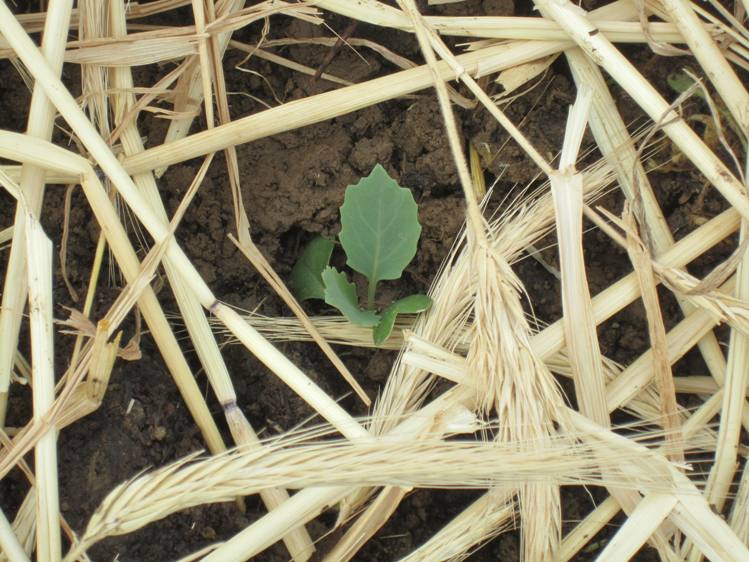
Perhaps growing food for people in need would fall under this “renegade” notion? Here is a seedling started by a southern Indiana farmer and planted by a volunteer for the Hoosier Hills Food Bank.

Cabbage seedling planted by a volunteer at a food bank garden

Cabbage seedling planted by a volunteer at a food bank garden

And one more: Late last fall I blogged about starting Austrian winter peas and my happiness at their growth in cold weather. They are generally not grown for a pea harvest, but intended as a cover crop with benefits—pea shoots are sweet and tender.

They didn’t do much during the winter, but this spring they are the healthiest of plants in my garden. I have snipped them nearly every day as salad and smoothie additions, and they are growing as fast as I can cut!

Austrian winter peas in spring

Austrian winter peas in spring

With seeds on my mind, no wonder this statement in a new mother’s Facebook post snagged my attention:

“I did not know until I got pregnant that the first organ to develop is the heart. It’s as if a heart seed gets planted and from the heart grows the human.”

Laura Henderson, founder of Growing Places Indy

Miraculous.

“What the World Needs”

I can always tell when I’m overloaded with the news; that’s when I start to despair. So much mess to clean up. It seems ridiculously tangled-up and tiresome, painful to look at.

In my own state we are attempting to disentangle from newly passed legislation designed to show my GLBT brothers and sisters that we are not welcome. Elsewhere, of course, there’s worse news. In Kenya suicide bombers caused untold anguish. In California the drought is now so severe that the governor mandated water restrictions. Then there’s the German pilot who decided to fly a planeful of people into the side of a mountain. For what?

Time to turn off NPR. When I get overwhelmed, this timeless advice from theologian Howard Thurman is a comfort:

“Don’t ask yourself what the world needs. Ask yourself what makes you come alive and then go do that. Because what the world needs is people who have come alive.”

By psyberartist (amaryllis  Uploaded by russavia) via Wikimedia Commons

By psyberartist (amaryllis Uploaded by russavia) via Wikimedia Commons

Definitely the needs of the world are bottomless, and the conflicts seem never-ending. So this question is a good barometer, an antidote to paralysis: What renews my heart? For me it is things like making meaning, being of service in small ways, reflecting, putting some hard-won learnings to use for others.

Sometimes, though, all that seems ever so small, and the question becomes: How do we renew ourselves, in this season of renewal, to continue with our chosen work?

Then a member of my extended family gives me a tremendous gift. She tells me that she regularly shares my reflections with her four teenagers. Some years back when I coauthored a book called Sudden Spirit: A Book of Holy Moments, she started the tradition of reading aloud from this work and discussing it with her children. Now that the kids are older, she’ll print thought-provoking blog posts and passages (mine among them) and ask them to initial when they’ve read them.

You can bet I was touched when I heard that! (And maybe she had told me before but I forgot; sometimes it’s hard for me to receive stuff like this.)

Knowing this totally refuels me. Because so much of what I do is basically invisible, it’s hard to know what kind of impact I’m having. But apparently, my little musings are helping the next generation of leaders.

Note to self: Remember to tell people I appreciate their work! (I think I’ll start with Roy Ballard and Michael Morrow, the men behind Hoosier Harvest Market. This online virtual farmers market brings me lovely salad greens, eggs, quail eggs, apples and so on—all locally grown and delivered to order to a business near my home.)

Because maybe it’s less a matter of renewing ourselves than renewing each other. Maybe then we can remember what exactly it is that makes us come alive, and have the courage to pursue it. Who in your life could use some of that fuel?

The Reimagining

Scott Russell Sanders, one of Indiana’s sagest voices for social and ecological justice, led a workshop Sunday called Writing While the World Burns.* His books, from Writing from the Center to A Conservationist Manifesto, have inspired me and countless other readers.

Before I even read the workshop description, I knew I needed to be there.

Untitled

I wasn’t disappointed. Scott has a generosity, thoughtfulness, and grace about him that may be a product of his years, or perhaps he’s just built that way. He brought together a disparate group of deeply passionate people and got us talking about where our work and lives fit into the bigger picture.

I know I’ve been on a bit of a Wendell Berry kick of late, but Scott’s the one who gave a Berry quote as context for that exercise:

“The significance—and ultimately the quality—of the work we do is determined by our understanding of the story in which we are taking part.”

Where do we fit? What is our important piece of the puzzle?

In my case, my larger story has to do with lighting the Lights—spreading the word about the tremendous work being done on so many fronts. And not only that, but being a Light, in my own small way.

Earth Hour moment at home - Córdoba Argentina

In fact, “story” is an apt word, because I see all of these efforts as a grand transition to the Story of Reunion (in Charles Eisenstein’s words)—leaving the defunct Story of Separation behind.

As writers, Scott told us, (and as teachers, artists, visionaries, and the like) we enlarge people’s vision of what’s possible. We write a new language that can supplant that tired old ethic of economic gain at any cost. We expand people’s understanding of humanity by sharing our knowledge of those they might consider “other.”

In short, we reimagine the world, and invite others to join us.

*Many thanks to the Indiana Writers Center for offering this tremendous workshop.

Wild Geese Wisdom

From Wendell Berry’s poem “The Wild Geese” comes this steadying stanza:

…And we pray, not
for new earth or heaven, but to be
quiet in heart, and in eye
clear. What we need is here.

I found his poem in a new essay collection called Sustainable Happiness, edited by the staff of Yes! Magazine. It reminded me of my introduction to the poet Mary Oliver, whose poem “Wild Geese” begins:

You do not have to be good.
You do not have to walk on your knees
for a hundred miles through the desert repenting.
You only have to let the soft animal of your body
love what it loves…

This was my first Mary Oliver experience years ago: having this poem recited just for me by my Rolfer while he worked the fascia of my feet to smithereens. (Rolfing is a super-intense type of bodywork that pairs well with poetry.)

I give you the lovely Mary Oliver, reading her poem.

Real Security

Last week I heard an NPR story about an interesting social study. Researchers surveyed residents of Palestinian towns before and after dismantling certain checkpoints that had been set up by Israeli forces.

In areas where the checkpoints were removed and people had greater freedom to move about their towns, the local Palestinians expressed much greater support for a peace process with Israel. Not only that, but there was a corresponding behavior change, with a decrease in Palestinian violence against Israelis in these areas.

It seems like a no-brainer that people would soften their attitudes if restrictions are lifted. The report noted that humiliation is a big driver of anger and violence, per numerous other social studies.

But the point the researchers made was this: Checkpoints put in place to increase security for Israelis actually had the effect of decreasing security.

Real security was achieved by dismantling them.

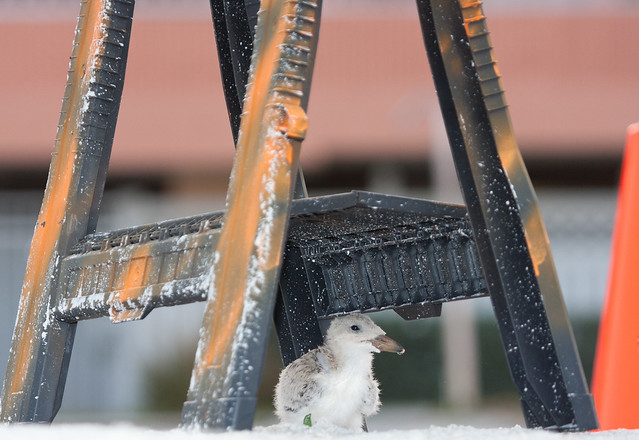
Baby Black Skimmer Barricade

Hearing the story made me think of a workplace dynamic that had upset a dear friend who’s otherwise happy in her job. Her manager had reacted harshly to a decision my friend had made, and expressed a need to control future such decisions. My friend felt hurt and angry, interpreting this as a lack of faith in her judgment.

The manager’s intent may have been to control an outcome, but the end result was employee dissatisfaction. By enforcing her will, the manager stands to lose the contributions of an innovative thinker. Instead of making the team’s work stronger, she’s created insecurity and mistrust.

A security checkpoint, a squelching of autonomy: It feels the same to me, energetically.

I see everything as an opportunity for self-reflection, and I also believe that anything healed within me helps to heal the world. So these stories prompt me to ask where I have played out a similar story within myself.

Have I posted a guard where it’s not needed, cutting me off from people perceived as “other”? Have I jerked the reins of my creativity in an effort to produce? Have I impeded the flow of inner wisdom with my expectation of a particular outcome?

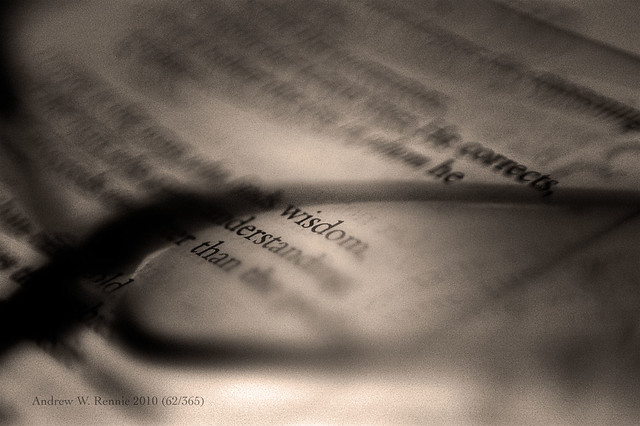
Wisdom (62/365)

How can I personally move from this old story of control and domination to a new story of trust, openness, and listening? What does it take to nurture that movement in myself and others?

A Hollow Reed

Years ago when I was untangling the emotional roots and antecedents of fibromyalgia, I saw a counselor, a lovely 60ish-year-old man with round spectacles. I kept hoping he would hook me up to his biofeedback machine and fix me. I would sit in a chair in front of him and look over at the biofeedback station significantly. Kind of like my dog points his nose at the treat bag, with great hope and impatience.

On our initial phone call I had told him that biofeedback was what I needed. I figured I would force my beleaguered body to relax, and boom, all would be well.

Instead, he asked me to close my eyes and breathe. How did my body feel, sitting in the chair? Where was the pain, where was the tiredness? What did it want to say? He’d ask me to play witness to the tumult inside me. “We are present to this discomfort,” he would say.

Eventually the witnessing came around to breathing in openness and ease. I was never long in his presence before I felt it: the touch of the Divine. I breathed in and invited it. The ache in my chest might grow more pronounced, but with each inhalation, I felt a lightness flood every cell, until the ache transformed into something softer, like a blossom opening to the sun.

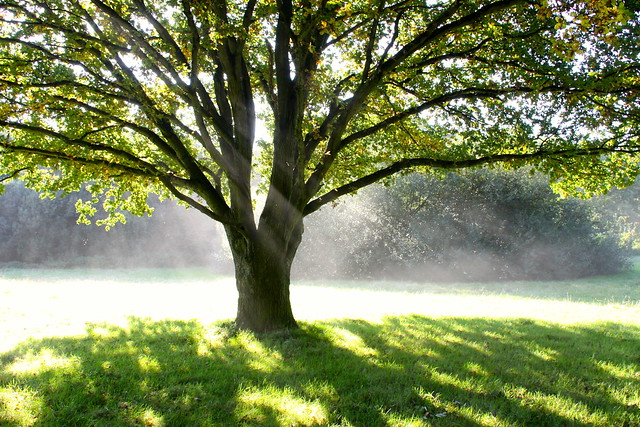
Sunlight

I don’t remember specifics from our time together, except the way my breath would flow the length of my body. I drew it in from my feet and exhaled it out my crown, an old yogic practice.

“You see how this is right there for you, as soon as you invite it?” I remember him saying. “This is your gift.”

It didn’t seem like much of a gift at the time, even though those meditations brought the rare sensation of settling me fully in my body. The grounded feeling never lasted; one step out of the haven of his office—that luscious sweetgum tree outside the window!—and I would leave my body again.

One thing stuck with me: He said once, “I am not the doer here,” with his long fingertips pressed to his white canvas shirt. “I am not in charge.”

He spoke of being a hollow reed, the Divine playing its music through us. “We just need to step aside, get our egos and personalities out of the way,” he said.

埙

I wasn’t sure that was possible, for me.

These days I find myself opening to that possibility, as I check in with guidance every step of the way. For the first time, I don’t plant myself so firmly in the driver’s seat.

I wrote about my tendency to push 18 months ago; rereading the post now, I see how I was playing with the idea of surrender, which had been enforced (again) by illness.

Only now is this starting to filter into daily practice. If life moves in a natural ebb and flow, as Charles Eisenstein suggests, then aligning my own activities with that natural movement brings a delicious serenity. Not only that, but cosmic forces line up to push me farther than I could ever push myself, and with much greater ease.

So I pause and ask: Is it actually time to do what the ego/driver in me wants to do? Or is it time to do something else? I’m finding more ease and joy as I move through life open to the possibility that it’s not all up to me.

Kinship

An ancient hackberry tree holds my heart this winter. I visit it on many of my walks.

beautiful hackberryA tree that has lived a long time has something to say about holding and releasing. I try to listen. (Maybe there’s a wise tree in your neighborhood who calls to you. I hope I’m not the only one out here hugging trees. I feel that they want us to give in to the impulse!)

I love to lean against the hackberry and feel its life force thrumming under my touch. Sometimes I rest my cheek against the bark and stretch my arms wide. Other times I wedge my feet between its tall roots and press my spine to the trunk.

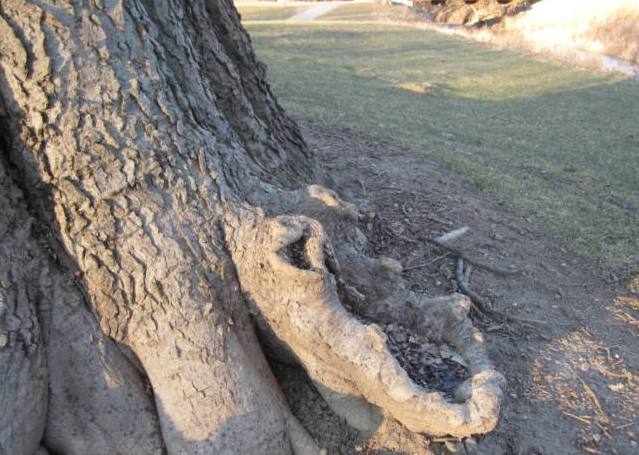
IMG_4461I could probably explore this tree for weeks and never know it fully. The roots have made a mysterious bowl here.

IMG_4464Here’s a front view of the same formation. Now it is an open mouth under two eyes.

IMG_4463Here the roots meander, a tangle of ropes.

IMG_4462Every time I touch this wise tree-being, I say: Thank you, and I love you. Standing in its presence, I feel I can send my care deep into the heart of the earth.

Perhaps tree-beings are speaking to you too? Or am I alone in thinking the borders between us and our kin are thinner than we once imagined?

Note: For another view of the tree that shows myself and my (somewhat indifferent) dog, check out the Spacious Light Intuitive Arts page.

Step Up to the Fire

One of my favorite year-end practices comes at Solstice time, when we gather with friends to mark the longest night. While we welcome the return of the light, we let go of what no longer serves us.

My spouse and I have been doing this with various groupings of women friends for a couple decades now. We build a fire and each burn something to symbolize what we’re ready to release.

IMG_4453Over the years I’ve noticed a shift in the types of things people throw on the fire. If I remember right, in our 20s and 30s we often burned things like business cards, to symbolize an important job transition. I recall burning “toxic” letters, wanting to shift a problematic relationship.

Looking back, the focus felt external to some degree: We needed to declare that something was over and done, and move on.

(I do recall that one creative soul burned a photocopy of a sponge, to indicate she no longer needed to absorb everyone else’s “stuff.”)

In general, nowadays, it feels like we all are more apt to turn our focus inward. What is it within me that is ready to slough off? Is it my need to be right? my habit of pushing? my fears? my dismissive self-talk?

One by one, we step up to the fire and burn the pattern that’s holding us back.

At our 2013 Solstice celebration, this is what I committed to the fire: my need to distract myself. What would happen, I wondered, if every time I thoughtlessly drifted to Facebook, email, or some other addiction, I first checked in on my inner world?

The result, over the course of the year, was a deepening of quiet, and an opening of possibility. I began to turn toward whatever plagued me instead of overriding it. I began to listen more carefully to guidance, to seek it, to act on it.

I had been moving in this direction since my dear friend, energy healer Merry Henn, introduced me to energy work several years back. In a 15-year quest to heal from fibromyalgia, the “invisible arts” (as I sometimes call them) proved indispensable. In combination with other healthy practices, energy healing and emotional clearing have brought me back to resilience. I no longer get sick at the drop of a hat, and I no longer need the maintenance regimen that sustained me for so long.

Now I find myself offering intuitive sessions and hands-on healing work to others, integrating everything I’ve learned. I never imagined myself in this role. But it turns out to be one of the most meaningful contributions I could ever make to a new Story of Reunion.

It was the Solstice ritual that helped me receive this unexpected gift.

I won’t say yet what I burned at the 2014 Solstice gathering, but who knows what magic is afoot after that releasing?

Every Day

I’m not one to do Christmas in a big way. In fact I can get quite tired of the holiday, which seems by turns tawdry, labor-intensive, and loaded. Since we don’t have children, there’s no pressure to create a memorable and magic Christmas, or to buy a lot of guilt-inducing gadgetry. I mostly stick to the humble and homespun kind of gift, like these lumpen loaves.

Mesquite bread, made with chili peppers and cilantro.

Mesquite bread, made with chili peppers and cilantro.

Still, I can get into the (self-created) pressures of the season as much as anybody. Something about the holidays hits all my “not enough” buttons.

So when someone said to me recently, “I think every day should be Christmas,” my immediate thought was something along the lines of “heck, no,” only saltier. But she was talking generosity, of course, not pressure and parties.

And this morning, when I woke up with a sense of excitement (even after all these years, like a kid!), I thought about that. What if every morning, we all woke up suffused with joy, anticipation, and love? What if every day was devoted to family and friends, and feeling so abundant that we share our gifts all around?

What if we kept the wonderment, the generosity, the magic—and lost the commercialism?

Then every day would be like Christmas.