The More Beautiful World

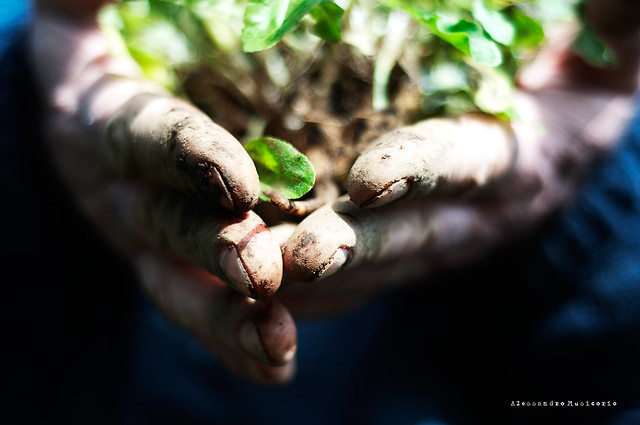
I’ve been savoring Charles Eisenstein’s book, The More Beautiful World Our Hearts Know is Possible. It’s affirming, challenging, stimulating, surprising—and filled with wisdom for this age of crisis. Nature in my hands Shared cultural myths make up the “Story of the People,” the beliefs we all hold about the way the world works. Eisenstein notes that the old story is beginning to crumble as we see institution after institution unveiled as unworkable, untenable. He shows how this old Story of Separation—based on control, force, domination, competition, and scarcity—informs everything we see: the prison system, food system, educational system, money system—not to mention religious institutions, childrearing practices, and even activist organizations.
Even the medical establishment’s treatment of illness is based on this model, where bacteria is the enemy we need to conquer to save our own skin. (Never mind that 90 percent of the cells that make up a human are actually bacteria and fungi!)

This overarching cultural myth—that we are separate from each other and the rest of nature, inhabiting a hostile universe built on random accident and competition—is the source of much pain, violence, despair, and exploitation.

But the old story is beginning to fall away as a new Story of Connection takes its place. This transition is far from complete, Eisenstein says. And the time between stories is fraught. Many of the institutions are revealing their true natures in horrifying ways, and our usual tactics seem useless in the face of the horror. That’s because the tactics are also made of that old story. Compelling people to change by force or ridicule, demonizing institutions and leaders as evil, even rushing to action or response before the best path is clear—these are all born from a model that won’t work anymore.

Meditation

“The situation on Earth today is too dire for us to act from habit—to reenact again and again the same kinds of solutions that brought us to our present extremity. Where does the wisdom to act in entirely new ways come from? It comes from nowhere, from the void; it comes from inaction.”

That passage is one of many that resonate with me, especially since I’ve been spending so much time in that void he mentions. Sometimes I worry that by the time I emerge from this cocoon the world will have been fracked to death. That urgency to stop such horrors is real, but we need to reach deeper than action. Our task is to create something new that leaves these old systems and tactics in the dust. We need to make a whole new world, based on the vision of connectedness. NJ - Montclair: Montclair Art Museum - Earth Mother Eisenstein brings up the ebb and flow of the birth process. Much of the time the mother is not pushing, but resting. When the time to push comes, the urge is unstoppable. But the push comes in its time, and not before.

“Can you imagine saying to her, ‘Don’t stop now! You have to make an effort. What happens if the urge doesn’t arise again? You can’t just push when you feel like it!'”

The question is, what are we gestating? What kind of world wants to be born?
Peas and the Possible

“The Possible’s slow fuse is lit

By the Imagination.”

—Emily Dickinson

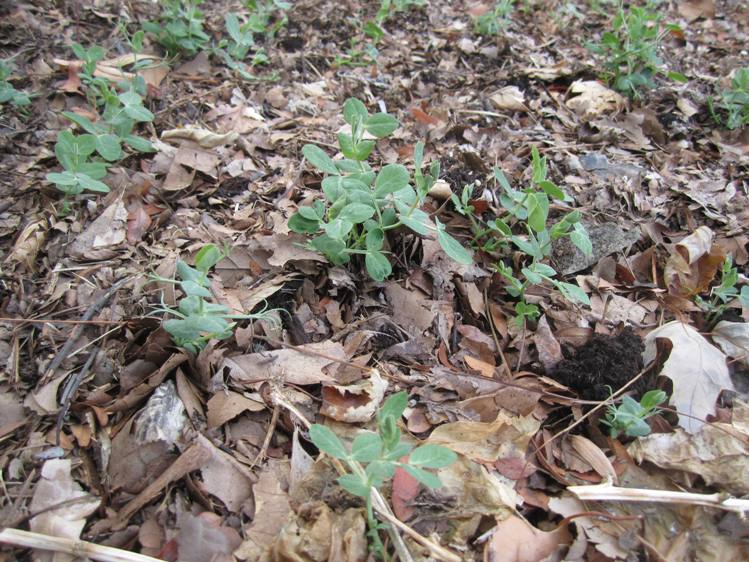
Austrian winter peas planted in my garden

Austrian winter peas planted in my garden

We have already had snow and single digit wind chills here. Yet these Austrian winter peas, planted very late, still grow.

My friend Dawn gave me a couple generous handfuls of seed to play with. I’d never heard of this hardy cover crop that doubles as a tasty wintertime salad green. But Mother Earth News had the full scoop on  planting Austrian winter peas. So somewhere between transplanting herbs and cooking up harvest stews, I threw those seeds in the ground.

I’m so glad I did!

This is the time of year when nighttime slams down on us pretty hard. A time for diving deep and dreaming. Those tender sprouts remind me that sweet tendrils of possibility can thrive in this liminal space.

I’ve been spending a fair amount of time in a space of unknowing. Allowing guidance to emerge organically, and playing with a deeper trust than I’ve ever had before.

And I love walking out my back door and seeing my little crop. If I never get to eat the shoots, I’ll be perfectly happy just with the view.

Thanks to Yes Magazine‘s Winter 2015 issue for the stunning Dickinson quote.

Before It’s Too Late

Guest Post by Rosemary Spalding, Earth Charter Indiana board president. (Part 2 of 2 of a firsthand report on the Sept. 21 People’s Climate March).

My husband Mark and I stayed  in Newark, NJ the night before the People’s Climate March. Early Sunday morning we began to make our way to 66th and Central Park West to meet a new contact from Earth Charter International. As we rode the train from Newark to NYC and then the subway to Central Park, our excitement built as we joined with dozens of others making their way to the march. Smiling people in T-shirts with names of organizations from all over the country packed subway cars that were standing room only.

Photo by Rosemary Spalding

Photo by Rosemary Spalding

When Mark and I emerged from the subway station at 66th Street, several volunteers welcomed us, directing us to our spot in the march. About 30 minutes before the march was to begin, people flowed into the wide street that borders Central Park on the west, filling it from curb to curb. While we stood in the street waiting, I just looked around, taking it all in. People were lined up behind us all the way to 86th St. and in front of us all the way to Columbus Circle.

Photo of Columbus Circle by Rosemary Spalding

Photo of Columbus Circle by Rosemary Spalding

It was crowded, and we learned later that many marchers couldn’t even fit in the street until the march had progressed several blocks. Many people carried homemade signs and some wore costumes. But most were simply there—joining in solidarity with others to demonstrate before our government and other world leaders gathering for the United Nations summit, that we demand action to address this urgent global crisis.

Communities displaced by climate change marched  in the demonstration. Photo by Christine Irvine.

Communities displaced by climate change marched in the demonstration. Photo by Christine Irvine.

And then the most exciting thing happened! I saw someone making his way through the crowd, like a salmon swimming upstream, coming towards me. As he drew closer I realized I recognized him. Like a teenaged groupie at a rock concert, I yelled, “LOOK, IT’S BILL McKIBBEN!”

I immediately felt foolish, but he looked over at me and smiled as he passed, never missing a step. I think I said “thank you” as he walked by. By the time I could get my iPhone out, he had been swallowed up by the upstream crowd that parted to let him pass.

Photo by Emma Cassidy

Photo by Emma Cassidy

As we walked the two miles past famous landmarks and through Times Square, hundreds of supporters on the sidewalks waved us by. We never saw a single person who challenged our message. Every so often throughout the march, a thunderous “sound wave” would come from in front of or behind us, and we would raise our voices and play musical instruments as the wave passed through on its way to the beginning or end of the march. Goosebumps!

At the end of the march people gathered for entertainment at several stages. I watched the Raging Grannies as they sang their versions of “On Top of Old Smokey,” “Roll Back the Barrels,” and “The Climate—It is A-Changin’.” Music and humor—welcome relief for such a serious subject.

Over 400,000 people marched in New York City that Sunday. Add to that the thousands attending local climate marches all over the country and the world, and you know that we cannot be dismissed as radical tree-huggers.

To the contrary—the People’s Climate March was mainstream. We witnessed an incredibly diverse collection of people of all ages and from all walks of life; people from every state and many nations; people of every color and culture; labor unions and healthcare workers; youth groups, college students and professors, parents and grandparents. All marching, singing and chanting for a common purpose—to say that we, the citizens of the world, recognize the direness of our situation and unite to convince our leaders to change course before it’s too late.

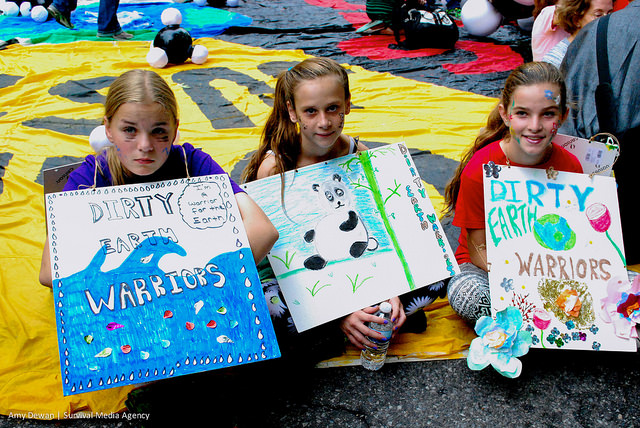
Photo by Amy Dewan

Photo by Amy Dewan

As Mark and I traveled back to Newark, exhausted but exhilarated from the day’s experience, I wondered—did we make a difference? I said a silent prayer: This time let those in power take notice; let meaningful change finally occur.

Rosemary Spalding is board president of Earth Charter Indiana and a founding member of the Irvington Green Initiative. She is an attorney with Spalding & Hilmes, PC, which is located in Irvington and concentrates its practice in environmental law.

Why I Marched in the People’s Climate March

Guest Post by Rosemary Spalding, Earth Charter Indiana board president. (Part 1 of 2).

Like most folks, I am concerned about a number of serious issues, but when it comes to climate change, my passion has turned into a kind of internal panic. My panic builds when I read reports that it is happening much faster than scientists were predicting less than 10 years ago.

Atmospheric greenhouse gas concentrations have increased so much that we’re no longer talking about avoiding tipping points or reversing global warming. We’re now talking about slowing the process as much as possible and adapting to the inevitable.

I think about the beautiful, bright children of my nieces and nephews and about the grandchildren I hope to have someday, and I am terrified for them. To what kind of existence are we condemning them and their children?

Photo of young NYC activists by Rosemary Spalding.

Photo of young NYC activists by Rosemary Spalding

Most of my votes, letters, and phone calls to government leaders at all levels have been completely ineffective. Earth Charter Indiana recently petitioned the Indiana Environmental Rules Board (ERB) to adopt a rule to develop a climate action plan for Indiana.

Despite the fact that over a thousand Hoosiers have signed the petition, the board dismissed it at their last meeting. Board members thought a climate action plan was someone else’s job—certainly not their job.

The ERB would not even grant a public hearing on the petition (which Earth Charter Indiana believes it is required to do under Indiana’s law permitting citizen rulemaking petitions).

Photo By Shadia Fayne Wood

Photo By Shadia Fayne Wood

That citizen petition (with extensive supporting documents) took months to prepare. The articulate and passionate young people of Youth Power Indiana respectfully submitted the petition to the ERB. But board members were unmoved.

I must confess that the ERB’s casual dismissal has shaken my fundamental belief in the integrity of our democracy. We are disheartened—but we are not done advocating for change. See the note at the end of this post to lend your support.

In the meantime, I had hoped to go to New York City to participate in the People’s Climate March—but the ERB’s cavalier rejection of a citizen petition cemented my resolve. I wanted to join with others to tell our government and world leaders gathering for the United Nations summit that we demand action—NOW.

Photo By: Emma Cassidy

Photo By Emma Cassidy

I have participated in lots of climate change rallies in Indianapolis as well as the march in Washington, DC last February, when 40,000 people turned out in the frigid cold to protest the proposed Keystone XL pipeline. But those experiences did not prepare me for what we experienced at the People’s Climate March last Sunday…

(To be continued in Part 2).

Note: If you are an Indiana resident dismayed by the Environmental Rules Board’s lack of attention to a citizen petition, please consider attending the next ERB meeting in support of a climate action plan.

When: Wednesday, November 12, 1:30-4:00 p.m.
Where: Indiana Government Center South – Conference Room A (check for meeting or room changes here.)
RSVP: julielrhodesconsulting@gmail.com or 317.371.2788

Want to do more? Contact Indiana Environmental Rules Board Members today to urge them to hold a hearing on the Petition for a Climate Action Plan for Indiana! Find contact information for board members here.

Rosemary Spalding is board president of Earth Charter Indiana and a founding member of the Irvington Green Initiative. She is an attorney with Spalding & Hilmes, PC, which is located in Irvington and concentrates its practice in environmental law.

To Look Up

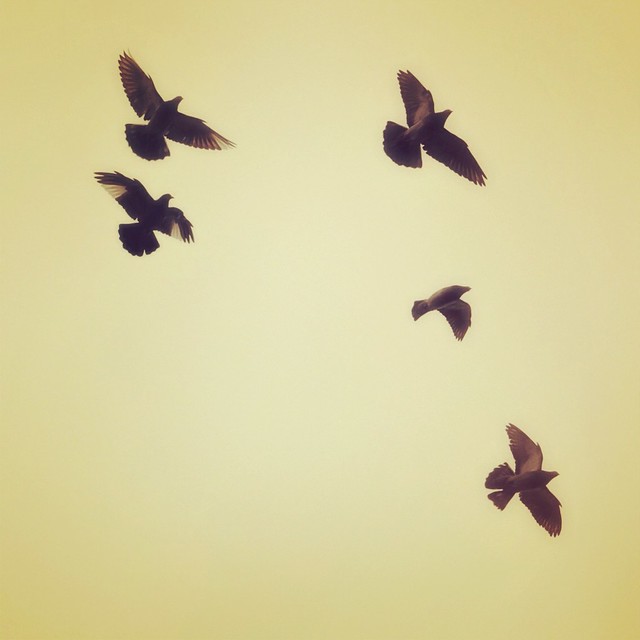
It hit me hard last week when the Audubon Society reported that half of North American birds’ migratory routes are threatened by climate change.

If loons find it too hot to summer in Minnesota, then what? You’d think they should just aim farther north, but will they find the food and cover that matches their needs? Are they supposed to migrate higher and higher till they fly right off the planet’s roof?

By Pete Markham, via Wikimedia Commons

By Pete Markham, via Wikimedia Commons

The scenario is not confined to some far-off future. It’s now. Southern California saw 90 to 95 percent of raptor nests failing because of drought. No nests, no procreation. How long can a species survive climate disruption?

I find I can’t stay with this topic; it’s too painful.

I felt the same last month, learning about a gigantic crater that opened in the Siberian permafrost. Scientists link the melting to warmer-than-normal summers the last two years, and say such sinkholes release vast amounts of methane.

Methane gas is more efficient at trapping radiation than carbon dioxide, with 20 times the impact on climate change, according to the EPA.

In Eaarth: Making a Life on a Tough New Planet, Bill McKibben describes a number of self-reinforcing feedback loops that lead to a faster and faster rate of climate change. The crater is just one example. He explains the feedback loops in this video.

Here we are, immersed in our lives, going around feeling one minute one way, the next another. I feel despondent. I cheer up. My writing goes well. My writing goes poorly. I help someone. I say something dumb. I worry over my sick cat. I celebrate her recovery. I walk around my neighborhood and love the trees. I come home and feel lonely, pleased, scared, self-satisfied, hopeless, and on and on.

I’m a dizzying universe. As are we all. Most of us barely keep it together, doing what needs to be done to meet the day-to-day demands of life.

And all the while, this other thing is winging above us. This bigger picture of demise.

Rise up...

And to look up invites so much pain, which we already have aplenty.

Two things help me face the times we live in. One is external, the other internal.

On the external side, I reach out, take action, make something, do something. I connect with neighbors who care as deeply as I do. Or join a demonstration, like this Sunday’s People’s Climate March in New York City. (I will join a crowd closer to home, at the People’s Climate Gathering in Bloomington.)

I plant a seed. I get moving.

On the internal side, I stay still and connect with what endures. I remind myself that matter is just slow energy, and energy can’t be destroyed. Feeling into my energy body takes me to a place beyond fear. Whatever the future brings, it will be better if I stay in this moment.

“Look up and see the light from the sun. And now see everything beneath it, everything around you. You are in the garden.”

—Karen Maezen Miller, Paradise in Plain Sight

Note: If you’re on the fence about joining this weekend’s events, read Rebecca Solnit’s new essay. “Only great movements, only collective action can save us now,” she writes.

Releasing the “Story”

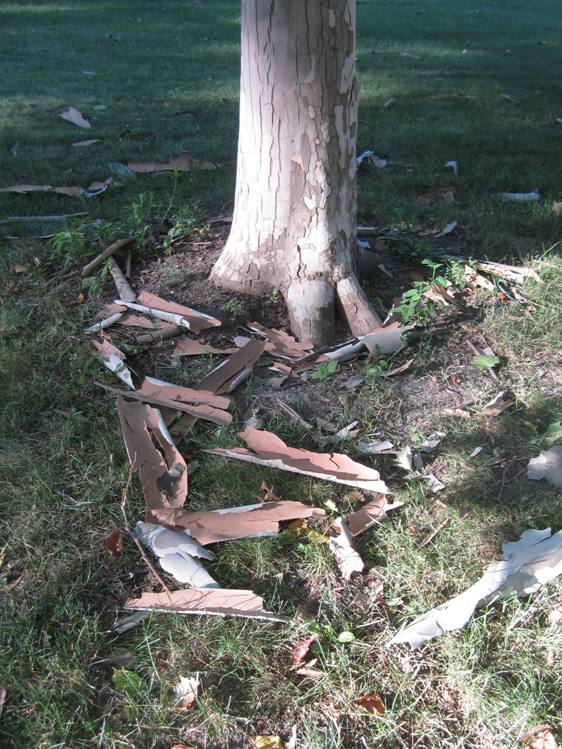
A sycamore on my street in the process of shedding its bark

A sycamore on my street in the process of shedding its bark

When the sycamores in my neighborhood begin their annual shedding, I always ask myself, what do I need to release this year to speed my growth?

Perhaps I need to examine the story that constantly loops through my brain. I’m sure some of it can fall away like bark sloughed off a tree trunk.

The ground under the trees is strewn with their old skin.

The ground under the trees is strewn with their old skin.

Zen teacher Norman Fischer speaks to this point eloquently.

“We take our point of view so much for granted, as if the world were really as we see it.

But it doesn’t take much analysis to recognize that our way of seeing the world is simply an old unexamined habit, so strong, so convincing, and so unconscious we don’t even see it as a habit.

How many times have we been absolutely sure about someone’s motivations and later discovered that we were completely wrong? How many times have we gotten upset about something that turned out to have been nothing?

Perspective

Perspective

Our perceptions and opinions are often quite off the mark. The world may not be as we think it is. In fact, it is virtually certain that it is not.”

—from Training in Compassion

Possible

Two quotes from Indian author and activist Arundhati Roy are on my mind tonight. First the disturbing.

“Either way, change will come. It could be bloody, or it could be beautiful. It depends on us.”

I don’t even have to look to the horrifying news out of the Middle East to find us awash in blood. Here in my town, last week two men pulled out guns to shoot each other for the unpardonable crime of bumping each other on the sidewalk.

It seems that people are less and less respectful of life, while the means to do harm are more and more lethal, efficient, and accessible. Where will it end?

And yet.

“Another world is not only possible, she is on her way. On a quiet day, I can hear her breathing.”

Yes, I hear her too. This is why I make a point, every day, to dwell in quiet.

Walking the Labyrinth on World Labyrinth Day in May.

Walking the Labyrinth on World Labyrinth Day in May.

Today I walked the Rivoli Park Labyrinth. I said an invocation before stepping in, and as I wound my way to the center, I imagined transformation happening. The breeze rearranging molecules, my porous body, which is really made of space and light and whirling particles.

I reached the stone at the center, and just as I sat down the sun broke through the clouds. I felt it warm my back.

I listened.

I said, thank you. And: may it be so.

All I Cannot Save

Monarch sipping on liatris, by Gene Wilburn, via Flickr Commons.

Monarch sipping on liatris, by Gene Wilburn, via Flickr Commons.

My heart is moved by all I cannot save

So much has been destroyed

I have to cast my lot with those who, age after age,

Perversely, with no extraordinary

Power, reconstitute the world.

—Feminist poet Adrienne Rich

Resilient Communities and People: How Yoga Can Help

Guest post by Gaynell Collier-Magar

Hi everyone! I am so honored to be a guest blogger on Shawndra’s amazing website. Shawndra is one of my Irvington Wellness Center yoga students. She has a beautiful, thoughtful practice, both on and off of the mat. She personifies how yoga can help with resiliency in life.

Yoga is a 5000-year-old tradition of practices (the Eight Limbs) to reduce suffering and still the mind. It is not a religion. However, the practices have been incorporated by many religions: Buddhism, Hinduism, and contemplative Christianity to name a few.

The physical practice or “asana” (“seat”) is meant to create resiliency in the body and mind to enable sitting in meditation for long periods of time. Unfortunately, in the West, the physical practice is often perceived as the path to buns of steel, pretzel poses, and very thin 20-something bodies.

The first lines of the Yoga Sutras state: “Now, the teachings of yoga. Yoga is to still the patternings of consciousness”. The Sutras explain how our habitual ways of thinking create suffering and how we can remedy this.

When we are reimagining a future for our communities, yoga could be a useful tool.

Photo by Jenny Spadafora

Photo by Jenny Spadafora, via Flickr Commons

So how does this happen? In the physical practice, it begins with being in the present moment—in the body and the breath. To get a feel for what I mean, try this:

Notice how you are sitting now. Are you slumping? Good…notice how you feel heavy in your body. Now, sit up straight, feel your bottom sitting in your chair, feel your feet on the floor, and lift your chest. Do you feel any lighter in your body? Slump again and notice. Sit up again and notice. Now close your eyes, put your hands on the tops of your thighs and take three deep, slow breaths. Focus on the exhale.

What was your mind doing? Chances are it wasn’t making a to-do list, obsessing about the person at work who drives you crazy, or yearning after a piece of chocolate. You begin to get a glimpse of the mind becoming more still—an experience that increases in depth and length with further practice.

The practice is to notice what is happening in the present moment, practice non-reaction, and return to the present moment. Neuroscience is showing that these practices literally re-wire the brain.

Two of the liabilities of community work are burnout and lack of fresh ideas. Our ego-driven “monkey mind” robs us of tremendous energy and creativity. As we engage in practices that still the mind, we create a mindspace in which to think outside the box—and the energy to act accordingly.

Photo by TZA, via Flickr Commons

Photo by TZA, via Flickr Commons

We also create a mind that is equanimous and unattached, yet deeply caring. We create a mind that is focused and in the present moment. We create a mind that is resilient.

It is not a leap of consciousness nor faith to realize how resilient minds can create resilient communities. The Buddha said, “All that we are is a result of what we have thought. The mind is everything. What we think we become.”

Gaynell has been a yoga practitioner for over 14 years. She was certified as a Vinyasa yoga instructor in 2009 by Rolf Gates and is a registered yoga teacher with Yoga Alliance. She is certified to teach adaptive yoga to people with physical disabilities, having studied with Matthew Sanford of Mind Body Solutions. She has taught Vinyasa, adaptive, and 12-step recovery yoga classes in Indianapolis and Cozumel, Mexico in Spanish and English. She holds a Bachelor’s Degree in Social Work and owns her own landscaping business, Growing Connection.

Join Gaynell and other terrific instructors at Shine Out Yoga Celebration, July 11-12 in Indianapolis, benefiting Mighty Lotus.

Confronting the Shadow

Second in a series

Consciousness shift is one thing, but what do we do about systemic ills?

I asked Julia Bystrova of Transition US about the governmental corruption holding us back from systemic policy-level changes—the big changes we are going to need, if we have a prayer of surviving the linked crises facing us. She had an interesting answer.

She pointed out that a healthy consciousness shift is already manifesting on the local level—witness sensible policy changes in cities all over the country. In LA, for example, a group called Tree People convinced their city that urban forestry is key to watershed management.

Photo by Lida, via Flickr Commons.

Photo by Lida, via Flickr Commons.

More than 1000 mayors have endorsed the US Conference of Mayors Climate Protection Agreement, vowing to reduce carbon emissions in their cities below 1990 levels, in line with the Kyoto Protocol.

And my own city, right smack in the middle of the stolid Midwest, shows some movement. This year we are gaining both a bike share and an electric car share program.

But beyond the local level where we can see real change happening, the picture looks bleak. As Julia put it, much of our larger governmental machine was “hijacked by corporate pirates.” These titans are not interested in seeing communities flourish on a local scale—not when there are profits to be had.

Greed and control are their modus operandi. Their greed is so extreme that they are willingly sacrificing people’s lives. And they’re deliberately sacrificing the life of the planet.

“That’s what we’re up against,” Julia told me. “We’re up against this darkness. It’s very classic, very mythological…It’s like this classic tale (that) I believe we are living out.”

But spiritually awake people can shine a light on the collective shadow. That’s what these madmen, as Julia calls them, represent: our collective shadow. It’s up to us to gain the maturity to stand our ground, in love and compassion, in the presence of this darkness.

In psychological work, the shadow is the unacknowledged, hated part of ourselves that rules our behavior—unless we turn toward it with love.

It’s time to look at such perpetrators in the face, with full awareness, unafraid.

Rebirth, by Jason Samfield, via Flickr Commons.

Rebirth, by Jason Samfield, via Flickr Commons.

Julia believes that more and more of us are reaching this level of awakening. If we confront them from a high level of integrity, institutions entrenched in corrupt power will crumble.

Again, a powerful vision to hold.

Next: Evidence of the shift.