Building Soil, Growing Food, Nurturing Relationships

I just listened to a podcast interview with Linda Proffitt, founder and executive director of Global Peace Initiatives here in Indianapolis. I’ve known Linda since the days I was responsible for Nuvo Newsweekly’s monthly social justice calendar. Back then I called her regularly to find out about GPI’s peace hikes and other activities, and I was always impressed with her programming.

Since that time GPI’s work has exploded onto the local resilience scene. They started by helping church groups grow food for the hungry, bringing countless volunteers together to experience the transformational power of service initiatives.
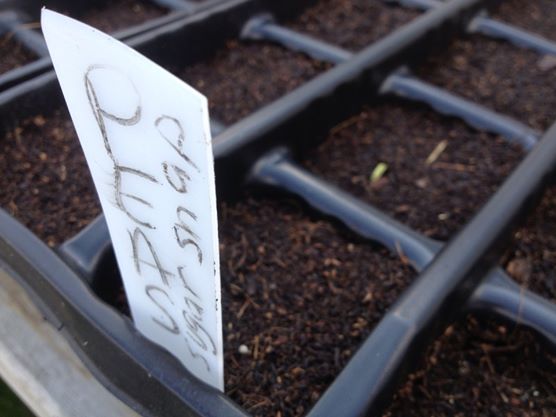
peasIn 2011, the organization began a new partnership with one of the most influential forces in the urban farming movement. Will Allen and his team at Growing Power designated GPI as a regional training center for Central Indiana. Spring of 2012 saw a well-attended “From the Ground Up” workshop at Peaceful Grounds, GPI’s newly formed center for agriculture and sustainability.

If you have a chance to listen to the podcast, you might be struck (like me) by the idea that produce is just one output of Peaceful Grounds. There’s also soil, which is foundational. And then there’s relationships.

People coming together to cooperatively grow food can form some powerful ties. And that’s what it’s all about at Peaceful Grounds.

Sharing worms with youthful visitors

Sharing worms with youthful visitors

Now at the Marion County Fairgrounds, Peaceful Grounds is about to start a weekly farm and arts market, Sundays from noon to 4 starting June 1.

GPI’s work is featured in a chapter of the new book Deep-Rooted Wisdom by Augustus Jenkins Farmer. The chapter is called “Stop Tilling the Soil”—and worm composting is a big part of the system at Peaceful Grounds. (I was thrilled learn that the worms eat brew mash from my local microbrewery, Black Acre, located right here in Irvington.)

Linda will be the guest speaker at next Tuesday’s Green Hour, a project of the Irvington Green Initiative. If you’re in town, come out and join us to hear all about this vital work.

Photos courtesy of Global Peace Initiatives.

Farming Females

Last month I enjoyed interviewing several women for a special section in Farm Indiana on women in agriculture. While some didn’t consider themselves farmers, all had valuable perspectives about what it means to bring a female sensibility to agriculture.

Many spoke of women’s connection to the earth as something deep and primal. Several compared the nurturing of plants and animals to caring for children.

And Kay Niedenthal, an urban farmer in Indianapolis, might have been talking about our procreative power when she said, “It’s like magic to make something from nothing. To start with dirt and a seed and then have a meal.”

Anna Welch of Fields of Agape in a field being prepared for hull-less oats.

Anna Welch of Fields of Agape in a field being prepared for hull-less oats. (The periodical has a much better photo of Anna by the terrific photographer Josh Marshall.)

I was intrigued by the fact that Anita Spencer of Homestead Growers didn’t start out growing organically. She and her husband were Miracle-Gro fans at the start. When a friend asked if they’d ever considered going organic, she said, “We laughed at her!”

But that question planted a seed all its own. They took a look at the contents of the famed formulation and realized they didn’t want all those chemicals in their bodies and those of their children. Nor did they want to sell produce grown that way.

Now Anita is proud to offer high-quality, chemical-free food to her customers through both Homestead Growers and its spinoff line of tomato sauces, Local Folks Foods.

(As a side note, this anecdote showed me how questions can spur behavior change, even the questions don’t seem well-received. I resolve to ask more questions!)

For the full story, including seven mini-profiles of women in agriculture and Josh Marshall’s beautiful photos, see the current issue of Farm Indiana (page A8).

Celebrating International Permaculture Day

Today is International Permaculture Day. Guest blogger Thomas Tlusty wrote the following piece exploring his connection to Permaculture, and its power.

Guest Post by Thomas Tlusty, founding partner of The Garden Tower Project

Two years ago, I saw sketches of a device that I felt certain had the potential to revolutionize urban agriculture. I had long been interested in the economics and environmental impact of our food system. So the design piqued my curiosity and unleashed my desire to have a positive impact in my own lifetime.

The Garden Tower is a water-saving, worm-friendly, uber-productive vertical gardening aid.

The Garden Tower is a water-saving, worm-friendly, uber-productive vertical gardening aid.

Since that fateful reveal, my life has been transformed. The Garden Tower Project reignited my passion, and I began rethinking current food production/distribution models. My eyes were opened to the plethora of pioneers, visionaries and everyday folks who are practicing, teaching, and studying Permaculture and sustainable farming/lifestyles.

I am inspired by those who inspire others. I’m thinking of luminaries like Bill Mollison, David Holmgren, and Will Allen. I’m also thinking of many less well-known but still pivotal figures, such as:

  • Community Slow Food Educators
  • Permaculture Design Educators
  • Elementary School Science Educators
  • Organic Gardening Instructors

I am a relative newcomer to this work. Yet I feel a kinship with those who aspire to build community and develop our inherent natural resources in a straightforward manner.

I’m troubled by the unbinding of our culture from its roots. Western civilization is “circling the drain” as we surpass our fragile planet’s carrying capacity (in our current mode of operation).

Permaculture (to me) represents an entirely sane alternative to the path on which we find ourselves today. Permaculture principles contain not only the seeds of hope but a catalyst for change. In practice, these concepts could improve the lives of untold millions and positively influence the course of our future on this planet.

I find hope in people working together in communities, sharing education and experience. And teaching our children well is our first and best hope.

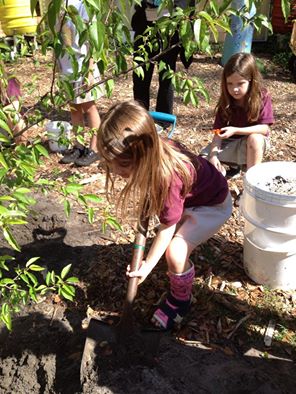
A child at  Learning Gate Community School prepares soil despite the cast on her leg. Thomas captions this photo “Our Hope For Mending a Broken Future.”

Our Hope For Mending a Broken Future: A child at Learning Gate Community School in Lutz, Florida, prepares soil despite the cast on her leg. Instructor: Cissy Brady Stanko

Permaculture engenders ideas and conversations around topics like environmental science, vermiculture, organic gardening, eco-art, and eco-psychology. And connections grounded in Permaculture positively transcend any political, socio-economic, racial, or gender barriers that have been erected in the past or could possibly be constructed in the future.

In my endeavors, I have developed friendships through online Permaculture forums and related Facebook pages. The connections range from the casual and conversational to the inspirational and uplifting. Together they raise me from the deep morass that had grown like a thick moss over my heart’s desire.

I’m now acting on a long-felt wish to accomplish something meaningful and utterly critical: addressing our outdated and increasingly toxic food production/distribution system. Without action and intent, habits will remain the same. Permaculture shows us the way to a very different future.

Thomas Tlusty was raised in Lombard, IL. Thomas was active in social justice and interested in food issues from a young age. In his late teens to early twenties, he worked at the Chicago Board of Trade (in Agricultural Commodities) for a leading grain exporter. The Ellettsville, IN resident has been a practicing Certified Natural Health Professional and is currently an Active Isolated Stretching Therapist in private practice. Thomas is a founding partner in the Garden Tower Project.

Unfurling

Happy belated Earth Day. Today I’m in a bit of a spring swoon. I fall in love with the world this time of year. I find myself looking more closely than usual, feeling wonder and deep gratitude.

For lunch I had a salad of farmers market greens, augmented by a few trout lily leaves. Several large colonies appear every April across the street from our house for a short time before fading back into the earth.

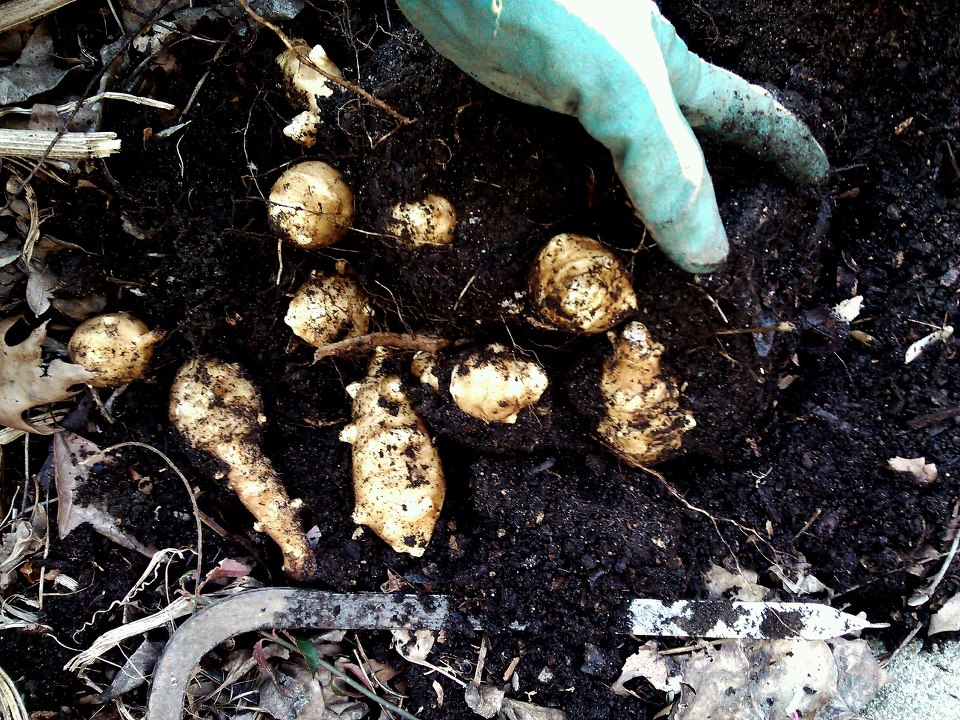
We’d dug our Jerusalem artichokes last week, so I cleaned one up and cut it into crispy little rounds for my salad. While I was scrubbing the dirt off, it occurred to me that something about Jerusalem artichokes is just flat amazing. All that sweetness growing deep underground.

Jerusalem artichokes, aka sunchokes, from our garden

Jerusalem artichokes, aka sunchokes, from our garden

The tops of the plants are dead; we left the ‘chokes in the ground all winter. Yet here they are on my plate, ready to complement the sharp tang of mustard and dandelion and arugula.

I feel especially tender toward trees this spring. Probably because winter was longer and harsher than usual. Snow and ice buried us for several months. Many branches cracked under the burden; some trees split in half.

So it seems more miraculous than ever to see trees pushing new leaves and buds and blooms. Every day on my walks, there’s beauty surrounding me.  The tulip trees are especially dear, with these new baby leaves, furry like does’ ears, unfurling.

New tulip tree leaves, via Wikimedia Commons

New tulip tree leaves, via Wikimedia Commons

It just hit me, watching this happen—slowly, slowly, but still the growth is there—how really astounding it is that a tree can make leaves and blooms and seeds. Think of it: the tree, a hard wood thing, somehow pushes out softness and color.

I suppose I could review the science behind it: phloem and xylem, was it? In any case it’s miraculous. There are channels within that rough brown case—it’s alive!

Did I ever tell the story of my cousin who was raised in the Caribbean? When she came to visit Indiana relatives in the winter, she was appalled to see all the “dead trees” standing around. “Why don’t you cut all those dead trees down?” she asked my dad, to his great amusement.

Sometimes what seems to be dead is only in a state of deep rest. Waiting for the right time to stretch up and out, touch the sunlight again.

What is unfurling in your spring?

Stop Collaborating

Photo by Mark Notarim, via Flickr Commons

Photo by Mark Notarim, via Flickr Commons

“People ought to support mitigation and adaptation within their own line of work…If you’re a butcher, baker, ballerina, banker, or a plumber, envision yourself as the post-fossil-fuel version of yourself, and get right after it.

So…stop co-operating with the status quo. Stop collaborating. Stop being afraid and stop feeling helpless. Just stop all that and start living by entirely other means.”

—Bruce Sterling, from WorldChanging

A Remedy for Nature Deficit Disorder

Guest blogger Dawn Slack wrote the following piece about Letha’s Fund, a terrific program of Indiana Native Plant and Wildflower Society (INPAWS). The fund facilitates schoolchildren’s nature-based excursions and youth-led projects. I am always happy to hear the latest on Letha’s Fund, because my Dad, Donovan Miller, was instrumental in setting it up. Check it out, and lend your support in his name if you feel so led.

Guest Post by Dawn Slack, Youth Outreach Chair for Indiana Native Plant and Wildflower Society (INPAWS)

garlicmustardpull_Ingraham

Kids initiated a garlic mustard pull with the help of Letha’s Fund

Knowledge Is Power

An essential INPAWS role is teaching our youth the value of our natural world, and connecting them to nature. Our members understand how nourishing it is to watch the sun rise and set, to set your hand in a riffle and watch water course downstream, to witness a flower blossom, or glimpse a dragonfly skimming the water’s surface.

We understand that experiencing nature enhances our ability to reason and solve problems. We know how being immersed in nature relieves our stress and energizes us.

We need our youth to understand these things too.

School outing at Winterhaven Wildflowers and Monarch Preserve

School outing at Winterhaven Wildflowers and Monarch Preserve

We Save Only What We Love

Our youth have little opportunity to bond with nature. Bombarded with technology that, sadly, discourages outdoor activities, they need encouragement and assistance getting outside.

In 2013 Letha’s Fund enabled almost 2,000 youth to visit natural areas or participate in outdoor experiences. And over the past five years Letha’s Fund has facilitated approximately 6,800 youth to learn about our amazing natural world.

Cold Spring students dig in, planting 400 plugs of forbs and sedges

Cold Spring students dig in, planting 400 plugs of forbs and sedges

Help Us Empower More Youth

Help us invest in a healthy future for our environment, one full of diversity and natural splendor, understood and loved by its future caretakers. Take a moment to learn about Letha’s Fund, share the flyer, and spread the word about such a wonderful program that is possible because of your aid.

Learn about Letha’s Fund on our website or send us your questions at lethasfund@inpaws.org or call us. Remember, knowledge is power. So pass it along, and help us help the next generation get into nature.

Harshman_kids_Ford

Harshman kids plant seedlings grown by Cold Spring School students with the help of INPAWS stalwart Donovan Miller (my dad!)

We will save only what we love;
We will love only what we understand;
We will understand only what we have been taught.

Senegalese environmentalist Baba Dioum

All photos courtesy of INPAWS.

Postscript: To read my dad’s invitation to INPAWS members to share their love of nature with children, click here and search on “Expertise Not Required.”


Like to Eat? Thank a Bee.

Kate Franzman, beekeeper and urban farmer

Kate Franzman, beekeeper and urban farmer

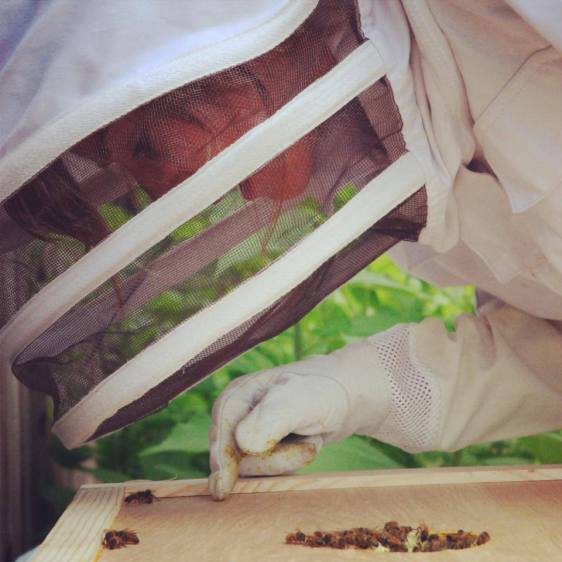
Kate Franzman is one of many fabulous people who keep the “indie” in Indianapolis. Concerned about the die-off of honeybees, she started Bee Public with a goal of increasing the number of honeybees in our city. The organization has placed hives at several urban farms, including one right in my neighborhood.

She’s a writer too, and her first-person story is featured in the current issue of Indianapolis Monthly. I generally don’t shrink from bees myself, but her description of capturing a swarm as a novice beekeeper is truly impressive.

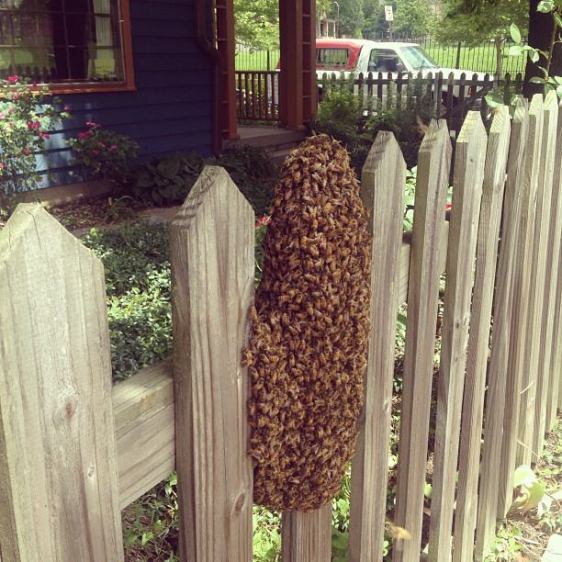
Swarm on a fence post in summer 2013. Kate scooped them by (gloved) hand into a box before transporting them to their new home at South Circle Farm.

Swarm on a fence post in summer 2013. Kate scooped them by (gloved) hand into a box before transporting them to their new home at South Circle Farm.

Her passion for these pollinators leads her to give talks and workshops emphasizing their importance. “Since 2006, we’ve lost more than one-third of our honeybee colonies nationwide, due in major part to Colony Collapse Disorder, an alarming phenomenon that occurs when the bees mysteriously desert their hive and die,” she writes.

“One out of every three bites of food we eat was made possible by a bee. So no bees, no food.”

Kate and a few of the creatures on whom our lives depend

Kate and a few of the creatures on whom our lives depend

The unusually harsh winter killed all the bees in Bee Public’s hives, so Kate initiated a crowdfunding campaign to raise money to replace the honeybees. The response has been one of “unprecedented generosity,” prompting her to pledge to purchase replacement bees for other urban farmers and expand the network of hives.

On May 10 at Pogue’s Run Grocer, Kate will present Bees 101, an overview of how to create a bee-friendly backyard. And if you want to take it further, Bee Public offers consulting and hive setup for local restaurants, community gardens, and urban farms. There’s even a sponsorship option for people not in a position to have a hive. Check out Bee Public’s site and Facebook page!

All photos courtesy of Bee Public.

Pay It Local

In Ball State University’s Down to Earth documentary about sustainable food systems, renegade farmer Joel Salatin makes a key point about the importance of spending food dollars locally. A small amount of cash spent at the farmers market or local food store might make a huge difference to the vendors there. You never know what kind of difficulties they face, and where they stand on the thin line between a manageable load and giving up.

It’s kind of like paying it forward, only you’re “paying it local.”

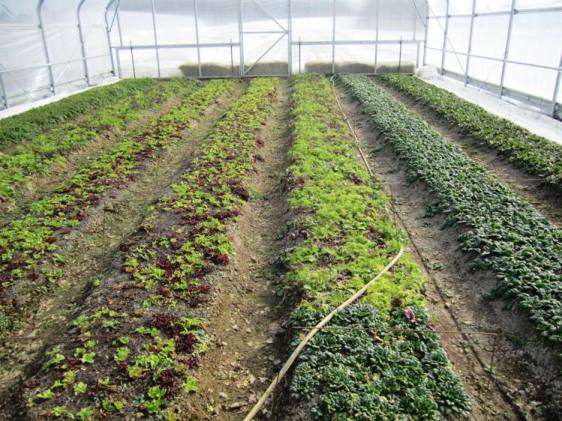
Freedom Valley Farm's high tunnel beds.

Freedom Valley Farm’s high tunnel beds.

It reminded me of something I blogged some months back:

The row we plant might be just the encouragement our elderly neighbor needs to start seeds on a windowsill. Which might nudge her granddaughter to visit a farmers market and buy a farmer’s tomatoes, and one of those funny-looking squashes while she’s at it. Maybe she’ll come back in ensuing weeks and bring her children and a friend, buying more locally grown food. Which shows the farmer that his produce is desired, and keeps him from throwing in the towel after a tough summer.

Since I wrote that I’ve talked to many small farmers as part of my freelancing job, and I’ve learned that farming is more difficult than any nonfarmer could ever imagine. What they do requires a lot of faith. And people to buy what they’re selling.

When I interviewed Hoosier Organic Marketing Education (HOME) founder Cissy Bowman for a Farm Indiana story, she emphasized the critical role of the nonfarmer ally. “Never feel disempowered,” she told me. “As a consumer your opinion is the most important, because you’re the one who buys it.”

Our consumer choice is not even just about food. It’s also about keeping land out of developers’ hands. If farmers can earn a living wage, fewer properties will be snatched up and turned into subdivisions and shopping malls. That means more acreage for wildlife, native plants, and pollinators.

From the front page of Farm Indiana

From the front page of Farm Indiana

The current issue of Farm Indiana contains two stories I wrote. One is about Cissy and HOME, a terrific nonprofit organization that helps farmers like Anna Welch with rural development projects and educates everyone about the importance of organics. The other is about Freedom Valley Farm, an Owen County operation that I thoroughly enjoyed visiting.

Jim Baughman showed me around his farm on a February day.

Jim Baughman showed me around his farm on a February day.

I can testify that Jim’s winter produce is among the best I’ve tasted. We’re talking melt-in-your-mouth spinach and juicy-crisp carrots. This guy is good at what he does, and he does it all without chemicals.

To read the stories, click here.

A Beautiful Thing

As the Intergovernmental Panel on Climate Change gathers in Japan to finalize their report on the status of global warming, I’m thinking about hope. Hope as choice and saving grace. Here’s a piece I wrote some time back.

My spouse and I recently watched a library DVD of the HBO series Enlightened, in which Laura Dern plays a woman seeking to expose the wrongdoing of her corporate employer.

Photo by manyhighways.com, via Flickr Commons

Photo by manyhighways.com, via Flickr Commons

The show is a mix of humor and pathos and drama, with the main character, Amy Jellicoe, revealed as both tender-hearted and colossally insensitive. She’s self-centered, obnoxious, impulsive—and, at times, luminous in her dreaming of a different world.

By the last episode, Dern’s character has discovered the cost of being a whistleblower, having lost her job and her love interest. The last blow comes when Amy’s mother says she is no longer welcome to live in her house.

The final scene finds her knocking at the door of her ex-husband Levi, who knows her best. Sitting next to Levi on his front stoop, Amy asks him, “Am I crazy?”

What a question. I’ve asked it of myself so many times. Am I crazy to think that this world can transform, that we can evolve as a species? Am I crazy to believe that we can pull each other to a higher vibration—one that would usher in a new era of equity and resilience?

Am I insane to believe that we can still thrive, even in the face of this terrible and seemingly irreversible mess we’ve made?

In the final words of the series, Levi, played by Luke Wilson, turns to her and says, “No.”

He says, “You’re just full of hope. You got more hope than most people do.”

He tells her, “It’s a beautiful thing to have a little hope for the world, you know?”

Photo by ZeHawk, via Flickr Commons

Photo by ZeHawk, via Flickr Commons

I’ve come to believe that to be hopeful is rarely foolish, or naïve, or crazy. Or if it is all of those, perhaps it doesn’t matter.

Hope is a choice I make for the sake of my own soul and soul of the world, for the health of those around me. I regularly renew my decision to be a holder of hope.

I choose to believe that it’s possible to live in such a way that doesn’t steal from the impoverished on the other side of the world, that doesn’t rape the earth. I choose to envision the possibility of healing this beleaguered planet.

Maybe I am crazy.

But I still believe. This better world is on its way.

To Belong

Winter aconites blooming in March 2013

Winter aconites blooming in March 2013

“As the globalized, placeless world spreads,
and as progress is increasingly defined as the ability to look out of a hotel window in any city and see the same corporate logos lit up in familiar neon,
it could be that the most radical thing to do
is to belong.”

Paul Kingsnorth, Real England