A Hollow Reed

Years ago when I was untangling the emotional roots and antecedents of fibromyalgia, I saw a counselor, a lovely 60ish-year-old man with round spectacles. I kept hoping he would hook me up to his biofeedback machine and fix me. I would sit in a chair in front of him and look over at the biofeedback station significantly. Kind of like my dog points his nose at the treat bag, with great hope and impatience.

On our initial phone call I had told him that biofeedback was what I needed. I figured I would force my beleaguered body to relax, and boom, all would be well.

Instead, he asked me to close my eyes and breathe. How did my body feel, sitting in the chair? Where was the pain, where was the tiredness? What did it want to say? He’d ask me to play witness to the tumult inside me. “We are present to this discomfort,” he would say.

Eventually the witnessing came around to breathing in openness and ease. I was never long in his presence before I felt it: the touch of the Divine. I breathed in and invited it. The ache in my chest might grow more pronounced, but with each inhalation, I felt a lightness flood every cell, until the ache transformed into something softer, like a blossom opening to the sun.
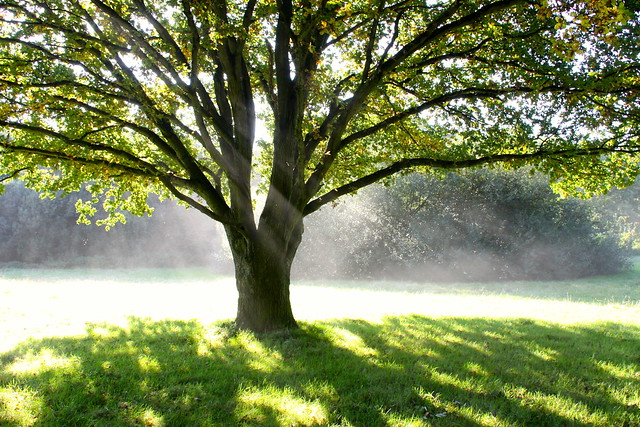
Sunlight

I don’t remember specifics from our time together, except the way my breath would flow the length of my body. I drew it in from my feet and exhaled it out my crown, an old yogic practice.

“You see how this is right there for you, as soon as you invite it?” I remember him saying. “This is your gift.”

It didn’t seem like much of a gift at the time, even though those meditations brought the rare sensation of settling me fully in my body. The grounded feeling never lasted; one step out of the haven of his office—that luscious sweetgum tree outside the window!—and I would leave my body again.

One thing stuck with me: He said once, “I am not the doer here,” with his long fingertips pressed to his white canvas shirt. “I am not in charge.”

He spoke of being a hollow reed, the Divine playing its music through us. “We just need to step aside, get our egos and personalities out of the way,” he said.

埙

I wasn’t sure that was possible, for me.

These days I find myself opening to that possibility, as I check in with guidance every step of the way. For the first time, I don’t plant myself so firmly in the driver’s seat.

I wrote about my tendency to push 18 months ago; rereading the post now, I see how I was playing with the idea of surrender, which had been enforced (again) by illness.

Only now is this starting to filter into daily practice. If life moves in a natural ebb and flow, as Charles Eisenstein suggests, then aligning my own activities with that natural movement brings a delicious serenity. Not only that, but cosmic forces line up to push me farther than I could ever push myself, and with much greater ease.

So I pause and ask: Is it actually time to do what the ego/driver in me wants to do? Or is it time to do something else? I’m finding more ease and joy as I move through life open to the possibility that it’s not all up to me.

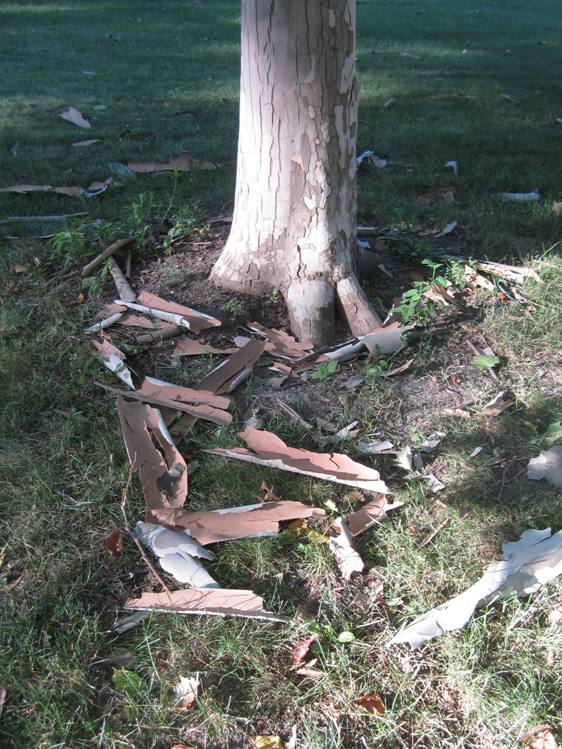
Releasing the “Story”

A sycamore on my street in the process of shedding its bark

A sycamore on my street in the process of shedding its bark

When the sycamores in my neighborhood begin their annual shedding, I always ask myself, what do I need to release this year to speed my growth?

Perhaps I need to examine the story that constantly loops through my brain. I’m sure some of it can fall away like bark sloughed off a tree trunk.

The ground under the trees is strewn with their old skin.

The ground under the trees is strewn with their old skin.

Zen teacher Norman Fischer speaks to this point eloquently.

“We take our point of view so much for granted, as if the world were really as we see it.

But it doesn’t take much analysis to recognize that our way of seeing the world is simply an old unexamined habit, so strong, so convincing, and so unconscious we don’t even see it as a habit.

How many times have we been absolutely sure about someone’s motivations and later discovered that we were completely wrong? How many times have we gotten upset about something that turned out to have been nothing?

Perspective

Perspective

Our perceptions and opinions are often quite off the mark. The world may not be as we think it is. In fact, it is virtually certain that it is not.”

—from Training in Compassion

Resilient Communities and People: How Yoga Can Help

Guest post by Gaynell Collier-Magar

Hi everyone! I am so honored to be a guest blogger on Shawndra’s amazing website. Shawndra is one of my Irvington Wellness Center yoga students. She has a beautiful, thoughtful practice, both on and off of the mat. She personifies how yoga can help with resiliency in life.

Yoga is a 5000-year-old tradition of practices (the Eight Limbs) to reduce suffering and still the mind. It is not a religion. However, the practices have been incorporated by many religions: Buddhism, Hinduism, and contemplative Christianity to name a few.

The physical practice or “asana” (“seat”) is meant to create resiliency in the body and mind to enable sitting in meditation for long periods of time. Unfortunately, in the West, the physical practice is often perceived as the path to buns of steel, pretzel poses, and very thin 20-something bodies.

The first lines of the Yoga Sutras state: “Now, the teachings of yoga. Yoga is to still the patternings of consciousness”. The Sutras explain how our habitual ways of thinking create suffering and how we can remedy this.

When we are reimagining a future for our communities, yoga could be a useful tool.

Photo by Jenny Spadafora

Photo by Jenny Spadafora, via Flickr Commons

So how does this happen? In the physical practice, it begins with being in the present moment—in the body and the breath. To get a feel for what I mean, try this:

Notice how you are sitting now. Are you slumping? Good…notice how you feel heavy in your body. Now, sit up straight, feel your bottom sitting in your chair, feel your feet on the floor, and lift your chest. Do you feel any lighter in your body? Slump again and notice. Sit up again and notice. Now close your eyes, put your hands on the tops of your thighs and take three deep, slow breaths. Focus on the exhale.

What was your mind doing? Chances are it wasn’t making a to-do list, obsessing about the person at work who drives you crazy, or yearning after a piece of chocolate. You begin to get a glimpse of the mind becoming more still—an experience that increases in depth and length with further practice.

The practice is to notice what is happening in the present moment, practice non-reaction, and return to the present moment. Neuroscience is showing that these practices literally re-wire the brain.

Two of the liabilities of community work are burnout and lack of fresh ideas. Our ego-driven “monkey mind” robs us of tremendous energy and creativity. As we engage in practices that still the mind, we create a mindspace in which to think outside the box—and the energy to act accordingly.

Photo by TZA, via Flickr Commons

Photo by TZA, via Flickr Commons

We also create a mind that is equanimous and unattached, yet deeply caring. We create a mind that is focused and in the present moment. We create a mind that is resilient.

It is not a leap of consciousness nor faith to realize how resilient minds can create resilient communities. The Buddha said, “All that we are is a result of what we have thought. The mind is everything. What we think we become.”

Gaynell has been a yoga practitioner for over 14 years. She was certified as a Vinyasa yoga instructor in 2009 by Rolf Gates and is a registered yoga teacher with Yoga Alliance. She is certified to teach adaptive yoga to people with physical disabilities, having studied with Matthew Sanford of Mind Body Solutions. She has taught Vinyasa, adaptive, and 12-step recovery yoga classes in Indianapolis and Cozumel, Mexico in Spanish and English. She holds a Bachelor’s Degree in Social Work and owns her own landscaping business, Growing Connection.

Join Gaynell and other terrific instructors at Shine Out Yoga Celebration, July 11-12 in Indianapolis, benefiting Mighty Lotus.

Where We Rarely Dwell

In my quest to be an engaged citizen, urban homesteader, radical homemaker, contributor to household coffers, writer, etc., I can get trapped in a life of busyness. I have so many goals. My days are full of checking the clock as I push myself to be more productive, to mark things off my  lists. (Yes, I have more than one list.)

One week before I fell ill, I was advised to take some unscheduled time every week. I never got the chance to try this radical experiment—because soon I was pretty much glued to the couch, in a haze of pain and exhaustion, just trying to get through my days. And even then, chafing at all that was left undone.

My cat Maggie enjoyed the couch time immensely.

My cat Maggie enjoyed the couch time immensely.

This is a typical pattern for me—I have to be forced to slow down. I suspect it’s not uncommon in our hyperproductive Western culture, this need to be sick or injured before we grant ourselves rest.

So when I listened to intuitive Lee Harris‘s monthly energy forecast this week, and heard him talk about slowing down, I had to laugh—it was so on-target. He said we must stop rushing about and go inside the body, where we rarely dwell. We’re so stimulated all the time that we don’t really know our inner selves.

And that’s a loss.

I like to think I’m fairly good at this: after all, I’ve studied mindfulness meditation! I practice yoga! I’ve done all kinds of personal healing! Yet, the fast track always, always hooks me, and I give short shrift to my dreamy, drifty side—until I have no other choice.

Harris says, “The ‘driving masculine’ side is not what we are needing as a world anymore. We have been hearing this for years, but it’s hard for us to change the program.”

I guess that’s why it takes enforced couch time before I can stop being so terribly driven.

Recently on a Transition US call about creating new stories, one of the panelists said something powerful: That we get tripped up if we try to remake the world in the context of an old, outdated story—meaning looking through the lens of competition, judgment, conflict, scarcity, and domination.

I’m reminded of the wisdom feminist poet Audre Lorde offered years ago: “The master’s tools will never dismantle the master’s house.” She was referring to racism and homophobia in the women’s movement, but it applies here too. How can we transcend the dominant culture’s destructiveness if we’re working from that old script—if we are subjugating our inner knowing (available only in stillness) to this constant striving and acting?

Stillness

Stillness

How, though—this is always my dilemma—how do I get important work done without this driven side of myself? Is there a new way of being that allows both the focus to finish (so satisfying: to finish!) and the freedom to swim about, aimlessly dreaming?

Perhaps, instead of a driver archetype, I could assume the gardener archetype. Cultivate change instead of push it. Would that work? What do you think?