The More Beautiful World

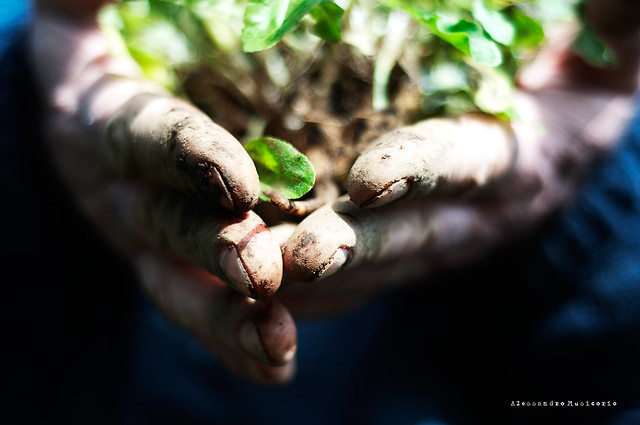
I’ve been savoring Charles Eisenstein’s book, The More Beautiful World Our Hearts Know is Possible. It’s affirming, challenging, stimulating, surprising—and filled with wisdom for this age of crisis. Nature in my hands Shared cultural myths make up the “Story of the People,” the beliefs we all hold about the way the world works. Eisenstein notes that the old story is beginning to crumble as we see institution after institution unveiled as unworkable, untenable. He shows how this old Story of Separation—based on control, force, domination, competition, and scarcity—informs everything we see: the prison system, food system, educational system, money system—not to mention religious institutions, childrearing practices, and even activist organizations.
Even the medical establishment’s treatment of illness is based on this model, where bacteria is the enemy we need to conquer to save our own skin. (Never mind that 90 percent of the cells that make up a human are actually bacteria and fungi!)

This overarching cultural myth—that we are separate from each other and the rest of nature, inhabiting a hostile universe built on random accident and competition—is the source of much pain, violence, despair, and exploitation.

But the old story is beginning to fall away as a new Story of Connection takes its place. This transition is far from complete, Eisenstein says. And the time between stories is fraught. Many of the institutions are revealing their true natures in horrifying ways, and our usual tactics seem useless in the face of the horror. That’s because the tactics are also made of that old story. Compelling people to change by force or ridicule, demonizing institutions and leaders as evil, even rushing to action or response before the best path is clear—these are all born from a model that won’t work anymore.

Meditation

“The situation on Earth today is too dire for us to act from habit—to reenact again and again the same kinds of solutions that brought us to our present extremity. Where does the wisdom to act in entirely new ways come from? It comes from nowhere, from the void; it comes from inaction.”

That passage is one of many that resonate with me, especially since I’ve been spending so much time in that void he mentions. Sometimes I worry that by the time I emerge from this cocoon the world will have been fracked to death. That urgency to stop such horrors is real, but we need to reach deeper than action. Our task is to create something new that leaves these old systems and tactics in the dust. We need to make a whole new world, based on the vision of connectedness. NJ - Montclair: Montclair Art Museum - Earth Mother Eisenstein brings up the ebb and flow of the birth process. Much of the time the mother is not pushing, but resting. When the time to push comes, the urge is unstoppable. But the push comes in its time, and not before.

“Can you imagine saying to her, ‘Don’t stop now! You have to make an effort. What happens if the urge doesn’t arise again? You can’t just push when you feel like it!'”

The question is, what are we gestating? What kind of world wants to be born?
Peas and the Possible

“The Possible’s slow fuse is lit

By the Imagination.”

—Emily Dickinson

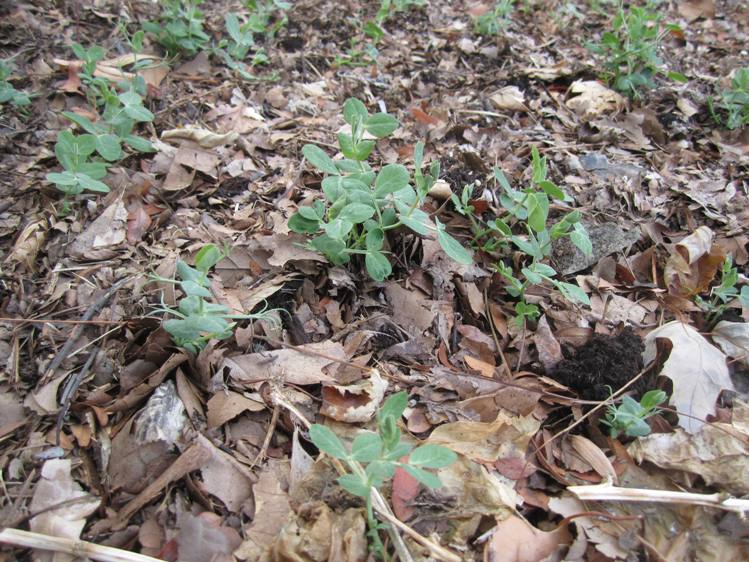
Austrian winter peas planted in my garden

Austrian winter peas planted in my garden

We have already had snow and single digit wind chills here. Yet these Austrian winter peas, planted very late, still grow.

My friend Dawn gave me a couple generous handfuls of seed to play with. I’d never heard of this hardy cover crop that doubles as a tasty wintertime salad green. But Mother Earth News had the full scoop on  planting Austrian winter peas. So somewhere between transplanting herbs and cooking up harvest stews, I threw those seeds in the ground.

I’m so glad I did!

This is the time of year when nighttime slams down on us pretty hard. A time for diving deep and dreaming. Those tender sprouts remind me that sweet tendrils of possibility can thrive in this liminal space.

I’ve been spending a fair amount of time in a space of unknowing. Allowing guidance to emerge organically, and playing with a deeper trust than I’ve ever had before.

And I love walking out my back door and seeing my little crop. If I never get to eat the shoots, I’ll be perfectly happy just with the view.

Thanks to Yes Magazine‘s Winter 2015 issue for the stunning Dickinson quote.

To Look Up

It hit me hard last week when the Audubon Society reported that half of North American birds’ migratory routes are threatened by climate change.

If loons find it too hot to summer in Minnesota, then what? You’d think they should just aim farther north, but will they find the food and cover that matches their needs? Are they supposed to migrate higher and higher till they fly right off the planet’s roof?

By Pete Markham, via Wikimedia Commons

By Pete Markham, via Wikimedia Commons

The scenario is not confined to some far-off future. It’s now. Southern California saw 90 to 95 percent of raptor nests failing because of drought. No nests, no procreation. How long can a species survive climate disruption?

I find I can’t stay with this topic; it’s too painful.

I felt the same last month, learning about a gigantic crater that opened in the Siberian permafrost. Scientists link the melting to warmer-than-normal summers the last two years, and say such sinkholes release vast amounts of methane.

Methane gas is more efficient at trapping radiation than carbon dioxide, with 20 times the impact on climate change, according to the EPA.

In Eaarth: Making a Life on a Tough New Planet, Bill McKibben describes a number of self-reinforcing feedback loops that lead to a faster and faster rate of climate change. The crater is just one example. He explains the feedback loops in this video.

Here we are, immersed in our lives, going around feeling one minute one way, the next another. I feel despondent. I cheer up. My writing goes well. My writing goes poorly. I help someone. I say something dumb. I worry over my sick cat. I celebrate her recovery. I walk around my neighborhood and love the trees. I come home and feel lonely, pleased, scared, self-satisfied, hopeless, and on and on.

I’m a dizzying universe. As are we all. Most of us barely keep it together, doing what needs to be done to meet the day-to-day demands of life.

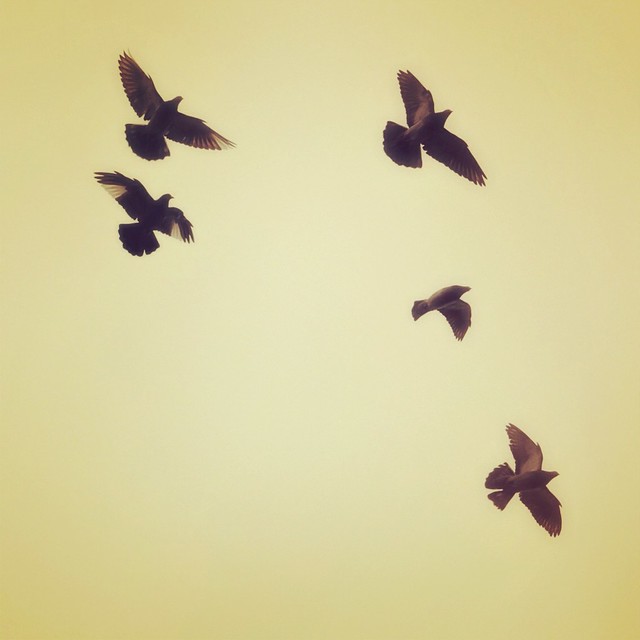
And all the while, this other thing is winging above us. This bigger picture of demise.

Rise up...

And to look up invites so much pain, which we already have aplenty.

Two things help me face the times we live in. One is external, the other internal.

On the external side, I reach out, take action, make something, do something. I connect with neighbors who care as deeply as I do. Or join a demonstration, like this Sunday’s People’s Climate March in New York City. (I will join a crowd closer to home, at the People’s Climate Gathering in Bloomington.)

I plant a seed. I get moving.

On the internal side, I stay still and connect with what endures. I remind myself that matter is just slow energy, and energy can’t be destroyed. Feeling into my energy body takes me to a place beyond fear. Whatever the future brings, it will be better if I stay in this moment.

“Look up and see the light from the sun. And now see everything beneath it, everything around you. You are in the garden.”

—Karen Maezen Miller, Paradise in Plain Sight

Note: If you’re on the fence about joining this weekend’s events, read Rebecca Solnit’s new essay. “Only great movements, only collective action can save us now,” she writes.

Lighting a Candle

So much sadness, trauma, pain, anger, fear is showing up in the personal news of my friends and in the wider news of recent weeks. But  here is a prayer for all of us, a message from an intuitive who grew up in war-torn Lebanon:

“I am lighting a candle in my heart for everyone… everyone… everyone. My heart is ablaze. My tears of joy, tears of sadness, tears of humility, and tears of hope bring this burn to a sizzle…only to find out that these candles are magical…they never go out.

By Luca Casartelli (Own work) via Wikimedia Commons

By Luca Casartelli (Own work) via Wikimedia Commons

Remember those special birthday cake candles that could not be stopped? The ones you blow out and they light up again? Ah, I am relieved that the light of my heart is infinite and eternal… has no borders… and ripples, boundless.

Now that love is set to permanent, I can really do my magic.”

—Iva of Sophia Speaks

Peace Pilgrim’s Breakfast

Can you stand one more post about berries? Since we don't have blueberries growing wild in Indiana, I chose this photo of mulberries to accompany the quote.

Can you stand one more post about berries? Since we don’t have blueberries growing wild in Indiana, I chose this photo of mulberries to accompany the quote.

“One morning for breakfast I had blueberries covered with dew, picking them from the bushes as I journeyed through the New England mountains.

I thought of my fellow human beings eating various kinds of processed and flavored foods, and I realized that if I could choose my breakfast from all the foods in the world, I could not make a better choice than blueberries covered with dew.”

Peace Pilgrim

Releasing the “Story”

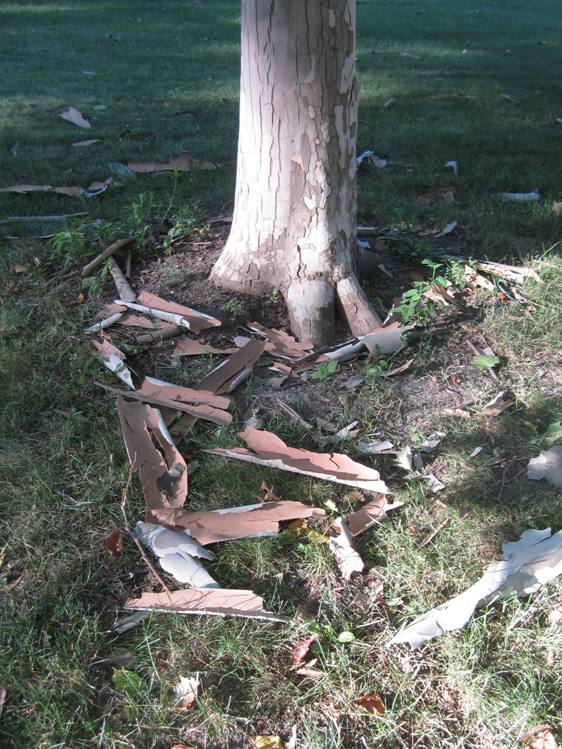
A sycamore on my street in the process of shedding its bark

A sycamore on my street in the process of shedding its bark

When the sycamores in my neighborhood begin their annual shedding, I always ask myself, what do I need to release this year to speed my growth?

Perhaps I need to examine the story that constantly loops through my brain. I’m sure some of it can fall away like bark sloughed off a tree trunk.

The ground under the trees is strewn with their old skin.

The ground under the trees is strewn with their old skin.

Zen teacher Norman Fischer speaks to this point eloquently.

“We take our point of view so much for granted, as if the world were really as we see it.

But it doesn’t take much analysis to recognize that our way of seeing the world is simply an old unexamined habit, so strong, so convincing, and so unconscious we don’t even see it as a habit.

How many times have we been absolutely sure about someone’s motivations and later discovered that we were completely wrong? How many times have we gotten upset about something that turned out to have been nothing?

Perspective

Perspective

Our perceptions and opinions are often quite off the mark. The world may not be as we think it is. In fact, it is virtually certain that it is not.”

—from Training in Compassion

Possible

Two quotes from Indian author and activist Arundhati Roy are on my mind tonight. First the disturbing.

“Either way, change will come. It could be bloody, or it could be beautiful. It depends on us.”

I don’t even have to look to the horrifying news out of the Middle East to find us awash in blood. Here in my town, last week two men pulled out guns to shoot each other for the unpardonable crime of bumping each other on the sidewalk.

It seems that people are less and less respectful of life, while the means to do harm are more and more lethal, efficient, and accessible. Where will it end?

And yet.

“Another world is not only possible, she is on her way. On a quiet day, I can hear her breathing.”

Yes, I hear her too. This is why I make a point, every day, to dwell in quiet.

Walking the Labyrinth on World Labyrinth Day in May.

Walking the Labyrinth on World Labyrinth Day in May.

Today I walked the Rivoli Park Labyrinth. I said an invocation before stepping in, and as I wound my way to the center, I imagined transformation happening. The breeze rearranging molecules, my porous body, which is really made of space and light and whirling particles.

I reached the stone at the center, and just as I sat down the sun broke through the clouds. I felt it warm my back.

I listened.

I said, thank you. And: may it be so.

The Biggest Sky

I’m back from living under the biggest sky ever. Playa,* a retreat for artists, writers, and other creatives, granted me precious time in silence in the midst of a stunning landscape. I have to say, Oregon is my new favorite state (next to Indiana, of course).

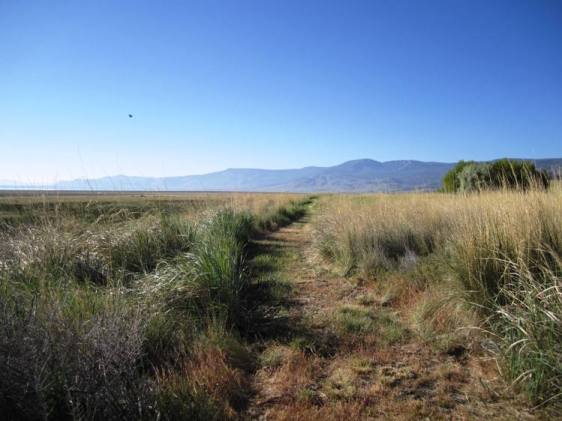
My first morning at Playa, I walked this mown path through the grass.

Morning walk in the high desert.

Morning walk in the high desert.

To my left was Summer Lake, the “playa” (defined as “a temporary lake, or its dry often salty bed, in a desert basin“). To my right, beyond the road, was a smallish mountain range known as Winter Ridge. The vistas pretty much gobsmacked this Midwestern girl.

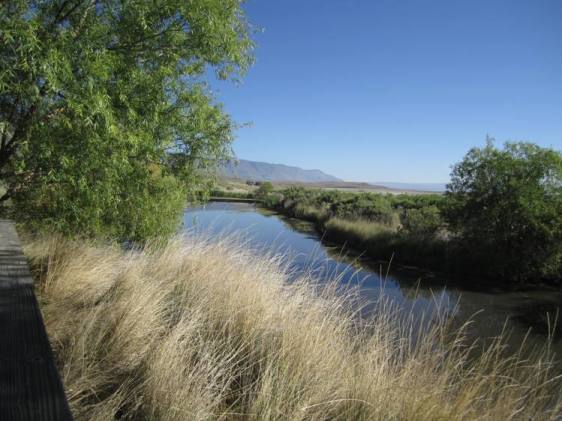
This was the view from my deck. I ate, read, wrote, and practiced yoga outside, shaded by two friendly trees.

My deck looked out over a pond. Who needs TV when you've got birds, dragonflies, jumping fish, and the occasional muskrat to watch?

Who needs TV or Internet when you’ve got birds, dragonflies, jumping fish, and the occasional muskrat to watch?

Pond life provided constant diversion, fodder, and entertainment. The jingles of my avian companions kept me humming all day. (I decided the redwing blackbird says, in French, Bon, vas-y! and in English, Look at meee, yeah!)

Every day I explored my interior and exterior worlds.

Walking on the mud flats.

Walking on the mud flats.

I was (and still am) overwhelmed with gratitude for such a gift.

An unexpected bonus  was connecting with so many incredible people, all in love with the natural world, all devoted to seeking, listening, experimenting, creating. In an upcoming post I will share a little bit about my co-residents, who inspired me almost as much as the wide-open space.

*Are you a writer, artist, naturalist, or researcher who would benefit from time away from routine demands? I would encourage you to apply for a residency at Playa. The program offers a combination of seclusion and conviviality in an absolutely gorgeous desert landscape. You won’t regret it, if you have the chance to go.

All I Cannot Save

Monarch sipping on liatris, by Gene Wilburn, via Flickr Commons.

Monarch sipping on liatris, by Gene Wilburn, via Flickr Commons.

My heart is moved by all I cannot save

So much has been destroyed

I have to cast my lot with those who, age after age,

Perversely, with no extraordinary

Power, reconstitute the world.

—Feminist poet Adrienne Rich

Resilient Communities and People: How Yoga Can Help

Guest post by Gaynell Collier-Magar

Hi everyone! I am so honored to be a guest blogger on Shawndra’s amazing website. Shawndra is one of my Irvington Wellness Center yoga students. She has a beautiful, thoughtful practice, both on and off of the mat. She personifies how yoga can help with resiliency in life.

Yoga is a 5000-year-old tradition of practices (the Eight Limbs) to reduce suffering and still the mind. It is not a religion. However, the practices have been incorporated by many religions: Buddhism, Hinduism, and contemplative Christianity to name a few.

The physical practice or “asana” (“seat”) is meant to create resiliency in the body and mind to enable sitting in meditation for long periods of time. Unfortunately, in the West, the physical practice is often perceived as the path to buns of steel, pretzel poses, and very thin 20-something bodies.

The first lines of the Yoga Sutras state: “Now, the teachings of yoga. Yoga is to still the patternings of consciousness”. The Sutras explain how our habitual ways of thinking create suffering and how we can remedy this.

When we are reimagining a future for our communities, yoga could be a useful tool.

Photo by Jenny Spadafora

Photo by Jenny Spadafora, via Flickr Commons

So how does this happen? In the physical practice, it begins with being in the present moment—in the body and the breath. To get a feel for what I mean, try this:

Notice how you are sitting now. Are you slumping? Good…notice how you feel heavy in your body. Now, sit up straight, feel your bottom sitting in your chair, feel your feet on the floor, and lift your chest. Do you feel any lighter in your body? Slump again and notice. Sit up again and notice. Now close your eyes, put your hands on the tops of your thighs and take three deep, slow breaths. Focus on the exhale.

What was your mind doing? Chances are it wasn’t making a to-do list, obsessing about the person at work who drives you crazy, or yearning after a piece of chocolate. You begin to get a glimpse of the mind becoming more still—an experience that increases in depth and length with further practice.

The practice is to notice what is happening in the present moment, practice non-reaction, and return to the present moment. Neuroscience is showing that these practices literally re-wire the brain.

Two of the liabilities of community work are burnout and lack of fresh ideas. Our ego-driven “monkey mind” robs us of tremendous energy and creativity. As we engage in practices that still the mind, we create a mindspace in which to think outside the box—and the energy to act accordingly.

Photo by TZA, via Flickr Commons

Photo by TZA, via Flickr Commons

We also create a mind that is equanimous and unattached, yet deeply caring. We create a mind that is focused and in the present moment. We create a mind that is resilient.

It is not a leap of consciousness nor faith to realize how resilient minds can create resilient communities. The Buddha said, “All that we are is a result of what we have thought. The mind is everything. What we think we become.”

Gaynell has been a yoga practitioner for over 14 years. She was certified as a Vinyasa yoga instructor in 2009 by Rolf Gates and is a registered yoga teacher with Yoga Alliance. She is certified to teach adaptive yoga to people with physical disabilities, having studied with Matthew Sanford of Mind Body Solutions. She has taught Vinyasa, adaptive, and 12-step recovery yoga classes in Indianapolis and Cozumel, Mexico in Spanish and English. She holds a Bachelor’s Degree in Social Work and owns her own landscaping business, Growing Connection.

Join Gaynell and other terrific instructors at Shine Out Yoga Celebration, July 11-12 in Indianapolis, benefiting Mighty Lotus.