No More “Long Hard Slog”

Several readers told me that Tearing up an Ancestral Contract resonated with them. Here’s another inheritance I’m reevaluating: the much-vaunted Protestant work ethic.

Don’t get me wrong—I’m glad I have a strong work ethic. I’m grateful that the folks in my lineage weren’t afraid of hard work, and that I inherited a bit of that spirit. I like to buckle down and get things done.

Saturday my neighbors and I participated in the Great Indy Cleanup. Photo by Heidi Unger.

Saturday my neighbors and I participated in the Great Indy Cleanup. Photo by Heidi Unger.

But sometimes, work isn’t the thing that is needed. Maybe it’s play. Maybe it’s stillness. Maybe it’s receiving. Maybe it’s rest.

I have known this, of course, in my head. But to really bring that knowledge into the body and energy field? That’s a different thing than intellectual understanding.

I completed two big projects a few weeks ago. I’d spent several weeks extremely focused, with most days quite regimented in order to fit everything in. And it felt good to work hard and get to the finish line.

With the deadlines past, I enjoyed a few leisurely days. It was hard not to feel like I was shirking. I worried that I was not getting important work done. I’d grown accustomed to pushing. So if I allowed myself to enjoy a slower pace, a few long walks in the sunshine, something felt “off.”
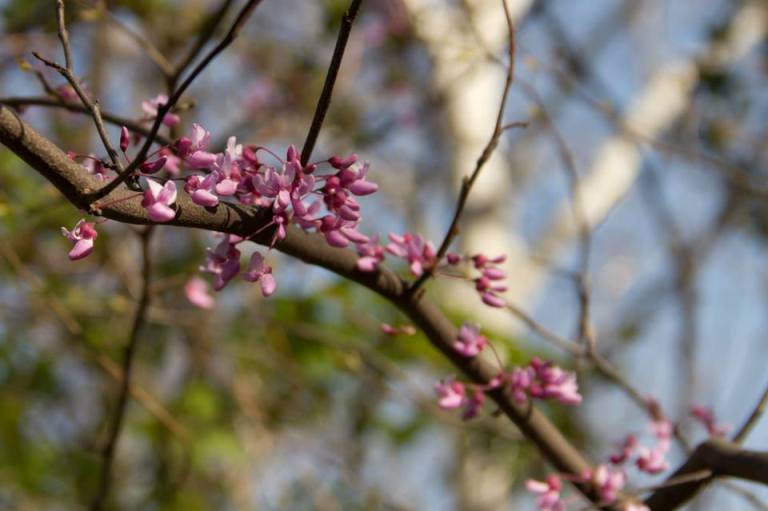
Redbud blossom photo by Heidi Unger.

Redbud blossom photo by Heidi Unger.

But I knew I didn’t want to live the rest of my life constantly driving myself beyond my capacity, as has been my habit lo these many years. I remembered the energetic principles I’ve been learning from energy healer friends like Merry Henn and Dawn Ryan. And I took a look at some core beliefs.

I’ve practiced self-testing my energy field (also known as muscle testing) for several years. At this point the skill is reliable enough to serve me in all kinds of capacities. For example, I can test my resonance with various beliefs.

The residual effect of my inherited work ethic manifests like this:

  • “It is impossible for me to be happy and rested and still meet my commitments.”
  • “I must work to the point of exhaustion in order to get my work done.”
  • “I must push my body to the point of illness to prove my worth.”

All of these statements “tested strong,” meaning my energy body resonated a big YES to each of these unhealthy beliefs. But these beliefs no longer serve me. I wanted to change them at an energetic level.

I used Emotional Freedom Technique (EFT) to quickly shift them, then rechecked: They tested weak. I worked with variations of the statements and did more rounds of EFT. Eventually I came upon:

  • “It is impossible to live in tune with my life purpose and feel happy and rested.”
  • “Aligning with my life purpose is a long, hard slog.”
  • “I must disregard my body’s need for rest if I intend to fulfill my life purpose.”

Well! I shifted these too, until I resonated something completely different. I now equate fulfilling my life purpose with deep joy and ease, a healthy body, connection, flow, and other such deliciousness.

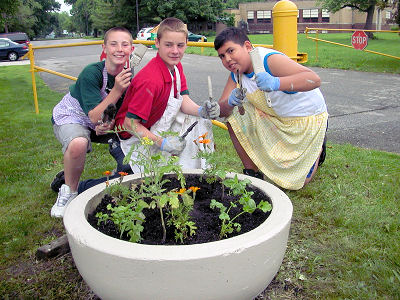
Clowning with invasive garlic mustard. My job at the cleanup was to pull it.

Clowning with invasive garlic mustard. My job at the cleanup was to pull it.

What about you—what contracts and core beliefs are you holding or releasing?

(Interested in learning a simple way to self-test? Check out this video.)

Tearing Up an Ancestral Contract

I woke up thinking about that beloved quote we see so many different places: “Your playing small doesn’t serve the world.” Attributed falsely to Nelson Mandela, the words are part of a beautiful passage by Marianne Williamson.

I realize now that I took that quote to heart, but not really into my being. I thought I understood it. I aspired to it. But recently I’ve been reviewing my ancestral contracts and commitments. I see more clearly now the ways I’ve limited myself.

I was raised Mennonite. Few would think it to look at me (and no one would guess it from my Sunday morning routine). But Mennonite-ness is a key part of my identity.

In many ways I don’t feel very far removed from that heritage—nor from my Amish forebears. Recently my spouse and I watched a PBS show about the Amish. We kept nudging each other: Yep. That’s us! (She descends from the same “plain people.”)

By Gadjoboy, via Wikimedia Commons

By Gadjoboy, via Wikimedia Commons

But what about these contracts I’m reviewing? Well, we Anabaptists are a humble people; that’s one of our main things. (Sometimes I think we’re pretty darn proud of our humility!)

And there is something to be said for taking a self-effacing approach to life. The world is full of braggadocio. Who needs it? Why not modestly go about our work? Actions speak louder than words, and all that.

I embrace many agreements stemming from my heritage. I value simplicity, stewardship, and nonconformity: carving a path that’s different from the mainstream.

But in our purported humility’s case, it seems that something unhelpful hitched a ride on that value. It’s a habit of self-effacement so extreme that it abnegates many of our gifts.

What do we have to offer, who are we to say, why would anyone care what we think?

Quick story: On more than one occasion, I heard my dad refer to himself as a “dumb Amishman.” (He said this jokingly—he was never really Amish, though his father had been.)

Related story: Sometimes I assist my spouse in whapping something together—perhaps reusing some wire and twine to make a garden trellis or the like. And one of us will quip, while surveying our finished product: “Not bad for a couple of Amish girls.”

Raised beds Judy and Dad made from reclaimed materials.

Raised beds Judy and Dad made from reclaimed materials.

It’s funny, and it speaks to the beautiful ingenuity that our forebears cultivated. But it also smacks of a self-doubt passed down for generations.

Our gifts have been buried under an avalanche of inherited beliefs about who we are and who we can never be. We run from the limelight. We say yes to too many tasks, making it impossible to complete our real assignment on earth. We keep our dreams under wraps.

At some point this unspoken agreement with our ancestors simply no longer serves.

I’m sure most people face ancestral contracts rooted in our ethnicity, religion, or nationality. Perhaps it’s time to bring these agreements to light. We can decide for ourselves whether to sign on the dotted line—or whether to tear the contracts up.

Unfurling

Happy belated Earth Day. Today I’m in a bit of a spring swoon. I fall in love with the world this time of year. I find myself looking more closely than usual, feeling wonder and deep gratitude.

For lunch I had a salad of farmers market greens, augmented by a few trout lily leaves. Several large colonies appear every April across the street from our house for a short time before fading back into the earth.

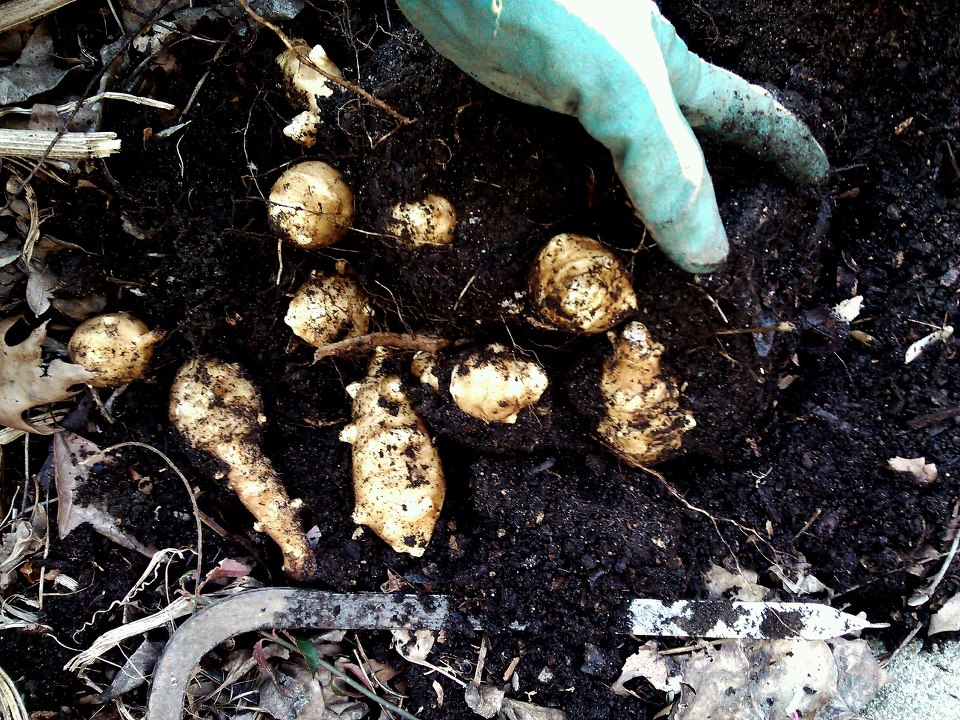
We’d dug our Jerusalem artichokes last week, so I cleaned one up and cut it into crispy little rounds for my salad. While I was scrubbing the dirt off, it occurred to me that something about Jerusalem artichokes is just flat amazing. All that sweetness growing deep underground.

Jerusalem artichokes, aka sunchokes, from our garden

Jerusalem artichokes, aka sunchokes, from our garden

The tops of the plants are dead; we left the ‘chokes in the ground all winter. Yet here they are on my plate, ready to complement the sharp tang of mustard and dandelion and arugula.

I feel especially tender toward trees this spring. Probably because winter was longer and harsher than usual. Snow and ice buried us for several months. Many branches cracked under the burden; some trees split in half.

So it seems more miraculous than ever to see trees pushing new leaves and buds and blooms. Every day on my walks, there’s beauty surrounding me.  The tulip trees are especially dear, with these new baby leaves, furry like does’ ears, unfurling.

New tulip tree leaves, via Wikimedia Commons

New tulip tree leaves, via Wikimedia Commons

It just hit me, watching this happen—slowly, slowly, but still the growth is there—how really astounding it is that a tree can make leaves and blooms and seeds. Think of it: the tree, a hard wood thing, somehow pushes out softness and color.

I suppose I could review the science behind it: phloem and xylem, was it? In any case it’s miraculous. There are channels within that rough brown case—it’s alive!

Did I ever tell the story of my cousin who was raised in the Caribbean? When she came to visit Indiana relatives in the winter, she was appalled to see all the “dead trees” standing around. “Why don’t you cut all those dead trees down?” she asked my dad, to his great amusement.

Sometimes what seems to be dead is only in a state of deep rest. Waiting for the right time to stretch up and out, touch the sunlight again.

What is unfurling in your spring?

Stop Collaborating

Photo by Mark Notarim, via Flickr Commons

Photo by Mark Notarim, via Flickr Commons

“People ought to support mitigation and adaptation within their own line of work…If you’re a butcher, baker, ballerina, banker, or a plumber, envision yourself as the post-fossil-fuel version of yourself, and get right after it.

So…stop co-operating with the status quo. Stop collaborating. Stop being afraid and stop feeling helpless. Just stop all that and start living by entirely other means.”

—Bruce Sterling, from WorldChanging

A Remedy for Nature Deficit Disorder

Guest blogger Dawn Slack wrote the following piece about Letha’s Fund, a terrific program of Indiana Native Plant and Wildflower Society (INPAWS). The fund facilitates schoolchildren’s nature-based excursions and youth-led projects. I am always happy to hear the latest on Letha’s Fund, because my Dad, Donovan Miller, was instrumental in setting it up. Check it out, and lend your support in his name if you feel so led.

Guest Post by Dawn Slack, Youth Outreach Chair for Indiana Native Plant and Wildflower Society (INPAWS)

garlicmustardpull_Ingraham

Kids initiated a garlic mustard pull with the help of Letha’s Fund

Knowledge Is Power

An essential INPAWS role is teaching our youth the value of our natural world, and connecting them to nature. Our members understand how nourishing it is to watch the sun rise and set, to set your hand in a riffle and watch water course downstream, to witness a flower blossom, or glimpse a dragonfly skimming the water’s surface.

We understand that experiencing nature enhances our ability to reason and solve problems. We know how being immersed in nature relieves our stress and energizes us.

We need our youth to understand these things too.

School outing at Winterhaven Wildflowers and Monarch Preserve

School outing at Winterhaven Wildflowers and Monarch Preserve

We Save Only What We Love

Our youth have little opportunity to bond with nature. Bombarded with technology that, sadly, discourages outdoor activities, they need encouragement and assistance getting outside.

In 2013 Letha’s Fund enabled almost 2,000 youth to visit natural areas or participate in outdoor experiences. And over the past five years Letha’s Fund has facilitated approximately 6,800 youth to learn about our amazing natural world.

Cold Spring students dig in, planting 400 plugs of forbs and sedges

Cold Spring students dig in, planting 400 plugs of forbs and sedges

Help Us Empower More Youth

Help us invest in a healthy future for our environment, one full of diversity and natural splendor, understood and loved by its future caretakers. Take a moment to learn about Letha’s Fund, share the flyer, and spread the word about such a wonderful program that is possible because of your aid.

Learn about Letha’s Fund on our website or send us your questions at lethasfund@inpaws.org or call us. Remember, knowledge is power. So pass it along, and help us help the next generation get into nature.

Harshman_kids_Ford

Harshman kids plant seedlings grown by Cold Spring School students with the help of INPAWS stalwart Donovan Miller (my dad!)

We will save only what we love;
We will love only what we understand;
We will understand only what we have been taught.

Senegalese environmentalist Baba Dioum

All photos courtesy of INPAWS.

Postscript: To read my dad’s invitation to INPAWS members to share their love of nature with children, click here and search on “Expertise Not Required.”


Like to Eat? Thank a Bee.

Kate Franzman, beekeeper and urban farmer

Kate Franzman, beekeeper and urban farmer

Kate Franzman is one of many fabulous people who keep the “indie” in Indianapolis. Concerned about the die-off of honeybees, she started Bee Public with a goal of increasing the number of honeybees in our city. The organization has placed hives at several urban farms, including one right in my neighborhood.

She’s a writer too, and her first-person story is featured in the current issue of Indianapolis Monthly. I generally don’t shrink from bees myself, but her description of capturing a swarm as a novice beekeeper is truly impressive.

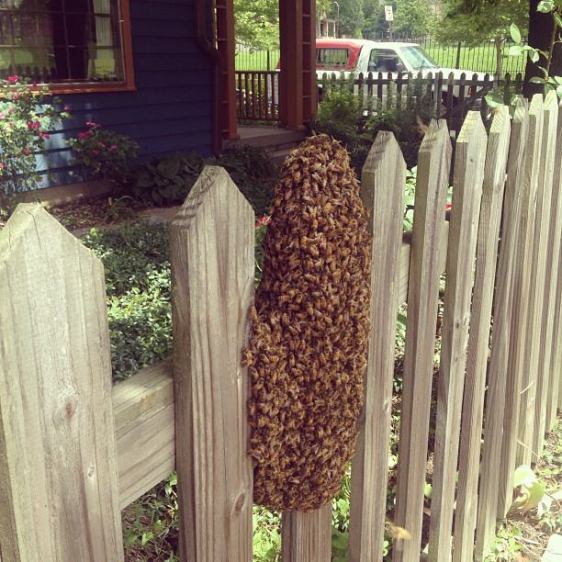
Swarm on a fence post in summer 2013. Kate scooped them by (gloved) hand into a box before transporting them to their new home at South Circle Farm.

Swarm on a fence post in summer 2013. Kate scooped them by (gloved) hand into a box before transporting them to their new home at South Circle Farm.

Her passion for these pollinators leads her to give talks and workshops emphasizing their importance. “Since 2006, we’ve lost more than one-third of our honeybee colonies nationwide, due in major part to Colony Collapse Disorder, an alarming phenomenon that occurs when the bees mysteriously desert their hive and die,” she writes.

“One out of every three bites of food we eat was made possible by a bee. So no bees, no food.”

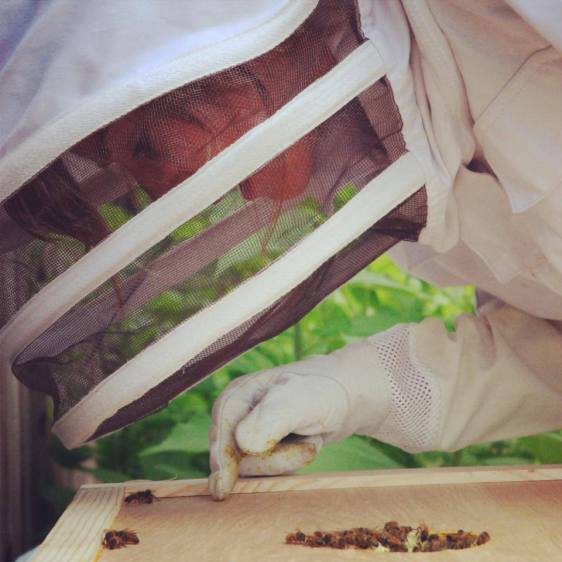
Kate and a few of the creatures on whom our lives depend

Kate and a few of the creatures on whom our lives depend

The unusually harsh winter killed all the bees in Bee Public’s hives, so Kate initiated a crowdfunding campaign to raise money to replace the honeybees. The response has been one of “unprecedented generosity,” prompting her to pledge to purchase replacement bees for other urban farmers and expand the network of hives.

On May 10 at Pogue’s Run Grocer, Kate will present Bees 101, an overview of how to create a bee-friendly backyard. And if you want to take it further, Bee Public offers consulting and hive setup for local restaurants, community gardens, and urban farms. There’s even a sponsorship option for people not in a position to have a hive. Check out Bee Public’s site and Facebook page!

All photos courtesy of Bee Public.

The Face of Resilience

Guest post by Anna Welch

Anna Welch is a farmer in Rush County, Indiana. With her husband and business partner, she owns Fields of Agape, growing organic grain, beans, and seed. Now she’s working to establish a cooperative mill in Carthage that would allow many more organic and transitional farmers to bring their products to niche markets. After we had a conversation about some of the barriers she’s faced, she sent me this reflection.

I think of the many times I wanted to quit, that it felt impossible to go forward with the limited resources and lack of support around me. I’ve been through periods of deep depression, anger, hopelessness, and resentment. I’ve been humbled many times over since committing my life to stewardship of the land and its fruit.

Anna Welch with friends at the entrance of the Carthage Mill. The historic Tweedy Lumber Mill is now the site of a sustainable ag business incubator.

Anna Welch with friends at the entrance of the Carthage Mill. The historic Tweedy Lumber Mill is now the site of a sustainable ag business incubator.

I had two choices: quit and return to the workforce, or retreat to a place of rest, and pray, reflect, journal, and wait to see who or what changed around me. Someone spoke words of encouragement, or a visitor stopped by the Carthage Mill and said how this place is necessary and will come to pass.

One of my greatest encouragers here at Carthage was my friend Allen, who came daily with his dog Rusty. The first day he stopped by, I was cleaning golden flax seed. He heard the machine and the gate was open, so he stopped. I’m so glad he did.

Allen had Lou Gehrig’s disease, but every day he drove his wheelchair on a route around Carthage, observing bean and corn fields, enjoying wildlife, and stopping by the mill, his favorite place. He worked the Alaskan pipeline in his younger years and lived in a teepee in Montana. He loved the mill, and he encouraged me to keep doing what I was doing.

I realized that if Allen could be in the state he was in and encourage me, then I needed to think outside of myself and look at what I could do to make a difference. Allen died this past October, and I officially formed The Carthage Mill, LLC with help from Hoosier Organic Marketing Education. I know he is pleased.

Regardless of the negative circumstances that we may be facing, there is always hope, always a divine purpose awaiting each of us—if we can turn our focus away from self and focus on those around us, on what needs exist, then determine what gifts and resources we have to overcome the challenge, or to serve someone. Nothing can stop us from fulfilling our purpose if we are on the right path.

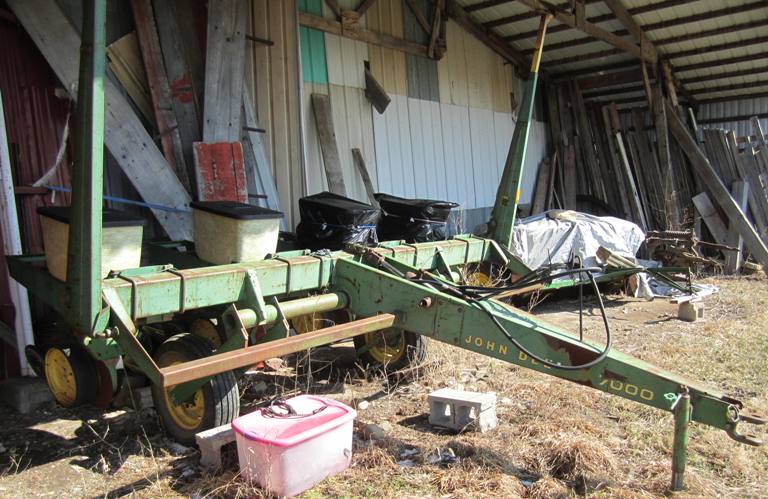
Equipment used to plant Fields of Agape grain and beans.

Equipment used to plant Fields of Agape grain and beans.

I have found that the success in life is how we learn to handle adversity and challenges. If we can grasp how to press on through adversity with humility and unconditional love for others (regardless of how they treat us), we will find our way.

When we find like-minded people whose passion is a good fit with our own, whose hearts are for others, then within that group each person can reach their potential quicker.

Encouragement, sharing of resources, being driven by the passion to serve rather than by personal gain—all of this brings about magnificent changes in communities large and small.

I’m never going to stop believing that it can happen.

A Beautiful Thing

As the Intergovernmental Panel on Climate Change gathers in Japan to finalize their report on the status of global warming, I’m thinking about hope. Hope as choice and saving grace. Here’s a piece I wrote some time back.

My spouse and I recently watched a library DVD of the HBO series Enlightened, in which Laura Dern plays a woman seeking to expose the wrongdoing of her corporate employer.

Photo by manyhighways.com, via Flickr Commons

Photo by manyhighways.com, via Flickr Commons

The show is a mix of humor and pathos and drama, with the main character, Amy Jellicoe, revealed as both tender-hearted and colossally insensitive. She’s self-centered, obnoxious, impulsive—and, at times, luminous in her dreaming of a different world.

By the last episode, Dern’s character has discovered the cost of being a whistleblower, having lost her job and her love interest. The last blow comes when Amy’s mother says she is no longer welcome to live in her house.

The final scene finds her knocking at the door of her ex-husband Levi, who knows her best. Sitting next to Levi on his front stoop, Amy asks him, “Am I crazy?”

What a question. I’ve asked it of myself so many times. Am I crazy to think that this world can transform, that we can evolve as a species? Am I crazy to believe that we can pull each other to a higher vibration—one that would usher in a new era of equity and resilience?

Am I insane to believe that we can still thrive, even in the face of this terrible and seemingly irreversible mess we’ve made?

In the final words of the series, Levi, played by Luke Wilson, turns to her and says, “No.”

He says, “You’re just full of hope. You got more hope than most people do.”

He tells her, “It’s a beautiful thing to have a little hope for the world, you know?”

Photo by ZeHawk, via Flickr Commons

Photo by ZeHawk, via Flickr Commons

I’ve come to believe that to be hopeful is rarely foolish, or naïve, or crazy. Or if it is all of those, perhaps it doesn’t matter.

Hope is a choice I make for the sake of my own soul and soul of the world, for the health of those around me. I regularly renew my decision to be a holder of hope.

I choose to believe that it’s possible to live in such a way that doesn’t steal from the impoverished on the other side of the world, that doesn’t rape the earth. I choose to envision the possibility of healing this beleaguered planet.

Maybe I am crazy.

But I still believe. This better world is on its way.

To Belong

Winter aconites blooming in March 2013

Winter aconites blooming in March 2013

“As the globalized, placeless world spreads,
and as progress is increasingly defined as the ability to look out of a hotel window in any city and see the same corporate logos lit up in familiar neon,
it could be that the most radical thing to do
is to belong.”

Paul Kingsnorth, Real England

Relocalizing the Food System

I love writing stories about food and farming. The people I meet are so passionate about their work. Almost everyone I interview is invested in reforming the broken food system. Bonus: They give me tasty things to eat.

Here’s a rundown of the treats I’ve sampled just in the past few weeks.

  • Cissy, a woman who’s long been the vanguard of Indiana’s organic movement, gave me some intensely flavorful pickles she made from cucumbers raised in her kitchen garden. I washed it down a glass of homemade kombucha that couldn’t be beat.
  • Jim, a farmer in Owen County, sent me home with a bunch of carrots he pulled from the wet earth like a late winter miracle.
  • Anna, a farmer in Rush County, gave me a huge jar of rolled wheat that her cooperative had grown and milled. (I used some in banana bread I baked for my weekly writing date—my writer buddies pronounced it wonderful.)
Checking out a display of LocalFolks Foods at Moore Corner Store while on assignment

Checking out a display of LocalFolks Foods at Moore Corner Store while on assignment

And a couple weeks ago, at Moore Corner Store, proprietor Jasen Moore offered me a taste of ketchup made by Indiana’s own LocalFolks Foods.

I’m no ketchup connoisseur, and in fact we never purchase it. But if I were a fan of this most American of condiments, I would never buy a national brand again. LocalFolks’ is sweetened with sugar, not the genetically modified scariness that comprises high-fructose corn syrup.

I happened to be in the natural food store when Hoosier Microgreens’ Alex Sulanke came along to introduce his product. So I got to munch uber-fresh sprouts of radish, cabbage, kale, arugula, and mustard from “the smallest farm in Indiana” (120 square feet).

Moore Corner Store is in the business of connecting small farmers and food entrepreneurs to the consumer. Though its hours are limited at present, this shop and others like it fill a critical role in relocalizing our food system.

For Jasen and his wife Sara, Moore Corner Store is more than just a business. It’s a mission. Jasen told me the enterprise arose out of concern for the state of our economy. Big box stores have fragmented communities and hurt the little guy.

Moore2“But a store like this…supports the local economy, minimizes carbon footprint, puts actual nutritious food on your plate, and it’s close to home.” The Moores live just up the street from the shop, though both must spend time elsewhere to make ends meet.

I just saw a documentary called Down to Earth in which the iconoclastic farmer Joel Salatin (made famous in Michael Pollan’s Omnivore’s Dilemma) made an important point: Your purchase of a farmer’s product might be the thing that keeps that farm afloat another week.

Is it worth changing our habits to spend a little more of our money at a farmers’ market or a shop like the Moores’? I would say yes. What about you? Have you connected with a small farmer, producer, or locally owned shop lately?

Check out my piece on Moore Corner Store here.