Seven Steeples Farm

Last month I got to meet Justin Berg and Mike Higbee, who are doing something I admire: turning unused urban land into an agricultural oasis. As with many such endeavors, they glean local materials to build soil—leaves from curbside refuse, manure from the police department’s Mounted Patrol stables.

What’s unique about this urban farm, though, is that it’s being built atop the pulverized remains of an old mental institution.

Seven Steeples Farm

Seven Steeples Farm

To anyone growing up in Indy, as I did, “Central State” was synonymous with the loonybin. We all knew that it was an insane asylum, back in the day, and as late as 1994 it was still operating as a psychiatric facility.

The enormous campus fell into disuse after Central State Hospital closed, but recently the site has been redeveloped into Central Greens urban village. Part of the project includes Seven Steeples Farm, so-called because the 5-acre parcel being farmed is on the footprint of a building called Seven Steeples, where women were institutionalized.

The building was demolished midcentury, and apparently is now buried under the vast lawn area where Justin and Mike have begun growing produce for the past year. Sheltering old trees that must have borne witness to all kinds of pain still stand, shading the chicken run and outdoor classroom area.

I have to say, this thing has lit my imagination in surprising ways. I’ve read The Yellow Wallpaper and other stories of “madwomen in the attic.” How easy it was to cart women away for any infraction back when this asylum was established (1850s.) I can think of several reasons why I myself, in an earlier era, could have gotten myself tossed in there.

And what sort of “treatment” did the women undergo, inside the walls of Seven Steeples?

It feels to me like a major healing of an old wound to have an urban farm there. Community volunteers (and patrons) enjoy a peaceful setting smack in the middle of a somewhat sketchy part of town. The food is accessibly priced so that people living in the middle of a food desert can have a decent choice of nourishment.

Justin Berg, farm manager, and Mike Higbee, project coordinator, with lady friend

Justin Berg, farm manager, and Mike Higbee, project coordinator, with lady friend

Visitors love to sit on the stumps next to the chicken run and just get on “chicken time.”

The farm has announced 2015 CSA (community supported agriculture) plans, and will also have a weekly farm stand to sell eggs and produce. (More info: info@sevensteeplesfarm.com or 317-713-9263.)

Justin says, “Call to set up a tour, and everyone’s more than welcome to come by the farm stand if they’re in the area. They can grab up some produce and come check out what a rural setting could look like in the city.”

See my Farm Indiana piece for more on this project.
Wild Geese Wisdom

From Wendell Berry’s poem “The Wild Geese” comes this steadying stanza:

…And we pray, not
for new earth or heaven, but to be
quiet in heart, and in eye
clear. What we need is here.

I found his poem in a new essay collection called Sustainable Happiness, edited by the staff of Yes! Magazine. It reminded me of my introduction to the poet Mary Oliver, whose poem “Wild Geese” begins:

You do not have to be good.
You do not have to walk on your knees
for a hundred miles through the desert repenting.
You only have to let the soft animal of your body
love what it loves…

This was my first Mary Oliver experience years ago: having this poem recited just for me by my Rolfer while he worked the fascia of my feet to smithereens. (Rolfing is a super-intense type of bodywork that pairs well with poetry.)

I give you the lovely Mary Oliver, reading her poem.

Real Security

Last week I heard an NPR story about an interesting social study. Researchers surveyed residents of Palestinian towns before and after dismantling certain checkpoints that had been set up by Israeli forces.

In areas where the checkpoints were removed and people had greater freedom to move about their towns, the local Palestinians expressed much greater support for a peace process with Israel. Not only that, but there was a corresponding behavior change, with a decrease in Palestinian violence against Israelis in these areas.

It seems like a no-brainer that people would soften their attitudes if restrictions are lifted. The report noted that humiliation is a big driver of anger and violence, per numerous other social studies.

But the point the researchers made was this: Checkpoints put in place to increase security for Israelis actually had the effect of decreasing security.

Real security was achieved by dismantling them.

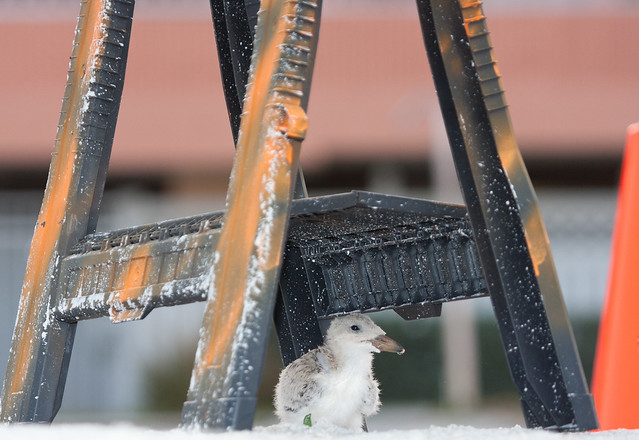
Baby Black Skimmer Barricade

Hearing the story made me think of a workplace dynamic that had upset a dear friend who’s otherwise happy in her job. Her manager had reacted harshly to a decision my friend had made, and expressed a need to control future such decisions. My friend felt hurt and angry, interpreting this as a lack of faith in her judgment.

The manager’s intent may have been to control an outcome, but the end result was employee dissatisfaction. By enforcing her will, the manager stands to lose the contributions of an innovative thinker. Instead of making the team’s work stronger, she’s created insecurity and mistrust.

A security checkpoint, a squelching of autonomy: It feels the same to me, energetically.

I see everything as an opportunity for self-reflection, and I also believe that anything healed within me helps to heal the world. So these stories prompt me to ask where I have played out a similar story within myself.

Have I posted a guard where it’s not needed, cutting me off from people perceived as “other”? Have I jerked the reins of my creativity in an effort to produce? Have I impeded the flow of inner wisdom with my expectation of a particular outcome?

Wisdom (62/365)

How can I personally move from this old story of control and domination to a new story of trust, openness, and listening? What does it take to nurture that movement in myself and others?

The Steps We Take Now

“We can indeed transform the world, and we are each called to take part in this sacred work.”

—Desmond Tutu, from the Foreword of Random Kindness

It seems that every day brings news of another horrific act of violence. The level of cruelty reaches appalling levels. Where are we going and why are we in a handbasket, as my mother would say?

But recently I got my hands on the reissue of this beautiful book, and it is like an inoculation against hopelessness.

Are we moving “closer and closer to a world where everyone is dead for no reason,” as the book describes one possible scenario? Or are we waking up to the fact that “we’re all making the soup we’re all eating?”

I first learned of this fabulously illustrated work from my sister Mesa Refuge resident Paloma Pavel, who is a total powerhouse. Years ago she started working in the anti-nuclear movement with Joanna Macy (my idol!), and she hasn’t stopped advocating since.*

Paloma coauthored the lovely little book expanding on the saying Practice Random Kindness and Senseless Acts of Beauty. Her coauthor, Anne Herbert, originated this statement, and the two originally collaborated on Random Kindness and Senseless Acts of Beauty in response to the Rodney King riots in Los Angeles.

An artist named Mayumi Oda (the “Matisse of Japan”) illustrated the book in a traditional folk art style based on 12th century Japanese picture scrolls. Frogs, cats, monkeys, birds, and rabbits play the part of humans on a dual path—will they (we) choose destruction, or delight?

Historically in Japan, this type of folk art used animal representations to spread subversive messages. It seems an apt medium for a book that proclaims, “We are all leaders now.”

The 20th anniversary edition has just been published. I had the thrill of hearing Paloma read its lyrical text on our last night at Mesa Refuge, a full year before the book was reissued.

Myself, Sierra Murdoch,  Jerry and Gail Needleman, and Paloma Pavel at Mesa Refuge

Myself, Sierra Murdoch, Jerry and Gail Needleman, and Paloma Pavel at Mesa Refuge

So beautiful:

“The steps we take now
Make new earth grow beneath our feet.”

“In every moment we live
We have the choice
To find the fight
Or make delight
We have power.

To hear Paloma read the full text aloud was just magic.

I borrowed the book from the library for now, but I plan to purchase my own copy. All royalties will be donated to antinuclear advocacy and community resilience across boundaries.

*Check out more of Paloma’s work at Earth House Center and Breakthrough Communities.

A Hollow Reed

Years ago when I was untangling the emotional roots and antecedents of fibromyalgia, I saw a counselor, a lovely 60ish-year-old man with round spectacles. I kept hoping he would hook me up to his biofeedback machine and fix me. I would sit in a chair in front of him and look over at the biofeedback station significantly. Kind of like my dog points his nose at the treat bag, with great hope and impatience.

On our initial phone call I had told him that biofeedback was what I needed. I figured I would force my beleaguered body to relax, and boom, all would be well.

Instead, he asked me to close my eyes and breathe. How did my body feel, sitting in the chair? Where was the pain, where was the tiredness? What did it want to say? He’d ask me to play witness to the tumult inside me. “We are present to this discomfort,” he would say.

Eventually the witnessing came around to breathing in openness and ease. I was never long in his presence before I felt it: the touch of the Divine. I breathed in and invited it. The ache in my chest might grow more pronounced, but with each inhalation, I felt a lightness flood every cell, until the ache transformed into something softer, like a blossom opening to the sun.

Sunlight

I don’t remember specifics from our time together, except the way my breath would flow the length of my body. I drew it in from my feet and exhaled it out my crown, an old yogic practice.

“You see how this is right there for you, as soon as you invite it?” I remember him saying. “This is your gift.”

It didn’t seem like much of a gift at the time, even though those meditations brought the rare sensation of settling me fully in my body. The grounded feeling never lasted; one step out of the haven of his office—that luscious sweetgum tree outside the window!—and I would leave my body again.

One thing stuck with me: He said once, “I am not the doer here,” with his long fingertips pressed to his white canvas shirt. “I am not in charge.”

He spoke of being a hollow reed, the Divine playing its music through us. “We just need to step aside, get our egos and personalities out of the way,” he said.

埙

I wasn’t sure that was possible, for me.

These days I find myself opening to that possibility, as I check in with guidance every step of the way. For the first time, I don’t plant myself so firmly in the driver’s seat.

I wrote about my tendency to push 18 months ago; rereading the post now, I see how I was playing with the idea of surrender, which had been enforced (again) by illness.

Only now is this starting to filter into daily practice. If life moves in a natural ebb and flow, as Charles Eisenstein suggests, then aligning my own activities with that natural movement brings a delicious serenity. Not only that, but cosmic forces line up to push me farther than I could ever push myself, and with much greater ease.

So I pause and ask: Is it actually time to do what the ego/driver in me wants to do? Or is it time to do something else? I’m finding more ease and joy as I move through life open to the possibility that it’s not all up to me.

Kinship

An ancient hackberry tree holds my heart this winter. I visit it on many of my walks.

beautiful hackberryA tree that has lived a long time has something to say about holding and releasing. I try to listen. (Maybe there’s a wise tree in your neighborhood who calls to you. I hope I’m not the only one out here hugging trees. I feel that they want us to give in to the impulse!)

I love to lean against the hackberry and feel its life force thrumming under my touch. Sometimes I rest my cheek against the bark and stretch my arms wide. Other times I wedge my feet between its tall roots and press my spine to the trunk.

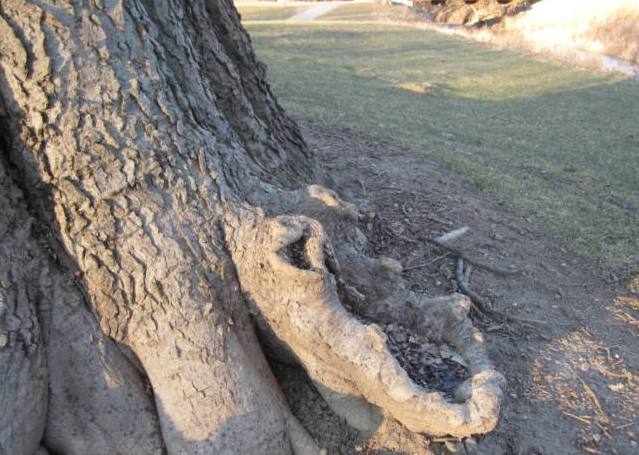
IMG_4461I could probably explore this tree for weeks and never know it fully. The roots have made a mysterious bowl here.

IMG_4464Here’s a front view of the same formation. Now it is an open mouth under two eyes.

IMG_4463Here the roots meander, a tangle of ropes.

IMG_4462Every time I touch this wise tree-being, I say: Thank you, and I love you. Standing in its presence, I feel I can send my care deep into the heart of the earth.

Perhaps tree-beings are speaking to you too? Or am I alone in thinking the borders between us and our kin are thinner than we once imagined?

Note: For another view of the tree that shows myself and my (somewhat indifferent) dog, check out the Spacious Light Intuitive Arts page.

Step Up to the Fire

One of my favorite year-end practices comes at Solstice time, when we gather with friends to mark the longest night. While we welcome the return of the light, we let go of what no longer serves us.

My spouse and I have been doing this with various groupings of women friends for a couple decades now. We build a fire and each burn something to symbolize what we’re ready to release.

IMG_4453Over the years I’ve noticed a shift in the types of things people throw on the fire. If I remember right, in our 20s and 30s we often burned things like business cards, to symbolize an important job transition. I recall burning “toxic” letters, wanting to shift a problematic relationship.

Looking back, the focus felt external to some degree: We needed to declare that something was over and done, and move on.

(I do recall that one creative soul burned a photocopy of a sponge, to indicate she no longer needed to absorb everyone else’s “stuff.”)

In general, nowadays, it feels like we all are more apt to turn our focus inward. What is it within me that is ready to slough off? Is it my need to be right? my habit of pushing? my fears? my dismissive self-talk?

One by one, we step up to the fire and burn the pattern that’s holding us back.

At our 2013 Solstice celebration, this is what I committed to the fire: my need to distract myself. What would happen, I wondered, if every time I thoughtlessly drifted to Facebook, email, or some other addiction, I first checked in on my inner world?

The result, over the course of the year, was a deepening of quiet, and an opening of possibility. I began to turn toward whatever plagued me instead of overriding it. I began to listen more carefully to guidance, to seek it, to act on it.

I had been moving in this direction since my dear friend, energy healer Merry Henn, introduced me to energy work several years back. In a 15-year quest to heal from fibromyalgia, the “invisible arts” (as I sometimes call them) proved indispensable. In combination with other healthy practices, energy healing and emotional clearing have brought me back to resilience. I no longer get sick at the drop of a hat, and I no longer need the maintenance regimen that sustained me for so long.

Now I find myself offering intuitive sessions and hands-on healing work to others, integrating everything I’ve learned. I never imagined myself in this role. But it turns out to be one of the most meaningful contributions I could ever make to a new Story of Reunion.

It was the Solstice ritual that helped me receive this unexpected gift.

I won’t say yet what I burned at the 2014 Solstice gathering, but who knows what magic is afoot after that releasing?

Every Day

I’m not one to do Christmas in a big way. In fact I can get quite tired of the holiday, which seems by turns tawdry, labor-intensive, and loaded. Since we don’t have children, there’s no pressure to create a memorable and magic Christmas, or to buy a lot of guilt-inducing gadgetry. I mostly stick to the humble and homespun kind of gift, like these lumpen loaves.

Mesquite bread, made with chili peppers and cilantro.

Mesquite bread, made with chili peppers and cilantro.

Still, I can get into the (self-created) pressures of the season as much as anybody. Something about the holidays hits all my “not enough” buttons.

So when someone said to me recently, “I think every day should be Christmas,” my immediate thought was something along the lines of “heck, no,” only saltier. But she was talking generosity, of course, not pressure and parties.

And this morning, when I woke up with a sense of excitement (even after all these years, like a kid!), I thought about that. What if every morning, we all woke up suffused with joy, anticipation, and love? What if every day was devoted to family and friends, and feeling so abundant that we share our gifts all around?

What if we kept the wonderment, the generosity, the magic—and lost the commercialism?

Then every day would be like Christmas.

The More Beautiful World

I’ve been savoring Charles Eisenstein’s book, The More Beautiful World Our Hearts Know is Possible. It’s affirming, challenging, stimulating, surprising—and filled with wisdom for this age of crisis. Nature in my hands Shared cultural myths make up the “Story of the People,” the beliefs we all hold about the way the world works. Eisenstein notes that the old story is beginning to crumble as we see institution after institution unveiled as unworkable, untenable. He shows how this old Story of Separation—based on control, force, domination, competition, and scarcity—informs everything we see: the prison system, food system, educational system, money system—not to mention religious institutions, childrearing practices, and even activist organizations.

Even the medical establishment’s treatment of illness is based on this model, where bacteria is the enemy we need to conquer to save our own skin. (Never mind that 90 percent of the cells that make up a human are actually bacteria and fungi!)

This overarching cultural myth—that we are separate from each other and the rest of nature, inhabiting a hostile universe built on random accident and competition—is the source of much pain, violence, despair, and exploitation.

But the old story is beginning to fall away as a new Story of Connection takes its place. This transition is far from complete, Eisenstein says. And the time between stories is fraught. Many of the institutions are revealing their true natures in horrifying ways, and our usual tactics seem useless in the face of the horror. That’s because the tactics are also made of that old story. Compelling people to change by force or ridicule, demonizing institutions and leaders as evil, even rushing to action or response before the best path is clear—these are all born from a model that won’t work anymore.

Meditation

“The situation on Earth today is too dire for us to act from habit—to reenact again and again the same kinds of solutions that brought us to our present extremity. Where does the wisdom to act in entirely new ways come from? It comes from nowhere, from the void; it comes from inaction.”

That passage is one of many that resonate with me, especially since I’ve been spending so much time in that void he mentions. Sometimes I worry that by the time I emerge from this cocoon the world will have been fracked to death. That urgency to stop such horrors is real, but we need to reach deeper than action. Our task is to create something new that leaves these old systems and tactics in the dust. We need to make a whole new world, based on the vision of connectedness. NJ - Montclair: Montclair Art Museum - Earth Mother Eisenstein brings up the ebb and flow of the birth process. Much of the time the mother is not pushing, but resting. When the time to push comes, the urge is unstoppable. But the push comes in its time, and not before.

“Can you imagine saying to her, ‘Don’t stop now! You have to make an effort. What happens if the urge doesn’t arise again? You can’t just push when you feel like it!'”

The question is, what are we gestating? What kind of world wants to be born?

Peas and the Possible

“The Possible’s slow fuse is lit

By the Imagination.”

—Emily Dickinson

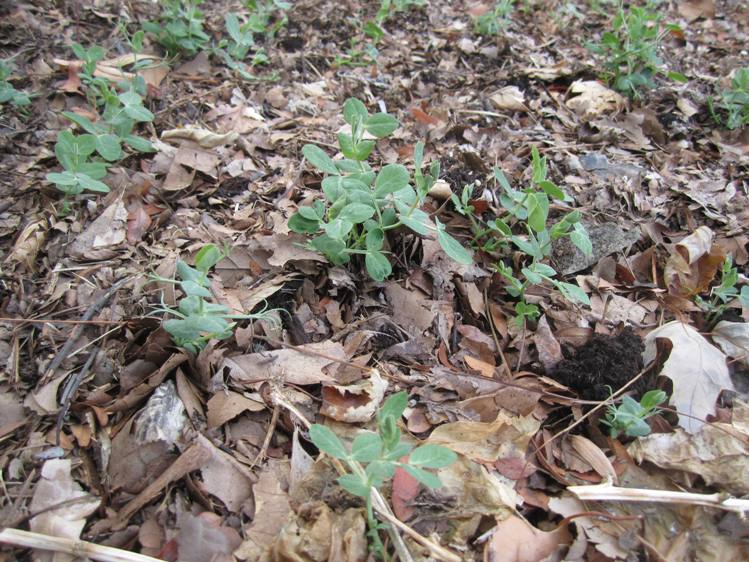
Austrian winter peas planted in my garden

Austrian winter peas planted in my garden

We have already had snow and single digit wind chills here. Yet these Austrian winter peas, planted very late, still grow.

My friend Dawn gave me a couple generous handfuls of seed to play with. I’d never heard of this hardy cover crop that doubles as a tasty wintertime salad green. But Mother Earth News had the full scoop on  planting Austrian winter peas. So somewhere between transplanting herbs and cooking up harvest stews, I threw those seeds in the ground.

I’m so glad I did!

This is the time of year when nighttime slams down on us pretty hard. A time for diving deep and dreaming. Those tender sprouts remind me that sweet tendrils of possibility can thrive in this liminal space.

I’ve been spending a fair amount of time in a space of unknowing. Allowing guidance to emerge organically, and playing with a deeper trust than I’ve ever had before.

And I love walking out my back door and seeing my little crop. If I never get to eat the shoots, I’ll be perfectly happy just with the view.

Thanks to Yes Magazine‘s Winter 2015 issue for the stunning Dickinson quote.