Magnify Love

Do your little bit of good where you are; it’s those little bits of good put together that overwhelm the world.

—Desmond Tutu

Here in the U.S., we’re feeling the reverberations of yet another mass shooting. Some call it the deadliest in our nation’s history. Even as I unplug from the news cycle, I’m energetically affected by the pain and anguish, the anger and fear.

Sadness is mostly what I feel when I think of the shooting. When I remember to, I turn toward the sadness, feel it in my body, notice the wish to numb it, alongside the urge to amass information in support of my personal philosophy about these types of tragedies.

I “embrace, allow, include,” as I’ve been coached in mindfulness training. I open up room for all my responses and attend to them with kindness. In that space I can consider right action.

All of which gives me more compassion for others on their own path.

I like to believe that humanity is evolving in a positive direction, appearances (seemingly) to the contrary. The horrible things that happen always grab our focus, fuel our outrage. It’s the same with the inflammatory things said by some pundits and politicians: Our attention gets hooked by ugly things that seem to confirm the awfulness of everything. And the ugliness magnifies.

A wise yoga/meditation instructor recently reminded me that our brains are wired to notice the snake amidst the flowers. Danger! Alert! We fixate on the negative. It’s biological.

Flower (1024x768)

No snake, just flower.

Mindfulness meditation creates an opening for a new practice to emerge. It offers a brief space—the length of a breath—in which we can begin to choose.

I wonder: what if we train our attention on something other than the horror? Not to look away blithely denying injustice, but turning toward the little acts of love and solidarity, small exchanges of soul happening every day. Is it a copout, born of privilege, to even suggest such a thing? Or is it an opening?

Some schools of Buddhism teach that the material world is nothing other than a construct of mind. What mind do I wish to inhabit?
Illusion (768x1024)

What do I choose to magnify with my attention?
Guest Post on Kindness

Today’s guest post is by my friend Heather Horst, and fits right in with a campaign by Indy Holistic Hub to spread kindness in December. #GetYourKindnessOn is the hashtag we are using to shine a light on compassionate acts we encounter. (I’ve found it quite uplifting, during these fractious days, to tune my radar to kindness. If we watch for compassion, nourish it, and spread it, we can’t help but magnify light.)

Guest post by Heather Horst

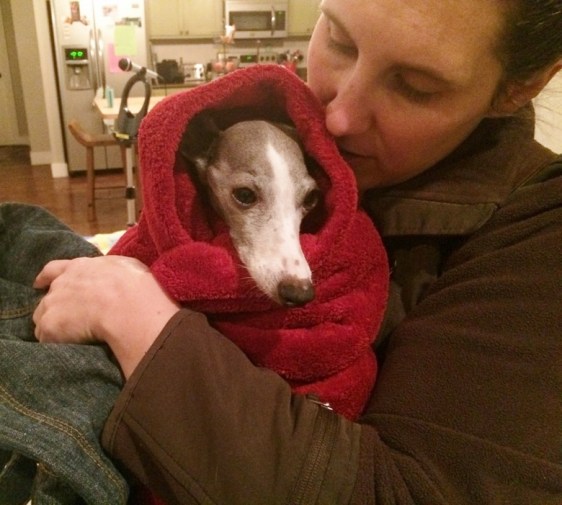
Lately I’ve been fostering a dog who is both gravely ill and incredibly sweet. Her name is Joy, and she’s pictured here.

Joy and Heather (780x701)

Joy and Heather

I’ve also been called out to do massage therapy during a friend’s labor and delivery. Between the two, there has been so much kindness. I’ve experienced so much support in caring for Joy. I’ve witnessed so much kindness and care for my brave friend as she worked hard to bring her baby into the world.

When I glance from my real life to national and world news, it’s culture shock. Because I’m not hearing about kindness. I’m hearing about brutality and a turning-away from the suffering of others, a turning-away from one’s own humanity.

I don’t accept that this is our true nature. It feels like a brokenness, a wound, an illness.

I trust that kindness is our true nature. That one day so many of us will be healed by (and healed to) kindness. So many of us will heal that when brutality or callousness appears among us, we will recognize it as an aberration.

We will surround it and heal it and not give it weapons or money or media attention.

…when brutality or callousness appears among us, we will recognize it as an aberration. We will surround it and heal it and not give it weapons or money or media attention.

I trust that kindness is our true nature. To those of you who have been carrying out these many kindnesses — THANK YOU! You heal my heart.

Heather is a nurse, a massage therapist, a spinstress of hula hoops and an amateur urban farmer. She lives, works, and plays in Goshen, Indiana.


What’s Already Here

This week in yoga class we opened our arms wide and bowed in surrender.

6427108983_8c8777c9d0_z

How I feel in yoga class at Irvington Wellness Center. Photo by Mitchell Joyce, via flickr Commons

Our teacher, Gaynell Collier-Magar, invited us to open in gratitude for the extraordinary privilege of experiencing what’s already here. We stood as trees with arms outstretched and my fingertips brushed the hand of Joyce at my left. Then later, lying back in a spinal twist, my fingers contacted Scott’s on my right. Each student deep in our space but connecting with the other.

The goodwill and warmth created in that space fed me, like it does every week.

And not just because they sang Happy Birthday to me before class. (“It’s not just a yoga class, it’s a community,” Gaynell said, and she’s right.)

She led us in half sun salutations, invoking joy as we raised our arms high, surrender as we opened our arms and bowed, equanimity as we rose halfway with hands on shins, surrender again as we folded to the floor, joy again as we rose to circle-sweep our arms high, and finally connection with the sacred as we rested our hands in prayer position at our hearts.

Yeah, it’s that kind of class. The kind where you know you’re just really lucky to be able to sit and breathe in awareness—even though the same breath walks in with you, and you could easily(?) contact it any old time.

In this studio I often tremble in release while holding postures, and even if I don’t understand it on a conscious level, I know that things are moving through me. Sometimes I cry. I cried this time while crimped into a half pigeon posture, leg folded under my torso, forehead on the floor, listening to Donna De Lory sing of being a sanctuary.

The tears came again in a forward bend while the song Mercy poured over us.

“One by one, could we turn it around,” etc. It slayed me. The longing, the heartfelt wish for healing of the world. For everyone to feel joy, surrender, equanimity, surrender, joy, connection.

What more is there than that?

And Now for Something Completely Different

I don’t very often blog about my personal writing project(s), but the terrific nature writer Katherine Hauswirth nominated me for a “blog hop” (writers sharing about their work). So, bear with me as I answer a few questions…

What is the working title of your book (or story)?
Thrivalists: Reimagining the World in an Age of Crisis is the working title of the nonfiction book I’m currently “shopping.” It’s in research/pitching phase, and in the meantime I’ve started work on another project, as yet untitled. Also, some of my articles and essays are linked here.

Where did the idea come from for these books?
Thrivalists came about when I realized how little media attention goes to the people who are pulling together to make a major shift on our planet. I’m so inspired by the community resilience movement and all its permutations. My goal with the book is to shine a light on folks working toward greater ecological/economic/social balance. (Secondary goal and total bonus: to get to rub elbows with fun people and learn all kinds of mad skillz.)

A sister volunteer/learner at an Olympia Mycelial Network project in Washington State

A sister volunteer/learner at an Olympia Mycelial Network project in Washington State

The second project is a work of creative nonfiction exploring my 15-year recovery from fibromyalgia, culminating in emergence of my own healing abilities. Part of my inspiration came from Seven Steeples Farm, where I’m helping to grow produce right where an 1880s-era women’s mental institution once stood.

What genre do your books fall under?
Creative nonfiction, tending toward memoir on the new project. Thrivalists is closer to immersion journalism, still with an element of memoir, and the book would be shelved under Green Living/Activism.

Which actors would you choose to play your characters in a movie rendition?
I’m thinking Julianne Moore could play this Mudgirl, but that’s as far as I’ve gotten on that question!

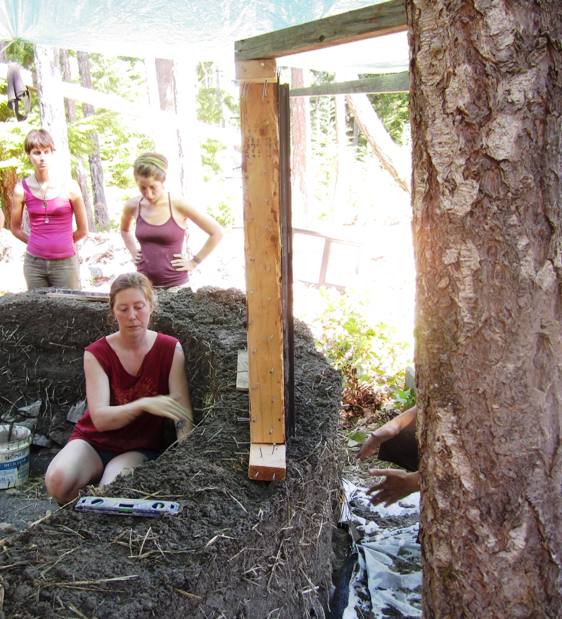
Rose (inside wall) facilitates a Mudgirls workshop.

Rose (inside wall) facilitates a Mudgirls workshop.

What is the one-sentence synopsis of your book?
Oof. Can I buy a sentence?

During a season of tending crops at Seven Steeples Farm, where the tomatoes and peas grow from ground that once held a 19th century mental institution for women, Shawndra Miller explores the turn in her own life from a 15-year bout with a debilitating mind/body ailment. While working the land she reflects on a wider societal transformation embodied by Seven Steeples, where something new is growing on the shell of the old.

Will your book(s) be self-published or represented by an agency?
I’m open at this point. My book proposal for Thrivalists has been making the rounds of agents and small presses. Meanwhile, I’m enjoying the process of discovery on the new project, while continuing to explore and highlight the community resilience movement.

How long did it take you to write the first draft of your manuscript?
The original Thrivalists book proposal, with a couple sample chapters, took about six months, but I keep adding to it as I travel and research, so it’s a moving target. The new one is still very young.

What other books would you compare this story to within your genre?
Thrivalists is a bit like Omnivore’s Dilemma in the way that the author’s process of research and discovery pulls the reader along. In subject matter, it’s close to Walk Out Walk On: A Learning Journey into Communities Daring to Live the Future Now by Margaret Wheatley and Deborah Frieze.

It’s hard to say on the new project since it needs more time to bake, but it might be compared to When Women Were Birds by Terry Tempest Williams.

Who or what inspired you to write this book?
I’m inspired by Charles Eisenstein’s work, in particular The More Beautiful World Our Hearts Know Is Possible. Without a massive consciousness shift, no amount of environmental activism or social change work will alter the bottom line of a culture built on dominance, control, and fear. That’s part of what I want to explore in the new project.

Thanks to Katherine Hauswirth for tagging me with this assignment! I nominate Julie Stewart, writer-and-farmer-in-residence at Urban Plot, to do the next blog hop.

The Reimagining

Scott Russell Sanders, one of Indiana’s sagest voices for social and ecological justice, led a workshop Sunday called Writing While the World Burns.* His books, from Writing from the Center to A Conservationist Manifesto, have inspired me and countless other readers.

Before I even read the workshop description, I knew I needed to be there.

Untitled

I wasn’t disappointed. Scott has a generosity, thoughtfulness, and grace about him that may be a product of his years, or perhaps he’s just built that way. He brought together a disparate group of deeply passionate people and got us talking about where our work and lives fit into the bigger picture.

I know I’ve been on a bit of a Wendell Berry kick of late, but Scott’s the one who gave a Berry quote as context for that exercise:

“The significance—and ultimately the quality—of the work we do is determined by our understanding of the story in which we are taking part.”

Where do we fit? What is our important piece of the puzzle?

In my case, my larger story has to do with lighting the Lights—spreading the word about the tremendous work being done on so many fronts. And not only that, but being a Light, in my own small way.

Earth Hour moment at home - Córdoba Argentina

In fact, “story” is an apt word, because I see all of these efforts as a grand transition to the Story of Reunion (in Charles Eisenstein’s words)—leaving the defunct Story of Separation behind.

As writers, Scott told us, (and as teachers, artists, visionaries, and the like) we enlarge people’s vision of what’s possible. We write a new language that can supplant that tired old ethic of economic gain at any cost. We expand people’s understanding of humanity by sharing our knowledge of those they might consider “other.”

In short, we reimagine the world, and invite others to join us.

*Many thanks to the Indiana Writers Center for offering this tremendous workshop.

Love Where You Live

I asked for a magnifying glass in my Christmas stocking this year. I’d just read Lyanda Lynn Haupt’s excellent book Crow Planet, in which she advocates becoming a “citizen naturalist.” I aspire to that: to take the time to look closely at nature, right here in the urban habitat. (She takes up a similar theme in The Urban Bestiary, which I enjoyed just as much.)

I wish I’d had the magnifying glass with me the other day when I was walking my dog and spotted the first yellow crocuses popping up. I could have fallen on my knees in front of them. I love the beauty of winter, but after days on end of white/gray/black/brown, that splooch of color just about knocks me out.

Photo by Vincent de Groot, via Wikimedia Commons

Photo by Vincent de Groot, via Wikimedia Commons

Wendell Berry has written of the importance of “backing out of the future into the present, where we are alive, where we belong.” As we make this shift, he says, we also move our focus from an abstraction called “the environment” into the places where we actually live.

This makes sense. When I co-founded the Irvington Green Initiative some years back, we settled on the tagline “Love Where You Live.”

The notion was echoed by my friend Maggie Goeglein Hanna, executive director of Fall Creek Gardens Urban Growers Resource Center. In a recent conversation, she said:

“I feel like you can’t really expect people to care about the natural world if they have no investment in their own place … In my mind, environmental solutions aren’t going to come if we’re only concerned about the pandas in China or the rainforest in the Amazon. Those are important things, but so is our own place, and it won’t ever get better if we all don’t take care of our own place.”

She went on to say that organic gardening in a community setting, as at Fall Creek Gardens, is a way of “opening up the conversation.” Finding earthworms in ground that used to be compacted dirt, watching a family of mockingbirds, planting seeds—all of these root us in the soil that nurtures us.

So with spring officially just hours away (wahoo!) (at least in the northern hemisphere), I’m doing more than planning this year’s garden. I’m renewing my commitment to enjoying the place where I live, and to observing the creatures and plants that share it with me.

What about you: What does it mean to love where you live?

The Steps We Take Now

“We can indeed transform the world, and we are each called to take part in this sacred work.”

—Desmond Tutu, from the Foreword of Random Kindness

It seems that every day brings news of another horrific act of violence. The level of cruelty reaches appalling levels. Where are we going and why are we in a handbasket, as my mother would say?

But recently I got my hands on the reissue of this beautiful book, and it is like an inoculation against hopelessness.

Are we moving “closer and closer to a world where everyone is dead for no reason,” as the book describes one possible scenario? Or are we waking up to the fact that “we’re all making the soup we’re all eating?”

I first learned of this fabulously illustrated work from my sister Mesa Refuge resident Paloma Pavel, who is a total powerhouse. Years ago she started working in the anti-nuclear movement with Joanna Macy (my idol!), and she hasn’t stopped advocating since.*

Paloma coauthored the lovely little book expanding on the saying Practice Random Kindness and Senseless Acts of Beauty. Her coauthor, Anne Herbert, originated this statement, and the two originally collaborated on Random Kindness and Senseless Acts of Beauty in response to the Rodney King riots in Los Angeles.

An artist named Mayumi Oda (the “Matisse of Japan”) illustrated the book in a traditional folk art style based on 12th century Japanese picture scrolls. Frogs, cats, monkeys, birds, and rabbits play the part of humans on a dual path—will they (we) choose destruction, or delight?

Historically in Japan, this type of folk art used animal representations to spread subversive messages. It seems an apt medium for a book that proclaims, “We are all leaders now.”

The 20th anniversary edition has just been published. I had the thrill of hearing Paloma read its lyrical text on our last night at Mesa Refuge, a full year before the book was reissued.

Myself, Sierra Murdoch,  Jerry and Gail Needleman, and Paloma Pavel at Mesa Refuge

Myself, Sierra Murdoch, Jerry and Gail Needleman, and Paloma Pavel at Mesa Refuge

So beautiful:

“The steps we take now
Make new earth grow beneath our feet.”

“In every moment we live
We have the choice
To find the fight
Or make delight
We have power.

To hear Paloma read the full text aloud was just magic.

I borrowed the book from the library for now, but I plan to purchase my own copy. All royalties will be donated to antinuclear advocacy and community resilience across boundaries.

*Check out more of Paloma’s work at Earth House Center and Breakthrough Communities.

A Hollow Reed

Years ago when I was untangling the emotional roots and antecedents of fibromyalgia, I saw a counselor, a lovely 60ish-year-old man with round spectacles. I kept hoping he would hook me up to his biofeedback machine and fix me. I would sit in a chair in front of him and look over at the biofeedback station significantly. Kind of like my dog points his nose at the treat bag, with great hope and impatience.

On our initial phone call I had told him that biofeedback was what I needed. I figured I would force my beleaguered body to relax, and boom, all would be well.

Instead, he asked me to close my eyes and breathe. How did my body feel, sitting in the chair? Where was the pain, where was the tiredness? What did it want to say? He’d ask me to play witness to the tumult inside me. “We are present to this discomfort,” he would say.

Eventually the witnessing came around to breathing in openness and ease. I was never long in his presence before I felt it: the touch of the Divine. I breathed in and invited it. The ache in my chest might grow more pronounced, but with each inhalation, I felt a lightness flood every cell, until the ache transformed into something softer, like a blossom opening to the sun.

Sunlight

I don’t remember specifics from our time together, except the way my breath would flow the length of my body. I drew it in from my feet and exhaled it out my crown, an old yogic practice.

“You see how this is right there for you, as soon as you invite it?” I remember him saying. “This is your gift.”

It didn’t seem like much of a gift at the time, even though those meditations brought the rare sensation of settling me fully in my body. The grounded feeling never lasted; one step out of the haven of his office—that luscious sweetgum tree outside the window!—and I would leave my body again.

One thing stuck with me: He said once, “I am not the doer here,” with his long fingertips pressed to his white canvas shirt. “I am not in charge.”

He spoke of being a hollow reed, the Divine playing its music through us. “We just need to step aside, get our egos and personalities out of the way,” he said.

埙

I wasn’t sure that was possible, for me.

These days I find myself opening to that possibility, as I check in with guidance every step of the way. For the first time, I don’t plant myself so firmly in the driver’s seat.

I wrote about my tendency to push 18 months ago; rereading the post now, I see how I was playing with the idea of surrender, which had been enforced (again) by illness.

Only now is this starting to filter into daily practice. If life moves in a natural ebb and flow, as Charles Eisenstein suggests, then aligning my own activities with that natural movement brings a delicious serenity. Not only that, but cosmic forces line up to push me farther than I could ever push myself, and with much greater ease.

So I pause and ask: Is it actually time to do what the ego/driver in me wants to do? Or is it time to do something else? I’m finding more ease and joy as I move through life open to the possibility that it’s not all up to me.

Putting the “Radical” in Mycology

Soon I’ll be on my way to this weekend’s Radical Mycology Convergence, an annual gathering of citizen scientists, mushroom enthusiasts, and other earth-loving types. It’s all about learning how to heal the earth by partnering with fungi.

Radical Mycology Collective founder Peter McCoy’s guest post explained how mushrooms become our allies, teachers, and partners.

“The Radical Mycology project revolves around just this philosophy: that by studying, working with, and learning from the fungal kingdom, humans can best find solutions to problems of personal, societal, and ecological health.”

—Peter McCoy

I mentioned before that I had a chance to help Peter and other radical mycologists with an installation of bioluminescent mushroom mycelium this summer in Olympia, WA. Here’s a bit more about that experience to whet your appetite for the convergence.

We used both “plug spawn” and “chip spawn” of a mushroom called panellus stipticus.

Peter holds a jar of "plug spawn"--bits of furniture dowel that he inoculated with mycelium.

Peter holds a jar of “plug spawn”–bits of furniture dowel that he inoculated with mycelium.

Panellus is not known for remediative properties, but for its ability to—seriously—glow in the dark.

I saw this bioluminescence for myself when I took a section of inoculated burlap home. Tiny mushrooms had emerged on the outside of the “chip spawn” bag, and they did indeed glow in the dark. One of the coolest things I’ve seen in a long time.

Checking out the "fruiting bodies" (tiny mushrooms) on the outside of the burlap bag full of inoculated wood chips.

Checking out the “fruiting bodies” (tiny mushrooms) on the outside of the burlap bag full of inoculated wood chips.

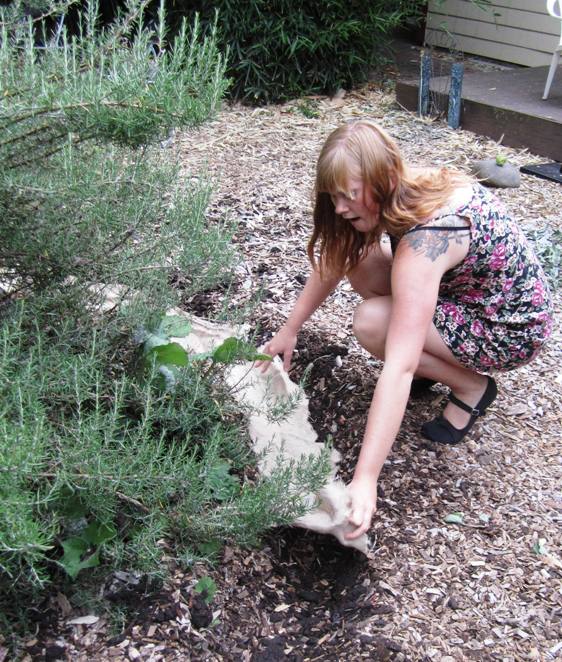
We used inoculated wood chips to make a path around an herb garden.

Lining the path with burlap

Lining the path with burlap

The hope is that on dark nights, visitors to the Commons at Fertile Ground will see a faintly glowing path. (And check the size of that rosemary plant in the photo above. That’s the Pacific Northwest for you.)

Spreading inoculated wood chips

Spreading inoculated wood chips

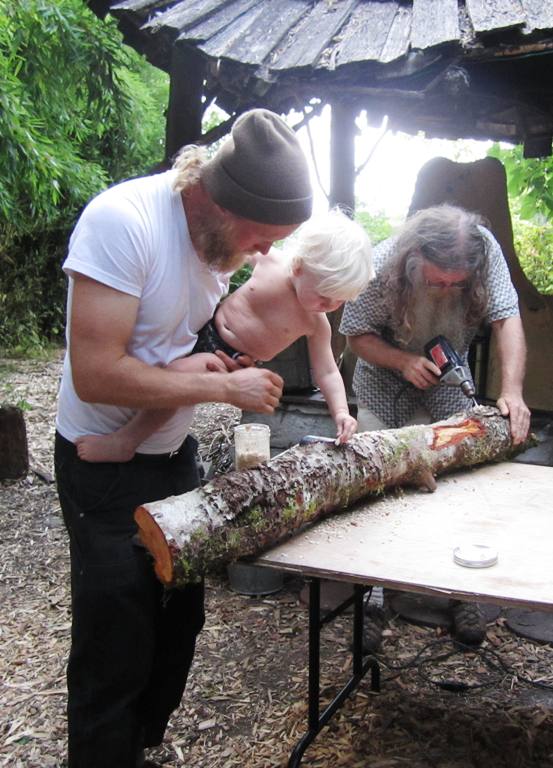
The dowel bits went into a freshly cut red alder log. Eventually the log itself should glow, or it may even pop out with little glowing mushrooms.

Drilling holes (at right) to be filled with plug spawn (left)

Drilling holes (at right) to be filled with plug spawn (left)

Peter emphasized that the same techniques could be used in a mycoremediation project, or to grow mushrooms as food or medicine.

Radical mycologists!

Radical mycologists (with finished alder log)

I’m so looking forward to learning more this weekend—it promises to be a deep immersion in all things mycological. A sampling of workshops:

  • Liquid Culture will Change the World
  • Direct Action for Myco-Activists
  • Permaculture for Radicals

The leaders will be guiding us through several onsite remediation projects. Other attractions: a Passion Show, culture/spore swap, and “forays.” Wahoo!

So to get in the spirit, for the first time ever I tried a mushroom called chicken of the woods. Its beautiful orange folds just called to me from the food co-op bin.

By Kbh3rd (Own work), via Wikimedia Commons

By Kbh3rd (Own work), via Wikimedia Commons

I’ve been sauteeing bits of it up with my eggs every day for lunch. I’m finding it a pretty complement to bright orange egg yolks, and it does taste like chicken. So here’s to trying new things.

Note: Registration is still open for the Radical Mycology Convergence, happening Oct. 9-13 in Orangeville, IL.

A Sacred Act

“Healing the wounds of the earth and its people does not require saintliness or a political party, only gumption and persistence. it is not a liberal or a conservative activity; it is a sacred act. It is a massive enterprise undertaken by ordinary citizens everywhere…”

—Paul Hawken, in Blessed Unrest

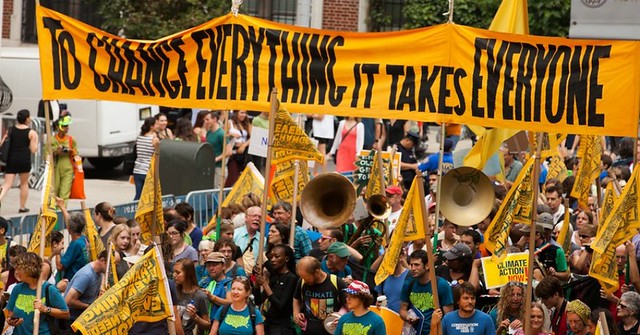
People's Climate March 2014 NYC
Some 400,000 people demonstrated for climate action in New York City last weekend. (A friend and I went to the youth-led Bloomington rally to help “raise the alarm” about climate change; the best part after the hooting and hollering was singing “We’ve got the whole world in our hands.”)

Stay tuned for a guest post from someone who joined the NYC demonstration.