The Steps We Take Now

“We can indeed transform the world, and we are each called to take part in this sacred work.”

—Desmond Tutu, from the Foreword of Random Kindness

It seems that every day brings news of another horrific act of violence. The level of cruelty reaches appalling levels. Where are we going and why are we in a handbasket, as my mother would say?

But recently I got my hands on the reissue of this beautiful book, and it is like an inoculation against hopelessness.

Are we moving “closer and closer to a world where everyone is dead for no reason,” as the book describes one possible scenario? Or are we waking up to the fact that “we’re all making the soup we’re all eating?”

I first learned of this fabulously illustrated work from my sister Mesa Refuge resident Paloma Pavel, who is a total powerhouse. Years ago she started working in the anti-nuclear movement with Joanna Macy (my idol!), and she hasn’t stopped advocating since.*

Paloma coauthored the lovely little book expanding on the saying Practice Random Kindness and Senseless Acts of Beauty. Her coauthor, Anne Herbert, originated this statement, and the two originally collaborated on Random Kindness and Senseless Acts of Beauty in response to the Rodney King riots in Los Angeles.

An artist named Mayumi Oda (the “Matisse of Japan”) illustrated the book in a traditional folk art style based on 12th century Japanese picture scrolls. Frogs, cats, monkeys, birds, and rabbits play the part of humans on a dual path—will they (we) choose destruction, or delight?

Historically in Japan, this type of folk art used animal representations to spread subversive messages. It seems an apt medium for a book that proclaims, “We are all leaders now.”

The 20th anniversary edition has just been published. I had the thrill of hearing Paloma read its lyrical text on our last night at Mesa Refuge, a full year before the book was reissued.

Myself, Sierra Murdoch,  Jerry and Gail Needleman, and Paloma Pavel at Mesa Refuge

Myself, Sierra Murdoch, Jerry and Gail Needleman, and Paloma Pavel at Mesa Refuge

So beautiful:

“The steps we take now
Make new earth grow beneath our feet.”

“In every moment we live
We have the choice
To find the fight
Or make delight
We have power.

To hear Paloma read the full text aloud was just magic.

I borrowed the book from the library for now, but I plan to purchase my own copy. All royalties will be donated to antinuclear advocacy and community resilience across boundaries.

*Check out more of Paloma’s work at Earth House Center and Breakthrough Communities.
A Hollow Reed

Years ago when I was untangling the emotional roots and antecedents of fibromyalgia, I saw a counselor, a lovely 60ish-year-old man with round spectacles. I kept hoping he would hook me up to his biofeedback machine and fix me. I would sit in a chair in front of him and look over at the biofeedback station significantly. Kind of like my dog points his nose at the treat bag, with great hope and impatience.

On our initial phone call I had told him that biofeedback was what I needed. I figured I would force my beleaguered body to relax, and boom, all would be well.

Instead, he asked me to close my eyes and breathe. How did my body feel, sitting in the chair? Where was the pain, where was the tiredness? What did it want to say? He’d ask me to play witness to the tumult inside me. “We are present to this discomfort,” he would say.

Eventually the witnessing came around to breathing in openness and ease. I was never long in his presence before I felt it: the touch of the Divine. I breathed in and invited it. The ache in my chest might grow more pronounced, but with each inhalation, I felt a lightness flood every cell, until the ache transformed into something softer, like a blossom opening to the sun.

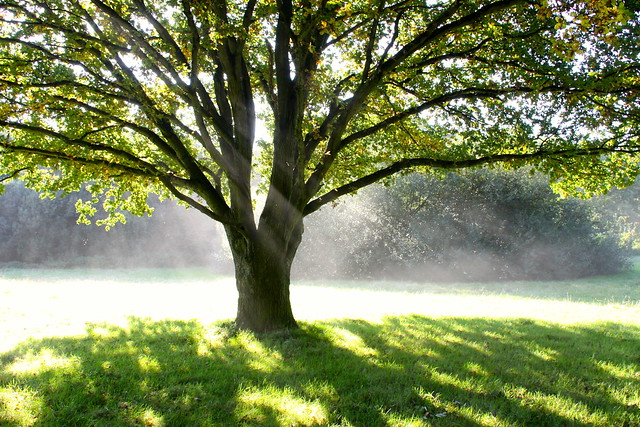
Sunlight

I don’t remember specifics from our time together, except the way my breath would flow the length of my body. I drew it in from my feet and exhaled it out my crown, an old yogic practice.

“You see how this is right there for you, as soon as you invite it?” I remember him saying. “This is your gift.”

It didn’t seem like much of a gift at the time, even though those meditations brought the rare sensation of settling me fully in my body. The grounded feeling never lasted; one step out of the haven of his office—that luscious sweetgum tree outside the window!—and I would leave my body again.

One thing stuck with me: He said once, “I am not the doer here,” with his long fingertips pressed to his white canvas shirt. “I am not in charge.”

He spoke of being a hollow reed, the Divine playing its music through us. “We just need to step aside, get our egos and personalities out of the way,” he said.

埙

I wasn’t sure that was possible, for me.

These days I find myself opening to that possibility, as I check in with guidance every step of the way. For the first time, I don’t plant myself so firmly in the driver’s seat.

I wrote about my tendency to push 18 months ago; rereading the post now, I see how I was playing with the idea of surrender, which had been enforced (again) by illness.

Only now is this starting to filter into daily practice. If life moves in a natural ebb and flow, as Charles Eisenstein suggests, then aligning my own activities with that natural movement brings a delicious serenity. Not only that, but cosmic forces line up to push me farther than I could ever push myself, and with much greater ease.

So I pause and ask: Is it actually time to do what the ego/driver in me wants to do? Or is it time to do something else? I’m finding more ease and joy as I move through life open to the possibility that it’s not all up to me.

Kinship

An ancient hackberry tree holds my heart this winter. I visit it on many of my walks.

beautiful hackberryA tree that has lived a long time has something to say about holding and releasing. I try to listen. (Maybe there’s a wise tree in your neighborhood who calls to you. I hope I’m not the only one out here hugging trees. I feel that they want us to give in to the impulse!)

I love to lean against the hackberry and feel its life force thrumming under my touch. Sometimes I rest my cheek against the bark and stretch my arms wide. Other times I wedge my feet between its tall roots and press my spine to the trunk.

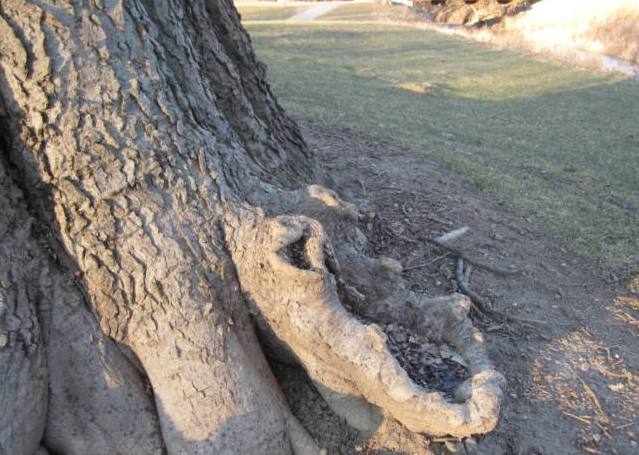
IMG_4461I could probably explore this tree for weeks and never know it fully. The roots have made a mysterious bowl here.

IMG_4464Here’s a front view of the same formation. Now it is an open mouth under two eyes.

IMG_4463Here the roots meander, a tangle of ropes.

IMG_4462Every time I touch this wise tree-being, I say: Thank you, and I love you. Standing in its presence, I feel I can send my care deep into the heart of the earth.

Perhaps tree-beings are speaking to you too? Or am I alone in thinking the borders between us and our kin are thinner than we once imagined?

Note: For another view of the tree that shows myself and my (somewhat indifferent) dog, check out the Spacious Light Intuitive Arts page.

Every Day

I’m not one to do Christmas in a big way. In fact I can get quite tired of the holiday, which seems by turns tawdry, labor-intensive, and loaded. Since we don’t have children, there’s no pressure to create a memorable and magic Christmas, or to buy a lot of guilt-inducing gadgetry. I mostly stick to the humble and homespun kind of gift, like these lumpen loaves.

Mesquite bread, made with chili peppers and cilantro.

Mesquite bread, made with chili peppers and cilantro.

Still, I can get into the (self-created) pressures of the season as much as anybody. Something about the holidays hits all my “not enough” buttons.

So when someone said to me recently, “I think every day should be Christmas,” my immediate thought was something along the lines of “heck, no,” only saltier. But she was talking generosity, of course, not pressure and parties.

And this morning, when I woke up with a sense of excitement (even after all these years, like a kid!), I thought about that. What if every morning, we all woke up suffused with joy, anticipation, and love? What if every day was devoted to family and friends, and feeling so abundant that we share our gifts all around?

What if we kept the wonderment, the generosity, the magic—and lost the commercialism?

Then every day would be like Christmas.

The More Beautiful World

I’ve been savoring Charles Eisenstein’s book, The More Beautiful World Our Hearts Know is Possible. It’s affirming, challenging, stimulating, surprising—and filled with wisdom for this age of crisis. Nature in my hands Shared cultural myths make up the “Story of the People,” the beliefs we all hold about the way the world works. Eisenstein notes that the old story is beginning to crumble as we see institution after institution unveiled as unworkable, untenable. He shows how this old Story of Separation—based on control, force, domination, competition, and scarcity—informs everything we see: the prison system, food system, educational system, money system—not to mention religious institutions, childrearing practices, and even activist organizations.

Even the medical establishment’s treatment of illness is based on this model, where bacteria is the enemy we need to conquer to save our own skin. (Never mind that 90 percent of the cells that make up a human are actually bacteria and fungi!)

This overarching cultural myth—that we are separate from each other and the rest of nature, inhabiting a hostile universe built on random accident and competition—is the source of much pain, violence, despair, and exploitation.

But the old story is beginning to fall away as a new Story of Connection takes its place. This transition is far from complete, Eisenstein says. And the time between stories is fraught. Many of the institutions are revealing their true natures in horrifying ways, and our usual tactics seem useless in the face of the horror. That’s because the tactics are also made of that old story. Compelling people to change by force or ridicule, demonizing institutions and leaders as evil, even rushing to action or response before the best path is clear—these are all born from a model that won’t work anymore.

Meditation

“The situation on Earth today is too dire for us to act from habit—to reenact again and again the same kinds of solutions that brought us to our present extremity. Where does the wisdom to act in entirely new ways come from? It comes from nowhere, from the void; it comes from inaction.”

That passage is one of many that resonate with me, especially since I’ve been spending so much time in that void he mentions. Sometimes I worry that by the time I emerge from this cocoon the world will have been fracked to death. That urgency to stop such horrors is real, but we need to reach deeper than action. Our task is to create something new that leaves these old systems and tactics in the dust. We need to make a whole new world, based on the vision of connectedness. NJ - Montclair: Montclair Art Museum - Earth Mother Eisenstein brings up the ebb and flow of the birth process. Much of the time the mother is not pushing, but resting. When the time to push comes, the urge is unstoppable. But the push comes in its time, and not before.

“Can you imagine saying to her, ‘Don’t stop now! You have to make an effort. What happens if the urge doesn’t arise again? You can’t just push when you feel like it!'”

The question is, what are we gestating? What kind of world wants to be born?

Peas and the Possible

“The Possible’s slow fuse is lit

By the Imagination.”

—Emily Dickinson

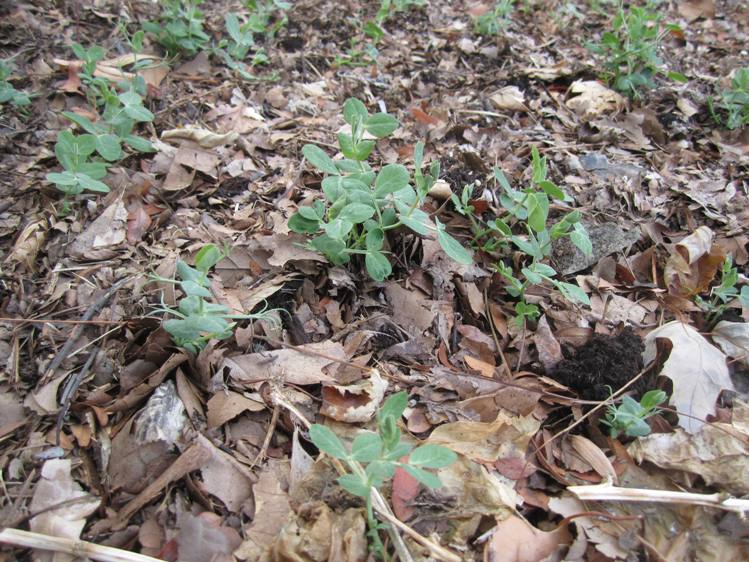
Austrian winter peas planted in my garden

Austrian winter peas planted in my garden

We have already had snow and single digit wind chills here. Yet these Austrian winter peas, planted very late, still grow.

My friend Dawn gave me a couple generous handfuls of seed to play with. I’d never heard of this hardy cover crop that doubles as a tasty wintertime salad green. But Mother Earth News had the full scoop on  planting Austrian winter peas. So somewhere between transplanting herbs and cooking up harvest stews, I threw those seeds in the ground.

I’m so glad I did!

This is the time of year when nighttime slams down on us pretty hard. A time for diving deep and dreaming. Those tender sprouts remind me that sweet tendrils of possibility can thrive in this liminal space.

I’ve been spending a fair amount of time in a space of unknowing. Allowing guidance to emerge organically, and playing with a deeper trust than I’ve ever had before.

And I love walking out my back door and seeing my little crop. If I never get to eat the shoots, I’ll be perfectly happy just with the view.

Thanks to Yes Magazine‘s Winter 2015 issue for the stunning Dickinson quote.

Neighborliness in a Soup

An email came into my inbox a few weeks ago announcing an initiative called City Suppers. The goal of the program—co-sponsored by City Gallery, Harrison Center for the Arts, and Indiana Humanities—was simply to promote neighborliness by way of soup. On a particular night, everyone citywide was encouraged to sign up to host their neighbors for a simple dinner.

Of course, I loved this idea.

As it turned out, my spouse and I had been talking about having a casual neighborhood get-together for a while. City Suppers gave us the impetus to actually do it—not to mention a deadline to get the house clean.

In my neck of the woods, we define “neighbor” rather loosely as “anyone else who lives in Irvington or thereabouts.” So we invited an assortment of folks—some from just around the corner and some from further afield.

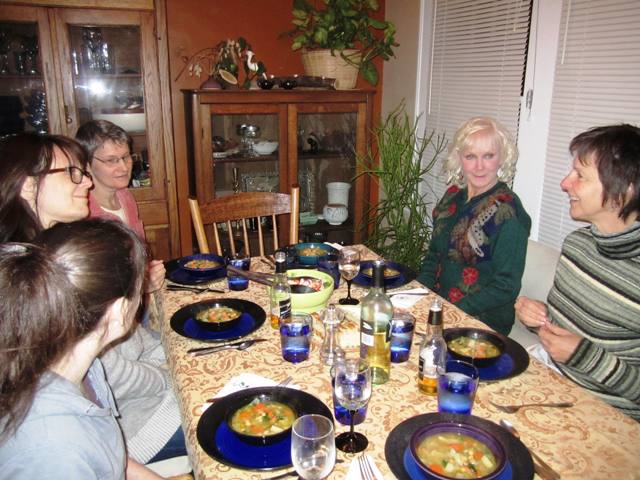
Around our table

A few of those who gathered around our table

Some had never met each other, and others had known each other a long time. Ages ranged from 1 year old to “I’ll never tell.”

We gathered around our table for a convivial evening. I made minestrone and bought some locally made focaccia and cheese. (Everyone seemed terrifically happy with the soup, which we call “peasant food” at our house—nothing all that fancy, but hearty, economical, and flavorful.) Guests brought wine, salad, and desserts. Truly mouthwatering desserts.

But the tasty, nourishing meal was really just an excuse for conversation and connection.

Life can be a full plate most of the time. So full that it seems hard to find the time for this kind of thing. In our neighborhood we have often socialized around shared projects. It was a novel change of pace to connect over a meal instead of at a meeting or work party.

We enjoyed it so much that we’re making more peasant food tonight and having different neighbors over. We’ll go to Russia instead of Italy, with borscht, rye bread, and beer. (Incidentally I traded with another neighbor—my chili peppers for her beets—for the starring veggie of the borscht. Our version of the “cup of sugar.”)

And bonus: the house is still pretty clean. Not that that matters—I figure if we waited till the perfect time to have people over, it would never happen. So why not just do it?

How about you—what’s your favorite way to connect with your neighbors? Is there something you’d like to initiate with the people living near you, but have been putting off? Why not get it going? It could be just the thing to warm a chilly winter night.

Expanding the Medicine Chest with Herbs

Last week I spent a sunny afternoon working an herb garden while learning more about the uses of medicinal herbs. My friend Greg Monzel is a community herbalist who’s helped many (including me) with natural medicines that he grows, gathers, and prepares. Another friend, Dawn Ryan, also helped with Greg’s culinary herb garden in exchange for several transplants.

We started with homemade herbal tea in the kitchen, where Greg’s son charmed the socks off us.

Ready for action

Ready for action

Since moving to this property, Greg’s had all his herbs in the “back 40.” Our goal was to help transplant culinary herbs to a kitchen garden right outside the back door.

To the back 40, with Greg's dog Timber eager to show us the way.

To the back 40, with Greg’s dog Timber eager to show us the way.

His ingenious plan: to keep a slight trench running the length of the bed, starting near the hose and slanting slightly toward the opposite end. With cornstalks laid in as slowly-decomposing organic matter, the trench will allow for ease of watering. Prepping the bed was our first task.

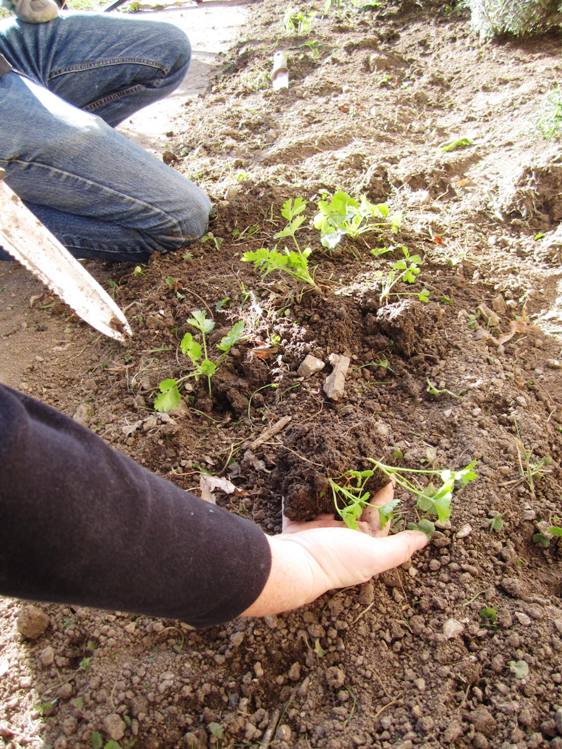
Planting cilantro in front of the trench

Planting cilantro in front of the trench

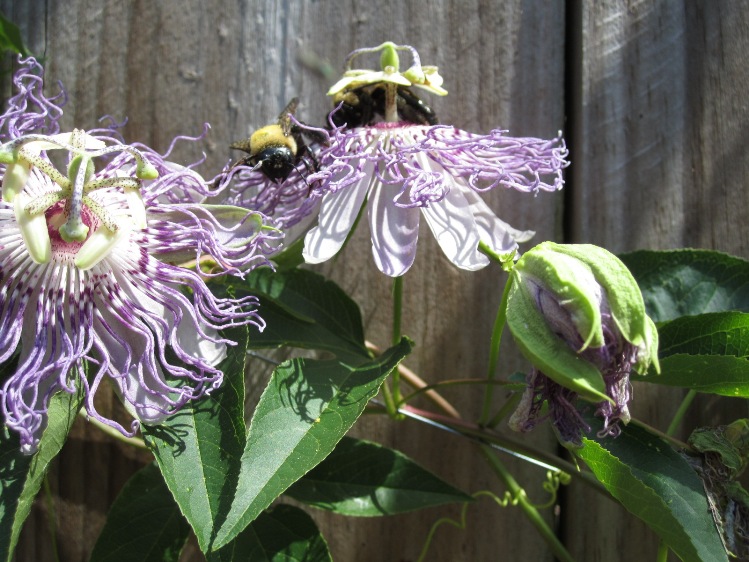
Then, over lunch of butternut squash soup and salad straight out of the garden, we talked about medicinal herbs. Greg produced a book called The Herbal Medicine-Maker’s Handbook, which included a list of the most useful herbs. I realized I already have several of these in my garden, though I only actively use one. (We have a passionflower growing up our fence. I cut the vines in fall to dry into a calming tea. That’s after we—and the bumblebees—enjoy the blooms all summer.)

A maypop planted along our fence, one of many plantings inspired by permaculture

Passionflower in summer. We thought we were growing it  for its fruit, but for me, it’s all about the tea!

And did you know that many culinary herbs also have medicinal function? Greg gave the example of sage: It dries up things like colds and post-nasal drip. This makes me happy to host three large sage “bushes,” which we periodically snip for seasoning and smudging.

Later, after we’d dug up and moved sage, lavender, thyme, parsley, and the like, it was time to make our selections from Greg’s herbs. I chose creeping thyme, feverfew, valerian, motherwort, pennyroyal, spearmint, yarrow, and a lovely wild mint that has been going strong for a couple generations now. Greg’s Dad first brought it into his garden, and Greg took starts of it, and now is giving starts away.

Herbalist and son showing us medicinal herbs

Herbalist and son showing us medicinal herbs

That’s the way of gardeners, isn’t it? In fact, the day reminded me an awful lot of hanging out with my Dad in his garden on a fall day. He’d divide plants and offer them to me and any of my friends who expressed the slightest interest.

Dawn and I worked together the next day, figuring out where to tuck in our new babies, giving them a good start. It felt great to expand the resilience of my home medicine chest, especially in such good company. And maybe someday soon I will have starts to give away myself.

diggin

DIY Food, Medicine, Soil: There’s a Shroom for That

I am still thinking about the Radical Mycology Convergence, an incredibly enriching experience. My last post covered mainly big picture inspiration. Here’s some more hands-on stuff.

For someone who likes to pick wild berries and weeds, I’m terribly ignorant of wild mushrooms. I had no idea that I could eat the puffball mushrooms that occasionally pop up right here in urban yards (my own included).

By Nowa (Own work), via Wikimedia Commons

By Nowa (Own work), via Wikimedia Commons

In a workshop called “Foraging for Five Foolproof Fungi” we learned about morels, maitake, chicken of the woods, puffballs, and oyster mushrooms. I now desperately want to go mushroom hunting.

But fungi offer us way more than food. As anti-tumor agents and immune boosters, certain mushrooms are powerful medicine. I was excited to hear Peter McCoy speak about home cultivation techniques as a way to make these therapies more affordable.

He said that capsulated versions of medicinal mushrooms are simply mycelium grown on brown rice and dehydrated, with an expensive price tag slapped on them. He passed around a bag of myceliated grains—I think it was cooked rye that had been inoculated with a type of medicinal mushroom mycelium—that kind of looked like white popcorn all mashed together. This is home-cultivated medicine that you can eat (although it probably doesn’t taste like popcorn!)

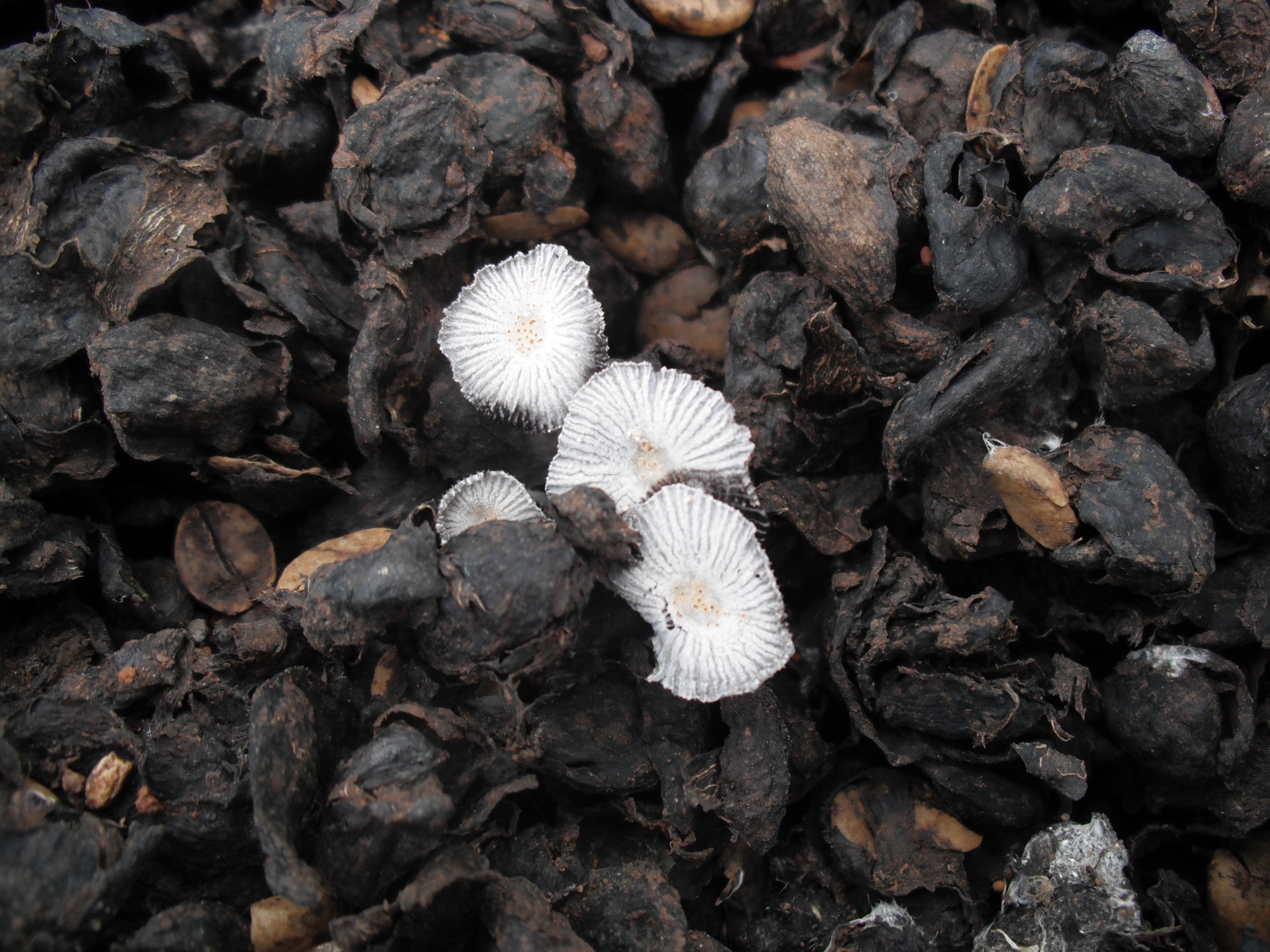
Then there’s the way fungi can turn waste products into food. I blogged about an example of this last year—how coffee plantation waste, normally burned, can be fed to mushrooms.

Coffee_pulp_mushroom

A mushroom growing on coffee pulp in south-west Rwanda, via Wikimedia Commons

It’s mind-boggling that a nutrient-dense superfood has so few demands; oyster mushrooms, for example, are 30 percent protein and can grow on cardboard! Even citydwellers with limited time and space can grow myceliated grains as a healthy, immune-boosting food.

And as soil helpers, fungi are critical. Below the soil surface many species of fungi are working their magic. But one species in particular, known as wine caps, has double benefit: They fruit with a deliciously edible mushroom, and they build soil tilth. They’re known as the garden mushroom for the way they can be cultivated right alongside garden vegetables.

"Stropharia aurantiaca". via Wikimedia Commons

“Stropharia aurantiaca,” via Wikimedia Commons

The upshot: My spouse and I have moved from this feeling of “it’s too overwhelming to take on a new project” to “let’s grow some mushrooms!”

We came home with plug spawn for chicken of the woods, and I’ve talked to my arborist friend about sending some logs my way this winter. (He said he’d love a few bits of spawn in exchange, and I’m happy to share!) We also want to try growing some winecaps in our garden beds. And since these are both spring projects—and who wants to wait?—we’ll probably grow oysters indoors from a kit this winter.

Stay tuned for reports on our experiments!

Can’t get enough radical mycology? Check out this interview with Peter at Permaculture Voices—the link has several videos showing hands-on home cultivation steps as well.

Fungi Offer a Model and a Hope

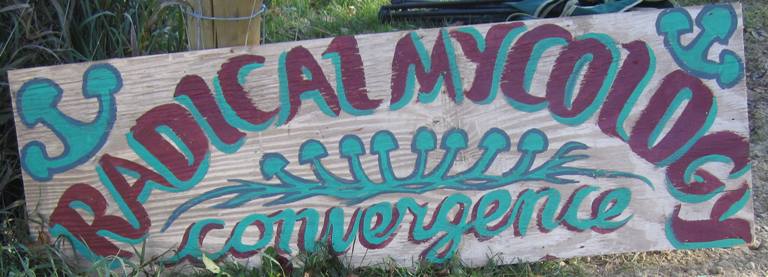
Last weekend’s Radical Mycology Convergence was an eye-opener to the mystery and power of the fungus kingdom.

signDid you know that fungi called endophytes live within plants, lending structure and resilience to the plant? “If we took away the fungal cells, we would see these scrawny, floppy little trees,” said Maia, one of the organizers.

Or that mycorrhizal fungi help plant roots take in nutrients in exchange for sugars? Trees in a forest benefit from this “silent stewardship role,” said Peter, an organizer and earlier contributor to this blog. He explained that the mycelium channels sugars to baby trees deep under the forest canopy to ensure their survival. Perhaps thinking of the “next seven spore generations.”

Or that only 10 percent of our cells is actually human—the rest bacterial and fungal? “We need to stop thinking of ourselves as singular organisms,” said Willoughby, another organizer. “We are walking ecosystems. We need to appreciate and nurture all these cells within us.”

From microscopic fungi, whose ecological role is often overlooked, to the 2500-acre honey mushroom in Oregon (largest living organism in the world), the message is clear: Fungi offer the human race a model and a hope.

Mycelium colonizing a log that's been inoculated with shiitake mushroom spore.

Mycelium colonizing a log that’s been inoculated with shiitake mushroom spore.

What struck me about the Radical Mycology Convergence was the deep respect for nature in general and fungi in particular. Here is a movement that is not about exploitive, extractive approaches to a “natural resource,” but rather: working with fungi as allies for the betterment of all life. That includes cultivating mushrooms for food sovereignty, medicine, and remediation.

The promise of mycoremediation is great, and Radical Mycology is all about spreading the tools for home cultivation. But as Peter emphasized, we need to be humble in our explorations. We don’t want to just burst onto a contaminated scene and “throw oyster mushrooms at it” without first observing the healing already taking place, organically, through the wisdom of the fungi naturally present.

“Who are we to say we know more than nature does?” he said. The time for presumptive action is over. We must first watch, learn, observe.

I learned so much more, but here’s one last thing: When a mushroom gets ready to reproduce, it sends out spores. A spore germinates into a hypha, a filament. It’s one strand of what eventually, with luck, becomes a mycelial network.

But that hypha is only one cell thick, and needs a partner, a genetic match. It works invisibly, underground. You can’t see it. If it comes together with another hypha, that’s when mycelium begins to branch in all directions through its environment. And finally, when conditions are right, it makes a beautiful fruiting body, a mushroom.

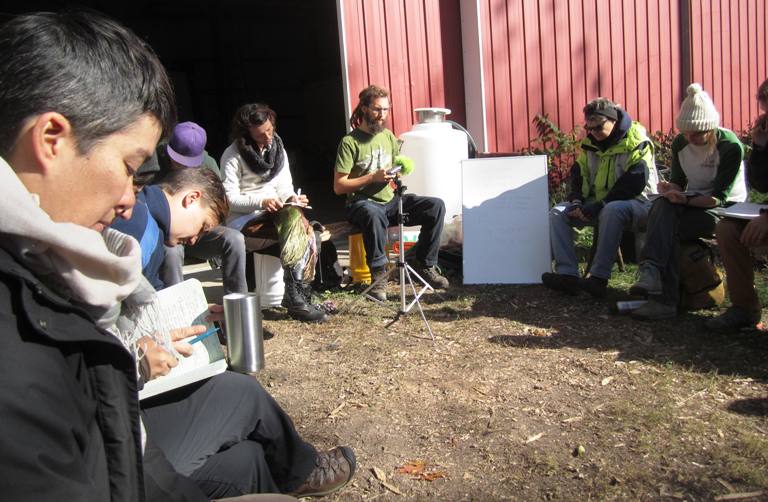
Cultivation workshop at the Radical Mycology Convergence (an event that one organizer likened to "the fruiting body of a mycelial network.")

Cultivation workshop at the Radical Mycology Convergence (an event that one organizer likened to “the fruiting body of a mycelial network.”)

A fitting metaphor for social change work, which is not always visible to the mainstream.

We may feel like we’re laboring in the dark, but when we connect with others—even starting with just one!—the network that results can produce something nourishing and healthy, a powerful gift that seems to show up “overnight.”